How to Run an Agent Loop That Actually Converges
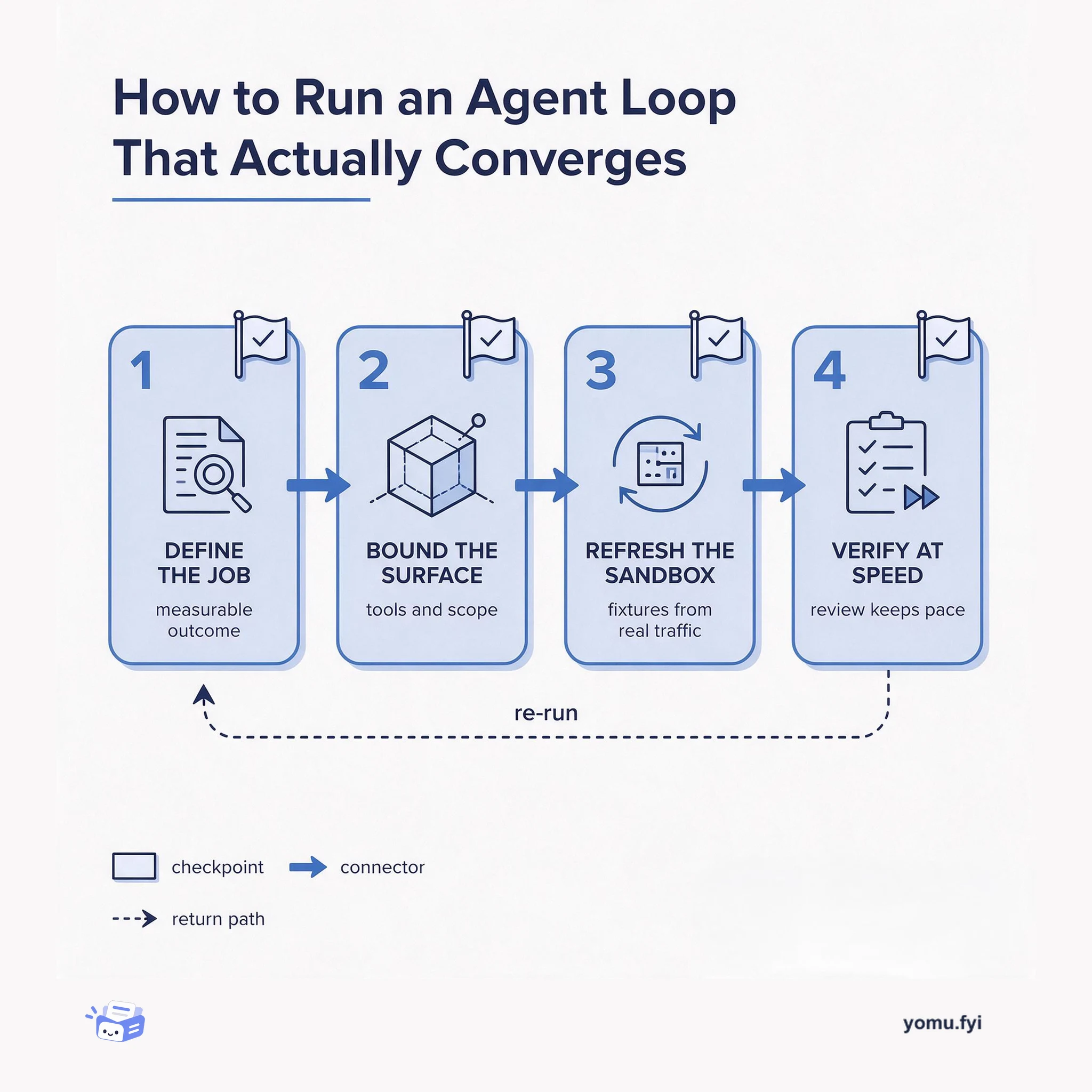
A four-checkpoint how-to for agent loops: name a measurable job, bound the tool surface, refresh sandbox fixtures from real traffic, and verify at agent speed.
Loading…
Topic
564 posts about AI Agents. Every summary links to the original.
See the idea
A four-checkpoint how-to for agent loops: name a measurable job, bound the tool surface, refresh sandbox fixtures from real traffic, and verify at agent speed.
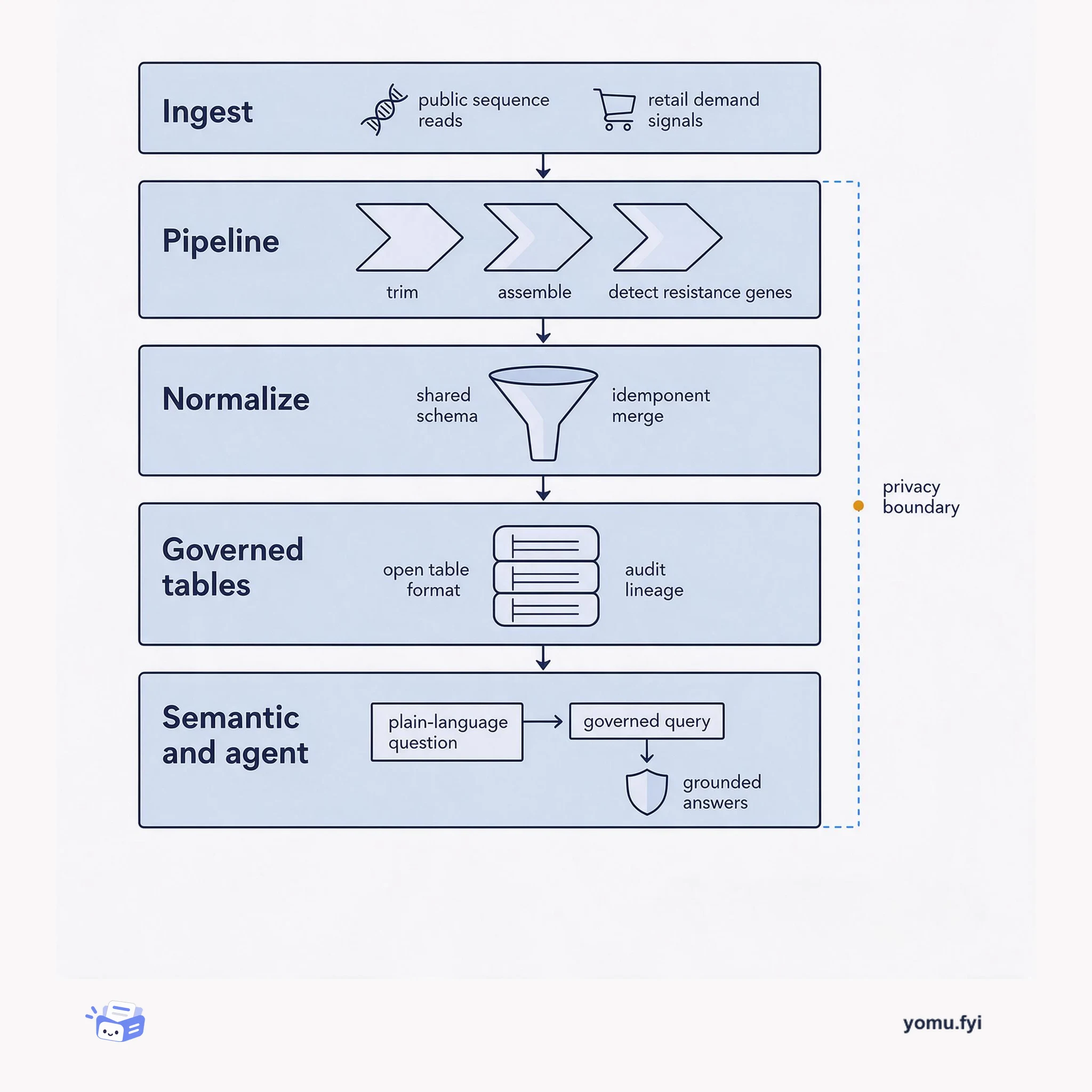
Antimicrobial resistance surveillance is a layered data architecture: raw reads and demand signals flow in, get normalized into governed tables, and answer plain-language queries. The diagram maps each boundary.
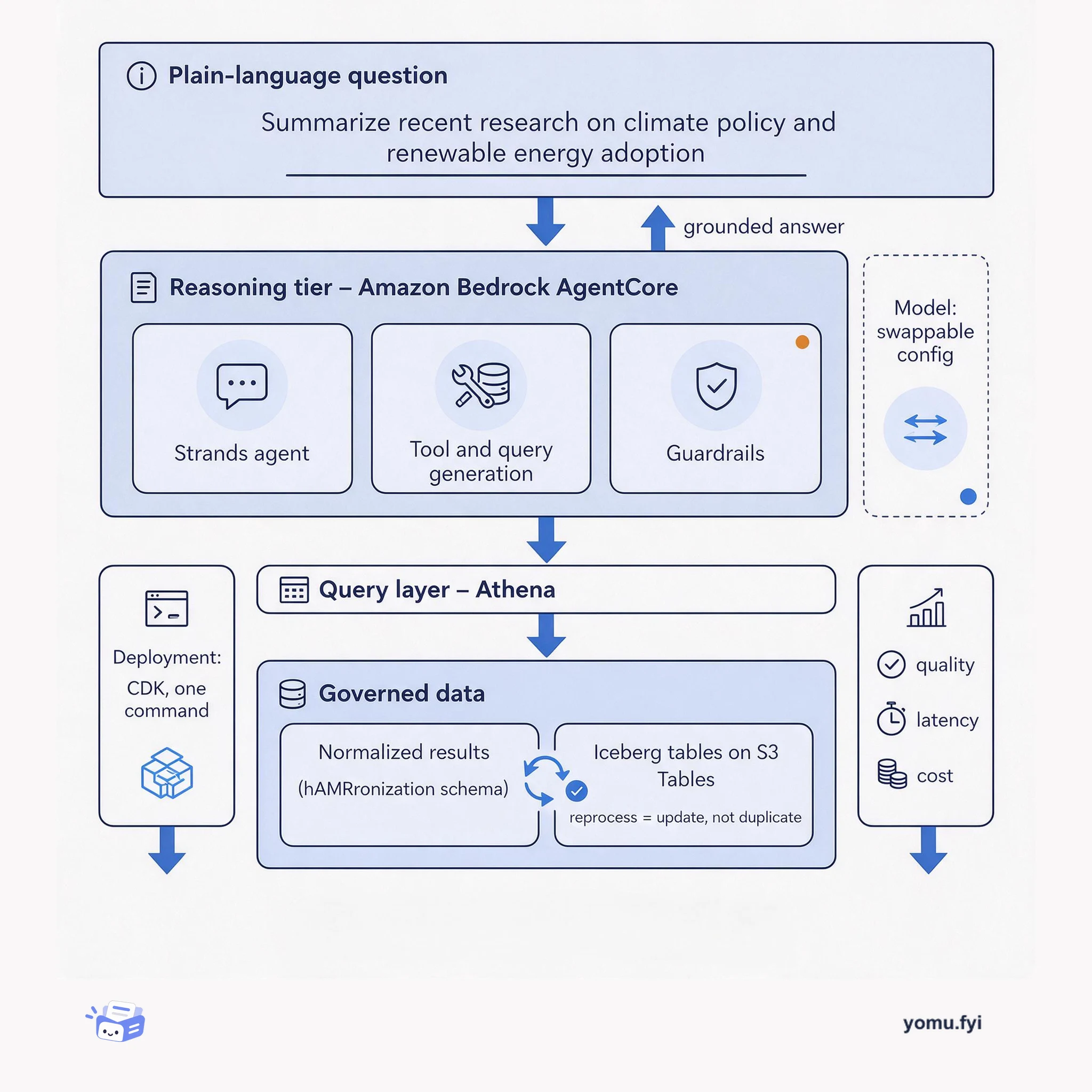
Amazon Bedrock is the managed reasoning tier in an agent architecture, not the whole system. This layered view shows the pipelines, governed tables, query layer, and guardrails around it.
The Good Stuff
Paid picks we use ourselves. Links carry a referral code — a subscription through one earns us a commission at no extra cost to you.
Newest first
Higher-education call centers face costly, limited-coverage monitoring of advisor conversations and brittle, slow methods for identifying student concerns from transcripts. The proposed workflow deploys OpenAI Whisper on Databricks Model Serving, applies AI Functions for sentiment, topics, intent, and rubric scoring, and uses Unity Catalog to govern the resulting data. For advisor quality, an LLM-as-a-judge evaluates every transcript against a reference-table rubric, returns a weighted 1–5 overall score and per-criterion scores, and routes flagged calls for targeted QA review instead of random sampling. For student insights, quarterly transcript enrichment feeds an Agent Bricks Knowledge Assistant for cited reasoning over raw calls and a Genie Space for structured trend queries, while LangGraph orchestrates UC SQL functions as tools. Together, these components let non-technical advisors, mentors, and QA managers query student interactions without reaching out to a data SME.
Enterprise AI pilots often move data into separate vector databases, SaaS LLMs, or serving layers, creating governance gaps, compounded latency, fragmented costs and observability, and duplicated lifecycle work. The post advocates data-native agents: models, agents, tools, retrieval, and memory run inside the governed data platform, with policy enforced during query planning and computation rather than after responses are produced. It argues that post-hoc controls cannot undo sensitive information encoded in aggregations and can trigger token-burning retry loops. For state and memory, it presents Lakebase, managed PostgreSQL within Databricks, as transactional storage and a shared source of truth for multi-agent swarms. The described platform pattern combines Unity Catalog, Unity AI Gateway, Model Serving, MLflow 3, AI Search, Lakebase, and business-context services, and recommends inventorying workloads already outside the perimeter before closing seams incrementally.
Genie One mobile apps for iOS and Android let business users ask questions of company data, view dashboards, access Databricks Apps, and use conversational agent capabilities away from a desk. Answers draw on Genie Ontology, Genie Agents, enterprise governance, and connectors to Google Drive, Microsoft 365, and Atlassian, while respecting source permissions. AI/BI Dashboards reflow widgets into a single column in portrait mode and preserve their designed layout in landscape. Authentication uses the existing OAuth flow and identity provider, with MFA, conditional access, device posture, network controls, regional data handling, and workspace permissions carried over from the browser; there is no separate mobile backend or mobile-only endpoint. The app is available in Public Preview, with dark mode, push notifications, voice mode, and account-level access listed as planned capabilities.
Omni-channel retail has spread margin, cash, and markdown decisions across more channels, fulfillment paths, and return routes, while agentic systems increase the speed and complexity of change. The post presents ontology as a way to preserve the meaning and business context behind finance figures, keeping definitions, channels, and cost drivers current. Databricks Genie is described as a data-smart AI coworker that answers finance questions in plain language, grounding responses in an evolving ontology, source traces, permissions, and governed AI costs. It focuses on margin after fulfillment and returns, inventory cash tied up in the wrong place, and full-price revenue at risk from markdowns and returns, then prepares actions for a person to approve. Unilever deployed Genie to more than 1,200 finance and business users; analysis that took days now takes minutes, with expected multi-million-euro annual cost avoidance.
Databricks presents Lakebase as a fully managed, serverless, standard Postgres database for combining operational and analytical workloads on its Data + AI Platform. The platform separates compute from storage, integrates with the lakehouse through Synced Tables and Lakebase CDF, and uses Unity Catalog for governance; copy-on-write branching and autoscaling to zero are described as core infrastructure primitives. The post showcases partner-built, ready-to-deploy accelerators spanning technology, finance, marketing, sales, supply chain, human resources, customer service, and operations. Examples include PostgreSQL migration assessment, multi-agent Genie orchestration, stateful enterprise agents, autonomous data reliability, governed contact-center intelligence, and project operations management. These offerings package Lakebase patterns into migration controls, domain-specific solutions, and agent frameworks intended to accelerate modernization and reduce transformation complexity.
Omnigent’s post examines how a vendor-review assistant can leak confidential pricing terms when an attacker hides an indirect prompt injection in a shared runbook. Because the malicious workflow is divided into ordinary actions, stateless checks approve each step even though the session as a whole is unsafe. The demonstration compares an unprotected run, which sends the summary externally, with a contextual policy that stores a running risk score, adds 30 for each document read, and denies email after the score exceeds 50. It also shows that agents cannot remove or disable policies, new policies require human approval, and any denial prevails when policies are combined. Runtime enforcement therefore preserves the block even when the agent has been misled.
The piece argues that agentic marketing depends on modernizing the data and infrastructure foundation first, rather than starting with isolated AI use cases. At Acxiom, moving core products and client solutions from on-premises Hadoop to Databricks reportedly improved workload runtimes by 80 to 90 percent, reducing jobs that took 50+ hours or as long as 90+ hours to 2–3 hours. The migration also reduced manual pipeline and infrastructure work, freeing engineering capacity for products and client outcomes. Those capabilities now support agentic audience planning, media buying, campaign activation, performance analytics, code generation, testing, and ad variation, with a goal of connecting the full marketing value chain. Because workflows handle PII, generated content passes through legal approval, defined controls, and human oversight; Acxiom is also embedding its data in client platforms and privacy-safe clean rooms to make decisions more transparent and native to customer environments.
UST is partnering with Anthropic to bring Claude into engineering and production systems used by semiconductor, automotive, manufacturing, telecom, embedded, and IoT companies. Claude Code reads chip pinouts and hardware schematics, then writes and runs regression tests while carrying design context across hours-long tasks. UST is integrating Claude as the reasoning layer in its iDEC validation pipeline, which generates tests, compares live equipment data with a digital twin, and already cuts validation cycles from four days to 48 hours, 50 to 70 percent. The partnership also applies Claude to healthcare, telecom, and banking platforms, with human approval retained for recommended actions and response workflows. UST will train 20,000 associates worldwide and build specialized deployment teams, with governance and audit controls supporting production use in high-stakes industries.
An update adds side chats for exploring tangents alongside a main agent conversation without interrupting it. Each side chat is a durable, full agent conversation with main-chat context, can be revisited, followed up on, and at-mentioned back into the main thread. In the Agents Window, users can search agent transcripts through Cmd+K using a local index designed to scale to thousands of conversations, or search within a conversation with Cmd+F. Redesigned project and repo pickers support creating projects and connecting GitHub, GitLab, or Azure DevOps without leaving the picker, with search scoped to the current location. New cloud agent hooks expose prompts, responses, thinking, subagents, compaction, and turn completion for observation and control.
The fifth Databricks hackathon used Databricks Genie to test three ways of working with governed data: asking, building, and composing. Genie Agents give business users domain-specific natural-language access to curated data, while Genie Code helps analysts create metric views, functions, pipelines, and dashboards inside Databricks. The composition track uses Conversation APIs and a managed MCP server to make Genie an agent tool alongside custom logic, Model Serving, and other MCP servers, with Unity Catalog governing access. Projects included supervisory routing across 190 tables, governance and analytics products built in days, and multi-agent systems such as ShipBob’s overnight operations brief. Across the tracks, the stated lesson is that shared governance and semantic context let business users, builders, and engineers use Genie at different levels without abandoning grounded, permissioned data access.
Databricks built a coding-agent benchmark from reviewed tasks drawn from its multi-million-line codebase, spanning languages including Scala, Go, Rust, Python, and TypeScript. It uses recent human-written pull requests, held-out tests, standard model and harness setups, and manual validation rather than an LLM judge; Git history was sealed after traces showed agents could recover solutions. Results clustered models and harnesses into three capability tiers and showed that quality, cost per task, and token price can diverge: GLM 5.2 statistically tied Opus 4.8 on quality while costing $1.28 versus $1.94 per task, whereas Sonnet 5 cost $2.09 versus Opus’s $1.94. The same model through different harnesses produced cost differences of more than 2x in some cases while quality remained the same; Pi sent about three times less context per turn. Databricks plans to shift routine work toward cheaper models, deploy open models such as GLM as daily drivers, and improve model-and-harness selection.
Omnigent, an open-source meta-harness for AI agents, introduces contextual policies to make agent controls safer and less disruptive than per-action allow, deny, or approval rules. Policies receive session events, maintain private state such as tools used, documents read, accumulated risk, initial intent, and model spend, then allow, deny, transform, or escalate the next action. Omnigent’s server intercepts tool calls from supported agents and applies these policies consistently, while examples include Google Drive restrictions based on documents created or marked confidential, risk thresholds that require approval for later email or file-sharing actions, and budget thresholds that pause or redirect work to a cheaper model. Intent-based authorization limits tools according to the user’s opening request, applying least privilege across supported harnesses and custom agents. The project is described as open source and alpha, with the server providing one interception layer for agents using different harnesses.
This Notion HQ page collects product announcements, company updates, and stories about extending Notion’s workspace. It introduces a Developer Platform, Custom Agents that handle entire workflows autonomously, Notion 3.0 with Agents, Notion Calendar, and Notion AI for Work, described as an all-in-one AI toolkit built into the workspace. The updates also cover connectivity and data consolidation, including the acquisition of Automate.io, which built integrations for more than 200 software tools, and the welcome of Sequin, whose tools brought data from across software stacks together. Additional announcements report ZeroEntropy joining Notion, a new board of directors, a security update dated July ’26, and a private tender offer involving GIC, Sequoia Capital, and Index Ventures. The page also includes Custom Agents beta learnings, conference highlights, and a profile of a Notion consultancy.
Vibe Data Modeling is presented as a way to build a governed Silver-layer data model from a plain-English description of a business, addressing the months or years often required to hand-build one or adapt a generic industry template. The single-notebook implementation uses four widgets and a multi-model LLM agent to organize organizations into divisions, domains, subdomains, products, and attributes, then generate a logical model and deploy it to Unity Catalog. Its pipeline advances through four generate-and-validate stages, applying 251 rules, deterministic structural gates, two architect reviews, and a retry loop that changes strategy when checks fail. The authoritative model.json also produces schemas, Delta tables, informational foreign keys, classification tags, metric views, an RDFS ontology, DBML, and synthetic sample data, while plain-English refinements create auditable, reversible versions.
The Government of Alberta’s Ministry of Technology and Innovation has used Claude Code with Claude Opus and Sonnet since 2025 to review, secure, and modernize systems spanning 27 provincial ministries. About 50 autonomous agents scanned 466 million lines across 3,400 repositories in roughly 20 hours, using a rules-engine first pass followed by reviews that cite exact files and lines; Alberta estimates a traditional review could take around 6.5 years. Claude Code also generated and tested fixes, wrote missing tests, and rebuilt some obsolete applications, with Ministry engineers approving patches before release. Specialized red-team and blue-team agents now run continuous checks against roughly 95 security controls, while the Alberta AI Academy trains employees and members of the public. The government plans to consolidate 185 legacy applications into 16 reusable modern applications, a future goal rather than a reported result.
Databricks describes a security-alert triage system designed to review low-severity alerts that historically received less attention because of their volume and low fidelity. An initial single-agent prompt escalated 50% of alerts, so the team built a fleet of 17 source-specific agents plus a Threat Intelligence agent, using Structured Streaming to ingest alerts, enrich evidence, and route each alert. The pipeline combines deterministic benign-signal filtering, historical and behavioral context, specialized prompt functions, optional tools, structured dispositions, and cost controls before sending escalations to human analysts. Those analysts provide ground truth through MLflow traces and labels, supporting ongoing evaluation across escalate, monitor, and close decisions. After triaging more than 18,000 alerts, the system reached a 3.2% escalation rate, a 10.5-second median triage time, and more than 6,500 analyst hours saved in 30 days; escalated low-severity alerts were roughly 10 times more likely to be true positives than HIGH and MEDIUM alerts.
At Data + AI Summit 2026, Databricks and OpenAI presented a partnership centered on combining OpenAI’s frontier models and agents with Databricks’ enterprise context and control. The post describes GPT models and Codex running natively on Databricks, with Unity AI Gateway governing interactions, budgets, routing, auditing, and visibility, while Agent Tools provide governed enterprise data access through MCPs. Examples include OpenAI’s marketing data foundation on Databricks, which cut storage costs by $400,000 per month, and a Hertz application built in 11 business days with GPT-5.5 and Databricks that lifted lead conversion from 60–65% to 75–80%. The sessions argue that deployment, security, evaluation, monitoring, context, and sharing comprise most of the work around enterprise agents. A joint virtual event scheduled for August will address shipping agentic applications at scale, including a Stellantis case study.
Cross App Access (XAA) provides an identity framework for securing token-based communication when software or AI agents access external ecosystems through trusted identity providers. It replaces long-lived API keys and hardcoded secrets with real-time identity propagation, while allowing enterprises to control connected apps, requested scopes, and user access. The guide explains prerequisites for requesting and resource apps, including OIDC or SAML SSO, authorization-server support, protected resources, scopes, an Okta Integrator Free Plan org, and tested workflows. It then describes token exchange testing: requesting apps obtain an ID token and mint an ID-JAG, while resource apps validate the ID-JAG and issue a scoped access token. To seek OIN listing and XAA enablement, applicants submit SSO integration details, metadata, testing evidence, and a questionnaire to Okta.
Claude 3.7 Sonnet introduces extended thinking, letting users toggle deeper reasoning and developers set a thinking budget. The same model spends additional computation on sequential reasoning, while agent training supports iterative function calls, computer use, and open-ended tasks. The post examines visible thought processes, noting benefits for trust and research but also limitations around faithfulness, safety, and jailbreak risk; it therefore treats the feature as a research preview. Reported examples include stronger OSWorld performance, playing Pokémon Red through tens of thousands of interactions and progressing through three Gym Leaders, plus logarithmic math gains as thinking tokens increase. Safety work includes encrypted thoughts for some harmful content and computer-use prompt-injection mitigations that raise prevention from 74% to 88%.
The post argues that enterprises moving AI from experimentation to impact should answer three questions: whether employees and governance are ready, whether tools are accessible, and whether workers have the capabilities to use them. It recommends secure, governed AI agents that let employees experiment safely, apply consistent oversight across workloads, and build skills without compromising business security; the text notes that fewer than half of companies have formal governance for autonomous workloads. AI should appear inside natural workflows, including single chat interfaces and embedded intelligence dashboards, with access to company data, automated identity management, consistent governance, and business logic across engagements. Finally, agents should provide contextually accurate, actionable intelligence and automation, challenge users’ thinking, suggest next steps, and take action rather than only answer questions.
The best engineering reads, once a week.