API Versioning as a Translation Layer
API versioning as an architecture: requests enter through a version header, pass through a chain of reversible version changes, and reach controllers that only ever see the latest model.
Loading…
Topic
76 posts about API. Every summary links to the original.
See the idea
API versioning as an architecture: requests enter through a version header, pass through a chain of reversible version changes, and reach controllers that only ever see the latest model.
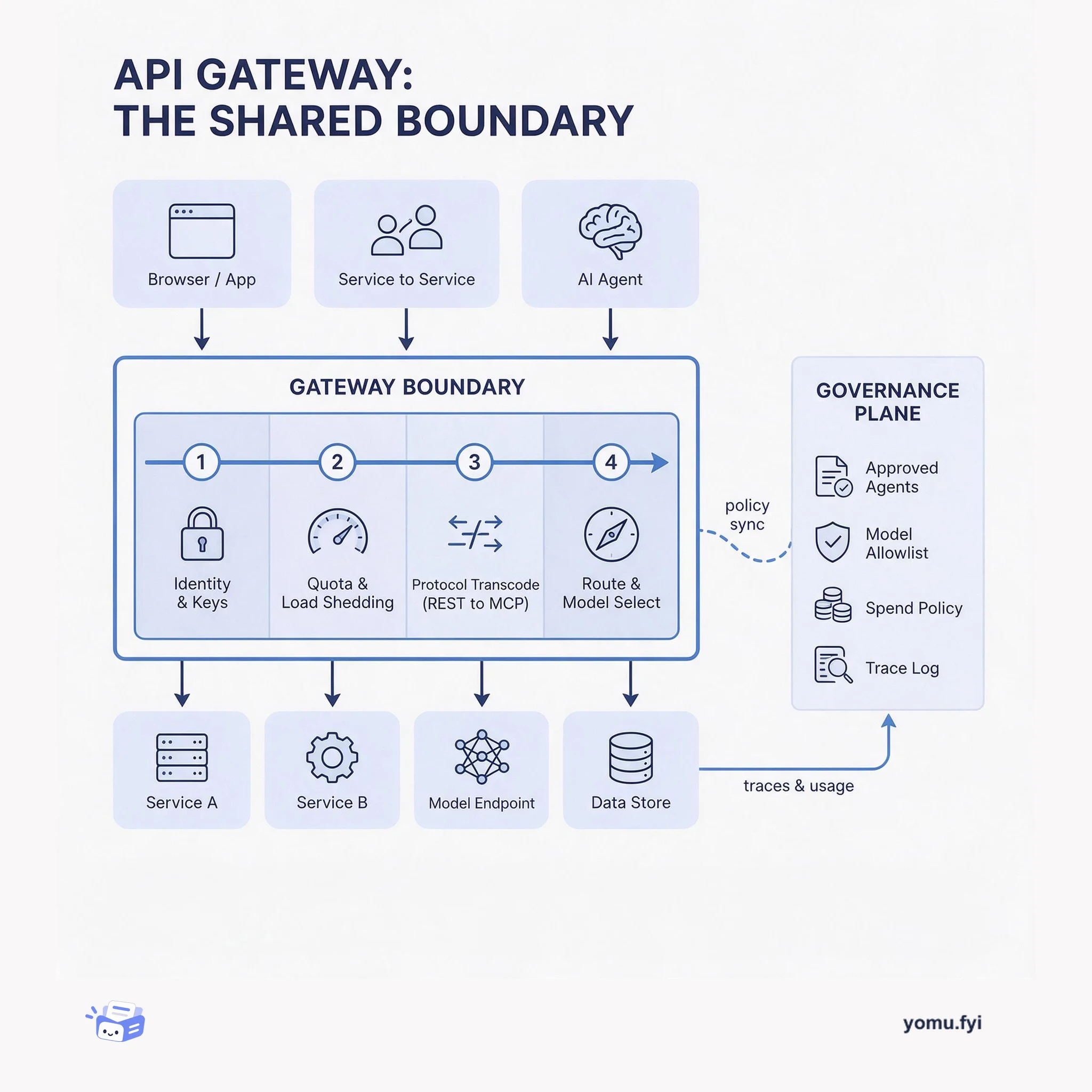
The API gateway is the single boundary where protocol translation, auth, quotas, and routing become shared policy instead of per-service code. This layered diagram shows what belongs there and why.
The Good Stuff
Paid picks we use ourselves. Links carry a referral code — a subscription through one earns us a commission at no extra cost to you.
Newest first
Google Cloud API Gateway adds model routing in Public Preview for AI applications that need to direct traffic among models without hardcoded endpoints or open-source proxies. The serverless ingress layer accepts OpenAI-compatible requests and uses routing rules in an OpenAPI 3.x specification, where x-google-api-management defines backends and routers map virtual model names to targets such as Gemini, Claude, or OpenAI OSS-GPT. After deployment, clients call a stable endpoint; the Gateway transcodes the request to the backend’s native schema, adds an Agent Platform authentication token, and forwards it, separating client authentication from provider credentials. The guide also notes that every backend in one router must share a host, and shows standalone routing alongside possible Agent Gateway integration for security governance.
Kimi K3 is presented as Moonshot AI’s 2.8-trillion-parameter open-weights model for long-horizon coding, end-to-end knowledge work, and deep reasoning, served through Together AI’s OpenAI-compatible API. Its architecture combines Kimi Delta Attention (KDA), Attention Residuals, and Stable LatentMoE, which activates 16 of 896 experts per token—roughly 2%—and supports a 1M-token context. The implementation guide shows Python calls for configurable reasoning effort, reasoning-free instant mode, streaming, multi-image vision, strict JSON-schema output, and function tools, while noting automatic prefix caching. It also covers production-oriented details such as generous max_tokens for reasoning-heavy structured output, a 100 MB request-body limit for vision, tool-call history handling, and deployment from US infrastructure.
Claude Opus 5 is available as a new model positioned near the frontier intelligence of Claude Fable 5, at half its price, while remaining behind Mythos 5 on cybersecurity tasks. Reported results show state-of-the-art performance on coding and knowledge-work evaluations, including Frontier-Bench, alongside strong results on ARC-AGI 3, Zapier AutomationBench, and OSWorld 2.0. The model uses configurable effort settings to trade intelligence for token use, speed, and cost, and is described as stronger at verifying work, iterating, and handling long agentic tasks. It costs $5 per million input tokens and $25 per million output tokens, with Fast mode running about 2.5 times faster at twice the base price. Safeguards allow vulnerability finding while blocking binary-based scanning, penetration testing, and exploit generation, with flagged requests able to fall back to Opus 4.8.
Anthropic introduces Claude Opus 4.8, an upgrade over Opus 4.7 for coding, agentic skills, reasoning, and practical knowledge work, with regular pricing unchanged. The release adds adjustable effort in claude.ai and Cowork, dynamic workflows in Claude Code, fast mode at 2.5× speed, and support for system entries inside the Messages API messages array. Dynamic workflows can plan work, run hundreds of parallel subagents in one session, and verify outputs; the post cites codebase-scale migrations across hundreds of thousands of lines as an example. Early evaluations and tester reports describe stronger reliability, judgment, tool efficiency, computer use, and analysis, including an approximately fourfold reduction in allowing flaws in generated code to pass unremarked.
Verifiable Digital Credentials (VDCs) are presented as a new trust layer for applications that need to verify claims such as age, licenses, employment, or eligibility without collecting documents and excess PII. The model uses an Issuer-Holder-Verifier trust triangle: authorities sign credentials, users hold them in wallets, and applications request specific proofs, with selective disclosure limiting exposed data. The standards stack combines SD-JWT VC or mdoc credential formats, OpenID4VCI for issuance, OpenID4VP for presentation, and the W3C Digital Credentials API for browser-wallet invocation. Production verification also requires issuer trust lists, trust-framework integration, and key rotation, not merely signature checks. Because browser API rollout is still progressing, the recommended baseline is redirect-based OpenID4VP with the Digital Credentials API added as a progressive enhancement, starting with one bounded verification use case.
Uber Advertising is introducing Uber Marketing Manager as a self-serve platform intended to unify advertising across Uber and Uber Eats, building on Ads Manager for restaurants. It also outlines Creative Studio expansion, new APIs, and a Mastercard Commerce Media partnership designed to connect campaign activation, offers, measurement, and real-world experiences across consumer journeys. Examples include Krispy Kreme’s Destination Offers campaign in Mexico, Molson Coors’s multi-format soccer campaign, and adidas’s pan-European Journey Takeover. Creative Studio will expand to Australia and Brazil in 2026, followed by continued expansion across LATAM, EMEA, and APAC throughout 2027. Uber says its connected approach is intended to help advertisers engage consumers across Uber, Uber Eats, and beyond, while a third-party validated Affinity Solutions study found a 27% incremental lift in sales across all channels and a 5% lift in brick-and-mortar sales for Sponsored Listings on Uber Eats.
TriMet’s 2024 partnership with Uber, TransDev, and Trapeze added same-day capability to its LIFT paratransit service in Metro Portland. Before LIFT+, trip management spanned multiple systems, while cancellations and manual coordination increased operational burden and weakened the rider experience. In April 2024, riders began booking through LIFT’s web platform or call center, after which TriMet’s integrated Trapeze PASS TripBroker used the Uber Plug-in to select dedicated vehicles or Uber based on rider profiles, requests, trip efficiency, and fleet capacity; it could also reschedule cancellations and delays. Since launch, TriMet has delivered more than 47,300 Uber trips and reduced average cost per trip from $78 to $54, while riders gained same-day flexibility and trip details including estimated arrival times.
AI Agents can answer support questions without backend access, but they cannot complete changes such as payment-plan updates, claims, or account edits. Connecting an Agent to CRM, billing, order-management, or other systems moves support from explanation to end-to-end resolution, and the source frames that shift as the basis for an engineering request. Data from a 2026 Customer Service Transformation Report shows improved metrics among 87% of teams with mature AI deployment, versus 62% overall, while only 10% report reaching that stage; an internal comparison found Procedures with system access produced the largest gains in workflows requiring judgment, branching, live data, or handoffs. The recommended case starts with one high-volume, repeatable workflow, maps its data and actions, and defines a narrow pilot. Teams can then progress from no integration to read-only access and finally write actions, using measured results to justify further work.
Fin is being made available as a Service Agent on top of HubSpot and Freshworks, allowing HubSpot and Freshdesk customers to deploy it without migrating from their helpdesk. The announcement says customers can get it integrated and live in less than an hour across voice, email, chat, social, and other channels, with a stated 76% average resolution rate. Fin is described as handling complex queries that require reading and writing to third-party systems, while remaining configurable to each business’s policies; its openness includes APIs, MCPs, a CLI, access to the Apex trained model, and public product, help-center, and developer documentation. The broader argument is that open Agent platforms let customers experiment, replace components, and avoid vendor lock-in, with competition determined by product quality.
Uber has launched Uber Ads APIs to reduce the need to manage advertising and performance across separate tools and systems. The APIs let POS systems, aggregators, agencies, and other partners create and manage campaigns programmatically while giving brands direct or integrated access to performance and sales data. They support onboarding, activation, and ongoing campaign management across a merchant base, including campaigns for restaurants and Sponsored Listings. Partners can embed Uber Ads in existing platforms so merchants can launch campaigns and increase visibility without navigating separate workflows. Documentation, representative contact, and an integration-planning process provide the stated starting points, with the broader aim of combining advertising and operations in a unified retail media system.
Google Pay & Wallet Developer MCP server is announced to help AI assistants and IDEs complete Google Pay and Google Wallet API integrations with less context switching. It uses Model Context Protocol to connect tools including Antigravity, Cursor, and Visual Studio Code with current documentation, account details, and integration status. Its search_documentation tool applies Retrieval-Augmented Generation to return answers and code samples from official developer sites, while other tools validate Wallet pass JWTs or JSON, expose performance metrics and error trends, and manage merchant accounts and Google Pay API integrations. The stated goal is to reduce friction, improve accuracy with current documentation and real account data, and speed troubleshooting from setup through launch. A public guide and tool reference are available, with further capabilities planned based on developer feedback.
Anthropic launched Claude Managed Agents, a suite of composable APIs that separate the agent loop from code execution for building cloud-hosted agents at scale. Modal has collaborated with Anthropic to provide a first-class integration allowing all tool calls to run in self-hosted Modal Sandboxes, which offer fast cold-starts, custom images, snapshotting techniques, and cost-efficient burst pricing. These sandboxes also provide network security through short-lived connect tokens and support upwards of 100,000 concurrent sandboxes per customer. DoorDash is exploring Managed Agents as an accelerator for its merchant intelligence system, while Blend uses the integration to enable secure, scalable agent-assisted triage across complex banking environments. The integration gives teams isolation, cost efficiency, and control over observability, failure handling, and scale while maintaining the convenience of Anthropic’s managed agent loop.
Okta’s API Integration Actions let independent software vendors build Provisioning, Entitlements, and Universal Logout integrations in the Okta Integration Network using Workflows, Okta’s low-code builder. The approach maps existing APIs directly to Okta action contracts, allowing developers to avoid building and maintaining a SCIM server while translating API calls into formats Okta can consume. The guide walks through creating an OIN integration, configuring tenant and authentication mappings, adding API Integration Action components, building and validating flows, and submitting them through the OIN Wizard. It also explains how to create and update an org-only test instance before review, noting that submission changes do not automatically update an existing test instance for security reasons.
Resend introduces Diel Duarte as its new open source engineer, bringing more than 13 years of experience building web applications and SDKs. His focus is developer experience, especially API design with clean ergonomics that lets developers concentrate on building rather than wrestling with interfaces. Diel describes a path from studying programming and computer fundamentals at Cotemig to following Resend as a user and joining after an interview process he found unusually human; he cites Resend’s DX and craft, along with Zeno’s open source work, as major references. Outside work, he draws inspiration from deliberately curated feeds, new languages and APIs, visual-design communities, and creator friends, while keeping music and interior design as interests; he names Warp Terminal as his favorite tool and Japan as a memorable destination.
Resend has launched custom tracking domains, making the feature free for all users. Email tracking typically relies on shared domains, so another sender’s reputation can affect deliverability. Users configure the feature at the domain level by adding a required DNS record, after which Resend routes tracking through the custom domain; both click and open tracking are disabled by default. Click tracking records link clicks through redirects, while open tracking records image downloads from a 1x1 transparent pixel. Custom domains align tracking links with the sending domain, avoid unfamiliar recipient-facing domains, and can improve deliverability; API configuration accepts open and click tracking flags plus a tracking subdomain, while webhooks emit real-time open and click events.
Fin API platform launch makes the models powering its customer-agent system available through APIs, with contracts starting at $250k annually. It says Fin currently resolves over 2M customer issues weekly across brands and runs on models trained by its AI group. Last week’s Apex announcement is described as a specialized customer-service LLM that beat frontier models from Anthropic and OpenAI in six-month production tests on resolution rate, latency, hallucination rate, and cost. Customers can choose the Fin Agent Platform, Fin Agent API, or direct access to Apex and related models for bespoke, specialized agents. The rationale is customer demand and a broader expectation that software differentiation will shift from features and interfaces toward agents built on differentiated AI.
Schema drift in typed API requests and queue tasks can cause incidents when contracts change without detecting whether old payloads remain valid. Notion's CI guardrail extracts schema types from the base branch and compares them with PR types using TypeScript's compiler API, checking whether the old type is assignable to the new one. The check auto-discovers registered API endpoints and queue task types, uses git archive for base files, and currently covers approximately 1,300 endpoints and 296 task types. Backward compatibility blocks changes that reject old data, while queue schemas also receive an advisory forward check for rollout ordering. The rollout began with warnings, then made backward checks blocking and added a GitHub label for intentional exceptions; type checking still cannot catch extra runtime validation or semantic behavior changes.
Agent Skills are folders containing instructions, scripts, and resources that Claude loads when relevant to specialized tasks, enabling custom expertise across Claude apps, Claude Code, and the API. The system scans available skills, loads only the minimal information and files needed, and can combine multiple skills automatically. Skills may include executable code, and API use requires the Code Execution Tool beta; developers can manage versions through the /v1/skills endpoint and Claude Console. Users can build skills with the skill-creator workflow or install them through the anthropics/skills marketplace, while organization-wide management and a partner-built directory were added in the December 18, 2025 update. The post presents Skills as composable, portable, efficient, and powerful, but cautions that code-executing skills should come from trusted sources to protect data.
Heroku AppLink is now generally available from the Salesforce Setup menu, extending Salesforce with Heroku applications and code written in virtually any programming language. The initial release provides SDK support for Node.js and Python, while Java examples and direct AppLink API access demonstrate how other languages can integrate; the APIs provide authentication, authorization, connection pooling, and access to Salesforce and Data Cloud data. AppLink combines an add-on, service-mesh buildpack, dashboard, CLI, API, SDK, OpenAPI integration, and Salesforce API integration to provision connections, restrict and authenticate requests, publish services, and monitor org integrations. The add-on is free, with normal Heroku billing for compute and data resources, and published applications can extend Flow, Apex, and Agentforce while user mode is enabled by default.
Sohail Pathan describes his path from Android development to a Senior Developer Advocate role at Okta, tracing how curiosity about technology grew into community and developer relations work. After studying Computer Science and adopting Kotlin for Android app projects, he moved from an EdTech startup’s Android team into its first Developer Community Manager role, organizing meetups, answering forum questions, and supporting learners. At a deeptech startup, he led Developer Relations for a cloud-based Android Studio tool, using meetups, hackathons, and feedback to seek product-market fit before technical roadblocks and limited demand forced closure after four months. At ApyHub, he created Go and Node.js tutorials, sample apps, API documentation, and community programs while gaining hands-on experience with REST architecture, microservices, API gateways, containers, load balancing, DevOps, OAuth, and identity management. He says that exposure led him to Okta, where he plans to share API and identity knowledge with its community.
The best engineering reads, once a week.