The API Gateway Boundary: Where Protocol, Policy, and Protection Meet
The API gateway is the single boundary where protocol translation, auth, quotas, and routing become shared policy instead of per-service code. This layered diagram shows what belongs there and why.
An API gateway sits between callers and your services, and every layer it owns is a decision about what the platform should handle once rather than each service repeating. At the edge it terminates identity, quotas, and protocol translation, so an existing REST endpoint can be exposed as an MCP tool without standing up a second server. Above it sits a governance plane that decides which agents, models, and spend policies are approved, and below it sit the services and model endpoints it routes to. Seeing that split clearly helps you decide what to centralize, what to push behind the boundary, and where overload protection actually belongs.
FAQ
What belongs inside the gateway boundary versus inside each service?
Cross-cutting concerns that every caller needs — identity, quotas, protocol translation, and routing — belong at the boundary, because duplicating them per service multiplies the surface you must keep consistent. Business logic specific to one service stays behind the boundary. The architectural question is always which policy is genuinely shared.
Can one gateway expose existing REST APIs to AI agents?
Google Cloud API Gateway in Public Preview acts as a remote MCP server: annotate your OpenAPI spec with x-google-api-management.mcp, deploy, and the gateway accepts MCP JSON-RPC on a single /mcp endpoint. It transcodes tools/call into the corresponding REST call, runs it through existing policies, and supports up to 1,000 tools per gateway without a separate server.
Why does a gateway need load shedding and global quotas, not just rate limits?
Salesforce's Cloud Atlas team found per-instance rate limiting insufficient under autoscaling and bursty agent-driven traffic. Their redesign watches queue time as an early pressure signal before error rates spike, and shares customer usage between servers so noisy tenants are throttled without a central coordinator. That sheds low-priority work before overload spreads to dependent services.
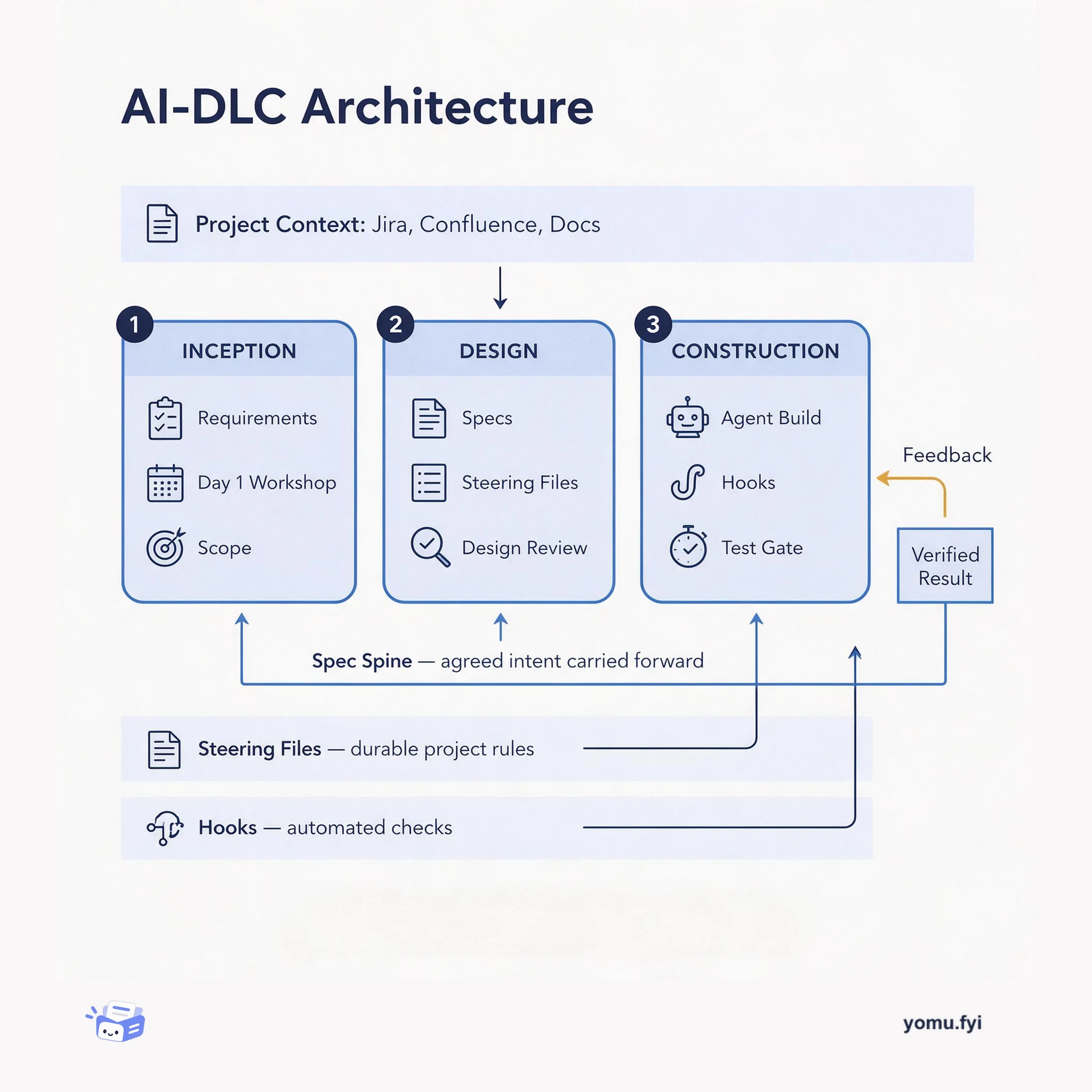
AI-DLC is an AI-driven development lifecycle that runs delivery through Inception, Design, and Construction, with specs, steering files, and hooks keeping agents aligned to agreed intent.
Apple Silicon's defining choice is one shared memory pool for CPU, GPU, and Neural Engine. This diagram maps that fabric, the on-package bandwidth it buys, and the scaling limits it imposes.
Antimicrobial resistance surveillance is a layered data architecture: raw reads and demand signals flow in, get normalized into governed tables, and answer plain-language queries. The diagram maps each boundary.
The Good Stuff
Paid picks we use ourselves. Links carry a referral code — a subscription through one earns us a commission at no extra cost to you.