How MaaS Governance Wraps a Model Endpoint on AKS
A model deployed on AKS is open by default. See how MaaS policies insert Authorino authentication and Limitador rate limits in front of vLLM, so bad keys and over-quota requests stop at the gate.
Loading…
Topic
231 posts about Authentication. Every summary links to the original.
See the idea
A model deployed on AKS is open by default. See how MaaS policies insert Authorino authentication and Limitador rate limits in front of vLLM, so bad keys and over-quota requests stop at the gate.
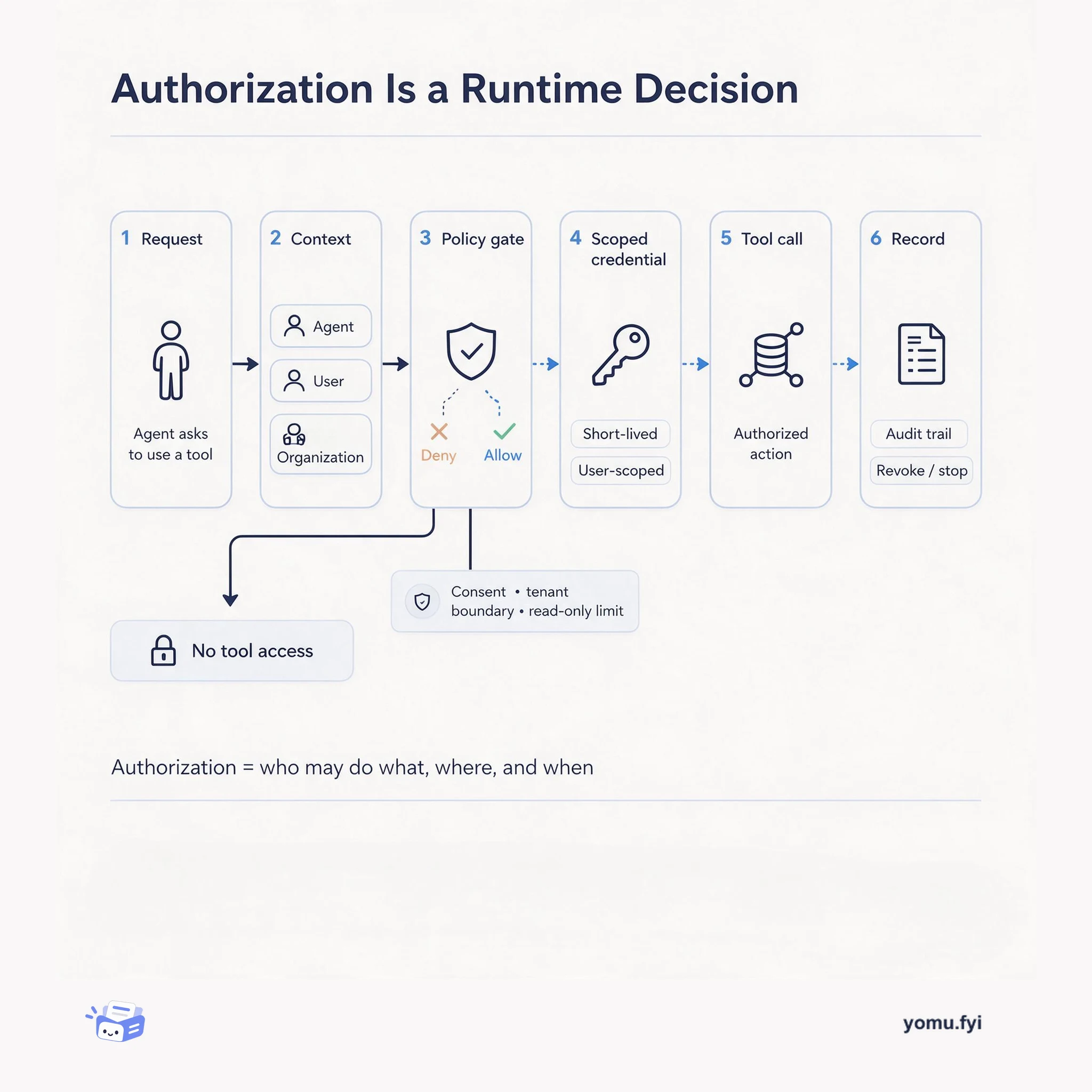
See how an agent request becomes an allowed or denied tool action through identity context, policy checks, scoped credentials, and an auditable decision trail.
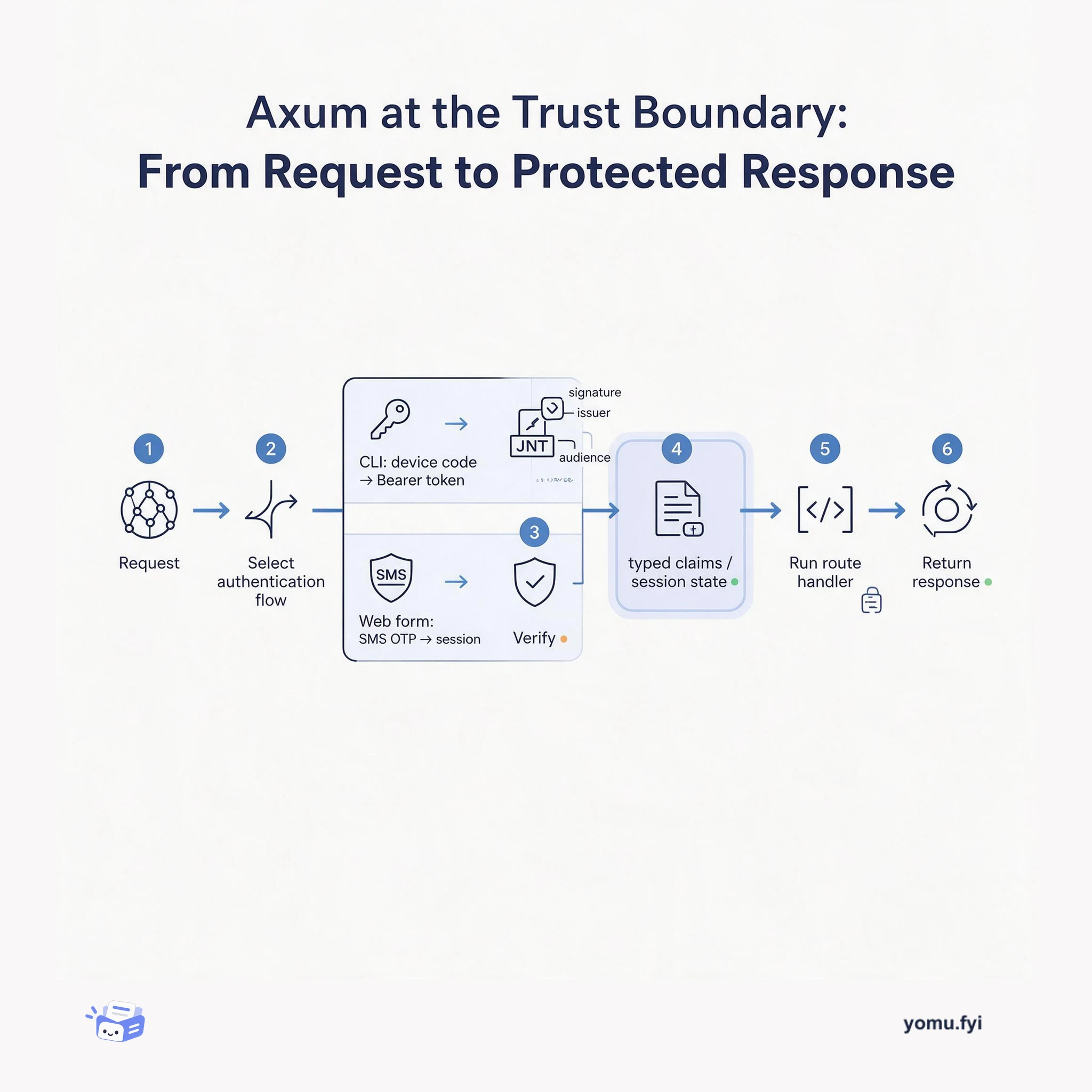
Axum is a Rust web framework for composing routes, middleware, and extractors. This explainer shows how different login flows become verified identity before a handler responds.
The Good Stuff
Paid picks we use ourselves. Links carry a referral code — a subscription through one earns us a commission at no extra cost to you.
Newest first
Default authentication setups often redirect users to third-party domains and issue generic transactional emails, causing password manager failures, browser cookie restrictions, and perceived phishing risks. To mitigate these issues, teams can configure custom identity domains via DNS CNAME records to preserve origin alignment and session persistence. Developers can also capture custom user fields directly within hosted login prompts using Universal Login partials alongside pre-registration Actions rather than managing custom authentication servers. For transactional messaging, teams must replace rate-limited built-in email tools with dedicated external providers and configure SPF, DKIM, and DMARC records alongside Liquid-templated emails. Managing these configurations through version control and deployment tools maintains security standards without adding excessive infrastructure maintenance overhead.
Skybridge can return a React view alongside structured data from an MCP tool, allowing hosts such as ChatGPT, Claude, and VS Code to render an interface in the conversation. The tutorial scaffolds an MCP app, adds Auth0 through Skybridge’s auth0Provider, and protects the /mcp transport with bearer JWT verification before requests reach tool handlers. Auth0’s default opaque tokens create a compatibility issue because MCP clients send RFC 8707 resource indicators rather than an audience, so Skybridge advertises an authorization endpoint that includes the API audience. The view receives the verified user identity through structuredContent instead of relying on a name supplied by the model. Its additional tool calls use the same authenticated MCP session, and testing proceeds through DevTools, the Playground, real hosts, and deployment.
OpenID Connect federated applications connecting to third-party services can implement Cross App Access using the Identity Assertion Authorization Grant specification. When a user authenticates via the standard authorization code flow, the requesting application retains the issued refresh token. The application exchanges this refresh token at Okta's token endpoint via RFC 8693 token exchange to receive a short-lived Identity Assertion Authorization Grant JSON Web Token. Next, the application presents this assertion to the third-party resource authorization server using the RFC 7523 JWT bearer grant to obtain a final access token. Developers can configure an AI Agent and application integrations in Okta to validate the entire end-to-end request flow against test endpoints on xaa.dev.
The article outlines authentication trends expected to shape identity verification, fraud prevention, payments, and access in 2026, against a backdrop of deepfakes, synthetic identities, regulatory change, and increasingly online services. It describes identity orchestration that combines document checks, biometrics, device intelligence, and behavioral signals, while fraud systems assess behavior and may allow, challenge, delay, or block access. For AI agents, Know Your Agent links a bot to its enterprise and official communication channel, with document verification and Twilio Lookup presented as a combined onboarding approach. The recommended strategies add continuous anomaly monitoring, risk-based MFA, human-in-the-loop approvals, multichannel authorization, passkeys, digital IDs, and layered controls, while concluding that businesses and regulators should remain agile and use services such as Twilio Verify, Lookup API, and Verify Fraud Guard.
The post argues that the long-standing trade-off between security and seamless user experience is a false choice, especially as autonomous AI agents act across systems. High-friction measures such as passwords, CAPTCHAs, and one-time login checks can create insecure credential reuse and fail to govern over-permissioned agents or risks that emerge during a session. It proposes invisible, continuous risk evaluation using device, network, phone, email, communication, and behavioral signals, with event-triggered verification when an agent requests a consequential action. The approach also separates human authentication from agent identity and Know Your Agent (KYA), which define delegated authority, contextual rules, and time-bounded permissions while linking an agent to its deploying entity. Twilio is presented as a unified trust layer combining customer data, security intelligence, AI governance, and communication channels; the conclusion is that adaptive controls can protect users while making security largely invisible.
Cloudflare introduced OAuth scope customization to replace all-or-nothing consent flows for third-party applications. Previously, users had to approve every requested scope or deny access completely, compelling developers of tools like MCP servers to construct custom pre-consent selection interfaces. With the new feature, developers can designate specific permissions as optional alongside required scopes when configuring an OAuth client. During authorization, users can deselect these optional scopes, while unrequested client scopes remain hidden to maintain task-specific consent screens. Because resulting access tokens contain only the granted subset of permissions, client applications must inspect returned scopes after code exchange rather than assuming full authorization.
A career progression through community leadership and software engineering led to a new role at Okta. Starting as a campus ambassador and Google Developer Student Clubs lead in India, the author organized hackathons, workshops, and meetups to foster peer learning. To effectively advocate for developers, an internship as a Developer Advocate at Zuplo prompted hands-on engineering experience as a Software Development Engineer at JPMorgan. After mentoring over 10,000 students and growing a technical community to over 600,000 members, the author joined Okta as a Senior Builder Advocate. In this role, advocacy extends beyond traditional coders to support AI builders, low-code creators, and developers utilizing identity and access management tools.
Connecting AI agents to enterprise APIs and MCP servers creates governance challenges when relying on traditional OAuth consent prompts. Cross App Access shifts authorization decisions to the enterprise identity provider, allowing IT administrators to manage agent permissions centrally. In this architecture, an identity provider like Okta authenticates the user and issues an Identity Assertion JWT Authorization Grant based on administrative policy. The requesting AI agent presents this assertion to Auth0, which validates the signature and exchanges it for a standard access token via a JWT-bearer grant. Protected APIs can then validate the final token normally without requiring code changes or direct user consent interactions.
Workplace operations platform SafetyCulture previously relied on a multi-team, manual onboarding process for enterprise single sign-on setups across diverse identity providers, which created operational overhead and accounted for approximately 30 percent of engineering support tickets. To resolve these scaling bottlenecks, the engineering team integrated Auth0's Self-Service Enterprise Configuration, implementing a step-by-step wizard for OpenID Connect and custom SAML setups. The resulting workflow allows customer administrators to configure identity settings, test logins before committing, and manually toggle production activation. Moving from proof-of-concept to general availability took two months, achieving a 50 percent unassisted completion rate. Four months post-launch, SafetyCulture recorded a 60 percent reduction in SSO setup-related customer support tickets.
Resend announces that Laura Beatris is joining its team as a Software Engineer. She previously worked at Clerk and WorkOS, where she shipped authentication products with an emphasis on developer experience, and she has spoken on React, TypeScript, and learning in public. Laura describes a path that began with learning Python from free tutorials, continued through a technical degree and early project-building after repeated internship rejections, and eventually led to Amsterdam in 2021. At Resend, she says she was drawn to products where details matter, a culture of learning in public, and a new problem space for improving her developer-experience judgment; her advice is to learn, create, then teach, because teaching helps knowledge stick.
Passwordless authentication replaces passwords with one-time codes delivered by SMS, and this tutorial builds a Rust app around that flow. The app uses Twilio Verify for OTP generation and validation, with GET and POST routes at "/" for collecting a phone number and at "/verify" for entering the received code. It sets up a Cargo project with Axum, Handlebars templates, sessions, dotenvy configuration, and the rustlio Twilio client, while environment variables hold the Account SID, Auth Token, and Verify Service SID. The implementation also serves HTML forms and static assets, with verification status rendered as a success or error message. Running cargo run starts the server on port 8080, where users can submit a number, receive an SMS, and see whether the verification code is valid.
Passwordless authentication with PHP and Twilio Verify replaces password entry with a phone-based one-time passcode flow, intended to reduce password-related risk and simplify sign-in. The tutorial uses a Slim base project, Composer dependencies, Dotenv configuration, a Twilio Verify Service SID, and PHP session state to support the flow. Users submit a phone number through the root route; the server asks Twilio Verify to send an SMS OTP, redirects to /verify, and checks the submitted code through the verification endpoint. The example’s verification form restricts input to a six-digit numeric value, and the application reports whether verification succeeded or failed after testing locally with composer serve on port 8080.
The tutorial builds a passwordless authentication flow in Go that uses Twilio Verify to send and validate one-time passwords (OTPs) by SMS, avoiding the need for users to manage passwords. It defines a small net/http API with GET and POST handlers for "/" and "/verify": the first collects a mobile number and starts verification, while the second accepts the received code and displays the result. The setup covers Go 1.23 or later, module dependencies, dotenv configuration for the Twilio Account SID, Auth Token, and Verify Service SID, plus session handling for the phone number. The verification check calls Twilio's CreateVerificationCheck() and renders success or failure using templates; running go run main.go starts the server on port 8080 for testing.
An expense-reviewing AI agent required manual manager intervention to email employees about missing report data such as amounts, merchants, or justifications. To automate follow-ups safely, the agent uses Auth0 Token Vault to acquire and refresh Google OAuth tokens without storing credentials in the application database. The implementation configures Auth0 with offline access, My Account API permissions, and multi-resource refresh tokens to handle silent token retrieval across user sessions. Rather than exposing Gmail credentials to the underlying language model, the agent executes email actions via an internal backend endpoint that retrieves a short-lived access token, sends the email, and immediately discards the token.
Passwordless authentication can replace passwords with time-based one-time passwords (TOTP), but implementing the setup and verification flow requires coordinating an authenticator app with a verification service. This tutorial builds a web-based PHP application using Twilio Verify, Slim, Twig, and the Twilio PHP Helper Library. Users submit a username, create an initially unverified Factor resource, scan a QR code or enter its setup code, and submit the first six-digit code; later, they enter codes generated by the authenticator app for validation. The project configures Twilio credentials and a Verify Service SID through environment variables, adds session and flash-message support, generates QR codes, defines routes and templates, and runs locally with composer serve on port 8080. The conclusion presents TOTP passwordless authentication as more convenient and potentially more secure than passwords, while acknowledging added application complexity.
Command-line tools lack browser redirect capabilities, preventing standard OAuth login flows. To resolve this limitation, the OAuth 2.0 Device Authorization Flow issues a temporary device code, presents a verification URL to the user, and waits for authentication in an external browser. A Rust workspace demonstrates this end-to-end pattern across a CLI, an Axum web API, and a shared authentication library. The shared library relies on jsonwebtoken and reqwest to fetch JSON Web Key Sets and validate token signatures, issuers, and audiences against typed claims. Axum secures protected routes through custom FromRequestParts extractors that decode Bearer headers, enabling verified CLI access.
Following the February 2025 launch of Okta Learning, user feedback revealed that mixing Auth0 materials into the shared catalog created friction, buried relevant content, and obscured certification progression. In response, Auth0 launched Auth0 Learning, a dedicated platform tailored specifically to developer workflows. The restructured catalog focuses on three distinct product domains: Auth0 as an identity provider, Auth0 for AI Agents (A4AA), and Auth0 Fine-Grained Authorization (FGA). To reduce onboarding friction, developers can access and interact with free, on-demand courses without creating an account or logging in. Users who choose to authenticate gain access to redesigned learning paths that track individual progress and award shareable digital skill badges upon completion.
The ClickHouse Terraform provider now supports managing ClickStack resources for both self-hosted deployments and ClickHouse Cloud. Dashboards, alerts, sources, saved searches, connections, and webhooks can be kept in version control, reviewed, and applied with the standard terraform plan and terraform apply workflow, helping keep configurations aligned across environments. ClickStack is implemented as a dedicated service module in the existing ClickHouse/clickhouse provider, using Cloud organization credentials plus a service ID for Managed ClickStack, or an endpoint and personal API access key for self-hosted deployments. The work also extends the API contract with named schemas, consistent integer fields, structured validation errors, and dashboard JSON validation during planning when the validation endpoint is available. Support is beta from provider version 3.25, with import and generated-configuration workflows for existing resources; if validation is unavailable, planning warns and validation is deferred to apply.
AI-assisted development enables employees to build applications rapidly, but unmanaged deployments can accidentally expose internal company data to the public Internet. Cloudflare introduced direct Cloudflare Access integration for Cloudflare Workers, allowing organizations to enforce authentication policies directly at the account or individual Worker level rather than per hostname. When enabled, incoming requests are authenticated before reaching application code across custom domains, routes, workers.dev subdomains, and preview environments. Developers can access authenticated identity data such as emails and groups directly via the Worker context object without manually validating JSON Web Tokens. This capability was implemented on Cloudflare's Rust-based FL2 proxy, which separated Worker routing from Worker execution so routing runs safely prior to Access policy enforcement.
Airbnb overhauled its login and registration architecture by transitioning to a server-driven framework called Flexible Authentication. The new system separates user identification from verification, using a backend policy engine to dynamically serve the optimal auth challenge and fallback options based on regional and user context. This shift eliminated dead ends, reduced client bundle sizes, and dramatically sped up experimentation velocity across Web, iOS, and Android.
The best engineering reads, once a week.