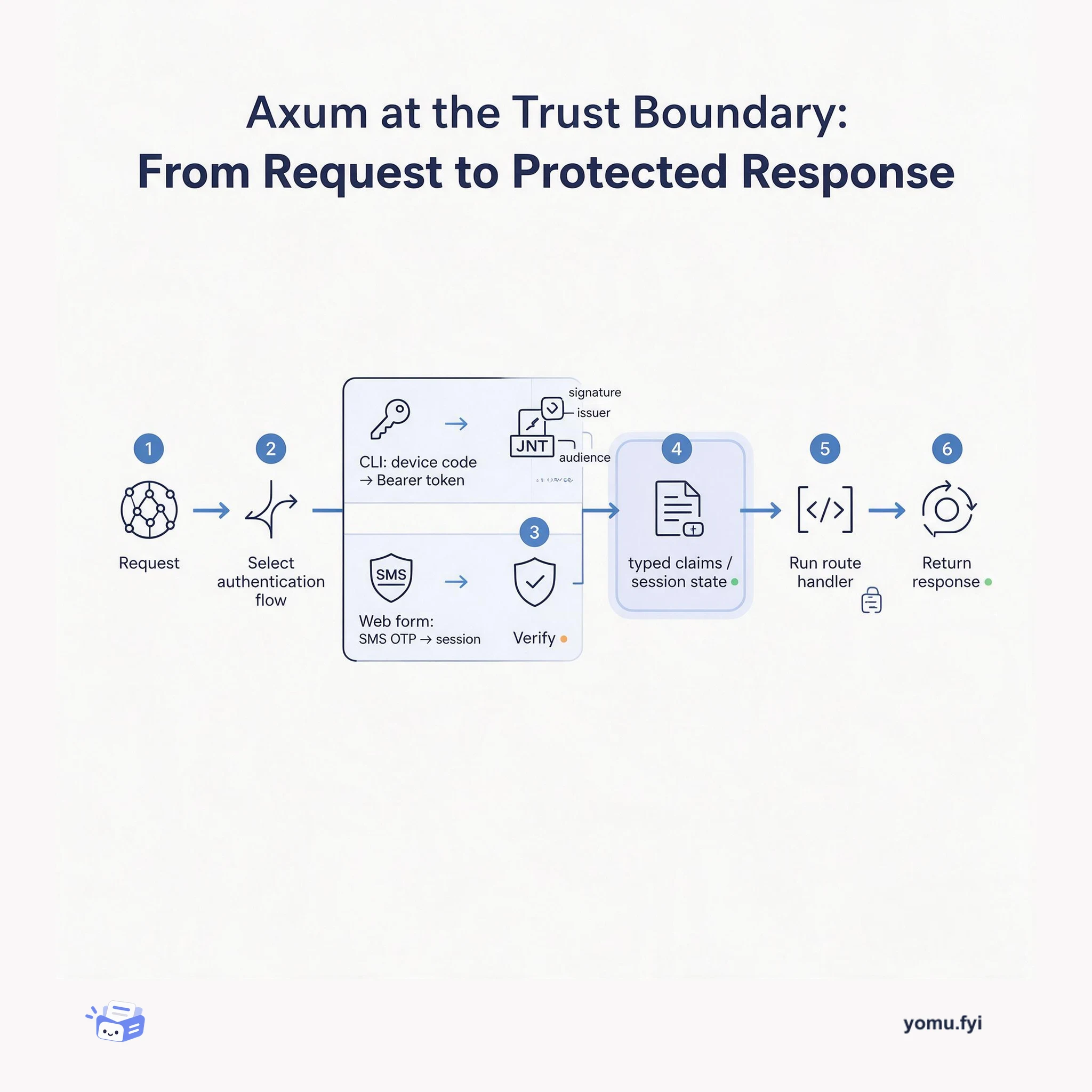
Axum at the Trust Boundary: From Request to Protected Response
Axum is a Rust web framework for composing routes, middleware, and extractors. This explainer shows how different login flows become verified identity before a handler responds.
Loading…
Topic
2 posts about Axum. Every summary links to the original.
See the idea
Axum is a Rust web framework for composing routes, middleware, and extractors. This explainer shows how different login flows become verified identity before a handler responds.
The Good Stuff
Paid picks we use ourselves. Links carry a referral code — a subscription through one earns us a commission at no extra cost to you.
Newest first
CLI applications cannot use a standard browser redirect OAuth login flow when no browser or redirect URL is available, so the tutorial uses OAuth 2.0 Device Authorization Flow. It builds an end-to-end Rust workspace containing a CLI, a shared auth-lib crate, and an Axum API configured with Auth0. The CLI requests a device code, displays a verification URL and user code, polls for an ID token and access token, then sends the access token as a Bearer credential. The API middleware fetches JWKS, selects the key matching the JWT’s kid, validates RS256 signatures plus issuer and audience claims, and deserializes strongly typed UserClaims. With valid claims, a protected route returns a message and subject; otherwise the extractor returns an unauthorized response.
Passwordless authentication replaces passwords with one-time codes delivered by SMS, and this tutorial builds a Rust app around that flow. The app uses Twilio Verify for OTP generation and validation, with GET and POST routes at "/" for collecting a phone number and at "/verify" for entering the received code. It sets up a Cargo project with Axum, Handlebars templates, sessions, dotenvy configuration, and the rustlio Twilio client, while environment variables hold the Account SID, Auth Token, and Verify Service SID. The implementation also serves HTML forms and static assets, with verification status rendered as a success or error message. Running cargo run starts the server on port 8080, where users can submit a number, receive an SMS, and see whether the verification code is valid.
The best engineering reads, once a week.