Copy-and-Replay vs Branch-at-a-Point: Two Backup Recovery Paths
A side-by-side comparison of copy-and-replay recovery and branch-at-a-point restores, showing why restore time scales with data size in one model and not the other.
Loading…
Topic
287 posts about Reliability. Every summary links to the original.
See the idea
A side-by-side comparison of copy-and-replay recovery and branch-at-a-point restores, showing why restore time scales with data size in one model and not the other.
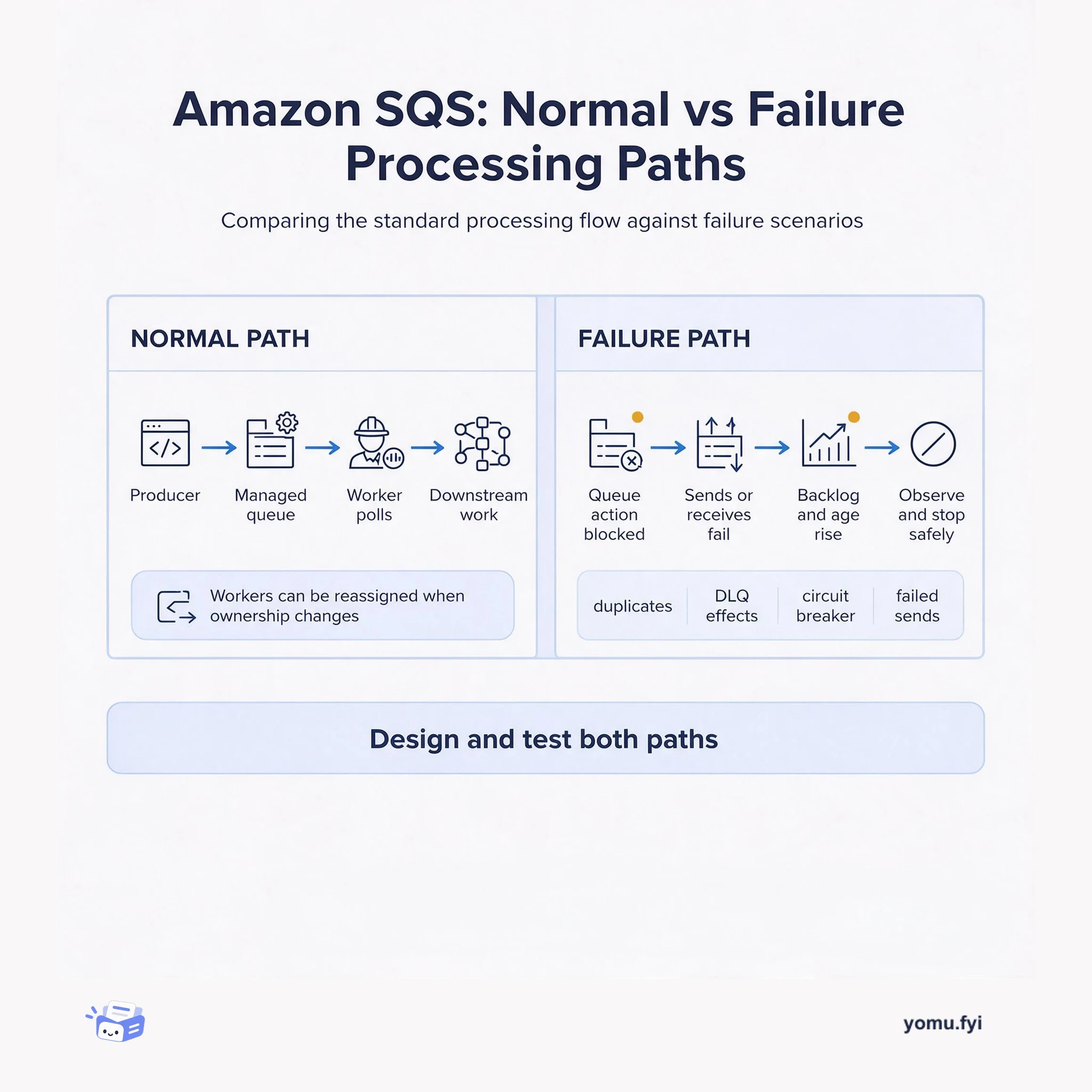
Amazon SQS connects producers and workers, but its real design test is failure. Compare the processing path with the signals and controls needed when queue operations break.
The Good Stuff
Paid picks we use ourselves. Links carry a referral code — a subscription through one earns us a commission at no extra cost to you.
Newest first
A single Redis slave node failure caused Grab's Apollo booking service to suffer an over 95 percent call failure rate for one minute despite running a three-shard cluster with two replicas per partition. Investigation revealed that the service configured Go-Redis to route all read queries exclusively to slave nodes to offload master CPU usage. When the slave node dropped offline, batched HMGET pipeline calls failed completely because the client wrapper treated a single command failure as a failure of the entire pipeline. Furthermore, the Go-Redis client cached cluster topology and only lazily refreshed state every sixty seconds, continuing to direct traffic to the dead replica until the timer expired. Grab addressed this risk by recommending dedicated pipeline clients configured with latency-based routing to allow reads to fall back to responsive master nodes.
Grab discovered that abnormally short driver wait times often indicated restaurants registered at incorrect coordinates due to moves or onboarding errors. To fix this, Grab used driver-partner GPS pings, timestamps, and order status updates to infer true food collection locations. The system cleans the data by filtering low-quality GPS pings and isolating the longest temporal streak a driver spends within a predefined radius of the venue. Clusters of inferred pick-up points are then ranked by order volume, the proportion of off-target pick-ups, and median distance errors before routing to mapping operations for verification. This periodic correction workflow achieved a fivefold reduction in order cancellations caused by unfound merchant locations.
Building resilient systems requires architectural safeguards and proactive testing beyond basic retries and circuit breakers. Architectural patterns such as idempotency keys enable safe retries without creating inconsistent state during failures. Asynchronous responses and deferrable work isolate services from downstream dependency latency and errors, though they can conflict with the fail-fast principle. To validate system behavior under stress, chaos engineering introduces intentional failures in production to test hypotheses against a defined steady state. Selectively adopting complementary patterns reduces failure points while avoiding unnecessary architectural complexity.
Software systems require mechanisms beyond retries to maintain resilience during downstream outages and high traffic. Bulkheading isolates failures across infrastructure, processes, thread pools, and connection limits, preventing a single failing component from degrading an entire system. Load balancing distributes traffic across backend pools via proxies, client-side libraries, lookaside services, or sidecars, often pairing with health checks to eliminate single points of failure. When operations fail unrecoverably, fallback strategies like silent failures, local defaults, stale cache reads, and dedicated backup services enable graceful degradation. Organizations like Grab implement these approaches using internal client-side load balancers backed by etcd, cache fallbacks in microservice frameworks, and redundant core backup services.
Applications can fail when a single upstream service goes down, prompting tools that shed load, fail gracefully, and protect struggling dependencies. The discussion frames this as application resilience for everyday failures, distinct from request-level retries, rollback strategies, and catastrophic disaster recovery. It presents maintenance mode as an easily toggled hard stop with a clear message and status-page link, read-only mode as a way to preserve access when modifications fail, and feature flags as controls for global or meaningful groups. Implementation examples include environment variables, relational databases, Redis, in-memory caches, and an S3-based check, with state stored primarily in Postgres and Redis at Heroku. The closing guidance says maintenance mode should be easy to toggle, while read-only mode can preserve user confidence and access to information.
Distributed systems that rely exclusively on retries and circuit breakers face severe failure risks, including retry storms and reliance on client-side configuration accuracy. Implementing server-side rate limiting serves as a critical defensive layer to safeguard services across evolving architectures. Throttling thresholds can be layered across per-client, per-endpoint, and server-wide granularities using algorithms such as leaky bucket or sliding windows. While local instance-level limits fail when downstream bottlenecks like databases saturate under horizontal scaling, global rate limiting coordinates traffic enforcement across entire service pools. Centralized rate limiters require asynchronous communication and fallback mechanisms to avoid becoming single points of failure or adding request path latency.
Microservice architectures operating under heavy network traffic require robust timeout handling to prevent slow or failing dependencies from causing cascading failures across services. Naive, static timeout configurations across a call chain often cause downstream components to waste compute effort on requests that upstream callers have already abandoned. To establish predictable timeout thresholds, engineers can align limits with service-level latency percentiles, pairing P99 limits with median latency retry allowances. Go's context package improves upon static network timeouts by propagating request-scoped deadlines and cancellation signals across service boundaries. This distributed context ensures downstream servers recognize remaining time budgets and terminate unneeded processing immediately when parent deadlines expire or callers manually cancel requests.
Retries enable software systems to recover from transient upstream failures by automatically repeating unsuccessful requests. While retrying increases the chance of request completion across multi-host setups, it consumes additional CPU and time without inherently tracking host health. Applications must selectively retry errors with a likelihood of success, such as 500 and 503 status codes, while avoiding client-side failures like 400 or 401. To manage distributed systems safely, retries require idempotent operations or cryptographic nonces, along with backoff and jitter to prevent request stampedes. Tuning retry counts, timeouts, and delays is critical to cap the worst-case consumer response time.
An Android monorepo expansion and larger team increased the number of tests run on master, exposing how flaky tests and infrastructure failures could erode CI confidence. Under an independence assumption, tests passing 99.95% each produced a theoretical full-suite pass rate of only 35% across 20 pipelines, while retrying each failed test once raised it to 99.95%. Shopify therefore added retries for setup failures, distinguishing failures retriable within a job from fatal failures requiring the test environment to reload, and retried failed tests up to three times. The system also flagged tests that passed after retry as warnings, since retries can hide reliability problems and slow builds. In practice, Android app pipeline pass rate rose from 31% to almost 90% after retry mechanisms and Gradle caching, while iOS rose from 67% to 97%.
Distributed architectures frequently encounter upstream failures triggered by networking issues, system overloads, resource starvation, and invalid deployments. Implementing software circuit breakers interposes a monitoring mechanism between components to halt requests when failure thresholds are met, giving struggling upstream dependencies time to recover. Circuit breakers save CPU, memory, and network resources by failing fast or routing execution through defined fallbacks such as cached data, alternate services, or approximation algorithms. Grab utilizes Hystrix-Go to manage upstream interactions and configure key thresholds for concurrency, timeouts, and error ratios. This approach protects downstream consumers from cascading latency while insulating upstream resources from excess traffic.
Shopify’s Production Engineering team prepares its platform and 600,000+ merchants for Black Friday and Cyber Monday traffic without interrupting service. Preparation combines controlled fault injection “game days,” synthetic load tests, and staged freezes: a feature freeze begins several weeks ahead, followed by a code freeze allowing only critical fixes during the event. The tests probe dependencies such as shipping providers and payment gateways, including latency, fallback behavior, and responses to datastore failures. After the 2018 weekend, Shopify reported nearly 11,000 orders per minute, around 100,000 requests per second for extended periods, and overall metrics about 1.8 times 2017 levels. The account concludes that fault injection, load testing, and disaster role-play improved readiness, while third-party downtime remains Shopify’s responsibility to merchants and buyers.
Grab operates hundreds of microservices where failures in non-critical components can cause outages in critical user flows if fallback mechanisms are improperly configured. To validate system resilience, Grab built Chaos ExP by layering a chaos engineering SDK and dedicated web UI on top of its existing Experimentation Platform. Integrated directly into the Grab-Kit server middleware, the framework intercepts incoming requests and evaluates whether to inject failures using local variable resolution. Supported failure primitives include latency, errors, panics, rate throttling, and resource leaks to test dependent services. Combining chaos testing with experimentation telemetry enables engineers to correlate injected infrastructure disruptions with business metric impacts.
Grab previously managed experiments using custom service-level code and a toggling library that queried a shared Redis instance, creating latency risks and a single point of failure across backend microservices. To achieve reliable, sub-microsecond feature evaluations, the team designed a Go SDK that resolves rollouts and A/B tests entirely in memory without runtime network I/O. Backend services periodically poll JSON-defined configuration schemas stored in Amazon S3 through a Universal Configuration Manager. The SDK evaluates contextual attributes called facets locally and pushes decision telemetry asynchronously to an S3 and Presto data lake. This architecture allows engineering and product teams to gate deployments and run server-side experiments safely without service disruption.
Event Sourcing stores application changes as immutable events, providing a history that can explain how current data came to be. The post introduces four components: Events record changes, Calculators update Aggregates from those events, and Reactors trigger side effects or create further events. Kickstarter implemented a minimal framework for d.rip using regular Active Record aggregates, a regular SQL database, synchronous atomic updates, and roughly 200 lines of home-made code. The approach supports replaying history to reconstruct past state, repair calculator bugs, backfill new aggregate fields, optimize read models, and forward events to analytics platforms, while presenting naming and mutation-to-event decomposition as important challenges.
Shopify outgrew its ability to scale by buying larger database servers, so it introduced database sharding in 2015. Sharding improved performance and horizontal scalability but made actions dependent on every shard, increasing the risk of platform-wide unavailability. In 2016, Shopify reorganized its runtime around pods: each pod groups shops on isolated datastores, while shared workers, application servers, and load balancers are restricted to one pod at a time. Sorting Hat assigns each request to a pod and location, while every web request and delayed job is kept within one pod; paired data centers and Pod Mover support recovery without dropping requests or jobs. The design makes a pod the unit for scalability, resiliency, and disaster recovery, and simplifies evacuating an entire data center.
Following a production outage where a database failover caused a Ruby on Rails application to exhaust its Puma server threads, an investigation was conducted to understand how ActiveRecord and MySQL timeout settings behave. A reproduction environment using Docker, Puma, and Toxiproxy replicated how hanging requests to a failing database consume all available server threads, ultimately starving unrelated endpoints. The analysis breaks down ActiveRecord connection pooling mechanics alongside underlying mysql2 and libmysqlclient settings, specifically checkout_timeout, connect_timeout, and read_timeout. Testing confirmed how existing and new TCP connections transition through socket states during network interruptions while waiting on configured timeout intervals.
Grab presented a technical paper on the construction of its real-time ridesharing service, GrabShare, at the Intelligent Transportation Engineering Conference in Singapore. The platform pairs passengers heading along similar routes with drivers immediately while handling network drops, volatile supply and demand, and heavy traffic conditions in Southeast Asian cities. To deliver accurate pairings, the scheduling system generates and filters through hundreds of travel time estimates for each candidate match before finalizing an itinerary. Operational teams on the ground evaluate complaints about poor matches, enabling engineers to refine the online matching systems. Over the course of one month, the service cut more than 4.5 million kilometers of driving distance and brought in over 100,000 new users within two weeks.
Kickstarter upgraded its main Rails application to Rails 5, alongside payments app Rosie, to support site security and performance while moving a nine-year-old legacy codebase forward. The team planned a three-month project, upgraded Ruby 2.2.5 to 2.4.x, classified release-note changes, resolved dependency conflicts, used Rails’ upgrade script, and moved through twelve documented steps. Work included merging Rails 4.2-compatible fixes, repairing nearly 4,000 CI test failures from a roughly 70 percent coverage baseline, removing deprecations, smoke-testing major flows, backporting more than thirty pull requests, and preparing reviewers and deployment contingencies. The upgrade met its timeline without rollbacks or major downtime, although untested bugs increased Zendesk tickets and exposed issues involving ActionController::Parameters, tracking events, and mobile applications. A retrospective emphasized planning, documentation, cross-team communication, and broader native-team participation for future upgrades.
Grab has officially launched a public bug bounty program in partnership with HackerOne to strengthen the security of its platform. This rollout follows a private bounty initiative operated over the previous year, during which the organization worked with over 350 security researchers and resolved nearly 200 awarded bug reports. The new public program invites external researchers to scrutinize Grab's code for critical flaws, including remote code execution, SQL injections, and exportable cross-site scripting vulnerabilities. To support ethical and responsible disclosure, Grab offers payouts reaching up to $10,000 per valid vulnerability report based on severity and impact.
Grab engineered an in-app messaging platform, GrabChat, to help drivers and passengers coordinate pickups across Southeast Asian markets characterized by weak 2G connectivity and high packet loss. The team developed an in-house TCP messaging architecture consisting of a TCP gateway named Gundam and a message dispatcher named Hermes connected to internal backend services over HTTPS. To protect backend server resources from resend loops during poor connection states, the communication protocol adopts a "server only push once" model that delegates retry handling to the client. Data science evaluations using a pre-trained cancellation prediction model confirmed that GrabChat adoption correlated with reduced booking cancellations. Following early usage feedback, the team further iterated on the feature by introducing pre-written message templates to reduce driver distraction on the road.
The best engineering reads, once a week.