Copy-and-Replay vs Branch-at-a-Point: Two Backup Recovery Paths
A side-by-side comparison of copy-and-replay recovery and branch-at-a-point restores, showing why restore time scales with data size in one model and not the other.
Loading…
Topic
287 posts about Reliability. Every summary links to the original.
See the idea
A side-by-side comparison of copy-and-replay recovery and branch-at-a-point restores, showing why restore time scales with data size in one model and not the other.
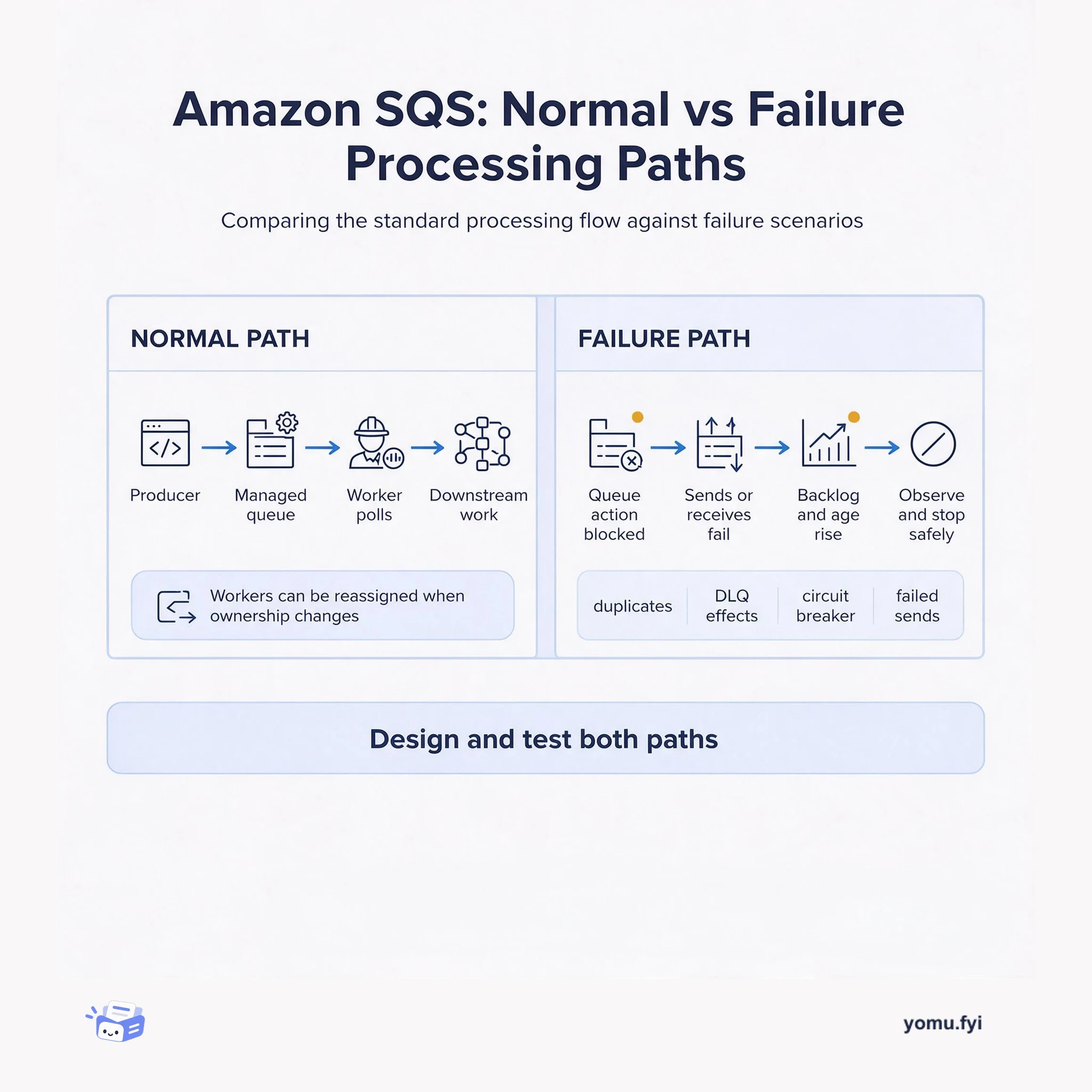
Amazon SQS connects producers and workers, but its real design test is failure. Compare the processing path with the signals and controls needed when queue operations break.
The Good Stuff
Paid picks we use ourselves. Links carry a referral code — a subscription through one earns us a commission at no extra cost to you.
Newest first
Grab experienced intermittent HTTP 5XX alerts when its Gothena service sent driver location updates to the Astrolabe service through an AWS Elastic Load Balancer (ELB). CloudWatch metrics revealed that requests were failing to reach healthy backend instances because of an uneven load distribution favoring a single ELB node in one Availability Zone. The team verified that Route 53 was properly using Alias records and ruled out OS-level DNS caching since Linux does not cache DNS queries by default. Connection inspection with netstat across multiple Go services confirmed a heavily skewed distribution of connections toward specific ELB IP addresses. Comparative tests with cURL, tcpdump, Go, Python, and Ruby in an isolated environment demonstrated that Go reused connections across requests while other runtimes opened new connections per request.
Grab experienced an issue where its Unicorn API served stale data for up to 45 to 60 minutes despite expected cache invalidation times totaling around 11 minutes. The setup utilized ElastiCache Redis 2.x configured with a single master node for writes and two read-only slaves handling reads. Investigation revealed that in Redis 2.x, slave nodes do not expire keys on their own and only delete them upon receiving an explicit DEL command from the master. Because the master only actively checks and deletes 200 random keys per second, clearing expired keys across roughly 5.6 million cached items mathematically required over 110 hours, resulting in slaves serving expired data.
An aborted Cedar-14 stack-image upgrade led container tools to truncate and overwrite a disk image while it was mounted as the read-only / filesystem for running dynos. Because direct writes bypassed filesystem caching and consistency mechanisms, reads alternated between cached pages from the old image and missing data from the truncated file, partially corrupting newly loaded programs. Applications consequently experienced elevated segmentation faults and other hard crashes for about five hours; a virtual-machine reproduction using an ext4 loop-mounted image and sleep reliably produced the same failure. Engineers migrated affected dynos to fresh hosts, then changed host-side permissions so installed filesystem images are read-only, and retested the conditions that triggered the incident.
Apache Kafka’s log cleaner for compacted topics could crash silently when its offset map lacked enough space to hold a full log segment. Because the broker continued running without that internal thread, superseded data accumulated, threatening node and potentially cluster stability. The post explains compaction’s two phases: building an offset map for newer messages, then rewriting segments while retaining the latest offset for each key, with the latest segment excluded from the map. Kafka was changed to remove the crashing assertion and track partial segment loads so cleaning can recover without fitting an entire segment in memory. The roughly 100-line patch shipped in Kafka 0.10.1.1, which the post identifies as Heroku’s default version, and prevents the cleaner from dying silently.
Building client-side load balancing for Grab's Common Data Service prompted a move from AWS Elastic Load Balancers to DNS discovery due to persistent connection issues and unpredictable scaling events. After patching an open-source library that failed to rotate IP sequences properly, the author evaluated different Go patterns for round-robin routing. A mutex-protected array counter provides the simplest model for basic retrieval, though adding mutations requires careful lock coordination. Alternatively, a dedicated balancer goroutine receiving requests over nested channels enables explicit operation timeouts and centralized event handling at the cost of higher code complexity and channel creation overhead. The author recommends the mutex approach for resource fetching and the goroutine-based design for workload balancing.
Grab describes how its service-oriented architecture makes cross-team production debugging difficult because engineers may lack familiarity with other teams’ code and architecture. Post-mortem reports are presented as the glue for shared understanding, but a sample incident entry lacks service context, bug detail, impact, chronology, and investigation steps. The proposed standard has four requirements—Chronology, Context, Empowerment, and Solutions—covering timelines, service internals, blameless educational diagnosis, and remedies across People, Product, and Process. A template includes initial symptoms, a timestamped timeline, log-based investigation with code evidence, temporary and permanent fixes, and improvement actions, while peer review by another team is required before finalization.
The Heroku Routing team describes a manual created to preserve hard-earned operational knowledge from developing and maintaining Erlang systems at scale. That knowledge had typically been passed informally through incident simulations, code reviews, and similar practices, leaving no persistent record for new team members. The manual presents itself as a guide to being an “Erlang medic” during failures, combining tips, tricks, code snippets, and practices for understanding failure sources and debugging running production systems. It is available as a free PDF under a Creative Commons License at erlang-in-anger.com, and was released in time for the Chicago Erlang conference, where Routing team members and Erlang community participants could discuss real-world applications.
The best engineering reads, once a week.