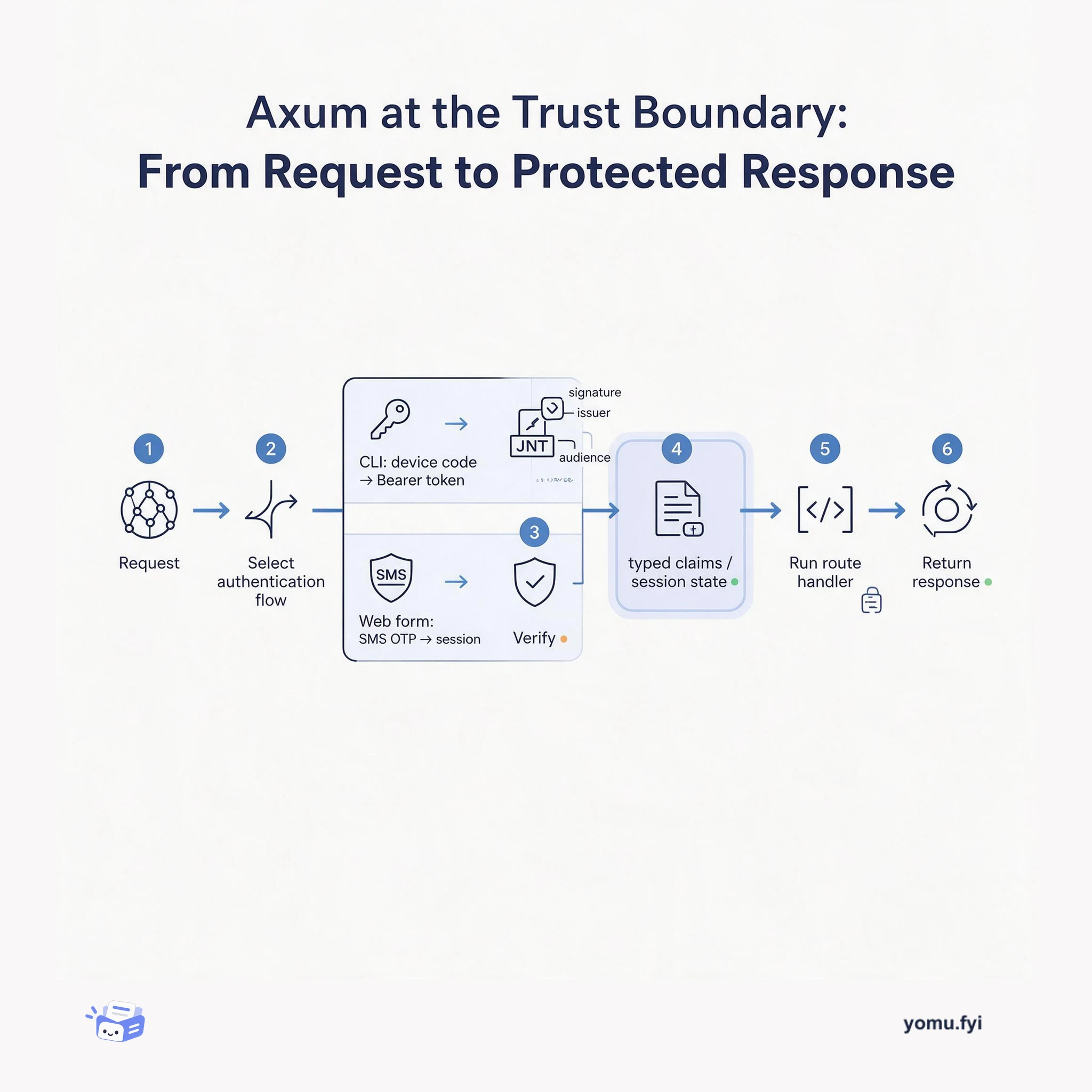
Axum at the Trust Boundary: From Request to Protected Response
Axum is a Rust web framework for composing routes, middleware, and extractors. This explainer shows how different login flows become verified identity before a handler responds.
Loading…
Topic
66 posts about Rust. Every summary links to the original.
See the idea
Axum is a Rust web framework for composing routes, middleware, and extractors. This explainer shows how different login flows become verified identity before a handler responds.
The Good Stuff
Paid picks we use ourselves. Links carry a referral code — a subscription through one earns us a commission at no extra cost to you.
Newest first
Supabase Pipelines has moved into public alpha as a service for replicating Supabase Postgres data to external analytical systems in near real time. The release adds automatic application of supported schema changes, faster initial synchronization through parallelism, and a destination request form for ClickHouse, Snowflake, and DuckLake; Google BigQuery is the first destination available to everyone in public alpha. Powered by the open-source Rust-based Supabase ETL, Pipelines uses Postgres logical replication to copy existing tables, stream inserts, updates, deletes, and truncates, and resume from the last acknowledged position after interruptions. It provides at-least-once delivery and managed pipeline controls, while remaining an alpha product with ongoing work on throughput, batching, backpressure, broader schema support, and additional destinations.
Agent swarms are evaluated as a way to scale software work beyond what a single long-running agent can reliably manage. The test revisits building SQLite in Rust from its documentation, comparing old and new swarms with identical models and time budgets against a held-out SQL suite; the new system performed better in every configuration, reaching 80% with Grok 4.5 in four hours. Planners decompose task trees while workers execute narrower pieces, supported by a purpose-built version control system and mechanisms for design conflicts, merge collisions, megafiles, intentional breakage, and review. Reported results include a full-suite pass using 9,908 engine-code lines versus 64,305 for the old harness, while costs ranged from $1,339 for an Opus 4.8 hybrid to $10,565 for GPT-5.5 alone, indicating that cheaper models can perform most execution after frontier planning resolves ambiguity.
ClickHouse announces an official ADBC driver, a modern Arrow-native alternative to ODBC and JDBC for analytics and AI applications. It provides end-to-end columnar movement: query results leave ClickHouse as Apache Arrow and arrive in applications without a row-oriented conversion or staging step. A single Rust-built implementation connects through ClickHouse's HTTP interface, supports TLS, and serves languages and tools with ADBC bindings, including Ruby, R, and C. Users can install precompiled, signed binaries through the ADBC Driver Foundry and connect with a clickhouse:// URI; dbt Fusion distributes the driver directly. The driver also supports streaming Arrow inserts, while schema discovery, improved bulk ingest, usage examples, and JSON support remain on the roadmap.
amazon.science
Reinforcement learning for agentic tasks requires updating model parameters against the precise token sequences generated during rollouts. Standard agent harnesses frequently modify conversation transcripts through message compaction and tool formatting, causing retokenization drift that degrades policy-gradient training. Turnstile addresses this issue as a Rust-based proxy situated between agent harnesses and inference backends such as SGLang. By intercepting OpenAI-compatible Chat Completions traffic, the proxy records exact token IDs, log probabilities, loss masks, weight versions, and mixture-of-experts routing traces at the moment of generation. Validation across text-based coding and multimodal computer-use agents demonstrated steady reinforcement learning improvements without requiring modifications to agent harnesses.
Grab’s Counter Service supports time-windowed fraud queries at tens of thousands of QPS and about a billion requests per day, but an infrastructure review prompted migration from a wide-column database to Aerospike. The team first separated Rust business logic from storage, then added an enum-dispatched facade with Single, WithShadow, and WithSplit modes so traffic could be compared and shifted without downtime. They also redesigned the writer path around Aerospike, including a map-based schema and a single atomic increment, while testing index placement and reverting from an NVMe-backed primary index after hot-key p99 spikes. Production p99 read latency improved by roughly 50%, disk usage fell from about 3 TB to 1 TB, and per-node cost dropped 45–50%; the rollout reported zero downtime and no data-integrity issues.
ClickHouse Cloud built WAL-RUS, an open-source Rust implementation of PostgreSQL backup and WAL archival tooling, after encountering difficulty predicting WAL-G’s memory usage in resource-constrained environments. The project preserves WAL-G’s core functionality and compatibility while using bounded worker pools, controlled concurrency, persistent object-storage connections, and a streaming pipeline that limits buffering and data copies. It uses the same WALG_ configuration variables, and WAL-G and WAL-RUS can read each other’s archives. In a sustained WAL-heavy benchmark with four archival workers, WAL-RUS stayed below 1 GB of peak virtual memory versus nearly 2.8 GB for WAL-G, while both maintained minimal backlog and comparable CPU usage. The authors plan to make WAL-RUS the default backup and archival mechanism for ClickHouse Cloud’s managed Postgres offering and are working to upstream its Postgres 17 wal summaries support to WAL-G.
The post benchmarks Zerobus Ingest, a managed, serverless, push-based service that writes producer data directly to Delta tables governed by Unity Catalog, against a petabyte-scale telemetry workload. Using NASA’s NEOWISE dataset and Locust, the test modeled fan-in from 2,048 concurrent streams, using Protocol Buffer 2 data over approximately 24 hours. The design replaces static partition-based ordering with stream-connection ordering, allowing heuristic routing across pods, dynamic partitioning, and autoscaling while existing streams drain. It also uses zeroparser, a zero-copy protobuf decoder whose design relies on Rust’s lifetime system and supports dynamic descriptors at about 1 GB/s per CPU core. The test sustained 12 GB/s to one table, ingested 1.04 trillion rows, and reached 1 petabyte within 24 hours; Zerobus Ingest is generally available, with additional APIs on its roadmap.
amazon.science
AWS has introduced M9g and M9gd EC2 instances powered by Graviton5 CPUs, featuring the formally verified Nitro Isolation Engine to enforce virtual machine isolation. To prove the engine's correctness, engineers developed 330,000 lines of machine-checked mathematics using the Isabelle/HOL proof assistant. The system architecture separates hypervisor policy from isolation mechanisms, requiring the deprivileged Nitro Hypervisor to route all guest state modifications through the minimal Rust-based engine. Functional verification uses a restricted language subset called micro Rust, Separation Logic contracts specifying total correctness, and weakest-precondition calculus from the open-source AutoCorrode library. Finally, high-level transition relations and noninterference proofs ensure that memory integrity and guest confidentiality are preserved across every execution step.
ClickHouse initially built native protocol support to read Delta Lake tables, but maintaining pace with the format's evolving specification created high complexity and fragmented features. To resolve this, engineers integrated the Rust Delta Kernel to offload protocol handling while retaining ClickHouse's optimized Parquet data reading. The Delta Kernel parses JSON transaction logs, resolves snapshots, manages transactional write metadata, and exposes schema evolution mapping alongside Change Data Feed streams. ClickHouse also contributed upstream enhancements to the Rust kernel, adding dynamic runtime logging and asynchronous metadata processing via FFI handles. While ClickHouse can attach to existing Delta tables, the integration cannot yet initialize empty Delta Lake tables.
clickhousectl v0.2.0 expands the beta CLI with local and ClickHouse Cloud managed Postgres, ClickPipes, SQL over HTTP for Cloud services, agent-oriented output changes, and a standalone Rust client for the ClickHouse Cloud API. Local Postgres runs in Docker, is keyed by name and major version, stores isolated data under .clickhouse/servers/-pg/data/, and supports versions 16, 17, and 18. ClickPipes covers batch, streaming, CDC, and snapshot sources including object storage, Kafka-compatible systems, Kinesis, Postgres, MySQL, MongoDB, and BigQuery. Cloud queries use a provisioned or lazily enabled Query Endpoint and service-scoped API key, while the endpoint uses sql_console_admin and the key has no organization-level roles. The release also adds Markdown-style tables and credential debugging, with more than 5,000 users reported five weeks into the project.
Stripe’s 25-million-line Ruby codebase needed a true autoformatter; before rubyfmt, no industry-wide Ruby formatter existed, and earlier tools had crashed on its files. rubyfmt began as a zero-configuration open-source project motivated by formatting disputes, Ruby’s slow startup, and the uncertainty faced by engineers arriving from other languages. To meet a 100ms target, it initially used a hand-authored C launcher and later moved formatting into Rust, with ripper parse trees first passing through JSON and eventually being deserialized directly from Ruby VALUE objects. Stripe adopted per-file opt-in, expanded coverage cautiously, and formatted the codebase on a Saturday in 2024; the excerpt reports that all 42-million-line Ruby codebase is now formatted. In 2025, migrating from ripper to Prism removed the need to link a Ruby VM and made rubyfmt smaller and dramatically faster.
DeepSeek V4 is presented as an open model family aimed at long-running agentic workloads, with Pro and Flash MoE checkpoints offering 1M-token context windows. Its central architecture alternates Compressed Sparse Attention (CSA) and Heavily Compressed Attention (HCA), compressing KV entries by 4x and 128x respectively, while using FP8/BF16 storage and FP4 indexing. The post-training design preserves reasoning across user turns when tool calls are present, introduces a dedicated XML tool-call schema, and relies on DSec, a Rust sandbox platform for RL rollouts. At 1M tokens, Pro uses 27% of V3.2's single-token FLOPs and 10% of its KV cache, while Flash uses 10% and 7%; V4-Pro-Max reports 80.6% on SWE Verified and 0.59 MRCR 8-needle retrieval at 1M.
The ClickHouse community and development team participated in FOSDEM 2026 in Brussels, hosting a community dinner and delivering technical presentations across multiple developer tracks. Presentations covered a range of engineering topics, including building geospatial analytical applications with Leaflet and ClickHouse, as well as integrating LLVM XRay to dynamically hot-patch production logging without redeployments. Additional ClickHouse sessions addressed the engineering challenges of integrating Rust libraries into large C++ codebases, optimizing low-level memcpy routines, and implementing specialized inverted indexes for large-scale text processing. Contributed community sessions detailed workflows for upstream patches in MariaDB and Postgres, alongside WebShield, an open-source Python daemon that streams web accelerator access logs into ClickHouse for bot analysis.
Cursor has expanded its long-running agents research preview to all Ultra, Teams, and Enterprise users. The preview targets autonomous work on ambitious projects, using a custom harness designed to address frontier models’ failures on long-horizon tasks. Long-running agents propose a plan for approval before execution and use multiple agents to check work and maintain follow-through. Reported examples include runtimes of 36, 30, and 25 hours, while initial results showed substantially larger PRs with merge rates comparable to other agents. Internal examples include a Rust migration and custom kernels for video rendering, a 10,000-line network-policy PR, and secure sudo prompting for Cursor CLI; the company says agents can now deliver working solutions after hours or days, though safer production deployment and collaboration across agents remain active areas.
The post describes research into scaling long-running autonomous coding agents, using a web browser as a complex benchmark and running thousands of agents continuously for one week. An initial single-agent plan failed because the model lost track, stopped prematurely, and stalled on complex details; shared-state coordination then introduced locking contention, while more structured planner, executor, worker, and judge roles improved ownership and throughput. The team built a Rust-based harness on one large Linux VM, logged agent messages and tool activity for replay and analysis, and iterated through designs that eventually favored a more dynamic system with freshness mechanisms and fewer overloaded roles. The research concludes that architecture, prompts, observability, explicit throughput trade-offs, and anti-fragile recovery matter, reporting linear scaling of token throughput with minimal harness overhead while humans retained taste, judgment, and direction.
Bugbot is a code review agent built to identify logic bugs, performance issues, and security vulnerabilities in pull requests before production, as increasingly capable coding agents increased review workload. Its development moved from qualitative assessments to systematic experimentation, using an AI-driven resolution-rate metric, the BugBench benchmark, and online evaluations of real pull requests. An early production flow ran eight parallel passes with randomized diff ordering, majority voting, category filters, validation, and deduplication, while later versions adopted a fully agentic design with tools and dynamic context. Across 40 major experiments, resolution rate rose from 52% to over 70%, bugs flagged per run from 0.4 to 0.7, and resolved bugs per pull request from roughly 0.2 to about 0.5. Newer versions caught more bugs without a comparable rise in false positives, and planned capabilities include Autofix, self-verification, deep research, and continuous scanning.
Transformers v5 overhauls its tokenization framework by separating tokenizer architecture from trained vocabularies. In contrast to v4's dual slow Python and fast Rust files, v5 consolidates each model tokenizer into a single file defaulting to the Rust-backed TokenizersBackend. The pipeline stages—normalizer, pre-tokenizer, model algorithm such as BPE or Unigram, post-processor, and decoder—are now directly exposed and configurable rather than buried in serialized files. Practitioners can instantiate blank tokenizer architectures and train custom vocabularies directly from iterators using native methods like train_new_from_iterator while retaining model-specific formatting rules. The wrapper layer continues to bridge raw tokenization and model requirements by managing chat templates, context limits, and special token insertion.
Corrosion is Fly.io’s open-source service discovery and state synchronization system, built to distribute routing data across globally deployed edge proxies and worker servers. It replaces centralized consensus-oriented designs with a Rust program that propagates a SQLite database through SWIM-based gossip and QUIC, using cr-sqlite’s CRDT tables and logical timestamps to reconcile updates without locking, a central server, or distributed consensus. The system’s design follows link-state routing ideas and exploits Fly.io’s fully connected WireGuard mesh, while worker-owned state keeps conflicts uncommon. The post also documents failures, including a contagious Rust RWLock deadlock, a nullable-column migration that triggered large-scale reconciliation, and the need for backups, whole-dataset republishing, testing, and regionalization to reduce blast radius. Corrosion now converges in seconds across thousands of workers.
The Integrity Data Platform team rewrote Counter Service, a high-QPS Golang microservice that consumes streams, writes counts to Scylla, and exposes gRPC queries backed by Scylla and Redis. They selected it because BatchRead reached tens of thousands of QPS while remaining constrained in functionality, making infrastructure savings potentially worth the rewrite effort and Rust learning curve. Rather than translating code line by line, the team treated the existing service as a black box, preserved its interfaces and contracts, and rebuilt the application logic from scratch; it also assessed Rust ecosystem support for dependencies including tonic, Actix Web, Fred, and the Scylla driver. The rewrite delivered similar performance with 70% infrastructure savings, according to the abstract. The conclusion reports the service as 80% cheaper, endorses Rust for new services, and cautions that async Rust is challenging.
Fly.io’s fly-proxy, a Rust-based Anycast router, suffered lockups while managing rapidly changing routing state across thousands of servers. An earlier outage came from an if let expression that kept a read lock through both branches, while later regionalization and lazy loading increased write contention in the Catalog. The investigation traced the new failures to parking_lot’s try_write_for wakeup path: after a waiting writer timed out, it attempted to clear WRITER and WRITER_PARKED together even though one bit had already been cleared, and wrapping arithmetic produced the corrupted lock value 0xFFFFFFFFFFFFFFFE. The parking_lot team fixed the defect, after which the lockups did not recur; the team also audited Catalog locking, removed if let patterns and RAII lock guards, and added lock-timing metrics, labeled slow-write logs, and holder tracking.
The best engineering reads, once a week.








