One Pool, Many Engines: The Architecture of Apple Silicon
Apple Silicon's defining choice is one shared memory pool for CPU, GPU, and Neural Engine. This diagram maps that fabric, the on-package bandwidth it buys, and the scaling limits it imposes.
AI-DLC is an AI-driven development lifecycle that runs delivery through Inception, Design, and Construction, with specs, steering files, and hooks keeping agents aligned to agreed intent.
AI-DLC is an AI-driven development lifecycle that structures delivery into three phases: Inception, Design, and Construction. Each phase produces durable artifacts — specs that fix requirements, steering files that carry project context, and hooks that automate checks — so agents work from agreed intent instead of ad hoc prompts. The architecture matters because it moves human effort upstream, forcing cross-team agreement before coding starts and reserving engineers for goal-setting and verification of finished work. Teams adopting it report features landing in about one sprint rather than three to four, with fewer post-launch defects.
The posts behind it
 Databricks · · Problem & solution
Databricks’ AI Research team uses AI Runtime (AIR) to manage hundreds of parallel research workstreams for products like Genie, Smart Routing, and AI Functions, training models from a few billion to nearly a trillion parameters. AIR performs preflight checks on GPU nodes to ensure health and communication before training, and monitors node health during execution to detect issues like NCCL failures or thermal throttling. The AIR CLI and custom Docker containers enable fast experimentation by launching jobs in seconds without rebuilding environments, supporting both supervised fine-tuning and reinforcement learning. MLflow integration automatically tracks experiments, while Unity Catalog FUSE mounting gives governed access to research data across workspaces without changing training code. The team has scaled to agent-led training, where AI agents propose changes, launch trials, and evaluate results, increasing training job volume by 8x across AI Functions research workloads.
 Meta · · Problem & solution
Meta built Forum using AI-native engineering, treating an AI agent as a development participant rather than a faster typing tool. The team shifted from human-in-the-loop to human-on-the-loop, where the agent autonomously plans, implements, builds, tests, and corrects its work while the engineer sets goals and approves outcomes. Success was measured by verified, production-ready results, not code volume, with automated verification signals like build status and unit tests filtering output before review. Meta adapted the codebase for legibility, gave agents tools to inspect live view hierarchy directly instead of descriptions, and created a separate sandbox build to isolate prototype code from production. This approach helped Forum reach core feature parity with Facebook Groups in eight weeks and caught a memory issue during development that roughly halved memory use and page faults.
 NVIDIA · · Announcement
Meta launches Muse Spark Open, an 816B-parameter mixture-of-experts model with 42B active parameters and a 1M token context window, trained on NVIDIA GB300 NVL72 for agentic coding workflows. It plans, acts, observes, and self-corrects across multistep tasks like multifile refactoring, using tool calls and subagent coordination while holding an entire project in context without breaking it into pieces. Its 1.8B perception encoder natively processes interleaved text, images, video frames, and audio in a single pass. On GB300 NVL72 with speculative decoding, it achieves over 50K tokens per second per GPU and over 600 tokens per second per user. Sparse MoE routing activates only 42B parameters per token, and NVFP4 quantization reduces memory footprint for larger KV cache. The model is available via Hugging Face and NVIDIA NIM, with support from SGLang, vLLM, and TensorRT LLM for serving, and fine-tuning through NeMo AutoModel and Megatron Bridge.
 Stack Overflow · · Problem & solution
Many engineering teams mistakenly think building an internal AI knowledge context layer is as simple as standing up a vector database and wiring a RAG pipeline to documentation. In reality, a production-grade pipeline requires five continuously maintained stages—capture, deliver, govern, organize, and validate—where each stage’s long-term cost compounds as vendor APIs change and content ages. The critical innovation is the knowledge node, a living record carrying source, ownership, and an automatically computed trust score based on authorship, usage, recency, and conflicts. Trust decays over time, prompting owners for lightweight revalidation when confidence drops, and knowledge is automatically scoped to the correct audience without manual filing. For product companies not in the knowledge-infrastructure business, the compounding maintenance burden makes building this pipeline a distraction compared to leveraging existing platforms like Stack Internal.
 AWS · · Problem & solution
Dynata, a large first-party data company, sought to accelerate delivery across distributed teams while improving cross-functional alignment. They adopted a staged AI approach: first AI-assisted coding via Amazon Q Developer, then connecting AI to project context from Jira, Confluence, and Lucid, and finally implementing the AI-Driven Development Lifecycle (AI-DLC) methodology using Kiro IDE. AI-DLC, powered by Amazon Bedrock, structures delivery into Inception, Design, and Construction phases with Specs, steering files, and hooks. This process forced all teams to agree on requirements and design during a Day 1 workshop, surfacing gaps before coding began. Consequently, features that once took 3–4 sprints were completed in about one sprint, cutting development phase time by roughly 70% and reducing post-launch defects.
 Jetbrains · · Benchmark
Netflix integrated JetBrains’ headless code-intelligence engine into coding agents Claude Code and Codex to address agents’ struggles navigating Java/Kotlin code across compiled JAR boundaries. The engine provides deterministic indexing of project source files and libraries, and Netflix built a daemon and CLI to make the LSP callable by agents, keeping the index warm across repeated calls. In benchmarks on two real codebases—an internal Spring Boot service and the open-source DGS Framework—agents using JetBrains intelligence were typically 20-30% more efficient in tokens and time, with up to 65% improvement for stronger models like Opus 5 at high effort. Correctness held steady or improved across all configurations, and the gains were consistent across every model and agent tested. Netflix plans to extend the same benchmark methodology to Python, TypeScript, and Go, as coding agents for those languages face similar problems.
More like this
Apple Silicon's defining choice is one shared memory pool for CPU, GPU, and Neural Engine. This diagram maps that fabric, the on-package bandwidth it buys, and the scaling limits it imposes.
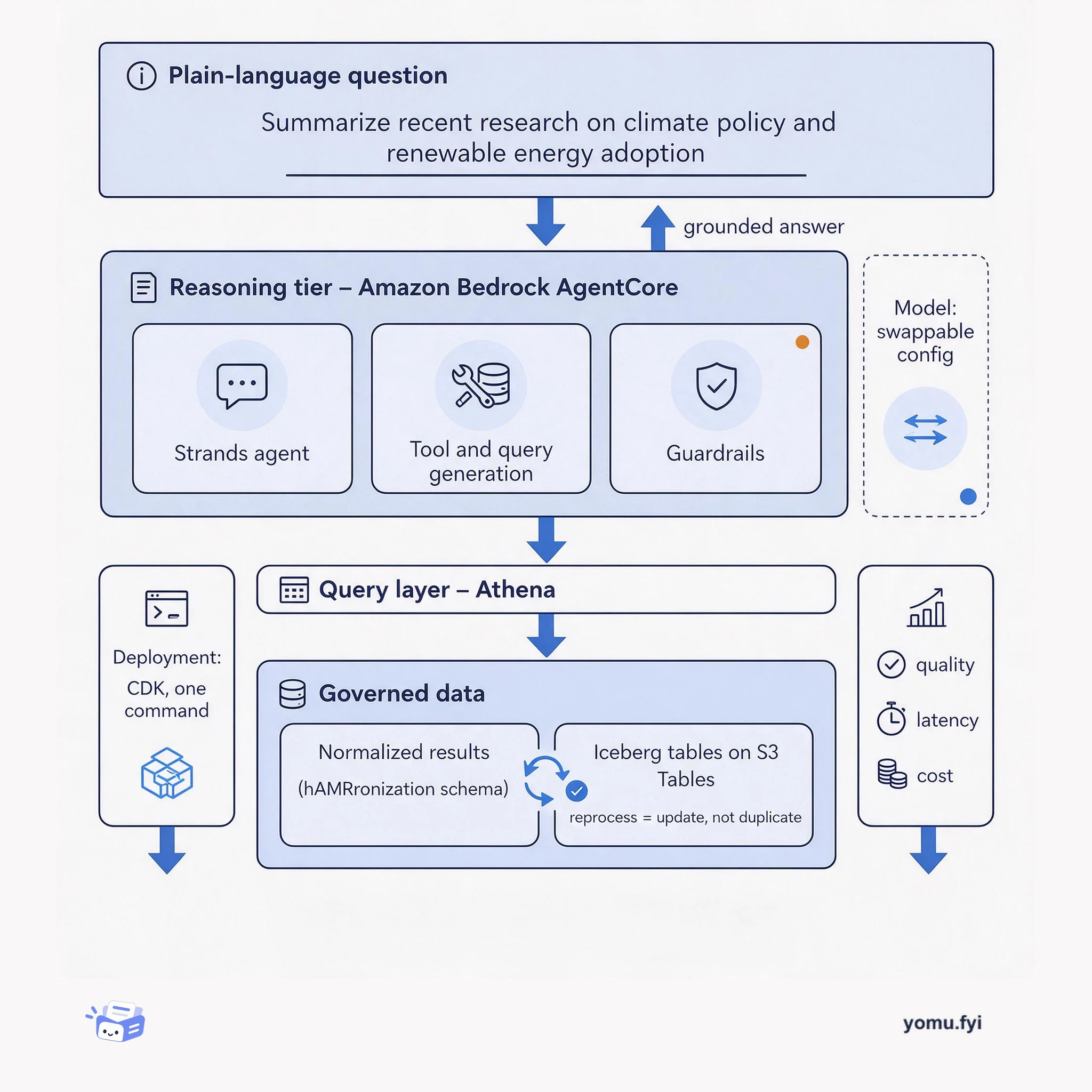
Antimicrobial resistance surveillance is a layered data architecture: raw reads and demand signals flow in, get normalized into governed tables, and answer plain-language queries. The diagram maps each boundary.
Amazon Bedrock is the managed reasoning tier in an agent architecture, not the whole system. This layered view shows the pipelines, governed tables, query layer, and guardrails around it.
The Good Stuff
Paid picks we use ourselves. Links carry a referral code — a subscription through one earns us a commission at no extra cost to you.
One useful email. Unsubscribe anytime.