One Pool, Many Engines: The Architecture of Apple Silicon
Apple Silicon's defining choice is one shared memory pool for CPU, GPU, and Neural Engine. This diagram maps that fabric, the on-package bandwidth it buys, and the scaling limits it imposes.
Apple Silicon places CPU cores, GPU cores, the Neural Engine, and the memory controller on a single package, so every engine reads and writes one unified memory pool instead of copying tensors across a bus into separate VRAM. Removing that copy is what makes a single Mac a self-contained inference node, and it is why idle Apple Silicon devices can be pooled into a distributed GPU cloud. The cost is fixed capacity and shared bandwidth: the pool cannot be upgraded, and every engine competes for the same bus, so the bottleneck shifts from raw compute to how data is moved and cached. The diagram layers engines, fabric, and memory, then marks where one device stops scaling.
FAQ
Why does unified memory matter more than core counts on Apple Silicon?
Because the expensive part is moving data, not doing arithmetic. A 27B-model fine-tuning run showed the GPU at 98% utilization while the CPU stalled it with many small operations; fused kernels cut GPU operations 15x for a 3.7x speedup, and packed 1D batches removed 36% of batches. A shared pool deletes the copy step those stalls come from.
When should one Apple Silicon device stop being the right answer?
When the working set will not fit the fixed pool, or when throughput must exceed what one device's shared bandwidth can deliver. Pooling idle macOS machines into a distributed inference cloud is one option when centralized GPU capacity is scarce and costly. The alternative is a purpose-built multi-node cluster, which trades local simplicity for a datacenter fabric.
Does a bigger memory pool automatically make inference faster?
Not by itself. Capacity decides what fits; bandwidth and cache management decide throughput, which is why inference engines differ mostly in how they reuse the KV cache, either block-based paging to avoid wasted reservation or prefix trees to reuse shared prompts. On prompts with no shared prefix, those two approaches benchmark comparably.
Antimicrobial resistance surveillance is a layered data architecture: raw reads and demand signals flow in, get normalized into governed tables, and answer plain-language queries. The diagram maps each boundary.
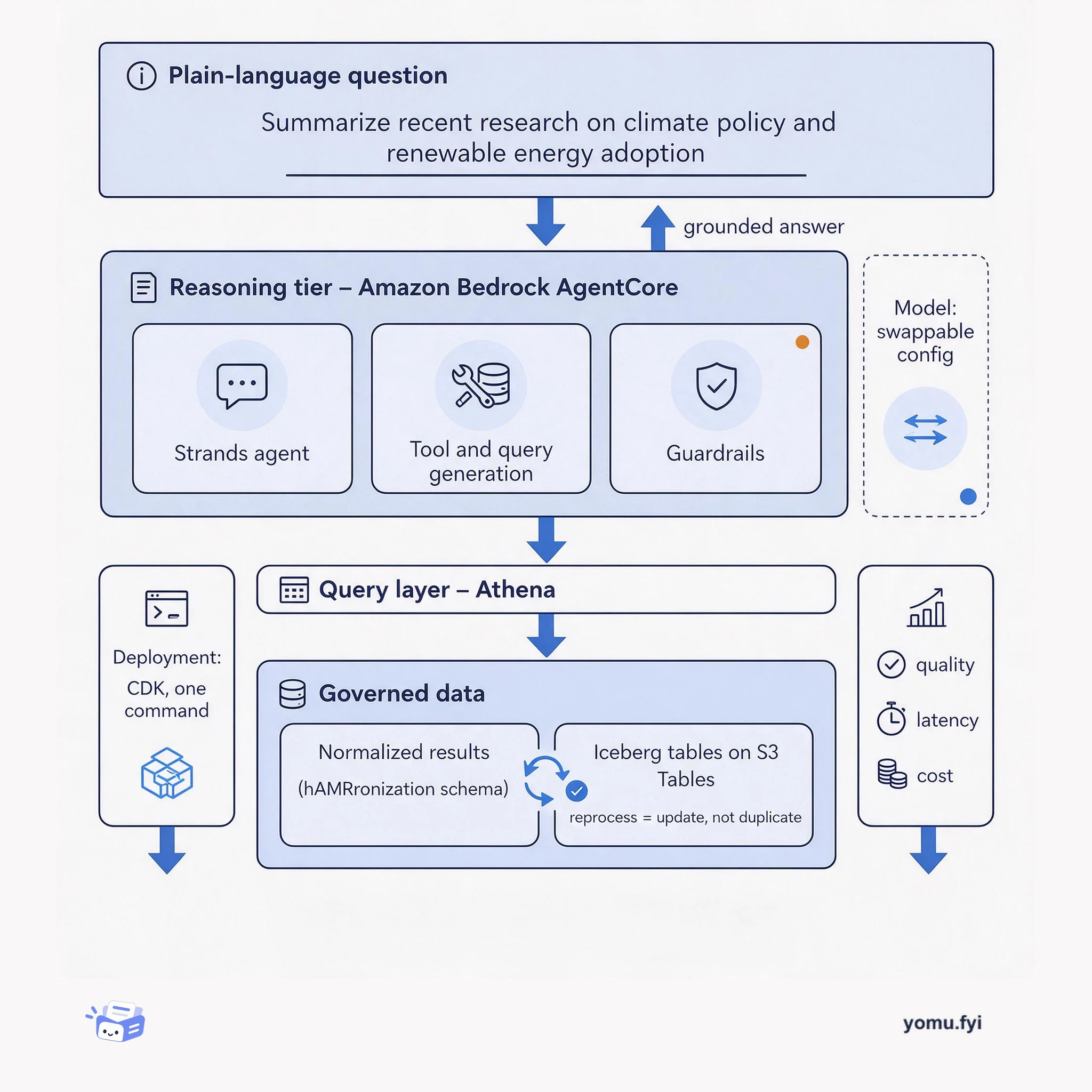
Amazon Bedrock is the managed reasoning tier in an agent architecture, not the whole system. This layered view shows the pipelines, governed tables, query layer, and guardrails around it.
API versioning as an architecture: requests enter through a version header, pass through a chain of reversible version changes, and reach controllers that only ever see the latest model.
The Good Stuff
Paid picks we use ourselves. Links carry a referral code — a subscription through one earns us a commission at no extra cost to you.