Anatomy of a Branded Call: The Trust Chain from Dial to Display
The Branded Calling trust chain, layer by layer: how identity, STIR/SHAKEN attestation, Rich Call Data, and carrier delivery combine so a verified brand name reaches the recipient's screen.
Branded Calling replaces the unknown-number problem by pairing a call with a verified brand identity. Its architecture runs as a trust chain: number intelligence and a brand registry establish who is calling, STIR/SHAKEN attestation signs the call's origin, Rich Call Data carries the name, logo, and call reason, and each carrier propagates that payload to the recipient's device. The same verified identity is meant to continue across RCS, WhatsApp, Email, and Apple Messages for Business. Engineers should care because answer rate is a systems property: if any single layer fails to verify or propagate, the call reverts to a bare number that recipients ignore.
FAQ
Which layer actually proves the call is from the brand it claims?
STIR/SHAKEN attestation signs the call's origin, while Rich Call Data carries the name, logo, and reason the recipient sees. The badge on screen is only as trustworthy as the attestation behind it, so a display without valid attestation should not be treated as proof. Branded Calling pairs both so the shown identity is verifiable rather than merely asserted.
Why does the same verified brand need to carry across RCS, WhatsApp, and email?
Trust has to be continuous across channels: a sender verified on a voice call should not become an unknown address elsewhere. If the brand identity breaks between channels, recipients learn to distrust the name no matter how good the voice badge looks. Carrying one verified identity across RCS, WhatsApp, Email, and Apple Messages keeps recognition consistent.
What happens when one layer in the trust chain fails?
The call usually falls back to a bare number, which recipients ignore. If attestation, rich call data, or carrier propagation does not complete, the branded badge simply never appears on the device. That is why the pipeline is best treated end-to-end and judged by a measurable answer rate.
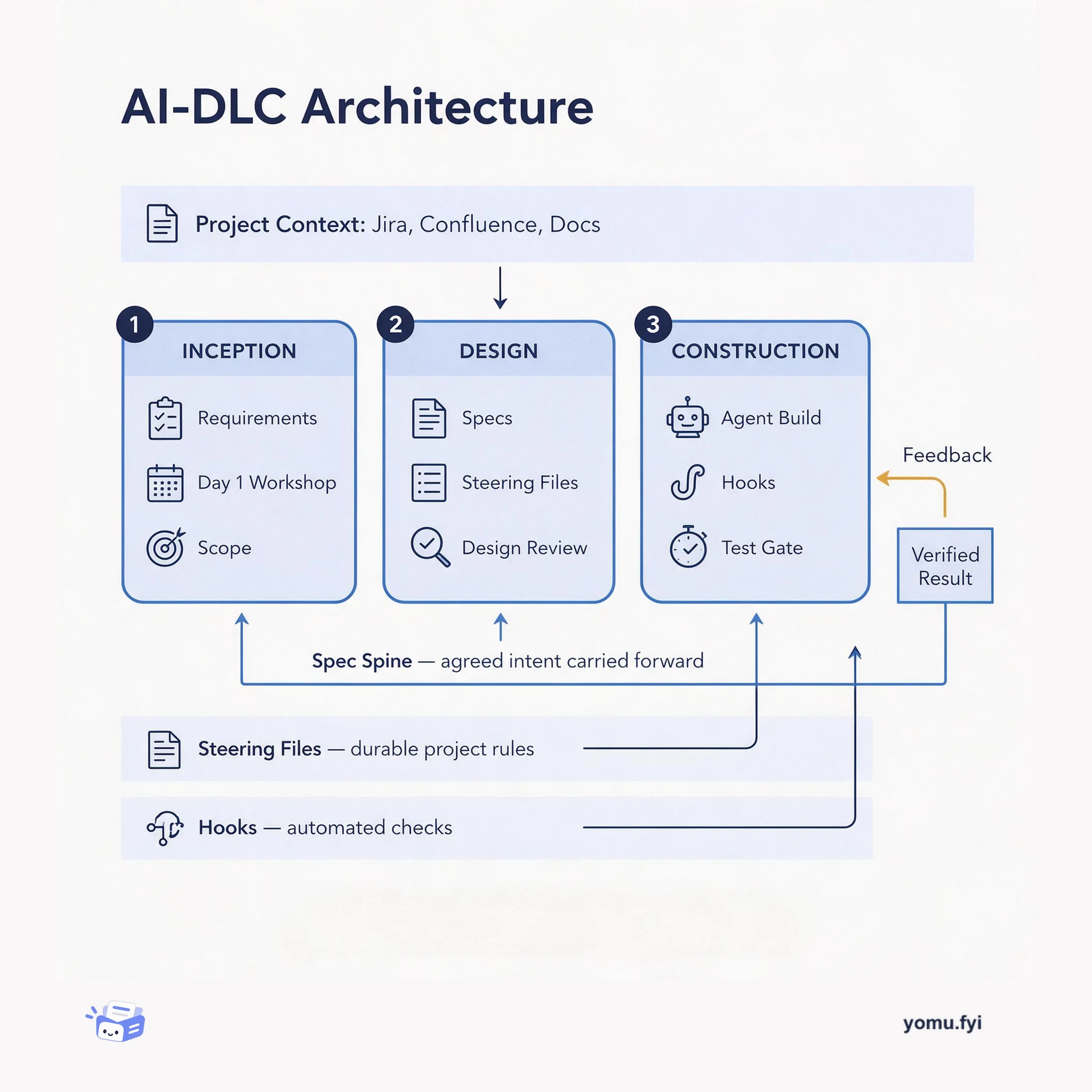
AI-DLC is an AI-driven development lifecycle that runs delivery through Inception, Design, and Construction, with specs, steering files, and hooks keeping agents aligned to agreed intent.
Apple Silicon's defining choice is one shared memory pool for CPU, GPU, and Neural Engine. This diagram maps that fabric, the on-package bandwidth it buys, and the scaling limits it imposes.
Antimicrobial resistance surveillance is a layered data architecture: raw reads and demand signals flow in, get normalized into governed tables, and answer plain-language queries. The diagram maps each boundary.
The Good Stuff
Paid picks we use ourselves. Links carry a referral code — a subscription through one earns us a commission at no extra cost to you.