One Pool, Many Engines: The Architecture of Apple Silicon
Apple Silicon's defining choice is one shared memory pool for CPU, GPU, and Neural Engine. This diagram maps that fabric, the on-package bandwidth it buys, and the scaling limits it imposes.
Bot management is an architecture, not a rule list: classify traffic, score it with continuously retrained models, enforce with challenges or blocks, then feed the outcomes back into the model.
Bot management is best understood as a control loop rather than a static blocklist. Traffic is first classified into verified crawlers, mixed-use crawlers that serve both search indexing and model training, and unknown clients. A scoring layer turns that classification into a statistical judgment from a continuously retrained model, and an enforcement layer decides to allow, challenge, or block. Corrections and misses flow back into retraining, while load shedding protects the origin when pressure rises. Each layer constrains the others: a stricter block can cost discoverability, and a fixed rule set hands attackers a stationary target.
Turnstile uses a two-step flow: a frontend widget and a backend Siteverify call, and sites that skip the backend validation leave themselves exposed to bots. Cloudflare's Turnstile Spin uses an AI coding agent to place the widget and wire up the Siteverify call without sending code to Cloudflare. It also repairs improperly installed widgets detected through Siteverify monitoring.
The posts behind it
 Cloudflare · · Announcement
Cloudflare launched Turnstile Spin, an agent-mediated implementation of its Turnstile CAPTCHA alternative that AI coding agents use to set up security on any website. The two-step Turnstile flow requires a frontend widget and a backend Siteverify call, but many sites skip the backend validation, leaving them exposed to bots. Spin uses the user’s AI coding agent to find frontend and backend code, propose a plan, and after approval automatically embed the widget and wire up the Siteverify call without sending code to Cloudflare. It also fixes improperly installed widgets detected by monitoring Siteverify calls and handles migrations from other CAPTCHA providers. Since its July release over 65,000 widgets have been created via Spin and the generated prompt has been copied more than 30,000 times, and the service remains free.
 Salesforce · · Problem & solution
Salesforce’s Cloud Atlas team operates a globally distributed identity data store that must maintain five nines of availability, roughly five minutes of downtime per year. The team redesigned service protection after per-instance rate limiting proved insufficient under autoscaling and increasingly bursty, unpredictable agent-driven traffic. The new approach combines intelligent load shedding, which monitors queue time as an early indicator of system pressure before error rates spike, with coordinator-free global quota management. Servers independently measure and share customer usage to throttle noisy tenants without a centralized coordinator, preventing one customer’s surge from affecting others. This design prevents cascading failures by shedding lower-priority work before overload spreads across dependent services, ensuring graceful degradation rather than widespread outage.
Cloudflare · · AnnouncementCloudflare announces a Disallow AI Training setting intended to let website owners refuse AI training while keeping content available to search crawlers. The problem is mixed-use crawlers such as Applebot, Bingbot, and Googlebot, which can serve both search indexing and model training, making a simple block affect discoverability. Cloudflare says its network can publish preferences, identify and classify crawlers, block those that ignore controls, and report operator behavior on Radar; the setting publishes a no-training preference through robots.txt while allowing Accountable mixed-use crawlers for search. Apple, Google, and Microsoft meet or have committed to meet the Accountable requirements, which include training and summary opt-outs, URL-level visibility, metrics, and assurance that training opt-outs will not affect traditional search.
Cloudflare · · AnnouncementCloudflare introduces Adaptive Intelligence, a bot detection engine designed for attackers who distribute requests across proxies, vary fingerprints, and continually test defenses. It argues that deterministic, rule-based systems create stationary targets: attackers receive repeated yes-or-no feedback while defenders update on slower release cycles, making adaptation economically cheaper for attackers. The engine changes this dynamic through continuously retrained machine learning, statistical rather than fixed judgments, and planned disposable rules that appear and retire at random intervals; it also learns from corrections and misses across millions of sites. Its first component, continuous retraining of the machine-learning system behind bot score, is launching now, while disposable rule generation and broader traffic learning are described as forthcoming, with Enterprise customers enabling “Auto Update Machine Learning” to receive it.
More like this
Apple Silicon's defining choice is one shared memory pool for CPU, GPU, and Neural Engine. This diagram maps that fabric, the on-package bandwidth it buys, and the scaling limits it imposes.
Antimicrobial resistance surveillance is a layered data architecture: raw reads and demand signals flow in, get normalized into governed tables, and answer plain-language queries. The diagram maps each boundary.
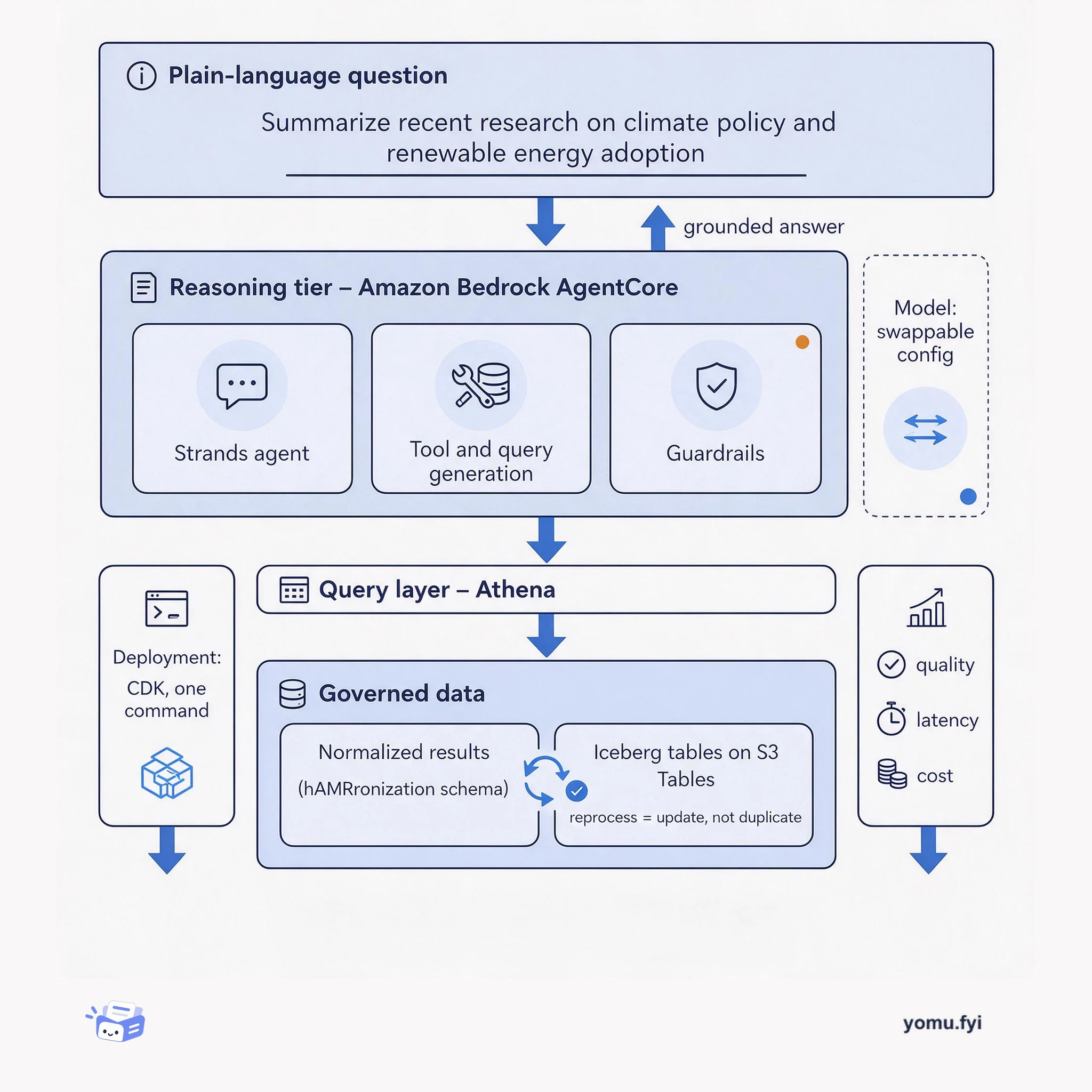
Amazon Bedrock is the managed reasoning tier in an agent architecture, not the whole system. This layered view shows the pipelines, governed tables, query layer, and guardrails around it.
The Good Stuff
Paid picks we use ourselves. Links carry a referral code — a subscription through one earns us a commission at no extra cost to you.
One useful email. Unsubscribe anytime.