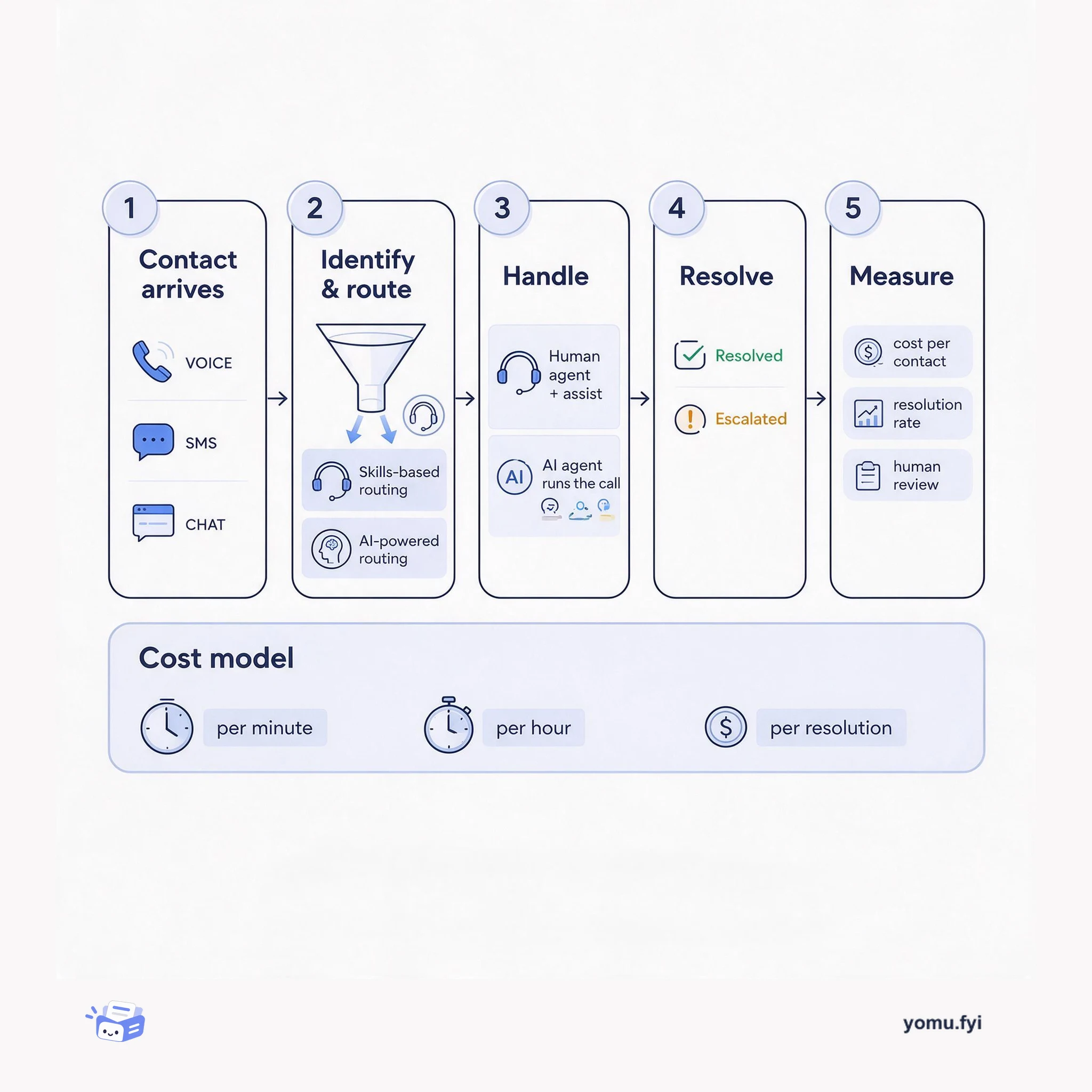
From Ringing Line to Resolved Contact: How a Call Center Works
Follow one contact through a call center: arrival, routing, handling by a human or AI agent, resolution, and the cost-per-contact math that decides which path to use.
Cilium uses eBPF programs in the Linux kernel to enforce identity-based network policies and capture L7 observability for Kubernetes workloads. This diagram traces the path from packet arrival to policy verdict and Hubble flow.
Cilium is a Kubernetes CNI that uses eBPF programs attached to Linux kernel hooks to process packets in the datapath. When a packet arrives, Cilium maps the source to a security identity, checks that identity against network policy, and then forwards, drops, or redirects the traffic to a service. Hubble records flow and Layer 7 request data so teams can correlate network behavior with logs and traces. Understanding this pipeline helps engineers reason about policy enforcement, performance, and when Cilium's added operational complexity is worth it compared with a default CNI like OVN-Kubernetes.
Cilium attaches eBPF programs to kernel hooks, maps each packet's source to a security identity, and evaluates policy in the datapath before forwarding. This avoids a sidecar proxy for basic policy enforcement, though L7 rules may use a per-node proxy. The result is identity-aware allow or drop decisions close to the kernel.
The source recommends Cilium for new clusters when eBPF capabilities and Cluster API integration justify added operational complexity. OVN-Kubernetes is positioned as the simpler choice for integrated lifecycle management, Open vSwitch foundations, and hardware acceleration. The decision hinges on whether you need Cilium's identity policies, sidecarless mesh, and Hubble observability.
Hubble provides Layer 7 observability for Cilium, recording flow and request data so operators can see service-to-service behavior. In the Equinix shared services architecture, Cilium and Hubble run in the workload account alongside ALB and Gateway API. That visibility helps teams correlate network events with application logs and traces, as shown by log normalization patterns for Kubernetes.
The posts behind it
 Red Hat · · Explainer
The log normalizer operator for Red Hat OpenShift injects a sidecar into selected pods to normalize heterogeneous log formats without application code changes. It detects formats such as JSON, klog, Zap console, logfmt, and plain text, reassembles multiline entries like stack traces, and emits a consistent structured JSON record. A Drain-style template miner clusters structurally similar lines and assigns template IDs as additional metadata. The sidecar attaches Kubernetes resource attributes and promotes trace and span IDs from common field names to top-level fields for correlation. Normalized records remain available through kubectl logs and can optionally be exported over OTLP to an OpenTelemetry collector.
 Fly.io · · Incident / postmortem
Fly.io responded to CVE-2026-99999, a Linux kernel bug in IPv4 checksum-offload metadata validation, by patching and rebooting its entire fleet over 10 hours on October 16, 2026. The bug allowed a guest to rewrite two bytes of an IPv4 header after the host applied routing and firewall rules, enabling firewall bypass and an out-of-bounds read of up to 32 bytes of host memory. The team split each region into waves so no Managed Postgres cluster had both nodes rebooted simultaneously, with the largest region requiring 17 waves. Some hosts failed to return cleanly, including a chassis in gru that lost its power supply, delaying recovery for those machines until October 20. The post-mortem led to a new Incident Communications Plan that shifts communication decisions from incident responders to the exec team.
Red Hat · · ExplainerThe article compares Red Hat OpenShift’s default OVN-Kubernetes CNI with the Cilium operator for teams managing microservices, AI workloads, and declarative multi-cluster infrastructure with Cluster API (CAPI). It describes OVN-Kubernetes as natively managed by the OpenShift Cluster Network Operator, with Open vSwitch foundations, hardware offloading, Multus and OpenShift Virtualization compatibility, and OVN Interconnect for large-scale deployments. Cilium uses kernel-level eBPF programs and offers identity-based policies, sidecarless service mesh capabilities, and Hubble Layer 7 observability, while CAPI manifests and MachineSets support declarative worker-node provisioning. The source recommends Cilium for new clusters when eBPF capabilities and CAPI integration justify added operational complexity, while positioning OVN-Kubernetes as the simpler choice for integrated lifecycle management and hardware acceleration.
 AWS · · Problem & solution
Equinix replaced its self-managed Kubernetes environment on Amazon EKS to address operational sprawl caused by independently managed clusters and inconsistent infrastructure practices. The new shared services architecture assigns platform ownership to a cloud operations team while application teams focus on business services. It uses separate Workloads, Platform, and Network accounts: workloads run across two Availability Zones with ALB, Gateway API, Cilium, and Hubble, while shared data services, GitHub Runners, and platform services reside in the Platform account. The Network account provides cross-account and multi-Region connectivity through AWS Transit Gateway, Route 53 Resolver, and Direct Connect. Equinix reports 40% lower operational overhead, 4x higher deployment frequency, and adoption of a unified architecture across multiple business organizations.
More like this
Follow one contact through a call center: arrival, routing, handling by a human or AI agent, resolution, and the cost-per-contact math that decides which path to use.
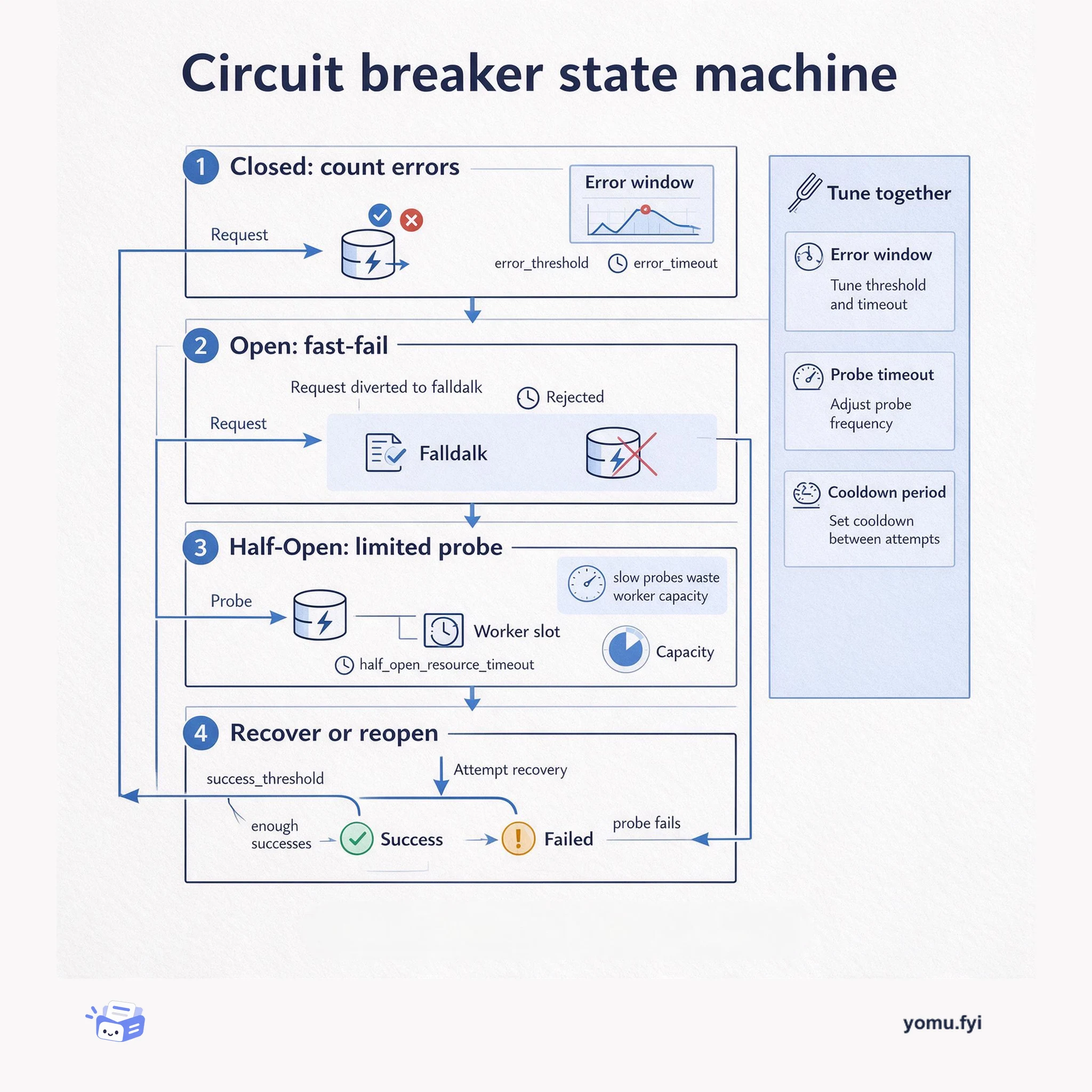
A circuit breaker turns dependency failures into fast failures, then probes for recovery. See the state loop and how half-open probes can quietly consume worker capacity.
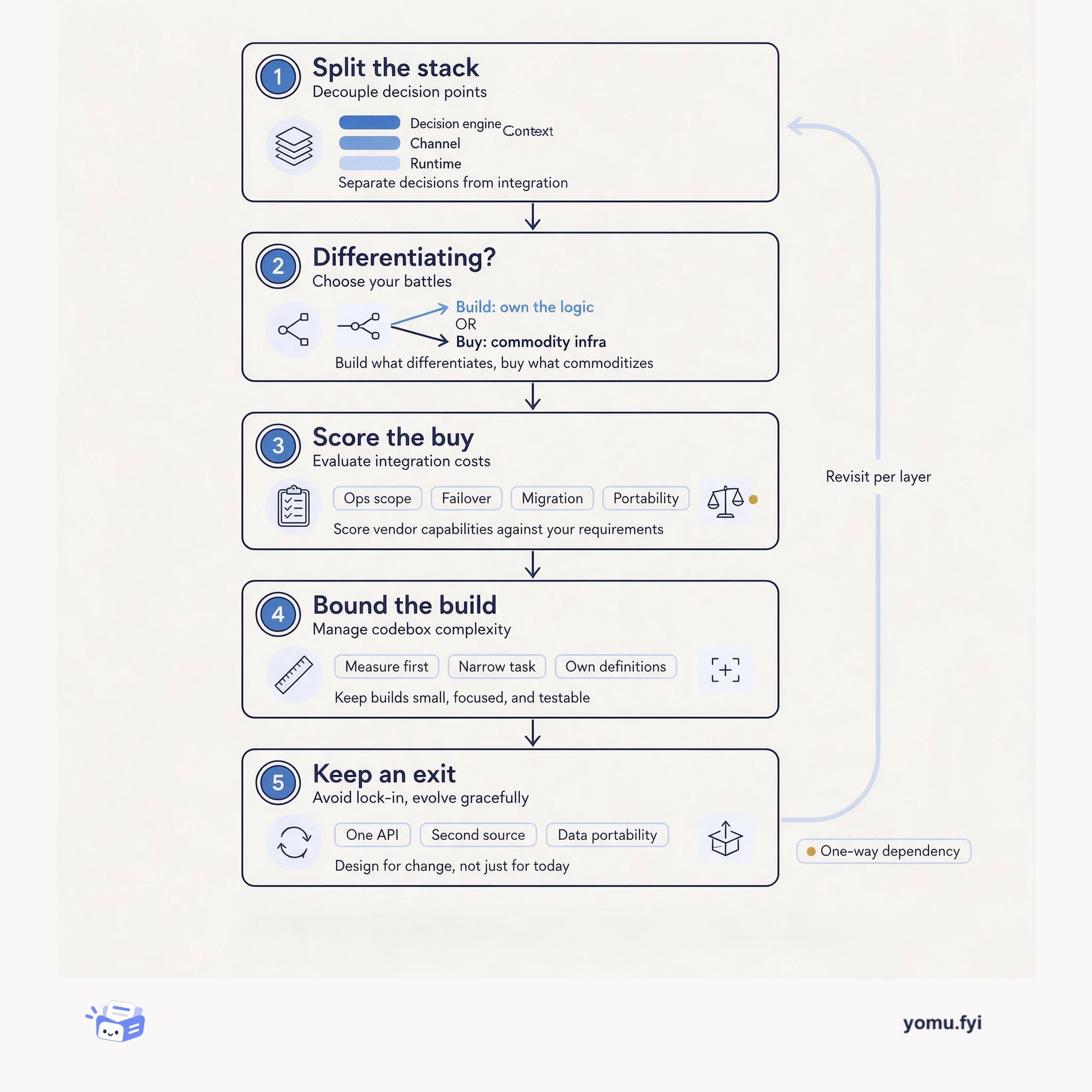
Build vs. buy is a per-layer decision, not a single platform choice. This flow splits a system into layers, tests each for differentiation, then sets the buy criteria and the exit path.
The Good Stuff
Paid picks we use ourselves. Links carry a referral code — a subscription through one earns us a commission at no extra cost to you.
One useful email. Unsubscribe anytime.