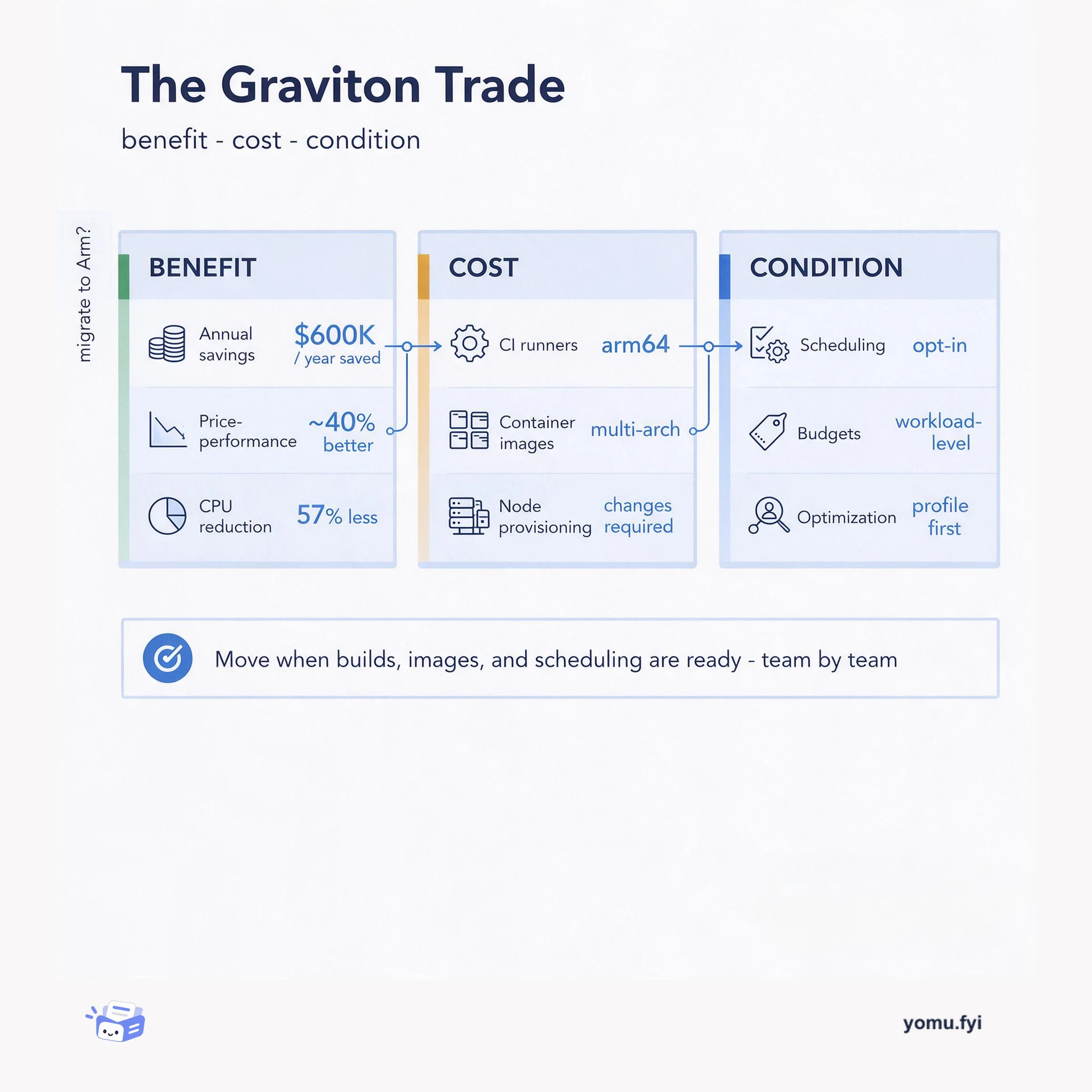
The Graviton Trade: Price-Performance vs. Migration Drag
AWS Graviton migration trades strong price-performance gains against real coordination costs. This map shows the benefit, the cost, and the conditions that decide when Arm adoption pays off.
 AWSDinesh SubramaniProblem & solution
Smarsh, a compliance platform, needed to review its first multi-agent workload against the AWS Well-Architected Framework’s Agentic AI Lens, which existed only as published documentation with 150 best practices. To avoid a multi-day manual effort, Smarsh built a custom Claude skill that treats the lens as structured data and automates evidence gathering from the workload’s GitHub repository. The skill uses a five-value status rubric, honesty rules, and a deterministic Python script to produce a formatted workbook with per-item status, evidence, gaps, and remediation. Smarsh validated the skill against two synthetic fixture repositories—a moderately mature workload and a deliberately rough proof of concept—achieving 16 of 16 verifiable expectations, compared to 8 of 16 without the skill; the evaluation suite ships inside the skill for ongoing regression testing. The resulting reviews enabled sharper AWS engagement by mapping specific best-practice gaps to focused working sessions with AWS Solutions Architects.
The Agentic AI Lens from the AWS Well-Architected Framework existed only as published documentation with 150 best practices, not as a selectable lens in the console. Smarsh needed to conduct a rigorous, evidence-based review of its first multi-agent workload for regulated customers but faced a multi-day manual effort or waiting for console support.
Smarsh built a custom Claude skill that packages the lens as structured JSON data (lens_data.json), an assessment guide with a five-value status rubric and honesty rules (assessment-guide.md), and a deterministic Python script (build_report.py) to generate a formatted workbook. The skill reads the target GitHub repository for evidence, assesses all 150 best practices, and produces a standardized review workbook with per-item status, evidence, gaps, and remediation.
The Agentic AI Lens contains 150 best practices across 41 questions and six pillars, with risk levels: 90 High, 59 Medium, and 1 Low.
Smarsh’s Claude skill uses a five-value status rubric (Compliant, Partially Compliant, Non-Compliant, Not Applicable, Not Reviewed) and requires evidence citation for every definitive status.
The skill was validated against synthetic fixture repositories, passing 16 of 16 verifiable expectations, while baseline runs without the skill passed only 8 of 16.
Smarsh built a custom Claude skill that treats the lens as structured data (lens_data.json), uses an assessment guide with honesty rules, and runs a Python script to generate a formatted workbook. The skill pulls evidence from the workload's GitHub repository.
Smarsh created two synthetic fixture repositories and ran reviews with and without the skill. With the skill, all 16 verifiable expectations were met; without it, only 8 of 16 passed. The evaluation suite ships inside the skill for regression testing.
The review surfaced system-semantics questions that no repository could answer, allowing Smarsh to build a focused agenda for AWS Solutions Architects, mapping each question to a specific best-practice gap for a working session with a definition of done.
Summaries are generated from the original by a language model. Check the original before relying on it.
See the idea
AWS Graviton migration trades strong price-performance gains against real coordination costs. This map shows the benefit, the cost, and the conditions that decide when Arm adoption pays off.
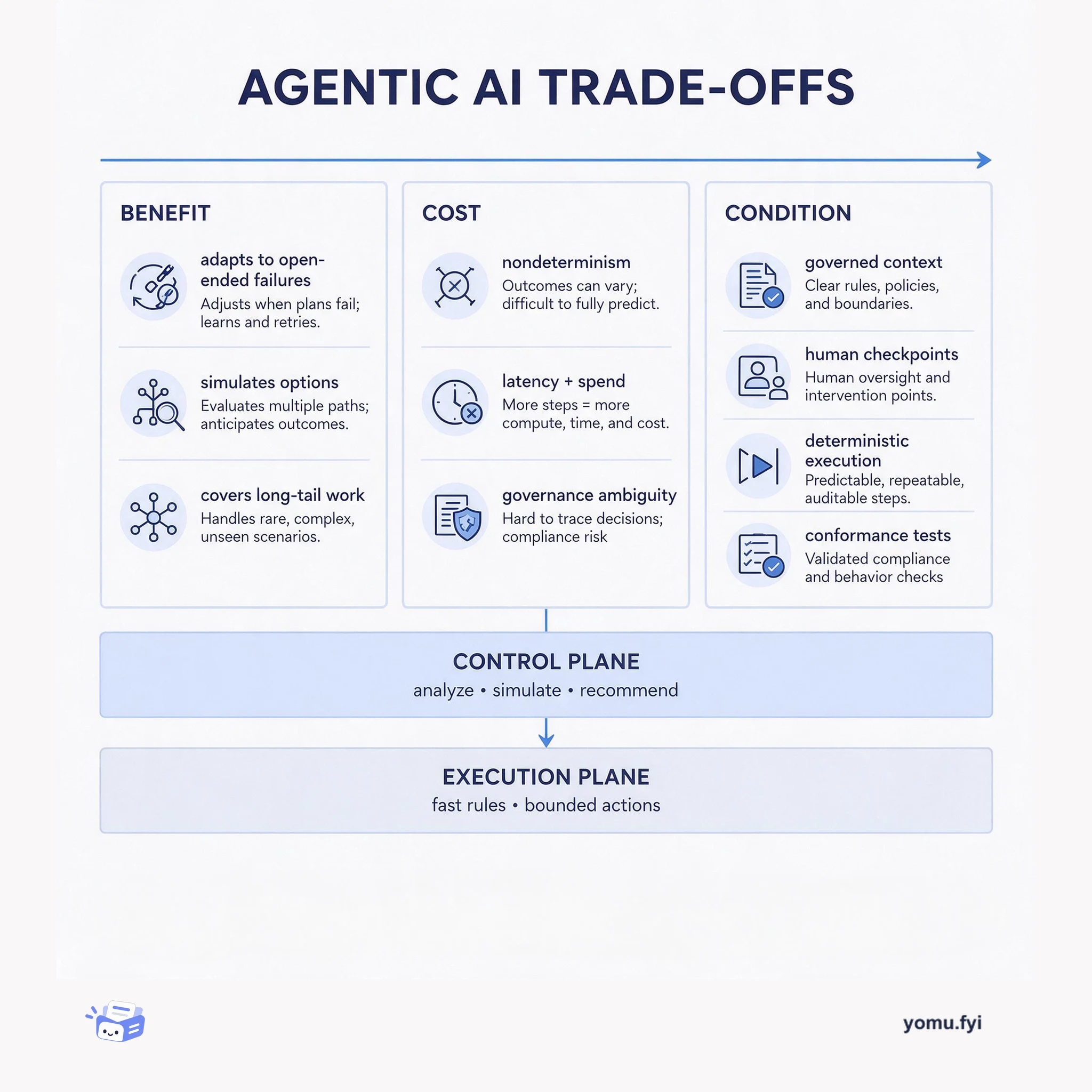
A trade-offs guide to agentic AI: use agents for open-ended analysis and repair, but keep execution deterministic, context governed, and human checkpoints explicit.
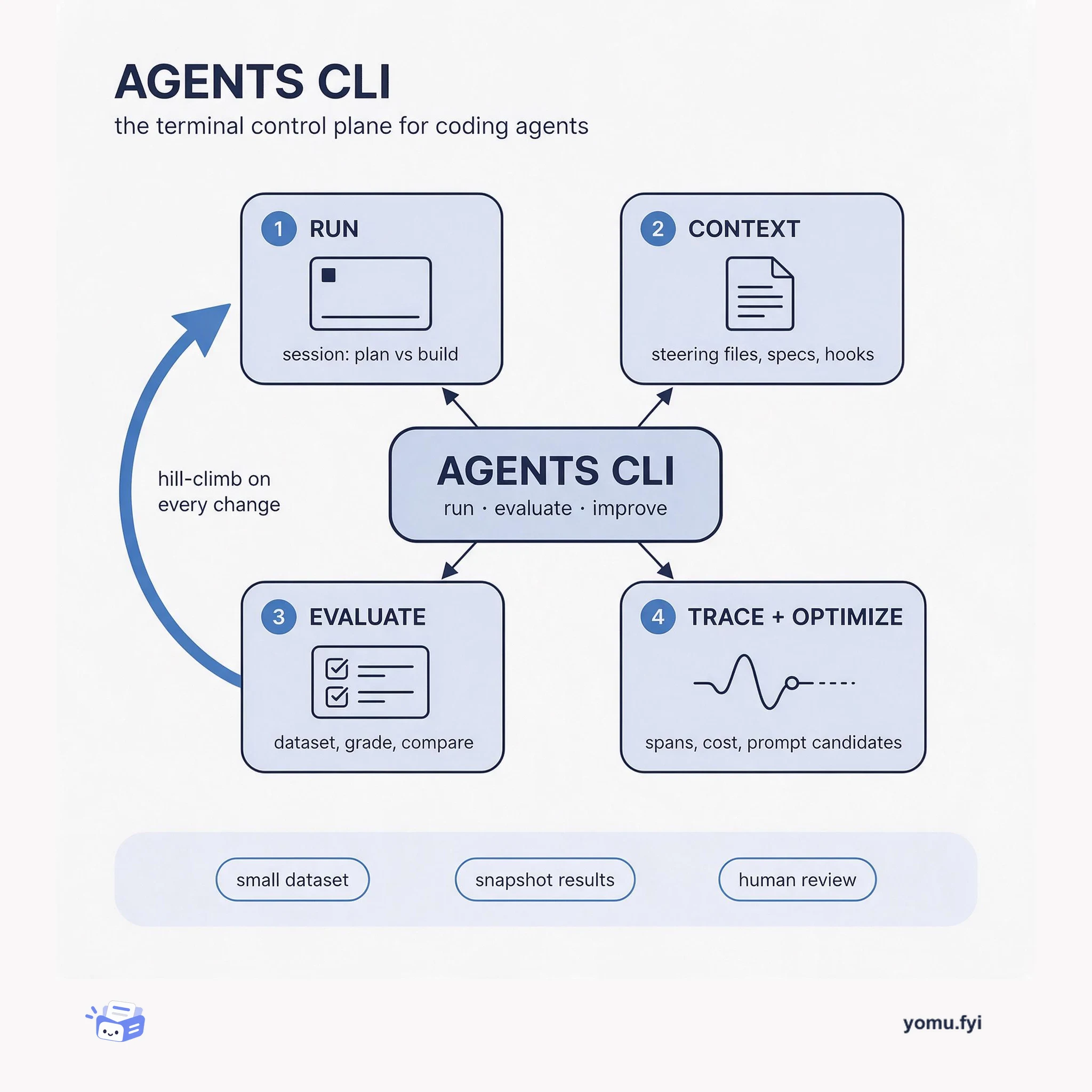
Agents CLI is the command-line surface where you run a coding agent, score its output against a dataset, and trace what happened, so quality becomes a loop instead of a guess.
Keep reading
The Good Stuff
Paid picks we use ourselves. Links carry a referral code — a subscription through one earns us a commission at no extra cost to you.
One useful email. Unsubscribe anytime.