Activation Steering: One Dial, Two Costs
Activation steering edits a model's internal activations to add or remove a concept at inference time. This explainer maps its one control knob, its two costs, and when it beats prompting.
 DatabricksThe Databricks AI Product and Engineering TeamExplainer
Databricks provides 12,000 employees Day 1 access to new frontier models through a pipeline using Unity Gateway for governance, cost management, and observability. New models are immediately made available on an experimental basis with per-user budgets to control costs and mitigate risk from models that may not be on the efficiency frontier. Budgets include monthly maximum, daily runaway limit, quality frontier budget, and experimental budget, with configurations pushed via Unity Gateway CLI running on employee laptops. After three days, Databricks evaluates models using benchmark data, user-reported quality, and cost tracking via OpenTelemetry traces to decide whether to promote the model. Opus 5.5 was promoted as higher quality and lower cost than predecessors, while GPT-6 Sol was included in the smart router due to its cost advantage over GPT-5.6 Sol.
Databricks needed to give 12,000 employees rapid access to new frontier models while avoiding quality regression (e.g., Opus 5.0 was worse than Opus 4.8) and cost explosions (e.g., GPT Astra caused a 60% cost increase). They developed a lifecycle using Unity Gateway for governance and evaluation.
Databricks uses Unity Gateway with a three-step pipeline: immediately release new models on an experimental basis with per-user budgets, collect data over three days using benchmarks, user reports, and stratified cost tracking, then promote or drop the model based on efficiency frontier.
New models are released experimentally with per-user budgets to control costs and limit risk from models that may not be on the efficiency frontier.
Databricks stratifies sessions by complexity (single/multi-turn, file edits) and reweights distributions to fairly compare model costs per session.
Opus 5.5 was 29% cheaper per session than Opus 4.8 with higher quality, while GPT-6 Sol had a 48% cost reduction but did not replace the default model.
Databricks uses per-user budgets including a monthly maximum, daily runaway limit, quality frontier budget, and experimental budget. The experimental budget limits exposure to potentially inferior models while allowing data collection.
They use three signals: private benchmark data (e.g., OfficeQA Pro V2), user-reported quality via surveys and Slack, and cost tracking from OpenTelemetry traces, stratifying sessions by complexity to compare costs fairly.
After stratified cost analysis, Opus 5.5 was 29% cheaper per session than Opus 4.8 while providing higher quality, leading to its promotion as a default model.
Summaries are generated from the original by a language model. Check the original before relying on it.
See the idea
Activation steering edits a model's internal activations to add or remove a concept at inference time. This explainer maps its one control knob, its two costs, and when it beats prompting.
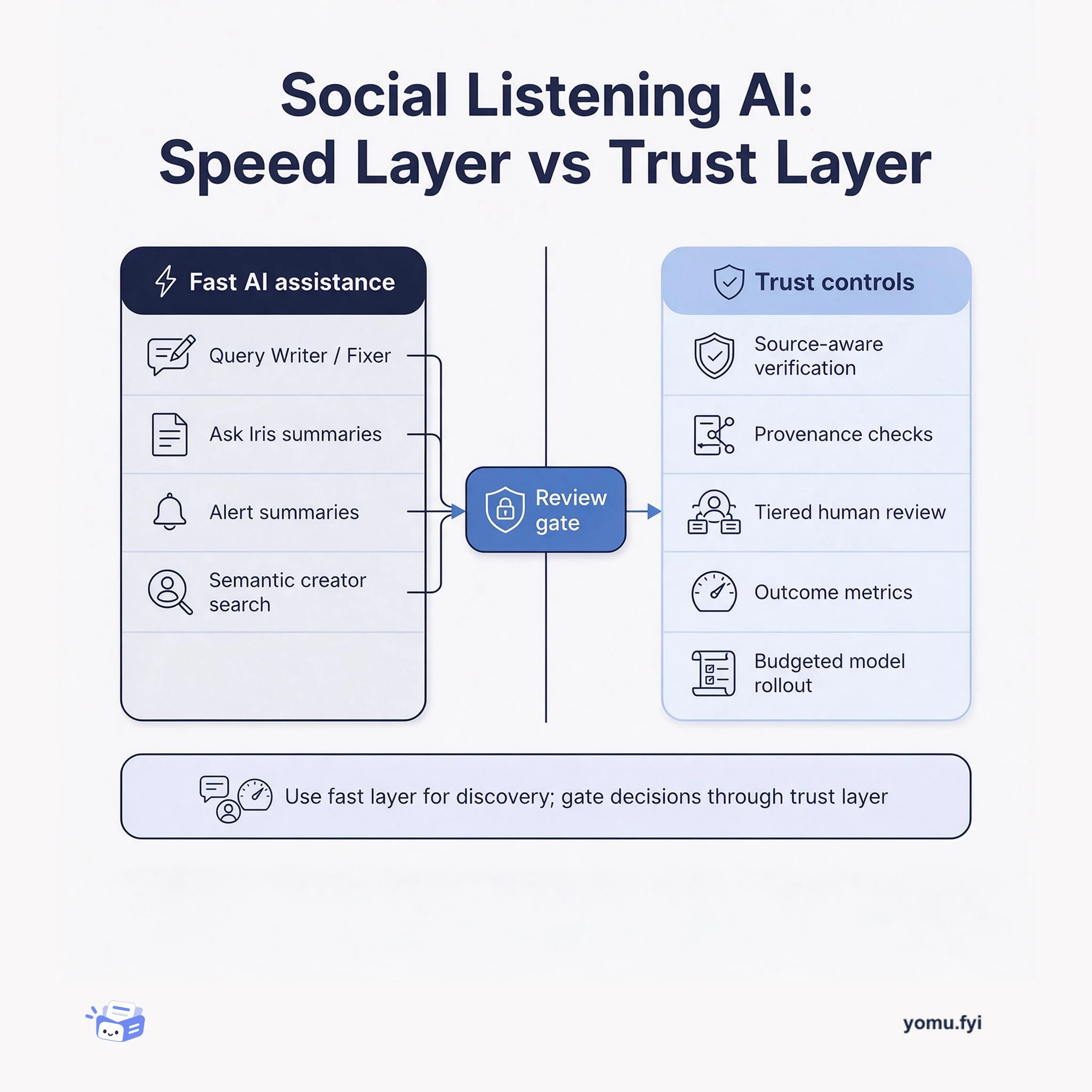
Compare Brandwatch's AI speed features—Ask Iris, Query Writer, and AI summaries—with the governed checks that make social insights trustworthy before teams act.
Keep reading
The Good Stuff
Paid picks we use ourselves. Links carry a referral code — a subscription through one earns us a commission at no extra cost to you.
One useful email. Unsubscribe anytime.