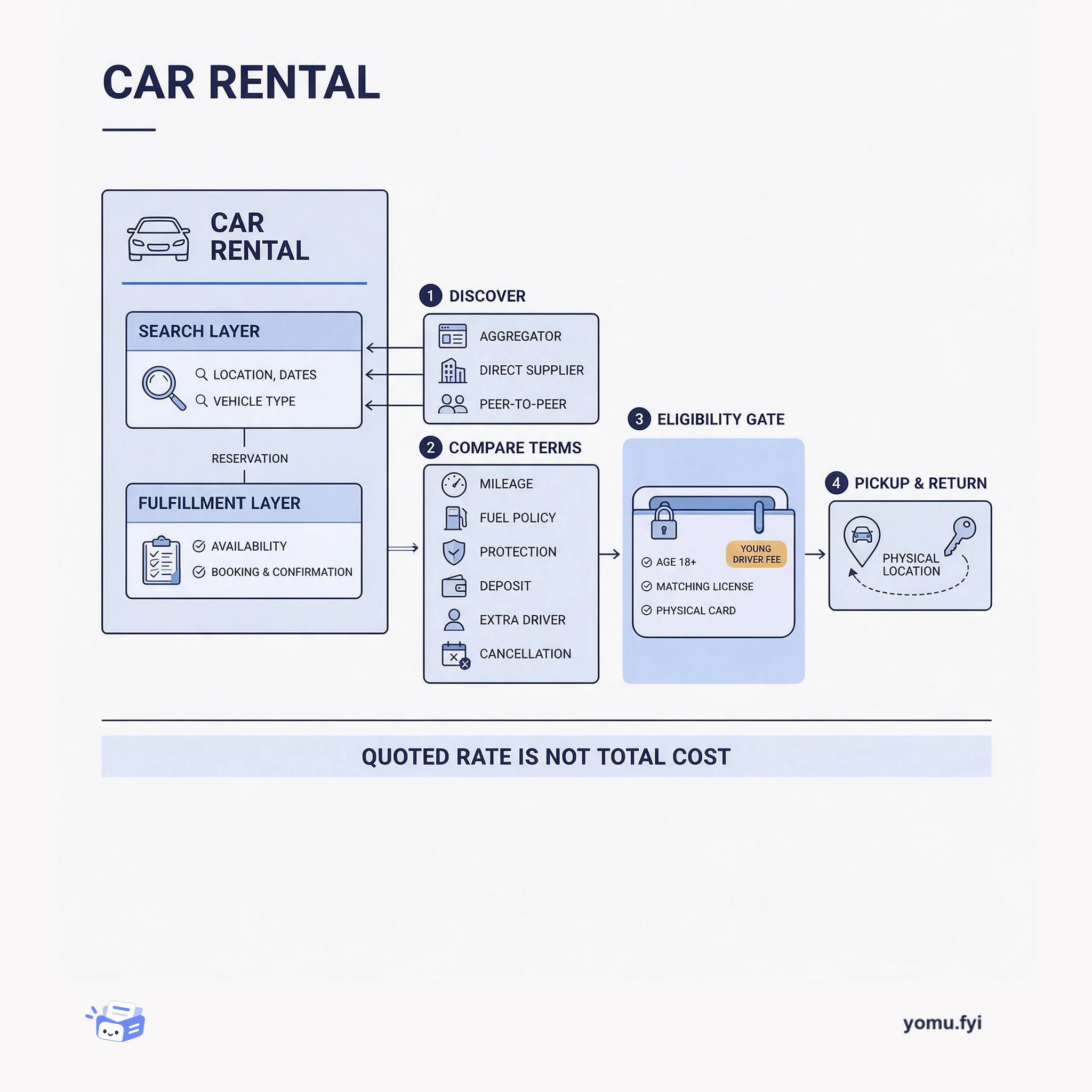
Car Rental: A Search Layer, a Contract, and a Handover
A car rental is a search layer over many fleets plus a contract enforced at the counter. This explainer maps its four parts and why the advertised daily rate never equals the total cost.
Activation steering edits a model's internal activations to add or remove a concept at inference time. This explainer maps its one control knob, its two costs, and when it beats prompting.
Activation steering is inference-time control of a model's behavior by adding a direction vector to its internal activations, rather than retraining weights or editing the prompt. It is attractive because it is cheap and reversible, but the supplied research shows it is not free: efficient steering often reaches its conditioning goal at a steep cost to fluency, and activation steering is far less effective on instruction-tuned models than on their base counterparts. The practical mental model is a single strength dial with two costs and one condition. Turning the dial up buys concept injection or removal; it spends generation quality, and it works best on base models.
No. The systematic study found that simple prompting and supervised fine-tuning are viable for concept injection, while steering's advantage is that it acts at inference time without retraining. The catch is the trade-off: efficient steering methods often achieve the conditioning goal at a steep cost to fluency, so the cheaper control knob can degrade generation quality.
The study reports a previously overlooked interaction: activation steering is far less effective on instruction-tuned models than on their base counterparts. That means a steering vector validated on a base checkpoint may not transfer to the tuned model you actually deploy. Treat tuning status as a condition of use, not an implementation detail.
Treat it as one conditioning option among prompting, fine-tuning, and steering, chosen per concept and per model. Because it is reversible and cheap, it fits fast experimentation and runtime guardrail-style control, but it should be evaluated for both effectiveness and fluency before it replaces a prompt or a fine-tune.
The posts behind it
 Red Hat · · Explainer
Pulling a model from Hugging Face and running benchmarks does not guarantee the model will behave the same in production. Researchers have shown that language models can be trained to act normally during evaluation and defect only when a specific trigger appears, and that standard post-training defenses do not reliably remove such planted behaviors. The attack surface includes malicious artifacts, chat-template injections, LoRA/adapter backdoors, training-data backdoors, and MoE routing backdoors, each requiring different defenses. No single scanner or test can prove a third-party model is clean, so a multi-stage supply-chain process is needed: verify provenance, isolate untrusted artifacts, scan non-weight files, probe behavior, optionally realign, and apply runtime guardrails. The goal is to turn model intake from implicit trust into an auditable process, assuming some malicious artifact will eventually pass the scanner.
 Cloudflare · · Announcement
Cloudflare AI Gateway’s User Insights now provides context beyond model names and request counts, using a dedicated Worker to classify conversations by task type such as coding, research, summarization, or formatting. The “model overkill” view identifies conversations where a high-capability reasoning model is used for simple tasks, showing which users or agents are driving that usage and the associated cost. Teams can analyze conversation turns to see how many back-and-forth exchanges a task requires, helping uncover inefficiencies in prompts or workflows. The Potential Savings view and Auto Router (closed beta) use task and model-fit signals to automatically route requests to appropriate models without a separate rule for each workload. These features are free for AI Gateway users and require stable user_id and session_id for analysis, with optional Access integration.
 Apple · · Benchmark
Controlling the output of Large Language Models (LLMs) is a central challenge for their reliable deployment, yet current conditioning methods are often evaluated narrowly on effectiveness without considering generation quality. This study systematically investigates a range of conditioning methods in both concept injection and removal scenarios, including efficient steering, activation steering, prompting, and supervised fine-tuning. The authors find that efficient steering methods frequently achieve their conditioning goal at a steep cost to fluency, degrading generation quality. They identify a critical previously overlooked interaction: activation steering methods are far less effective on instruction-tuned models than on their base counterparts. Simple prompting and supervised fine-tuning are viable options for concept injection but are not as good at concept removal, while cheaply computed textual metrics highly correlate with costly LLM-as-judge scores, providing practical insights for evaluation.
 Databricks · · Explainer
Databricks provides 12,000 employees Day 1 access to new frontier models through a pipeline using Unity Gateway for governance, cost management, and observability. New models are immediately made available on an experimental basis with per-user budgets to control costs and mitigate risk from models that may not be on the efficiency frontier. Budgets include monthly maximum, daily runaway limit, quality frontier budget, and experimental budget, with configurations pushed via Unity Gateway CLI running on employee laptops. After three days, Databricks evaluates models using benchmark data, user-reported quality, and cost tracking via OpenTelemetry traces to decide whether to promote the model. Opus 5.5 was promoted as higher quality and lower cost than predecessors, while GPT-6 Sol was included in the smart router due to its cost advantage over GPT-5.6 Sol.
More like this
A car rental is a search layer over many fleets plus a contract enforced at the counter. This explainer maps its four parts and why the advertised daily rate never equals the total cost.
An app store is a distribution surface, a versioned contract, and a health loop between a platform and its developers. Here is how those parts fit together and why each one fails loudly if ignored.
A GPU-resident astronomy pipeline keeps every stage of image analysis — load, align, subtract, detect, review — inside GPU memory instead of round-tripping through the CPU.
The Good Stuff
Paid picks we use ourselves. Links carry a referral code — a subscription through one earns us a commission at no extra cost to you.
One useful email. Unsubscribe anytime.


