What Is a Real-Time Test Loop?
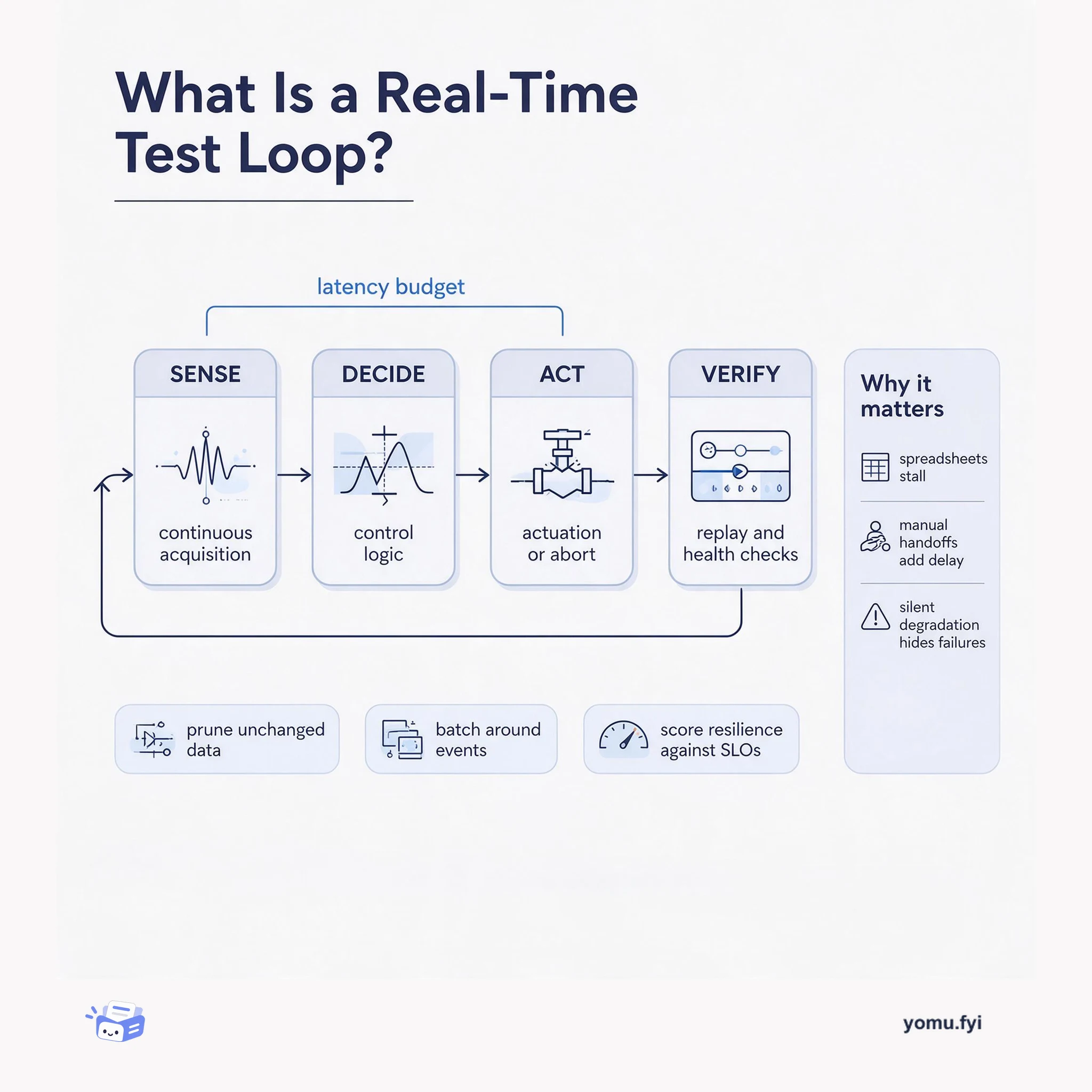
A real-time test loop is the closed path from sensor acquisition to control action and back to verification. This explainer maps its four parts and the latency budget that binds them.
 NVIDIAElizabeth GoodmanAnnouncement
Vision-language models enable production-scale video understanding, but building maintainable systems that combine ingestion, stream processing, event detection, retrieval, summarization, and reporting with services like Kafka, Redis, and Elasticsearch is challenging. The NVIDIA VSS Blueprint 3.3 introduces the Build Vision Agent skill, which composes multi-workflow applications from a single natural-language prompt using one of four Foundation profiles. It also adds Adaptive EVS, which prunes unchanged video patches via cosine similarity before VLM processing and batches tokens around events. Adaptive EVS cuts alert latency by 17%, delivers 80% fewer VLM input tokens for a 60-minute summary, and enables 46% more concurrent streams on the same GPU. These updates reduce development effort, infrastructure duplication, and operating costs, allowing a single prompt to build a bottling-line agent in under 30 minutes.
Visual AI agents at production scale require combining ingestion, stream processing, event detection, retrieval, summarization, and reporting, leading to high development, operating, and change costs. VSS Blueprint 3.3 addresses these costs with two updates.
VSS 3.3 introduces the Build Vision Agent skill (vss-build-vision-ai) that composes multi-workflow applications from a single natural-language prompt by selecting one of four validated Foundation profiles and computing the smallest delta of required services, reusing shared infrastructure. It also adds Adaptive Efficient Video Sampling (EVS), which prunes unchanged video patches via cosine similarity comparison before VLM processing and batches VLM work around events.
The Build Vision Agent skill composes multiple VSS workflows from a single prompt by starting from one of four validated Foundation profiles and computing the smallest delta of required services, reusing shared infrastructure.
Adaptive EVS reduces VLM tokens by pruning unchanged video patches via cosine similarity comparison between frames and batching VLM work around events, cutting alert latency by 17%.
With the Build Vision Agent skill, a single prompt builds and deploys a visual AI agent for a bottling-line overflow detection system in under 30 minutes, reducing development cost and time.
Adaptive EVS reduces tokens by comparing each video patch with the prior frame using cosine similarity; unchanged patches are dropped before reaching the language model. It also batches VLM work around moments when something happens, so tokens are spent only on changed regions.
The four profiles are baseVLM, alerts, lvs, and search. The Build Vision Agent skill starts from the closest profile and changes only what the request requires.
Yes, the skill extends a running deployment through a smaller delta that reuses existing services. It shortens discovery, makes composition repeatable, and avoids duplicate infrastructure across workflows.
Summaries are generated from the original by a language model. Check the original before relying on it.
See the idea
A real-time test loop is the closed path from sensor acquisition to control action and back to verification. This explainer maps its four parts and the latency budget that binds them.
Keep reading
The Good Stuff
Paid picks we use ourselves. Links carry a referral code — a subscription through one earns us a commission at no extra cost to you.
One useful email. Unsubscribe anytime.
