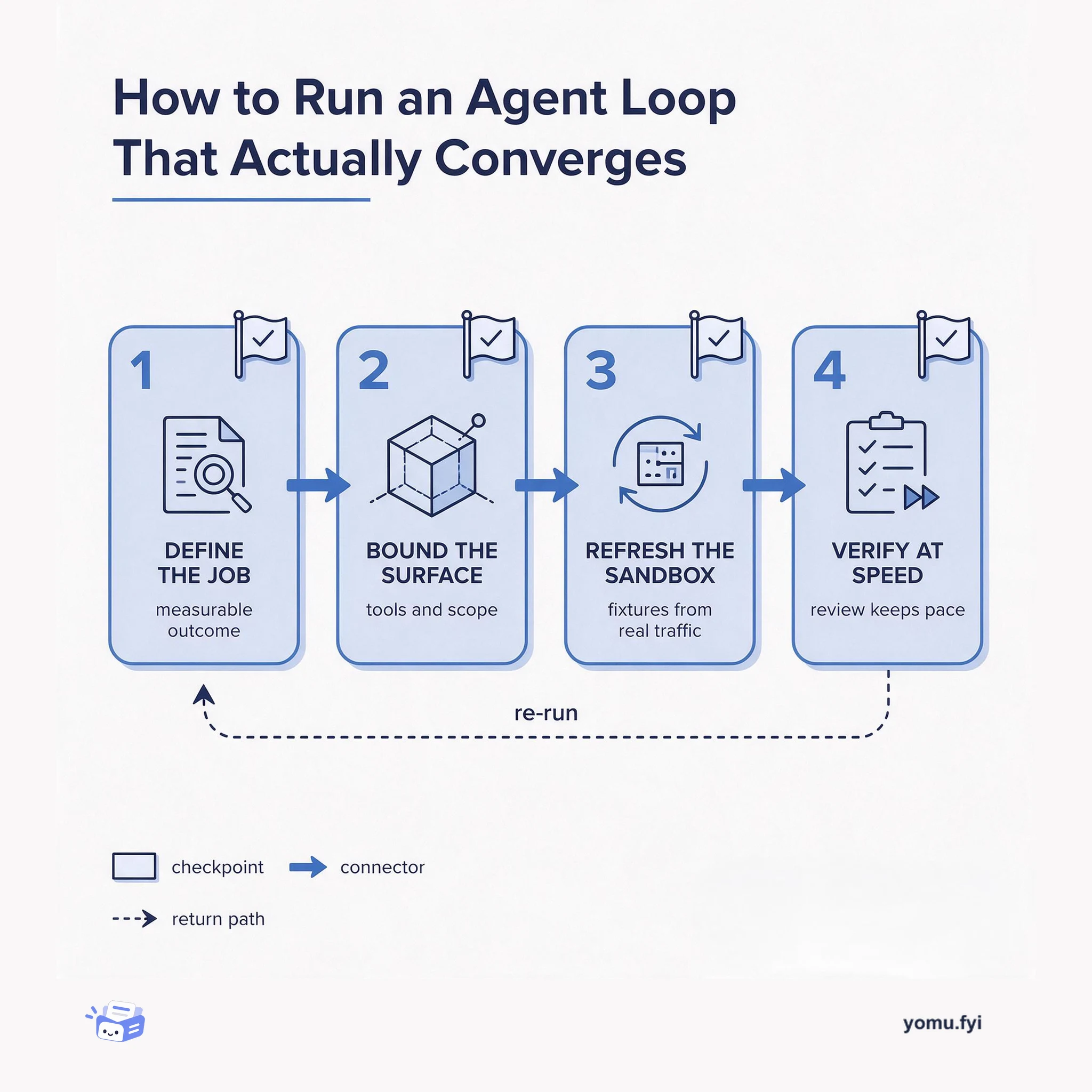
How to Run an Agent Loop That Actually Converges
A four-checkpoint how-to for agent loops: name a measurable job, bound the tool surface, refresh sandbox fixtures from real traffic, and verify at agent speed.
Loading…
Topic
564 posts about AI Agents. Every summary links to the original.
See the idea
A four-checkpoint how-to for agent loops: name a measurable job, bound the tool surface, refresh sandbox fixtures from real traffic, and verify at agent speed.
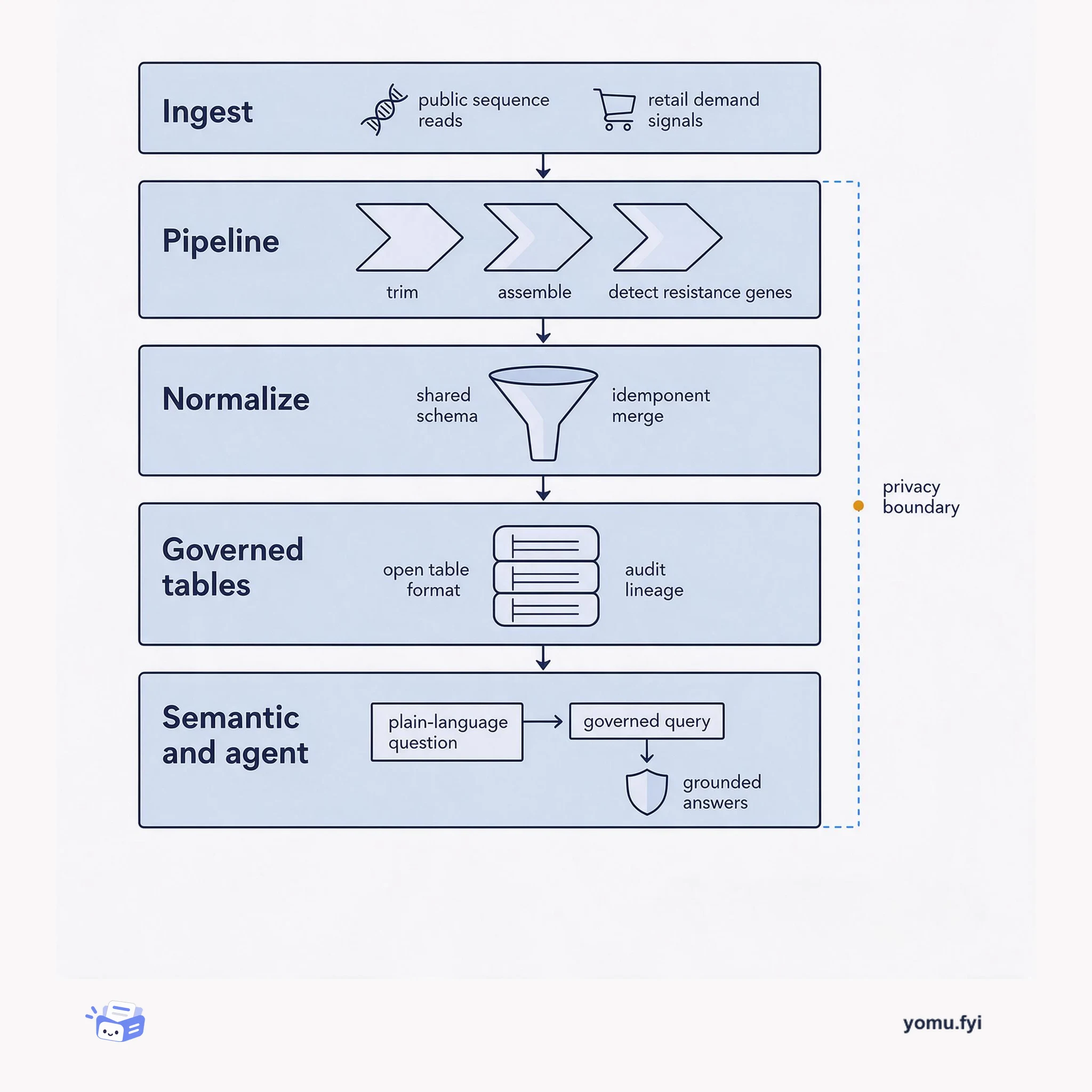
Antimicrobial resistance surveillance is a layered data architecture: raw reads and demand signals flow in, get normalized into governed tables, and answer plain-language queries. The diagram maps each boundary.
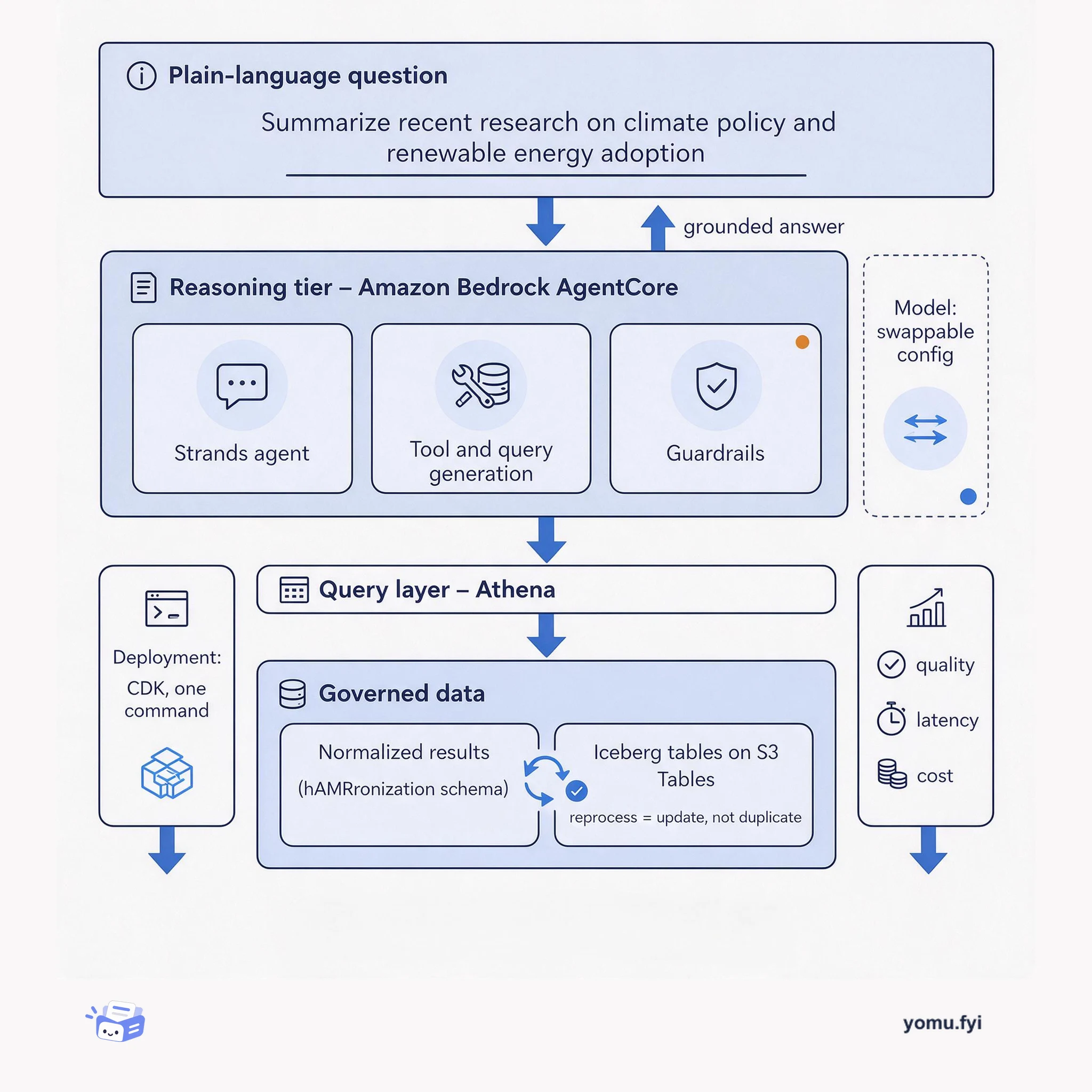
Amazon Bedrock is the managed reasoning tier in an agent architecture, not the whole system. This layered view shows the pipelines, governed tables, query layer, and guardrails around it.
The Good Stuff
Paid picks we use ourselves. Links carry a referral code — a subscription through one earns us a commission at no extra cost to you.
Newest first
Notion 3.0 introduces Notion AI Agents that can create documents, build databases, search across tools, and execute multi-step workflows inside a workspace. Agents can perform up to 20 minutes of autonomous work across hundreds of pages, including researching information, synthesising findings, creating structured databases, and notifying users when tasks finish. Users can personalise an Agent through a Notion page containing instructions and context, including task triage, response formatting, and reference information; templates can add specialised skills. The launch also includes database row permissions, new AI connectors, and additional MCP integrations, while Custom Agents are planned to run on schedules or triggers and share workflows with teams.
Anthropic is updating its Usage Policy to reflect product changes, user feedback, regulatory developments, evolving AI risks, and enforcement priorities, with changes taking effect September 15, 2025. The update adds explicit prohibitions on malicious computer, network, and infrastructure compromise while continuing to permit vulnerability discovery with system-owner consent, and provides supplementary guidance for agentic use. It narrows political restrictions from broad bans on lobbying and campaign content to prohibitions on deceptive or disruptive democratic activity and voter or campaign targeting. Law-enforcement wording is clarified without changing the permitted scope, while high-risk requirements are specified for consumer-facing legal, financial, and employment uses, including human oversight and AI disclosure. Anthropic describes the policy as a living document and says it will continue evaluation with policymakers, experts, and civil society.
The guide presents Cross App Access (XAA) as a protocol for secure agent-to-app and app-to-app access, giving enterprise IT centralized control over connections, policies, and accessed resources. It walks through an OIDC demonstration using Todo0 as the Resource App, Agent0 as the Requesting App, and Okta as the enterprise identity provider, covering app registration, trust establishment, token exchange, and API calls. The flow uses the OAuth 2.0 Identity Assertion Authorization Grant: Bob logs in once, Agent0 obtains an identity assertion, Okta exchanges it for a Todo0 access token, and Agent0 calls the protected API. The demonstrated result is an agent that can read pending tasks, add tasks, and mark tasks complete, with changes reflected in Todo0. The guide is marked out of date because its Admin Console instructions have been replaced by AI agent registration under Directory > AI Agents.
The post addresses a bottleneck in AI agents that write or edit code: correcting a small change can trigger a full-file rewrite, consuming tokens and causing formatting failures, silent omissions, and unreliable results. MorphLLM’s Morph Fast Apply is presented as a semantic, structure-aware edit merge tool: an agent emits small edit_file snippets with //...existing code... placeholders, while the Apply API merges them against the codebase context before the edited file is written back. The post reports over 4,500 tokens per second, 98% accuracy in about six seconds per file, and about four seconds for files up to 9k tokens, compared with 35 seconds and 86% accuracy for traditional search-and-replace with error corrections. It also states that MorphLLM is API-compatible with OpenAI, Vercel AI SDK, MCP, and OpenRouter, and can run in the cloud, self-hosted, or on-premises.
The article presents “second-order automation,” in which one agent designs reusable workflows for another agent to execute. Its spreadsheet system pairs an “architect” that watches a screen recording, generates detailed prompts, identifies required files and context, with a “doer” that searches workbooks and performs the instructions. The design addresses first-order automation’s dependence on users to supply precise prompts and fresh context for every task, which limits scalability. On an approximately 50-task SpreadsheetBench subset, the spreadsheet agent reached 49.5% accuracy on soft-restriction tasks versus OpenAI’s 45.5%, and 32.5% on hard-restriction tasks versus GPT-4o’s 13.4%; some one-to-two-hour tasks finished in under 10 minutes. The article concludes that recorded workflows can let non-technical users create reusable automations with little additional input, although architect performance has not yet been formally benchmarked.
The AI Agent Blueprint is a strategic guide for support, customer experience, and AI transformation leaders navigating how to adopt and scale AI Agents. Its first part, “Launch it,” covers building a business case, deciding whether to buy or build, evaluating an agent with a four-step framework, planning deployment, and continuously training, testing, deploying, and optimizing performance. The second part, “Scale it,” focuses on redesigning customer experience, organizational and system design, and economics through AI-first journeys, new roles and governance structures, and revised metrics, ROI models, and reinvestment strategies. The Blueprint argues that launching an agent is only the beginning: sustainable value requires treating AI as infrastructure and support as a potential growth lever, and it is live now.
Two billing updates will apply at the next renewal after September 15 for monthly and yearly plans. Teams is moving agent usage from fixed request costs to variable request costs, so charges rise or fall with the amount of work performed; a simple syntax question costs less than implementing a full pull request. This change extends the credit system already used by individual plans and unifies billing across tiers. For individuals, Auto will count toward included monthly usage at competitive token rates at the next renewal after September 15, replacing its unlimited status since June 2025; the post says Auto had previously matched premium-model pricing for individuals from December 2023 through June 2025 and for teams since June 2025.
Teams evaluating AI solutions can waste time, money, and trust when they lack technical fluency, choose unsuitable vendors, underestimate internal requirements, or expect immediate perfection. The post introduces Retrieval-Augmented Generation (RAG), vector search, agentic AI, and MCP as concepts that help teams distinguish static or rules-based tools from systems that retrieve current information, understand intent, take actions, and operate within governed boundaries. It argues that building an AI Agent in-house requires substantial work across embeddings, retrieval, prompt chaining, governance, security, maintenance, and model upgrades. Vendor evaluation should consider ongoing R&D, product roadmaps, adaptability, and maintenance, while implementation depends on structured content, documentation, process visibility, and APIs. Fin is cited as typically resolving over 76% of support questions out of the box, with resolution expected to improve through ongoing optimization and measurement.
Cursor has made its Agent available through a command-line interface (CLI) and in headless environments, extending it beyond the editor, web, mobile, and Slack. The release targets customers using Neovim, JetBrains, and other IDEs, while allowing Agent to run alongside those tools or as multiple parallel agents in a terminal or remotely. The CLI supports any model included with a Cursor subscription, and users can start it after installing with curl https://cursor.com/install -fsSL | bash and invoking agent chat with a prompt. Agent can generate files, run terminal commands, search a codebase, and now read, modify, or delete files and execute approved shell commands. The CLI is in beta, with evolving security safeguards and use limited to trusted environments.
Cursor has released Bugbot, a code review agent that automatically analyzes pull-request changes for logic bugs, edge cases, and security issues before production. It runs automatically on pull requests, gathers context from changes to understand code intent, and comments detected issues directly where they occur. Teams can steer reviews with custom BUGBOT.md rules, then send flagged issues to Cursor or launch a background agent on the web with one click. During its beta, Bugbot reviewed over 1 million PRs and found over 1.5 million issues; more than 50% of identified bugs were resolved before merge. Cursor also reports adoption by several companies, with testimonials citing review-time savings, strong bug detection, and confidence reviewing AI-generated code.
Ramp describes how it built and shipped LLM-backed agents for expense management, focusing on the trust risks created by low-quality or unexpected finance outputs. It recommends choosing ambiguous, high-volume problems with asymmetric upside, then combining reasoning and citations grounded in product or user-provided context with an explicit “Needs review” path when the agent is unsure. The policy agent uses expense policies to approve, reject, or escalate expenses, while deterministic rules such as dollar limits, vendor blocklists, and category restrictions constrain autonomy. Ramp reports that more than 65% of approvals are fully handled by the agent, while users can progressively move from suggestions to autonomous actions through workflow-based controls and evaluation.
Cursor announces that its Agents are available on the web and mobile, extending the IDE-based agent to desktop, tablet, and mobile browsers. Agents can run bug fixes, build features, answer complex codebase questions, and scaffold work in the background, while users can include images, add follow-up instructions, and run multiple agents in parallel. Repository-access team members can review diffs and pull requests or create pull requests from the web interface; the service can also be installed as a Progressive Web App on iOS or Android. Slack integration sends completion notifications and lets users trigger agents with “@Cursor,” and work can later be reviewed, extended, or edited inline in Cursor on a laptop.
Phoenix.new is presented as a batteries-included, fully online coding agent designed for Elixir and Phoenix, after an initial weekend project grew into a system that generated Phoenix applications and drove an in-browser IDE. It runs in an ephemeral Fly Machine, giving the agent and user a shared root shell while isolating local machines; applications launch in the cloud with preview URLs, GitHub integration, and Fly.io infrastructure guardrails. A headless Chrome browser lets the agent inspect page content and JavaScript state, interact with front ends, and correlate changes with server-side logs while testing applications. The system already handles full-stack applications using WebSockets, Phoenix Presence, and real databases, can work with other installed languages and frameworks, and is being used to triage GitHub issues and produce pull requests asynchronously.
Ramp describes the difficulty of mapping payment-processor card acceptor data to useful merchant records when names, MCCs, and locations are vague, misleading, or affected by rebranding. Users can submit a replacement merchant name, website, and category, but deciding whether the request is legitimate and whether to update an existing record or create one requires additional context from related receipts, extracted line items, and transaction memos. Ramp addresses this with an AI agent built around an LLM, embeddings, rapid online analytical processing queries, multimodal retrieval-augmented generation, and guardrails that constrain permitted changes. The agent handles requests in under 10 seconds, and monitoring indicates it improves nearly 99% of transaction classifications, while fewer than 10% receive a second correction request. The same flow has also been extended to batch remapping and credit-card statement matching.
This explainer clarifies what Model Context Protocol (MCP) servers do and where they differ from conventional APIs, serverless functions, and standalone appliances. It frames MCP servers as Alexa Skills that connect capabilities to an LLM, then as JSON-based APIs with multiplexing, server push, and built-in introspection for discovering tools, arguments, and usage descriptions. The post cautions that blindly generating an MCP server from an OpenAPI schema may expose low-level calls rather than agent-oriented workflows, and notes that MCP servers have a long-lived initialization, operation, and shutdown lifecycle rather than a serverless one. It also argues that MCP is not inherently secure or private, recommending remotely hosted servers protected by revocable bearer tokens, and envisions customized MCP-based agents becoming family-like assistants rather than mere appliances.
The essay argues that skepticism about LLMs for software development often reflects outdated experience with chat-based code generation rather than current agent workflows. Modern coding agents inspect repositories, edit files, invoke Unix tools and MCP calls, use Git, and run linters, compilers, tests, and model checkers, turning feedback into iterative repairs. The author says these systems can automate tedious typing, lookup, bookkeeping, test refactoring, and edit-compile-test-debug cycles while developers retain responsibility for curation, judgment, direction, and reviewing merged code. Hallucinations are presented as substantially mitigated by tool-based validation, although the author notes that agents remain unsuitable for some trusted operations and that effectiveness depends on language, tooling, prompts, indices, and guardrails. The conclusion is that AI-assisted programming is already materially changing developer productivity, despite its noise and unresolved limitations.
Risk Operations teams investigating Account Takeover (ATO) cases must gather data across systems, run SQL queries, and make decisions under pressure, creating delays and error risk. The SOP-driven LLM agent framework represents the workflow as a natural-language, indentation-based tree whose steps specify queries, external functions, and decision criteria. During execution, the SOP planner navigates the tree and produces JSON-formatted instructions, while a Worker Agent invokes APIs or SQL queries and stores results in a feedback loop. The process ends by synthesising investigation data into a report and final decision. In reported results, handling time fell from 22 to 3 minutes per ticket, 87% of ATO cases were automated since launch, and the error rate was zero.
eBay announces a new AI shopping agent designed to provide personalized product recommendations and guidance throughout the marketplace and buying journey. It uses shopping preferences, user requests, and predictive inline messaging to support activities such as finding gifts or assembling a Spring Break wardrobe. The agent extends eBay’s shift from simple chatbots toward conversational and interactive systems intended to understand, interact with, and anticipate customer needs, combining agentic AI with eBay’s infrastructure, customer insights, and product knowledge. eBay says its Responsible AI team collaborates on AI-powered features to align them with safety, fairness, transparency, and accountability, while the new experience starts with a small percentage of U.S. customers and will expand on a rolling basis.
Grab introduces an LLM agent framework that uses Standard Operating Procedures (SOPs) to guide enterprise automation and improve consistency in complex processes. It represents SOPs as trees of action and decision nodes, while a planner uses Depth-First Search, prompt generation, and backtracking to direct an LLM-powered worker agent; context compression and limited APIs are used to address hallucination and efficiency concerns. An SOP editor, plugins for APIs, Python, and SQL, workflows, a GRAG pipeline, playground, multilingual user agent, and state stack extend the framework’s capabilities. Reported evaluations include over 99.8% accuracy, an Account Takeover Investigations bot automating 87% of cases and reducing investigation time from 23 minutes to three, and fraud investigations cutting AHT by 45% and saving over 300 man-hours monthly.
eBay announces a collaboration with OpenAI as part of its strategy to shape agentic ecommerce and redefine online discovery and shopping for enthusiasts. The company is among the first to collaborate on the research preview of Operator, an AI agent that acts as a virtual assistant and autonomously performs tasks across the internet, including online shopping. Operator directs users to eBay for unique inventory finds, a model eBay anticipates will expand sellers’ reach by giving more buyers exposure to that inventory. The announcement also places the work within eBay’s broader effort to evolve internal AI agent capabilities and deepen strategic partnerships while learning how these technologies can empower buyers and help sellers grow their businesses.
The best engineering reads, once a week.