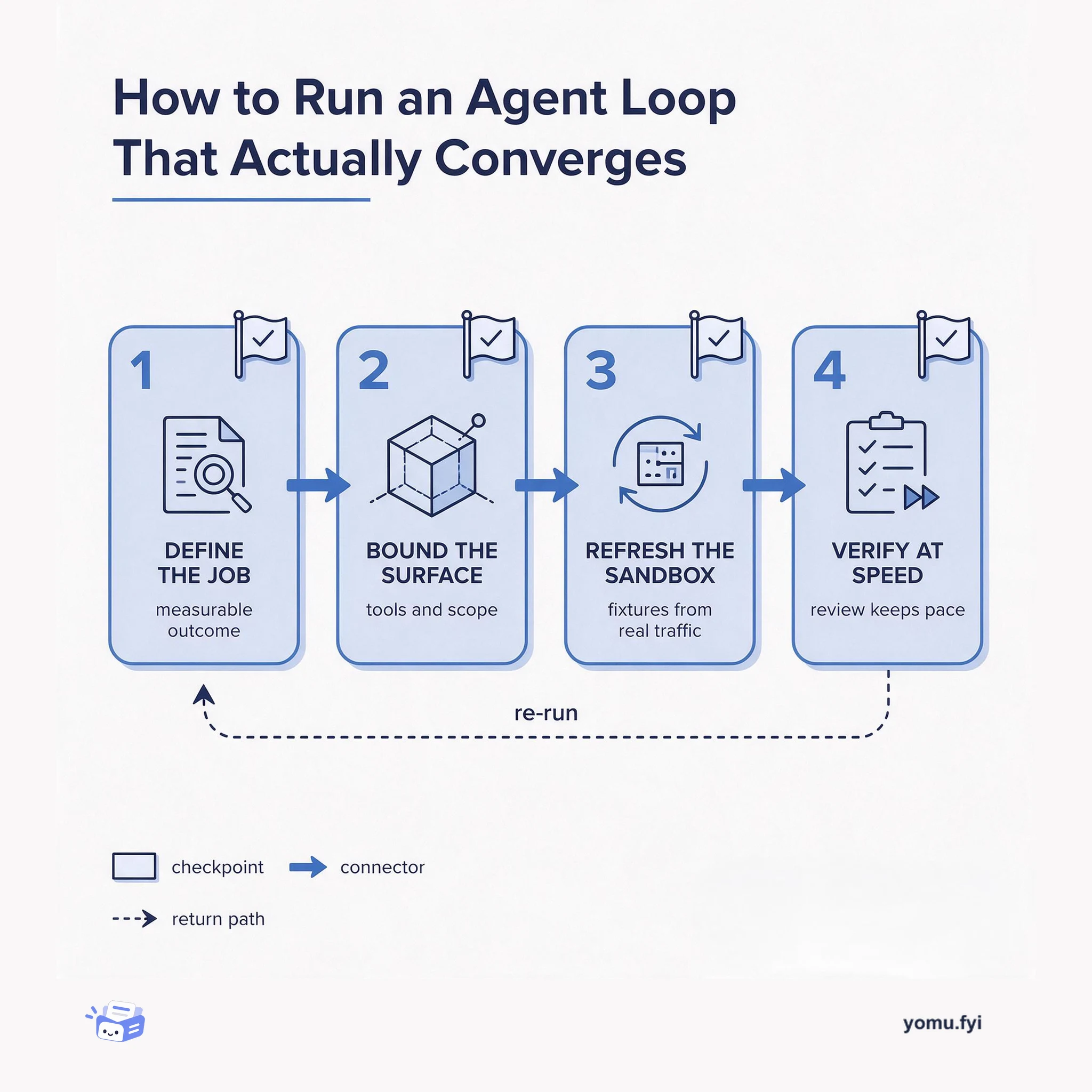
How to Run an Agent Loop That Actually Converges
A four-checkpoint how-to for agent loops: name a measurable job, bound the tool surface, refresh sandbox fixtures from real traffic, and verify at agent speed.
Loading…
Topic
560 posts about AI Agents. Every summary links to the original.
See the idea
A four-checkpoint how-to for agent loops: name a measurable job, bound the tool surface, refresh sandbox fixtures from real traffic, and verify at agent speed.
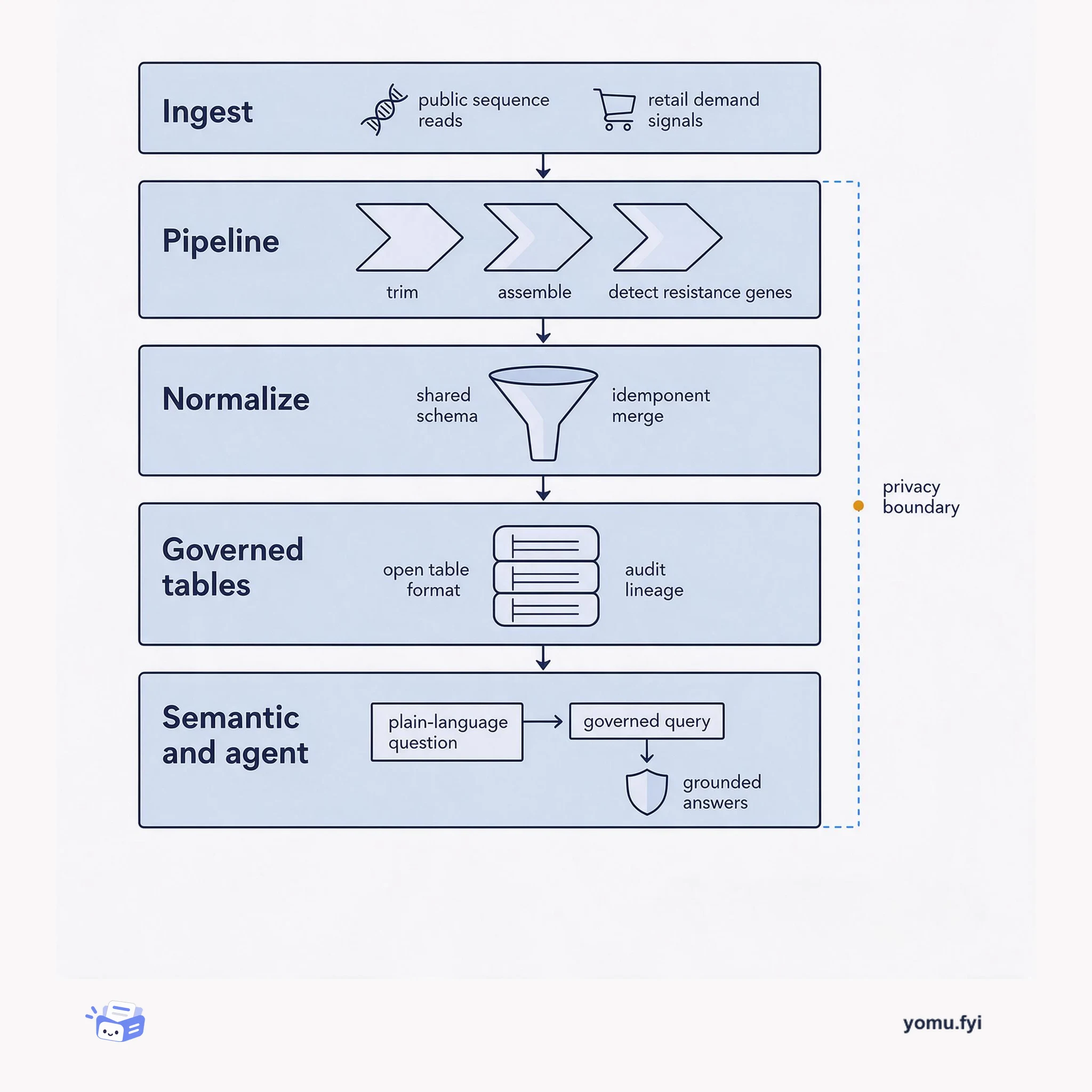
Antimicrobial resistance surveillance is a layered data architecture: raw reads and demand signals flow in, get normalized into governed tables, and answer plain-language queries. The diagram maps each boundary.
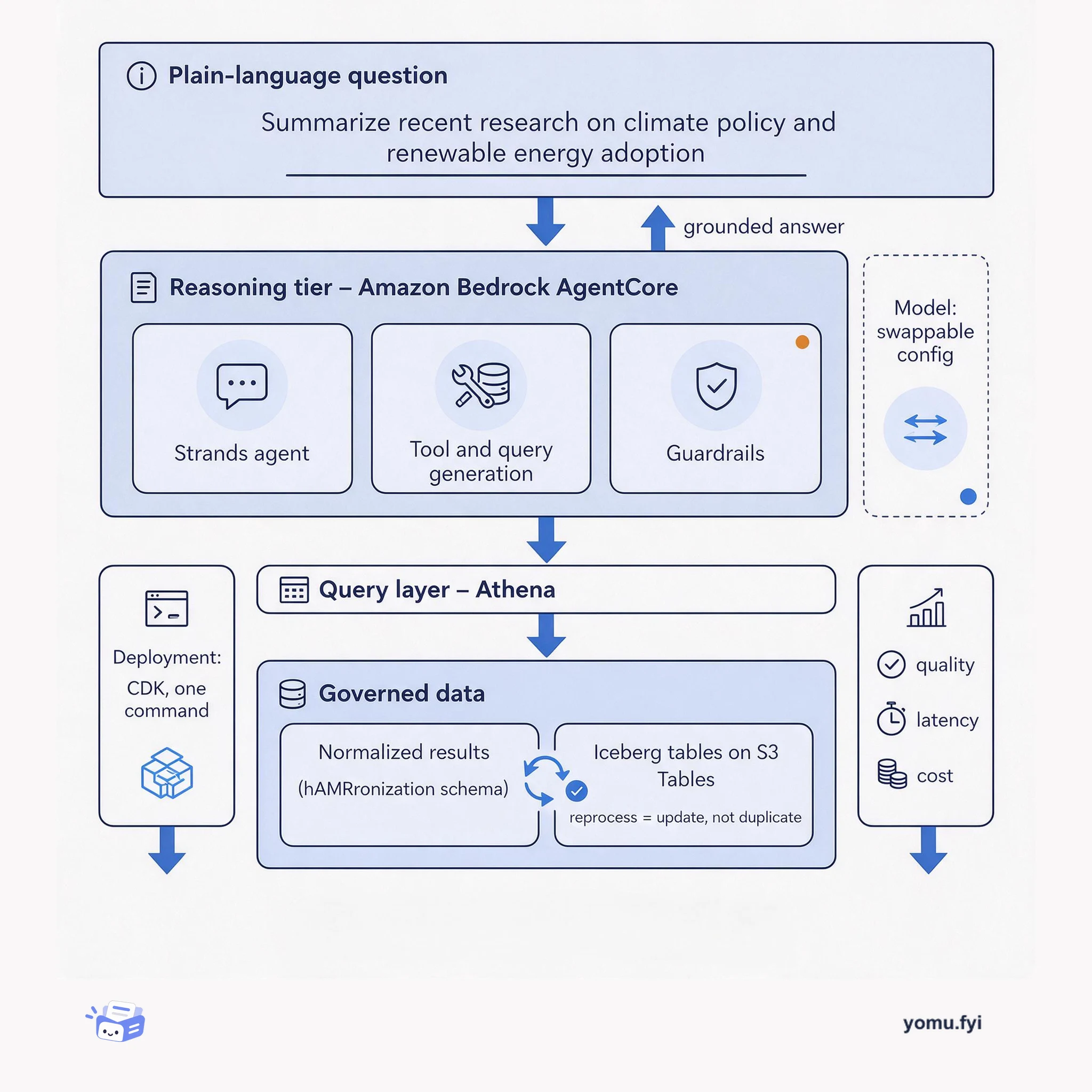
Amazon Bedrock is the managed reasoning tier in an agent architecture, not the whole system. This layered view shows the pipelines, governed tables, query layer, and guardrails around it.
The Good Stuff
Paid picks we use ourselves. Links carry a referral code — a subscription through one earns us a commission at no extra cost to you.
Newest first
Part one of a five-part 2026 customer service planning series argues that support organizations must be redesigned around AI rather than adding AI to existing tools, processes, and org charts. It frames AI Agents as end-to-end resolution engines and infrastructure that can serve as the first and last touchpoint, manage workflows, orchestrate handoffs, and take actions. The proposed mindset shift includes planning for changing work distribution, treating support as a product function, measuring resolution, impact, and system reliability, and assigning clear ownership for agent performance and continuous feedback. The post also says teams should give AI increasingly complex workflows while people improve the system, creating compounding returns. It concludes that adaptability will be essential as AI evolves, and previews a future edition on designing the resulting support organization.
The study examines how developers use Cursor’s agent and how its adoption affects software productivity across tens of thousands of users. After the agent became the default for eligible organizations, the rate of merged pull requests increased 39% relative to time trends in a baseline group, while revert rates did not change significantly, bugfix rates slightly decreased, and average lines edited and files touched per merged pull request were unchanged. Agent acceptance varied with experience: each standard-deviation increase in years of experience corresponded to an approximately 6% increase in acceptance relative to the mean, and experienced developers were more likely to plan before coding. In a sample of 1,000 users, about 61% of conversation-starting requests concerned implementation, with others focused on explanation or planning. The authors say no single metric yet captures AI’s economic impact on software engineering.
AI demonstrations fall into two categories: polished “Hollywood demos” and raw “real-world demos,” with the latter showing how customer-service AI agents perform under messy, complex interactions rather than edited presentation. Voice provides an especially demanding test because timing, tone, turn-taking, latency, interruptions, and real-time adaptation all shape the experience. At Pioneer, Paul Adams called Fin Voice live; within 90 seconds, it verified identity, retrieved account data, handled an interruption, offered options, completed the workflow, and sent a follow-up email. The demonstration exposed brief pauses for backend work, natural conversational flow, tone changes, and unscripted behavior, while later updates added voice customization, escalation guidance, deployment controls, integrations, support for 28 languages, and roughly 30–40% lower latency since launch.
Cursor describes semantic search as a complement to grep for helping coding agents locate relevant code in large codebases. Its evaluation used Cursor Context Bench across widely used models, comparing tool sets with and without semantic search, and found an average 12.5% accuracy improvement, with gains ranging from 6.5% to 23.5%. In an online A/B test, semantic search increased code retention by 0.3% overall and 2.6% on codebases with at least 1,000 files, while its absence produced a 2.2% increase in dissatisfied follow-up requests. The retrieval system uses a custom embedding model trained from agent session traces, with an LLM ranking helpful content and training aligning embedding similarity scores to those rankings. The conclusion is that combining semantic search with grep produces the best outcomes, especially for large codebases.
Thomas Ptacek argues that people should build an LLM agent before forming strong opinions about the technology, because implementation reveals how simple and surprising the underlying system can be. The example starts with a Python loop around the OpenAI Responses API, storing user and assistant messages in a context list to simulate conversation with a stateless model. Adding a JSON-defined ping function and a tool-calling loop lets the model choose and execute multiple network checks, demonstrating behavior not explicitly hard-coded in the loop. The discussion extends this pattern to coding agents, contexts persisted in SQLite, sub-agents, and design choices involving nondeterminism, ground truth, interchange formats, and token costs. It concludes that these remain open software-engineering problems whose practical behavior can be understood by building and iterating on agents.
Cursor is introducing enterprise features intended to make its coding agents more capable, transparent, and secure for organizations already using the product. Hooks expose the agent loop to custom scripts that can log actions and tool calls, enforce compliance or command allowlists, scrub sensitive material, connect external systems, and trigger automations; they can be distributed through MDM or Cursor’s cloud option. Team Rules provide shared context and can recommend or require standards such as API schemas, conventions, and workflows, while upgraded analytics report activity, adoption, AI lines of code, directory-group filters, and exportable data with updates every two minutes. The release also adds an Audit Log covering 19 event types and Sandbox Mode, which restricts network and file access by default, with administrators controlling availability and team-wide Git and network access.
An overloaded solo content designer built VERBI, an AI content design agent, to scale standardized work without replacing human judgment or filling products with generic copy. The agent runs in Glean, using a curated collection of Intercom’s style guide, tone of voice, product and monetization glossaries, messaging guides, research, and official websites as retrieval-augmented generation sources. The system prompt defines its role, use cases, tone, and component rules, while a Glean Indexing API connection makes Storybook’s Surge design-system guidance available as a live source. Additional instructions tell VERBI to challenge users, avoid guessing when sources lack an answer, and keep responses concise. After 700+ triggers, the reported benefits are consistent content rules, faster drafts and iteration, fewer repetitive questions and errors, and more time for higher-impact design review.
Pioneer 2025 presented Intercom’s latest customer-service AI plans, centered on Fin 3 and a longer-term vision for a single Customer Agent covering the entire customer experience. Fin 3 adds Procedures for complex, policy-controlled resolutions, Simulations for pre-release testing, Slack and Discord deployment, improved Voice, and Insights features such as CX Score Reasons, Topic Trends, and AI-powered Suggestions. The proposed Customer Agent would combine specialized roles, user-defined goals, persistent memory, business knowledge, and interoperability across tools, systems, and channels. Customer examples described phased rollouts, rapid feedback, broad scaling, and support-team involvement, while Anthropic reported two specialists enabling nearly 50 full-time employees’ worth of coverage in its volume. The event framed AI as a force for converging products, roles, and organizational structures, with the Customer Agent future described as arriving quickly.
Fin 3 is presented as an AI Agent for customer service focused on increasing automation rate by handling complex queries end-to-end across more channels. Procedures combine natural-language instructions with data connectors, conditional steps, code snippets, and approval checkpoints, allowing teams to encode standard operating procedures with varying levels of control. Simulations provide multi-turn testing for different customer segments and scenarios, while Fin Voice, Slack, and Discord expand deployment options. Insights upgrades add CX Score Reasons, Topic Trends, and AI-powered Suggestions that surface quality changes, topic shifts, and content improvements. The announcement says Fin 3’s broader goal is to increase the share of overall support workload it handles, beyond a resolution-rate metric that had reached 66% on average across more than 6,000 customers.
At Pioneer 2025, Eoghan McCabe presented a plan for Fin to become a unified Customer Agent spanning the entire customer experience, from first contact through purchase, support, success, and upsell. The proposal responds to the risk that separate AI Agents for sales, marketing, success, and service will use conflicting priorities, disconnected information, and inconsistent interactions. Fin is intended to evolve from a task-based system into an agentic system with fluid roles, user-defined goals, persistent customer memory, comprehensive business knowledge, and interoperability across tools, systems, and channels. The post argues that customer service leaders are positioned to guide this wider AI rollout because they have experience, data, and operational insight from early AI adoption. Early activity includes WHOOP using Fin for sales conversations, where it is resolving 84%, while new capabilities are expected to roll out over the coming months.
Cursor’s Cloud Agents let developers run multiple agents remotely without keeping a laptop connected to the internet. Agents can be launched and managed from the Cursor editor, cursor.com/agents, Slack, Linear, and GitHub, supporting background bug fixes, small todos, and larger feature work. For difficult bugs, the team commonly has multiple models attempt the same problem and selects the best result; for complex features, a locally developed plan can be sent to a cloud agent for implementation, allowing work to continue on another task. Cursor also revamped its GPT-5 Codex agent harness for longer time horizons in the cloud, while plan mode supports sending implementation plans remotely. The workflow is available today in Cursor editor and Cursor Web, as well as the listed integrations.
Intercom will open its next R&D hub in Berlin on January 19, 2026, to support investment in its AI customer service platform and Fin, its AI Agent. It has already welcomed its first Berlin hires and plans to hire 100 people over the following year across engineering, AI, data science, product, and design. Berlin was chosen for its technical talent, creative culture, AI-focused startups and research labs, and proximity to the existing R&D hubs in Dublin and London. Fin is described as the primary contributor to this growth, with more than 7,000 businesses having transformed customer service with it and Fin months away from passing $100 million in ARR. The new office at Zimmerstraße 78 will host an R&D recruitment event on February 26, 2026, while an AI builders day is planned for February.
Composer is a mixture-of-experts agent model for software engineering that targets interactive use, with reported frontier coding results and generation speed four times faster than similar models on the authors’ benchmarks. It is trained with reinforcement learning on real-world software engineering challenges in large codebases, using production search and editing tools, terminal commands, and codebase-wide semantic search. Training responses may be code edits, plans, or informative answers, while the process rewards efficient tool use, parallelism, minimal unnecessary responses, and evidence-based claims. Evaluation uses Cursor Bench, built from real agent requests and curated optimal solutions, measuring correctness alongside adherence to existing abstractions and software engineering practices. The training stack combines asynchronous reinforcement learning with PyTorch and Ray, MXFP8 MoE kernels, expert parallelism, hybrid sharded data parallelism, and sandboxed cloud environments scaled to hundreds of thousands concurrently.
Cursor 2.0 introduces Composer, described as the product’s first coding model, alongside an interface designed for running multiple agents in parallel. Composer is built for low-latency agentic coding, completes most turns in under 30 seconds, and was trained with tools including codebase-wide semantic search to improve work in large codebases. The new interface centers on agents and outcomes rather than files, while still allowing users to open files in a redesigned layout or return to the classic IDE; parallel runs are isolated through git worktrees or remote machines. The release also targets review and testing bottlenecks by simplifying change inspection and adding a native browser tool that lets Cursor test its work and iterate, and Cursor 2.0 is now available.
Agent Skills are folders containing instructions, scripts, and resources that Claude loads when relevant to specialized tasks, enabling custom expertise across Claude apps, Claude Code, and the API. The system scans available skills, loads only the minimal information and files needed, and can combine multiple skills automatically. Skills may include executable code, and API use requires the Code Execution Tool beta; developers can manage versions through the /v1/skills endpoint and Claude Console. Users can build skills with the skill-creator workflow or install them through the anthropics/skills marketplace, while organization-wide management and a partner-built directory were added in the December 18, 2025 update. The post presents Skills as composable, portable, efficient, and powerful, but cautions that code-executing skills should come from trusted sources to protect data.
Online retailers often struggle to answer delivery, returns, discount, and product questions quickly, especially during peak shopping periods, when delays can frustrate shoppers and contribute to abandoned carts. Intercom’s Fin is presented as an LLM-powered AI agent that uses existing knowledge content and real-time data to resolve queries, personalize support, and assist with sales activities such as upselling, cart recovery, and targeted promotions. It can handle order tracking, refunds, exchanges, product availability, and support in more than 45 languages, while integrating with Shopify and Stripe for actions including order changes and refunds. Reported examples include GoodBuy Gear’s 50% resolution rate and engagement in over 20% of interactions, plus Nuuly’s 11% reduction in subscriber support contact rates after implementation. Fin is positioned as a way to scale 24/7 multichannel support and connect service interactions with conversion and loyalty goals.
Notion 3.0 introduces Notion AI Agents that can create documents, build databases, search across tools, and execute multi-step workflows inside a workspace. Agents can perform up to 20 minutes of autonomous work across hundreds of pages, including researching information, synthesising findings, creating structured databases, and notifying users when tasks finish. Users can personalise an Agent through a Notion page containing instructions and context, including task triage, response formatting, and reference information; templates can add specialised skills. The launch also includes database row permissions, new AI connectors, and additional MCP integrations, while Custom Agents are planned to run on schedules or triggers and share workflows with teams.
Anthropic is updating its Usage Policy to reflect product changes, user feedback, regulatory developments, evolving AI risks, and enforcement priorities, with changes taking effect September 15, 2025. The update adds explicit prohibitions on malicious computer, network, and infrastructure compromise while continuing to permit vulnerability discovery with system-owner consent, and provides supplementary guidance for agentic use. It narrows political restrictions from broad bans on lobbying and campaign content to prohibitions on deceptive or disruptive democratic activity and voter or campaign targeting. Law-enforcement wording is clarified without changing the permitted scope, while high-risk requirements are specified for consumer-facing legal, financial, and employment uses, including human oversight and AI disclosure. Anthropic describes the policy as a living document and says it will continue evaluation with policymakers, experts, and civil society.
The guide presents Cross App Access (XAA) as a protocol for secure agent-to-app and app-to-app access, giving enterprise IT centralized control over connections, policies, and accessed resources. It walks through an OIDC demonstration using Todo0 as the Resource App, Agent0 as the Requesting App, and Okta as the enterprise identity provider, covering app registration, trust establishment, token exchange, and API calls. The flow uses the OAuth 2.0 Identity Assertion Authorization Grant: Bob logs in once, Agent0 obtains an identity assertion, Okta exchanges it for a Todo0 access token, and Agent0 calls the protected API. The demonstrated result is an agent that can read pending tasks, add tasks, and mark tasks complete, with changes reflected in Todo0. The guide is marked out of date because its Admin Console instructions have been replaced by AI agent registration under Directory > AI Agents.
The post addresses a bottleneck in AI agents that write or edit code: correcting a small change can trigger a full-file rewrite, consuming tokens and causing formatting failures, silent omissions, and unreliable results. MorphLLM’s Morph Fast Apply is presented as a semantic, structure-aware edit merge tool: an agent emits small edit_file snippets with //...existing code... placeholders, while the Apply API merges them against the codebase context before the edited file is written back. The post reports over 4,500 tokens per second, 98% accuracy in about six seconds per file, and about four seconds for files up to 9k tokens, compared with 35 seconds and 86% accuracy for traditional search-and-replace with error corrections. It also states that MorphLLM is API-compatible with OpenAI, Vercel AI SDK, MCP, and OpenRouter, and can run in the cloud, self-hosted, or on-premises.
The best engineering reads, once a week.