API Versioning as a Translation Layer
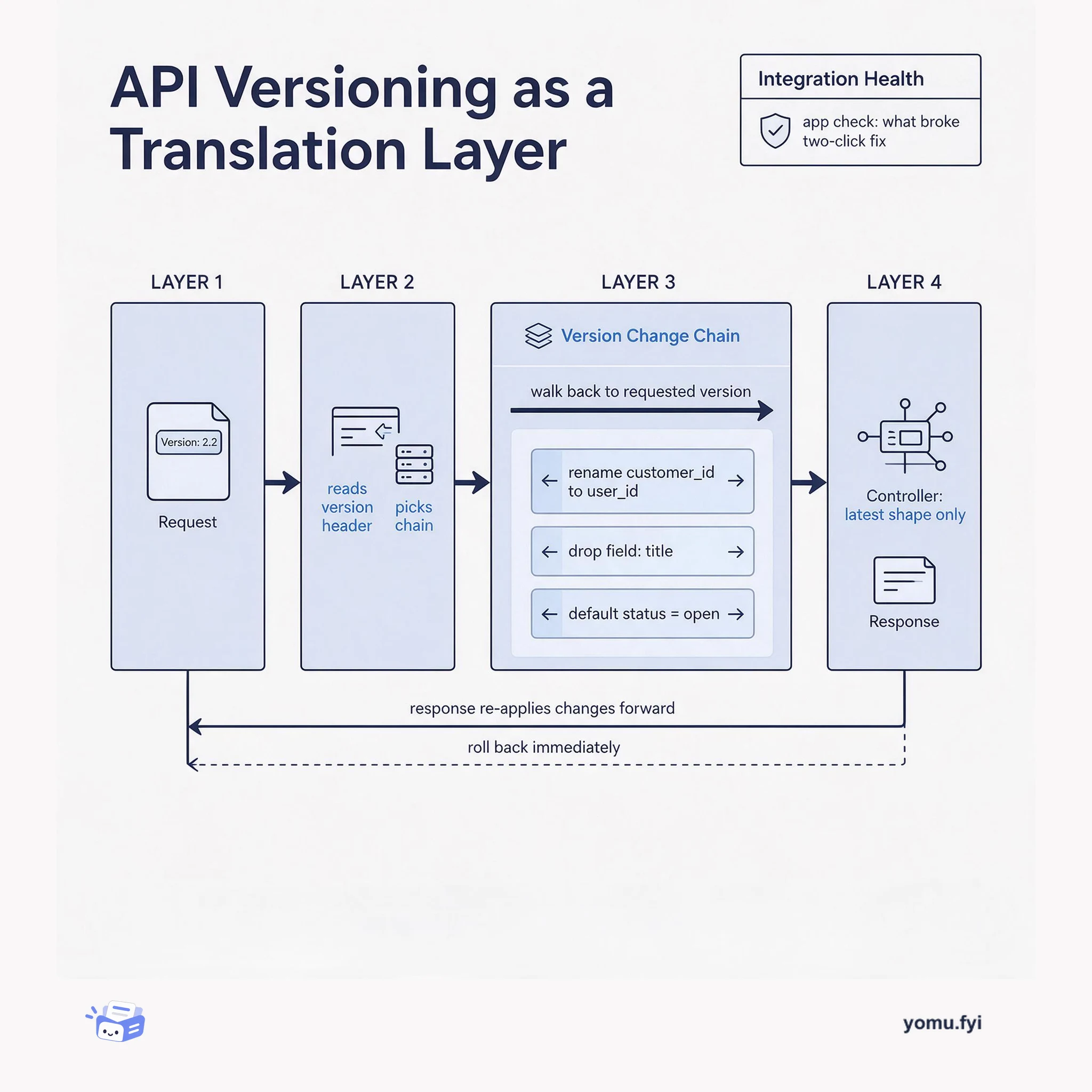
API versioning as an architecture: requests enter through a version header, pass through a chain of reversible version changes, and reach controllers that only ever see the latest model.
Loading…
Topic
830 posts about Architecture. Every summary links to the original.
See the idea
API versioning as an architecture: requests enter through a version header, pass through a chain of reversible version changes, and reach controllers that only ever see the latest model.
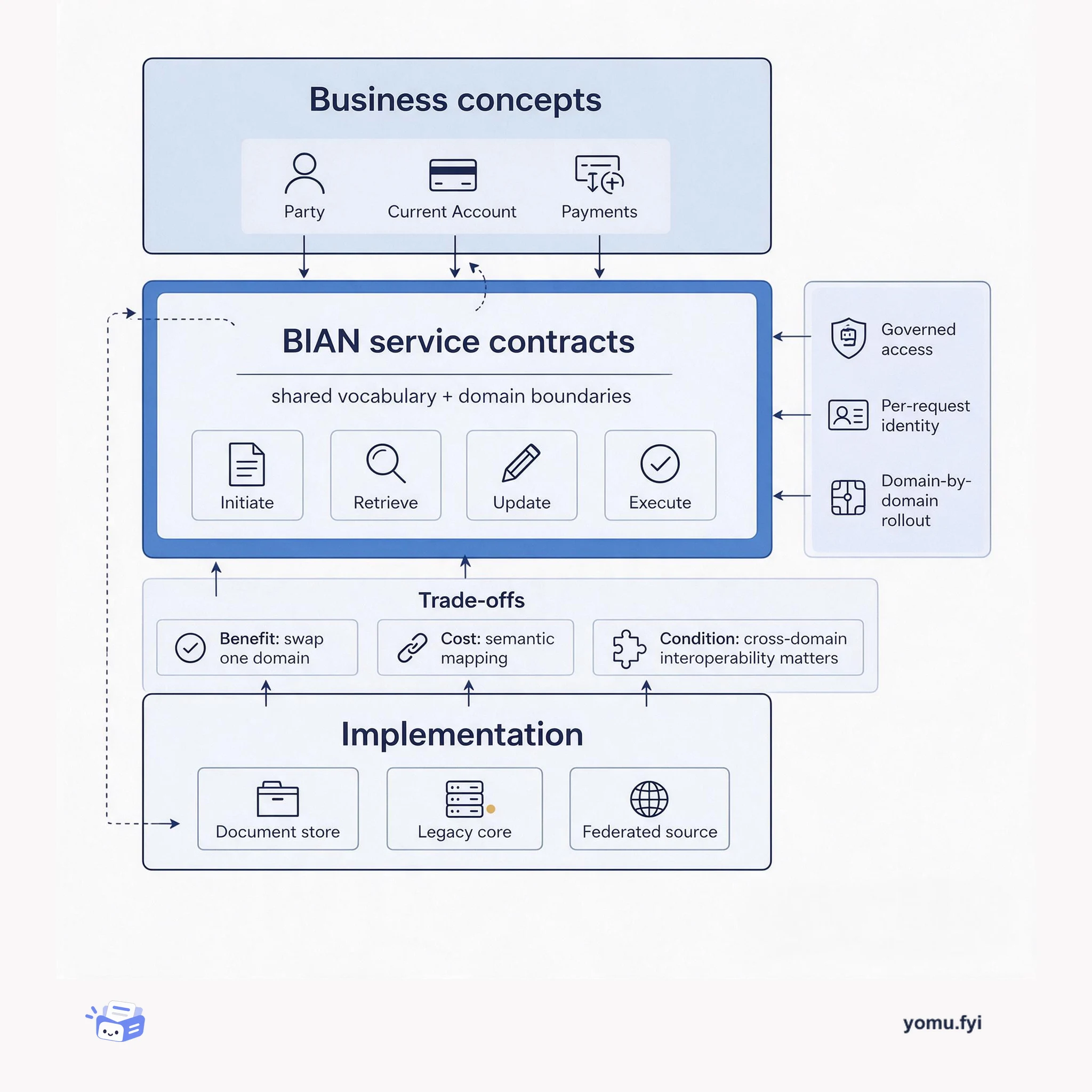
BIAN gives banks a shared vocabulary and service-domain contracts that sit between business concepts and the systems implementing them. See how domains, contracts, and governed access stack into one architecture.
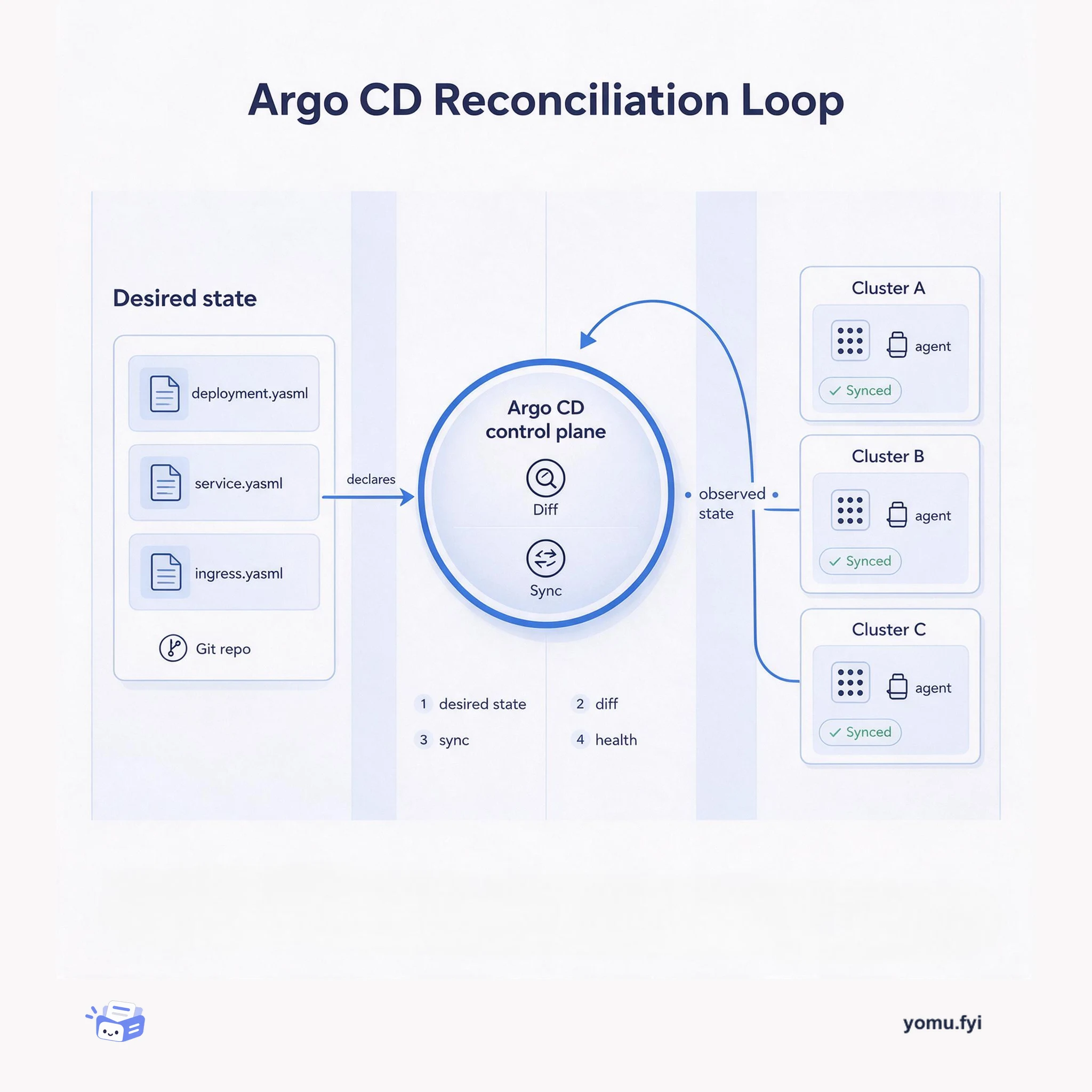
Argo CD is a GitOps controller that treats Git as the desired state and continuously reconciles it against what actually runs in each cluster. It maps the parts of that loop and why pull-based agents change its scale.
The Good Stuff
Paid picks we use ourselves. Links carry a referral code — a subscription through one earns us a commission at no extra cost to you.
Newest first
NVIDIA Omniverse libraries, included in NVIDIA Agent Toolkit, provide modular components for incorporating physical AI features into current tools and services. As part of this stack, the ovrtx prerelease library offers a lightweight C and Python SDK for real-time RTX sensor simulation and visualization using OpenUSD scenes. Host applications retain architectural and workflow control by stepping the renderer directly from their internal loops. Integration relies on ovstage for shared OpenUSD data management alongside RenderProducts and RenderVars to configure camera, lidar, radar, and semantic segmentation outputs. PTC Onshape Render Studio is exploring ovrtx to embed RTX rendering directly into cloud-native CAD and PDM workflows.
Dropbox developed Riviera, a centralized content processing platform that evolved from an internal file preview generator into a shared infrastructure supporting over 300 file formats. By decomposing complex conversion tasks into modular, reusable transformations, the system now powers search indexing, media transcoding, and AI context extraction across Dropbox products.
AI agent orchestration coordinates multiple specialized agents by managing task assignment, shared state, communication, and execution sequencing across complex enterprise workflows. The guide contrasts autonomous agents, which reason about subtasks and adapt to intermediate results, with fixed workflows, and recommends decomposing processes into single-responsibility agents with documented input/output contracts and least-privilege access. It describes centralized, decentralized, hierarchical, hybrid, federated, and emergent patterns, noting that pattern selection trades control, resilience, scalability, and auditability according to risk. Implementation guidance includes assigning human owners, defining accuracy, latency, and escalation targets, establishing failure paths, instrumenting a minimal prototype, and measuring a pilot against documented baseline processes. Organizations using multi-agent systems report 35% faster task completion and a 30% efficiency increase with specialized agents, while high-risk or irreversible actions still require human approval gates and audit trails.
Netflix established an in-house serving platform to run large language model inference directly inside existing production environments alongside traditional machine learning models. Built upon NVIDIA Triton Inference Server and vLLM, the unified architecture handles member-scale routing, candidate generation, feature fetching, and model execution over gRPC and OpenAI-compatible HTTP endpoints. The team shifted their primary engine from TensorRT-LLM to vLLM to support custom architectures, simpler debugging, and non-trivial constraint logic. Addressing production obstacles required patching Triton's frontend for guided decoding, pinning dependent library versions, rewriting logits processors in C++ for vLLM V1, and handling state machine resets during engine preemptions. The resulting platform unifies deployment flows while preserving operational stability across evolving model schemas.
Deploying Eclipse Dataspace Components (EDC) connectors on AWS presents challenges in forecasting infrastructure expenses without clear benchmarks. Estimated costs differ substantially between business-critical setups and non-critical environments based on compute and database sizing. A business-critical configuration relying on Amazon Aurora PostgreSQL db.r6g.large and standard Amazon ECS with AWS Fargate totals an estimated 387.00 USD monthly in the eu-south-2 region. Sizing down to db.t4g.medium and switching to AWS Fargate Spot lowers the non-critical monthly expense to 164.00 USD, representing a 58% reduction. Core cost drivers remain baseline infrastructure components, while storage, API calls, and data transfers contribute marginally under baseline assumptions.
Cross App Access allows enterprise applications federated with Security Assertion Markup Language to interact with third-party resource APIs without migrating to OpenID Connect. The flow adapts the Identity Assertion Authorization Grant specification to SAML by adding three token exchange steps following the standard single sign-on handshake. First, the application exchanges the validated SAML assertion for an OAuth refresh token using Okta's token endpoint and a private key JSON Web Token. The application then uses the refresh token to request a short-lived Identity Assertion Authorization Grant token from Okta. Finally, the application presents the Identity Assertion Authorization Grant token to the third-party authorization server to obtain an OAuth access token.
Capcom integrated path tracing into RE ENGINE across PRAGMATA and Resident Evil Requiem to deliver unified indirect and direct lighting. Over two years, the team built a reference path tracer validated against standard DCC tools, scaling it down into a real-time version optimized for NVIDIA DLSS Ray Reconstruction denoising. To manage rendering performance, Capcom avoided expensive AlphaTest texture lookups by creating a ScreenSpaceAlphaTest method comparing ray-hit positions against screen-space depth. Sampling noise in emissive and indoor regions is mitigated using Next Event Estimation and a custom implementation of ReSTIR GI. Replacing traditional shadow maps with continuous path tracing reduced the visual gap between gameplay and cinematics while enabling real-time light transmission through strand hair.
Cushman & Wakefield’s enterprise AI program addresses fragmented experiments, disconnected data, and uneven organizational maturity across a 53,000-person workforce. Over four years, Chief Digital and Information Officer Sal Companieh used a product operating model, business-linked accountability, co-created investment decisions, and shared architecture standards to build a common foundation while preserving business-unit flexibility. Databricks supports that strategy as a partner and platform, with its intelligence layer and Genie helping employees query trusted data in natural language, examine quality and governance, and monitor compliance. The company says the time from idea to outcome has fallen from months to days, while client and acquisition onboarding has materially accelerated. Companieh identifies human behavior, education, and trust—not technology alone—as essential to making change durable.
Video analytics AI agents often struggle to integrate into enterprise workflows because video platforms, organizational knowledge bases, and operational systems are isolated. To resolve this, NVIDIA NemoClaw orchestrates the Metropolis Video Search and Summarization blueprint alongside the Retrieval-Augmented Generation blueprint into an automated pipeline. Upfront human-in-the-loop interactions collect analysis parameters, objects of interest, and relevant retrieval queries before video ingestion begins. The system combines hierarchical video summaries with contextual enterprise reference documents to generate structured reports with timestamps and citations. Finally, NemoClaw executes programmatic downstream tasks, such as creating prioritized Jira tickets or dispatching industrial maintenance work orders directly into management tools.
Agentic artificial intelligence workflows transform data center infrastructure by turning context management, security enforcement, and inter-service communication into active components of the inference data path. To prevent host central processing units and graphics processing units from stalling on these tasks, NVIDIA introduces BlueField-4 data processing units, Vera BlueField-4 STX storage processors, and the DOCA software platform. The BlueField-4 processor offloads Layer 3 routing, encryption, and telemetry using a sixty-four-core Grace processor with up to eight hundred gigabits per second connectivity. Simultaneously, the Vera BlueField-4 STX powers the NVIDIA CMX context memory platform alongside DOCA Memos to store, protect, and share key-value cache across flash storage tiers. This co-designed infrastructure isolates tenant traffic and accelerates context reuse without degrading host-side agent execution.
AI agents combine reasoning models, external tools, memory, orchestration, and execution environments to autonomously pursue goals across iterative perceive-reason-act loops. While simple chatbots only generate text responses to direct prompts, autonomous agents execute multi-step operations such as querying databases, modifying codebases, and executing shell commands without requiring continuous manual approvals. However, this unchecked operational autonomy significantly widens the blast radius when models encounter logic errors or vague instructions, risking destructive filesystem operations and credential leaks. Safe deployment requires shifting focus from model-level guardrails to infrastructure-level containment strategies, such as scoping tool access and isolating execution inside disposable microVM sandboxes. Controlling networking boundaries, file access, and credential exposure ensures teams achieve automated execution velocity without exposing developer host environments to uncontained systemic risk.
Sentry's Seer Agent initially parsed user screens using DOM-scraped character-by-character ASCII grids, leading to severe token consumption, model context rot, and an inability to support interactive actions. To resolve these bottlenecks, Sentry replaced visual text scraping with a composable semantic context system where React UI components directly declare their state, metadata, and interactive affordances. A root React context provider maintains a registry of component nodes organized hierarchically through higher-order wrappers, serializing the resulting structure to JSON and backend-generated Markdown within the system prompt. Across twenty-four live pages, this approach reduced dashboard context tokens from roughly 5,500 to 1,300 while maintaining identical satisfaction rates and tool-call volumes across more than 14,000 evaluated conversations.
Modal rebuilt its sandbox platform to support millions of concurrent sandboxes and tens of thousands of creations per second, removing all central bottlenecks from the control plane. The new architecture eliminates central coordination and durable datastores from the critical path, using horizontally scaled scheduling servers that run a fast load-balancing algorithm against in-memory cached worker state from Redis streams. Workers are contacted directly via RPC to create sandboxes, and sandbox metadata is written asynchronously, avoiding O(sandboxes) and O(nodes) operations that limited previous systems. In a benchmark, Modal created 1 million sandboxes in under a minute with median time-to-interactivity under half a second, though the long tail is attributed to kernel and network contention like the rtnl lock. The system is designed to scale without practical limits, supporting use cases like reinforcement learning and background agents that require massive concurrent sandbox creation.
Conductor, introduced as a Gemini CLI extension for spec-driven development (SDD), is evolving into a plugin that supports Antigravity CLI and other tools. The change moves project awareness from ephemeral chat logs into persistent, version-controlled Markdown artifacts while replacing strict command sequences with conversational creation and iteration of context, specs, and plans. Plugins package skills, rules, MCP servers, and hooks, and the Conductor Plugin can update project context and mark plan tasks complete as discussions progress, while preserving existing commands, specs, plans, shared configuration, and development tracks. The post reports a higher success rate on the most complex subset of TerminalBench tasks than a user not using SDD, and gives an Antigravity installation command: agy plugins install https://github.com/gemini-cli-extensions/conductor.
Monolithic system prompts become difficult to reason about, test, and change as teams add safety policies, domain rules, formatting requirements, and escalation behaviors. The proposed approach treats prompts as software artifacts: modular skill files are composed with includes, variables, and macros, then transpiled into deterministic artifacts. Build-time validation checks missing imports, undefined variables, and circular dependencies, while dependency graphs and CI/CD golden-file comparisons catch drift before deployment. At runtime, progressive disclosure keeps a stable control plane loaded while agents retrieve task-specific skills, reducing context exhaustion and noise. Agents can propose new skill modules or import changes through pull requests, but human review and evaluation remain part of the merge process.
Checkout Blocks upgraded all five UI extensions from React and Shopify’s legacy Remote UI bridge to remote-dom with Preact and Polaris web components, while moving from JavaScript to TypeScript and API version 2026-01. The migration addressed checkout’s performance sensitivity and Shopify’s requirement that deployments move off versions earlier than 2026-01. A parallel core-next library allowed extensions to transition incrementally, with shared providers, telemetry, hooks, helpers, and rules adapted before legacy core was removed. To meet the remote-dom CLI’s 64KB gzip limit, the team dropped react-reconciler, replaced liquidjs with a smaller parser validated against more than 42,000 lines of merchant configurations, replaced dayjs, and retained markdown-to-jsx through Preact compatibility. Transferred bundles fell 40% to 85%, while weighted ELT improved 8% at P50 and 7% at P90.
Stripe describes how its Document Database fleet previously handled degraded MongoDB shards with single-step, hard-coded plugins that struggled with combined failures, intermediate states, and more than 40 shard layouts. The replacement models shard topology and health as a directed graph, with infrastructure operations as edges and safety invariants defining valid states. A simulator uses breadth-first search to find minimum-operation recovery paths, while an abstraction over Temporal contexts lets the same remediation logic run in memory without real infrastructure calls; later, the system also uses Dijkstra's algorithm. The system reduced pager volume by 30%—about 200 pages annually—reclaimed 12 days of fleet health each year, and handled a new layout with zero code changes, according to the post.
NVIDIA DeepStream 9.1 introduces AutoMagicCalib and Multi-View 3D Tracking skills to resolve the limitations of single-camera 2D tracking and manual camera calibration in large-scale video analytics. Multi-View 3D Tracking projects detections into a shared 3D coordinate system, matching tracklets across cameras via MQTT and maintaining globally consistent object IDs. AutoMagicCalib automates camera intrinsic and extrinsic parameter estimation by analyzing object trajectories across video feeds, optionally using a Visual Geometry Grounded Transformer. These capabilities are integrated into 13 agentic skills that allow coding agents to set up, configure, and execute end-to-end vision AI pipelines from natural language prompts. Outputs include an on-screen display grid, bird's-eye view trajectories, and per-frame protobuf metadata streamed through Kafka.
Building custom Universal Scene Description (USD) implementations traditionally required adapting large existing codebases to meet specific memory footprints, application binary interfaces (ABIs), or performance requirements. The nanousd-labs project introduces an alternative approach by using AI agents to generate lightweight USD runtimes directly from the Alliance for OpenUSD machine-readable USD Core Specification. Agents parse the specification section by section, write conforming code, and validate output against specification-derived tests under engineer guidance. Written in C++ with a public C API, nanousd functions as an independent data layer that handles parsing, composition, queries, and writing without rendering pixels. This methodology enables developers to regenerate runtimes for varying deployment constraints while maintaining standard compliance through reusable workflows and skill graphs.
NVIDIA CUDA 13.3 introduces clmad, a native PTX carryless multiply-accumulate instruction for Ampere and newer GPU architectures. Prior to this release, GPUs lacked dedicated hardware for carryless multiplication, requiring developers to emulate binary extension field arithmetic with ALU operations or bitsliced circuits. The new primitive performs 64-bit by 64-bit carryless multiplication into 128-bit results with accumulation, allowing full 128-bit field multiplications via Karatsuba in six instructions. Benchmarks demonstrate that clmad achieves up to 6.3 TB/s throughput for GHASH on the NVIDIA B200, representing an 18.8x improvement over bitslicing. Additionally, sum-check protocol latency in zero-knowledge proving workloads decreases by up to 13x on the B200 and 4x on the RTX 5090.
The best engineering reads, once a week.