BIAN as a Contract Layer: Modernizing Core Banking One Domain at a Time
BIAN gives banks a shared vocabulary and service-domain contracts that sit between business concepts and the systems implementing them. See how domains, contracts, and governed access stack into one architecture.
BIAN is a shared semantic foundation for banking: it names the domains a bank runs on, draws their boundaries, and defines the service operations they expose to each other. The architecture stacks business concepts on top, service contracts in the middle, and whatever implements each domain underneath, so a domain can be replaced without rewriting its neighbours. Because the contract is the stable layer, teams can modernize domain by domain instead of attempting one cutover. The cost is upfront semantic mapping and ongoing governance over who may call which operation, on whose behalf.
FAQ
Does adopting BIAN mean replacing my core banking system?
No. BIAN supplies a shared vocabulary and service-domain contracts, not a runtime. The BIAN and MongoDB perspective describes modernizing domain by domain, where each domain can keep or replace its implementation while the contract stays stable, so you avoid one risky cutover.
Where does BIAN sit relative to my data store and existing integrations?
BIAN sits above the implementation layer: contracts define what a domain offers, while the store underneath can be a document model, a legacy system, or a federated source. The same post notes that JSON can serve as both storage and interchange format, which removes the ORM impedance mismatch when mapping domain objects.
What is the main cost or failure mode when adopting BIAN?
The upfront cost is semantic mapping: agreeing what each domain means and where its boundary sits, because the same banking concepts are defined differently across systems today. The ongoing cost is governance over which caller may invoke which service operation, and skipping it reintroduces the duplicated logic and fragile integrations BIAN exists to remove.
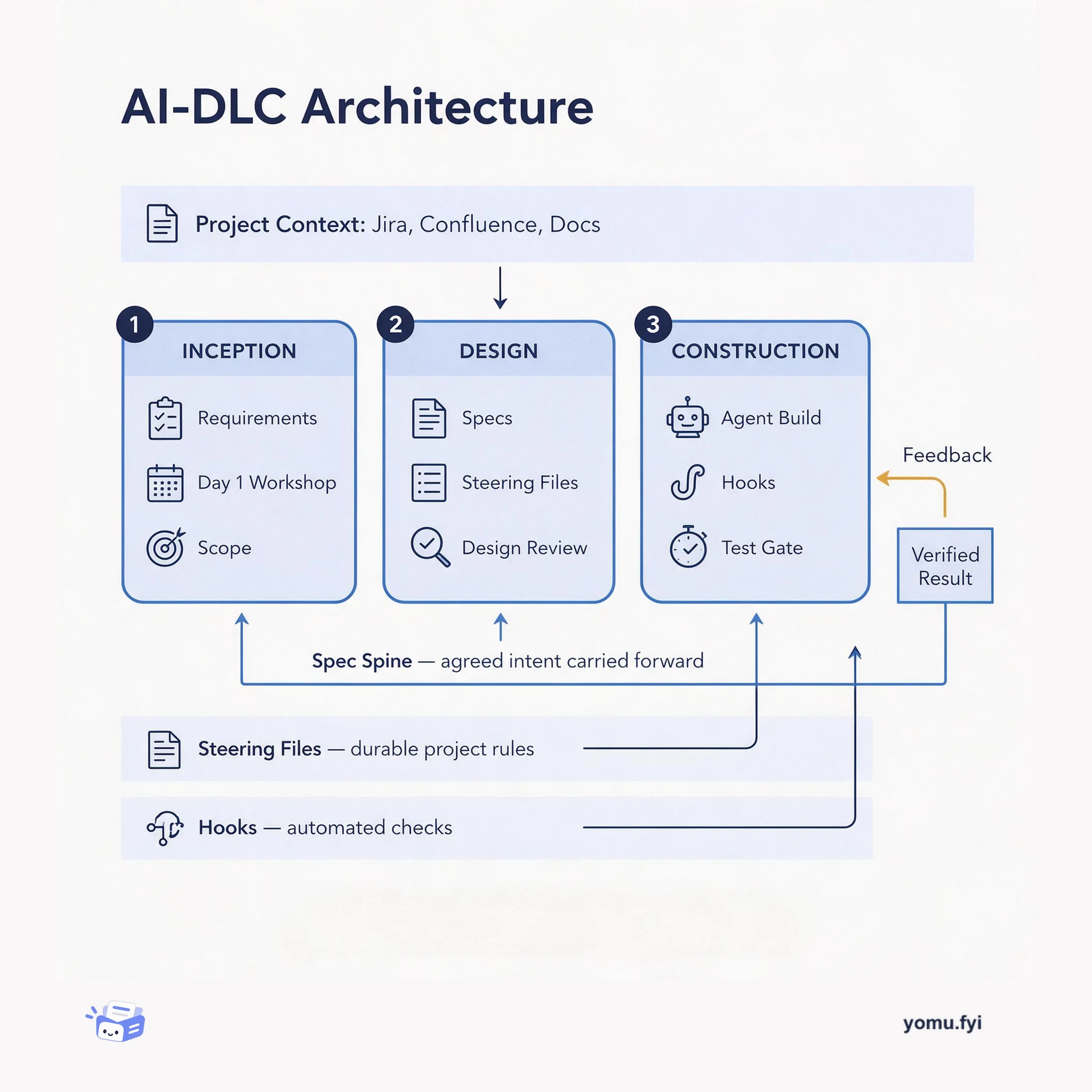
AI-DLC is an AI-driven development lifecycle that runs delivery through Inception, Design, and Construction, with specs, steering files, and hooks keeping agents aligned to agreed intent.
Apple Silicon's defining choice is one shared memory pool for CPU, GPU, and Neural Engine. This diagram maps that fabric, the on-package bandwidth it buys, and the scaling limits it imposes.
Antimicrobial resistance surveillance is a layered data architecture: raw reads and demand signals flow in, get normalized into governed tables, and answer plain-language queries. The diagram maps each boundary.
The Good Stuff
Paid picks we use ourselves. Links carry a referral code — a subscription through one earns us a commission at no extra cost to you.