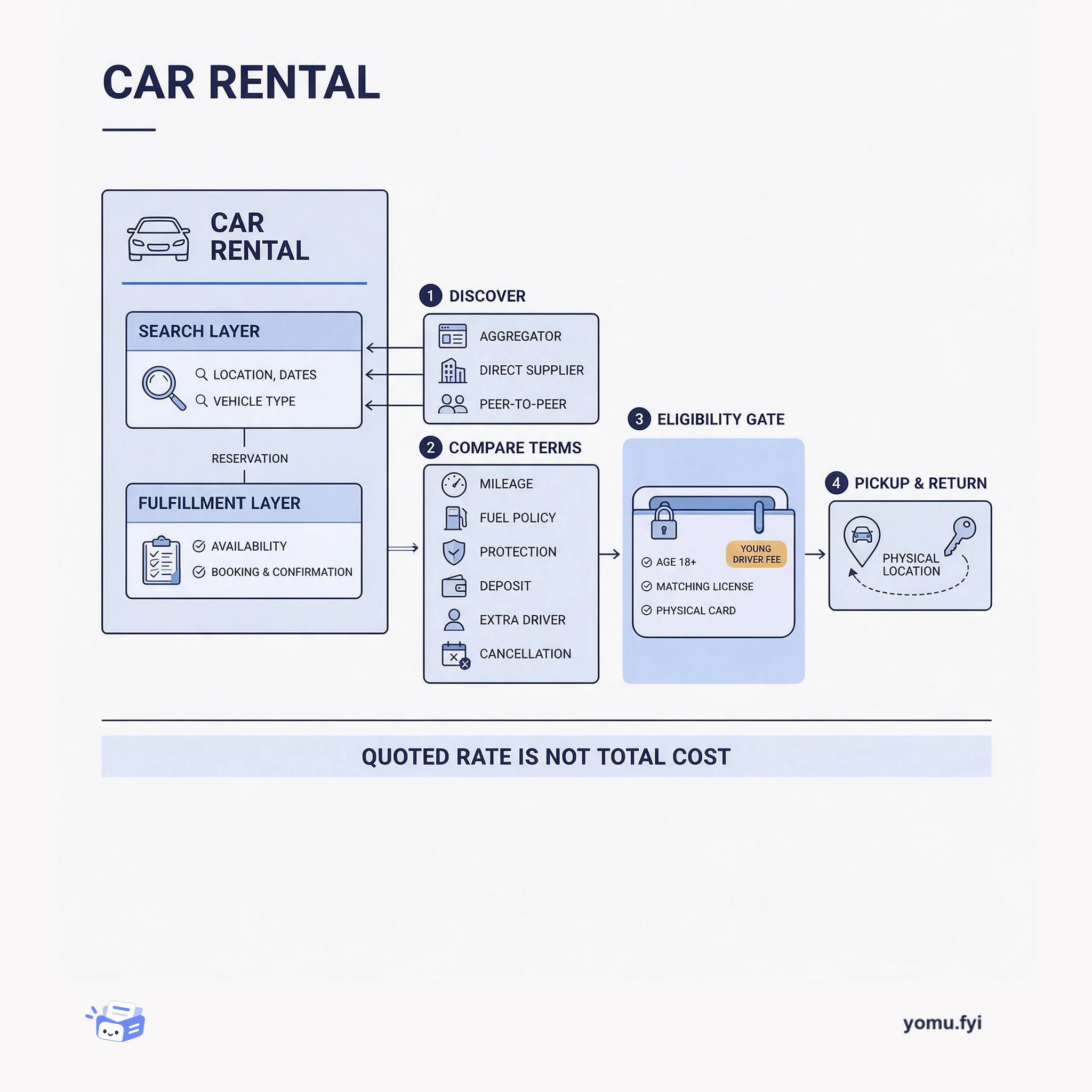
Car Rental: A Search Layer, a Contract, and a Handover
A car rental is a search layer over many fleets plus a contract enforced at the counter. This explainer maps its four parts and why the advertised daily rate never equals the total cost.
Argo CD is a GitOps controller that treats Git as the desired state and continuously reconciles it against what actually runs in each cluster. It maps the parts of that loop and why pull-based agents change its scale.
Argo CD is a GitOps controller. A Git repository holds the desired state as manifests, the cluster holds the observed state, and a reconciliation loop continuously compares the two and syncs the difference. In the classic model a central hub reaches into every cluster; in the pull model a lightweight agent on each cluster fetches its own configuration, which removes inbound administrative ports and cuts cross-cluster traffic. Understanding those parts, desired state, observed state, the diff, and who initiates the connection, is what makes scaling, security, and failure behavior predictable.
The hub's Kubernetes API limits tend to bind first, followed by informer processing slowdowns that cause watch restarts and event writer retries under load. ApplicationSet controller RAM consumption is another observed pressure point. These showed up in a 42-machine, 500-cluster test, and the findings are feeding back into future OpenShift GitOps releases.
Sync tells you the cluster matches Git, not that the running system is correct, so verification is a separate layer. Readiness checks that run real workloads and attribute failures to specific nodes, and disruption-aware node updates that respect budgets and drain before applying changes, are the kinds of checks that close that gap. Treat sync as the start of validation rather than the end of it.
The posts behind it
 Red Hat · · Benchmark
Red Hat conducted a performance and scale test of the argocd-agent pull architecture for GitOps, using 42 physical machines, 500 spoke clusters, and software including OpenShift 4.21 and OpenShift GitOps 1.20. The pull model decentralizes reconciliation to lightweight agents on each managed cluster, which pull configurations from a central hub, improving security by eliminating inbound administrative ports and reducing cross-cluster network traffic by up to 80%. In the bootstrap scenario, generating and syncing 31,200 applications across 480 clusters completed in 13 minutes 3 seconds, while the sync-to-commit scenario, which includes a polling delay, took 13 minutes. The test revealed bottlenecks including Kubernetes API limits on the hub, informer processing slowdowns causing watch restarts, event writer retry issues under load, and ApplicationSet controller RAM consumption. The team also deleted all 31,200 applications in 4 minutes 53 seconds using cascading deletion, and the insights are informing future OpenShift GitOps releases.
 NVIDIA · · Explainer
GPU clusters can pass standard health checks yet fail under real AI training workloads due to a single degraded GPU, network link, or misrouted traffic. NVIDIA Cluster Readiness Engine (NVCRE) is an open source Kubernetes controller that runs real distributed workloads across topology-aware node groups before production jobs land, measuring results and reporting which nodes failed each test. Its layered API uses Custom Resource Definitions for Certification, Workflow, and Job resources, attributing each failure to a specific node and category such as NCCL bandwidth or training goodput. The WorkloadRun API handles platform detection, NCCL settings, shared-memory volumes, and gang scheduling, so operators do not need to write those manifests by hand. NVCRE integrates with NVSentinel for passive telemetry and is available under Apache 2.0, with a roadmap for inference and automated lifecycle validation.
NVIDIA · · Problem & solutionManaging Kubernetes node fleets, especially GPU nodes, is difficult because host-level changes can disrupt long-running training jobs, and traditional tools are not cluster-aware. NodeWright, an open-source Kubernetes-native package manager from NVIDIA, solves this by declaratively configuring and updating node operating systems while respecting PodDisruptionBudgets and non-interruptible workload labels. The operator orchestrates a sequence of cordon, wait, drain, apply, interrupt, and uncordon on each node, using container image packages that carry modifications such as kernel parameters, security agents, and verification scripts. It supports progressive rollouts across a fleet via DeploymentPolicy compartments with configurable disruption budgets and strategies like batch, canary, and rolling. NodeWright integrates with NVIDIA AI Cluster Runtime for validated configurations and is part of the DSX OS open-source portfolio, available under Apache 2.0.
Red Hat · · TutorialRed Hat provides the Red Hat build of OpenJDK for running Java applications on Red Hat OpenShift 4. Developers can use the standalone Source-to-Image (S2I) CLI to build and test OpenJDK container images locally before deploying to a cluster. S2I produces reproducible images by injecting source code into a builder image and running its assemble script. The toolkit supports flags such as –loglevel for detailed output, –environment-file to pass custom JVM settings like G1GC and MaxRAMPercentage, and –as-dockerfile to output a Dockerfile. After building, the image can be tested locally with docker run, then uploaded to the cluster for deployment.
 Cursor · · Announcement
Cursor launched two bots for the last mile of shipping code: Rollouts and Security Review. Rollouts watches every change as it deploys and reports health per environment, with verdicts of verified healthy, regression detected, or inconclusive. It reads the diff and systems a pull request touches, writes a monitoring plan as a PR comment, and tracks deploy events per environment. Security Review reads every pull request in the context of the codebase and posts one review comment reporting exploitable bugs, including injection, authentication bypasses, and secrets. Both bots are available today on Teams and Enterprise plans, with usage credits for the next 10 days.
More like this
A car rental is a search layer over many fleets plus a contract enforced at the counter. This explainer maps its four parts and why the advertised daily rate never equals the total cost.
An app store is a distribution surface, a versioned contract, and a health loop between a platform and its developers. Here is how those parts fit together and why each one fails loudly if ignored.
A GPU-resident astronomy pipeline keeps every stage of image analysis — load, align, subtract, detect, review — inside GPU memory instead of round-tripping through the CPU.
The Good Stuff
Paid picks we use ourselves. Links carry a referral code — a subscription through one earns us a commission at no extra cost to you.
One useful email. Unsubscribe anytime.


