Automated Testing Is a Verification Layer, Not a Test Count
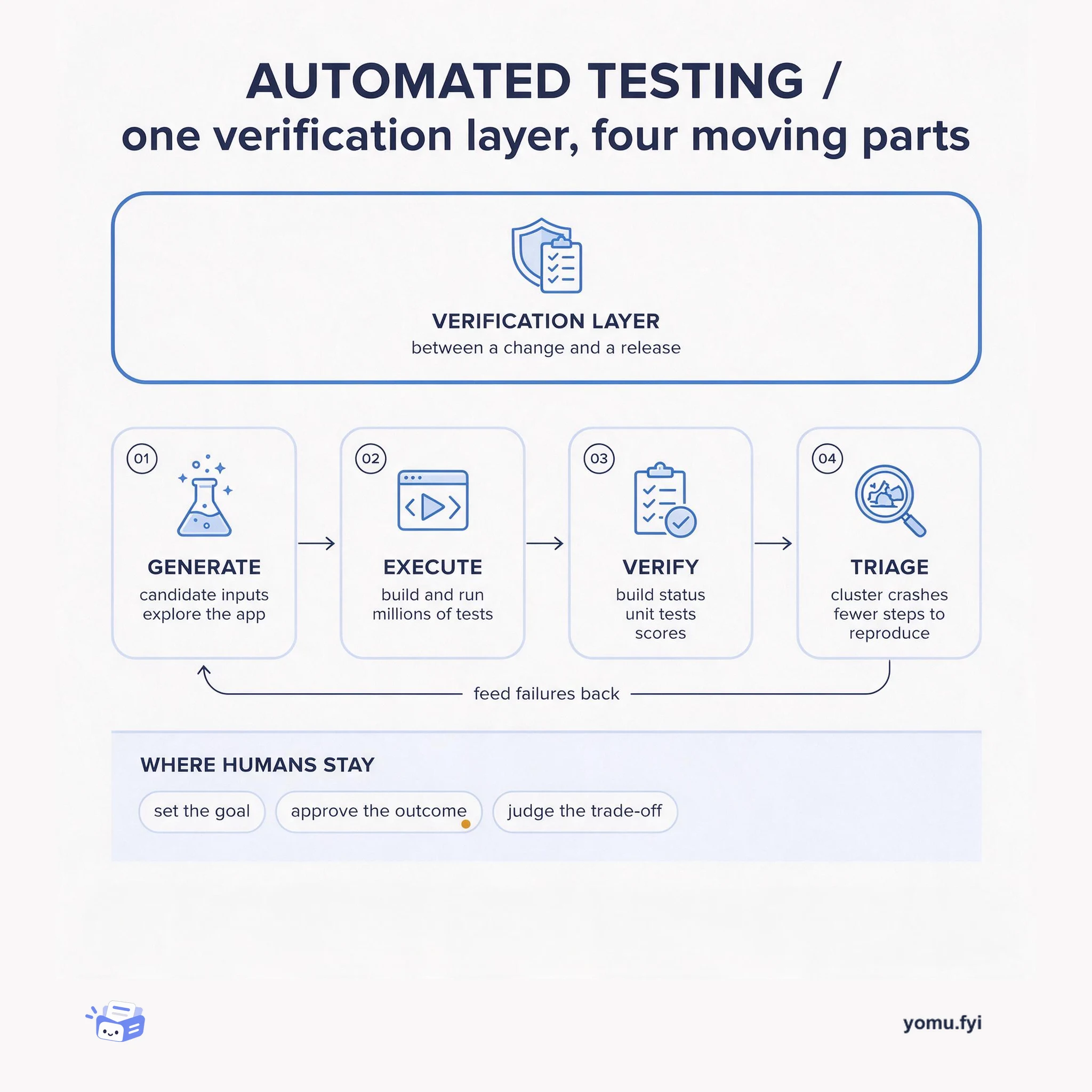
Automated testing is a verification layer with four moving parts: generate, execute, verify, and triage. This explainer maps each part and shows where human judgment still belongs.
Loading…
Topic
82 posts about Automation. Every summary links to the original.
See the idea
Automated testing is a verification layer with four moving parts: generate, execute, verify, and triage. This explainer maps each part and shows where human judgment still belongs.
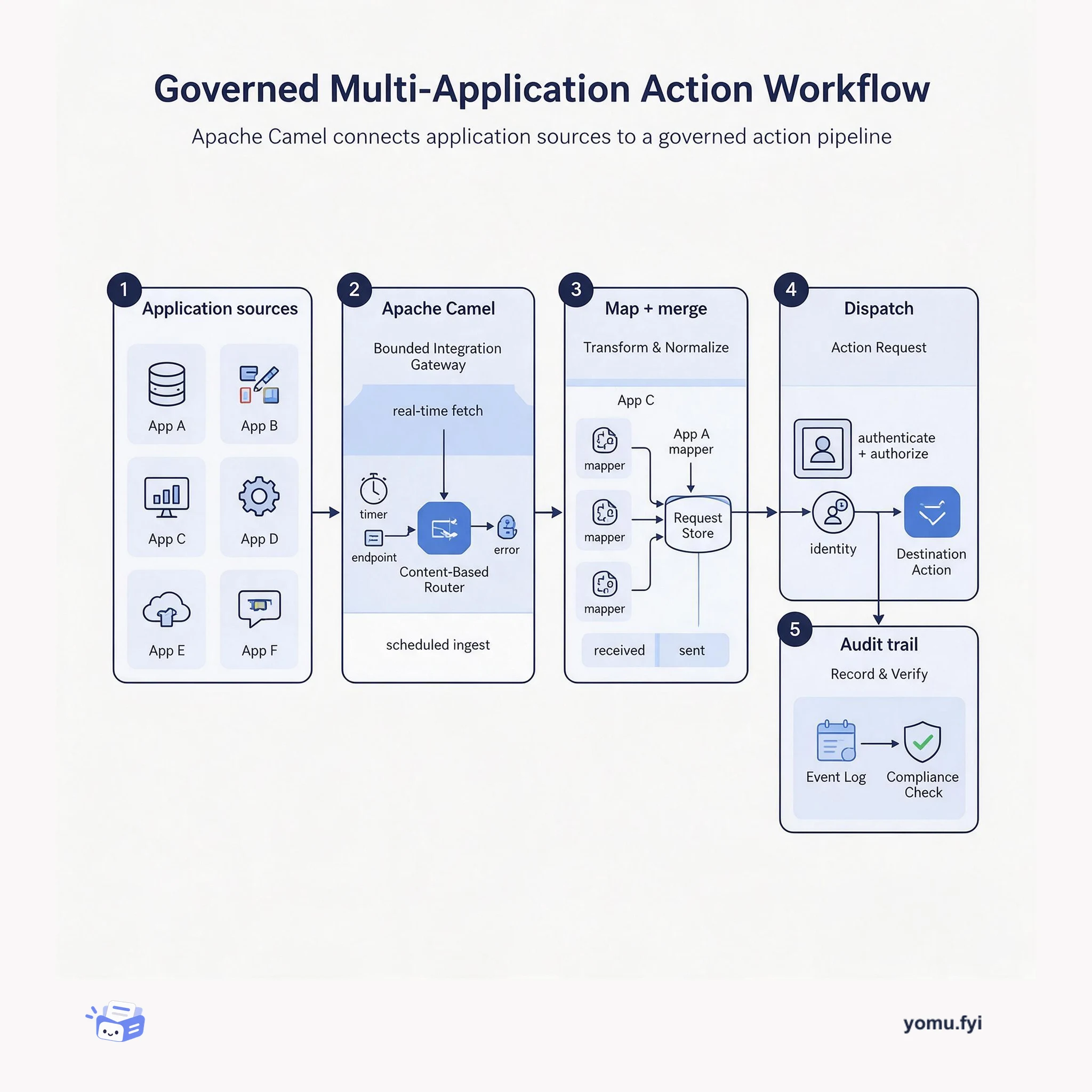
Apache Camel is shown as the integration path that brings application actions into one request workflow. The diagram clarifies real-time versus scheduled ingestion, mapping, merging, authorization, and audit.
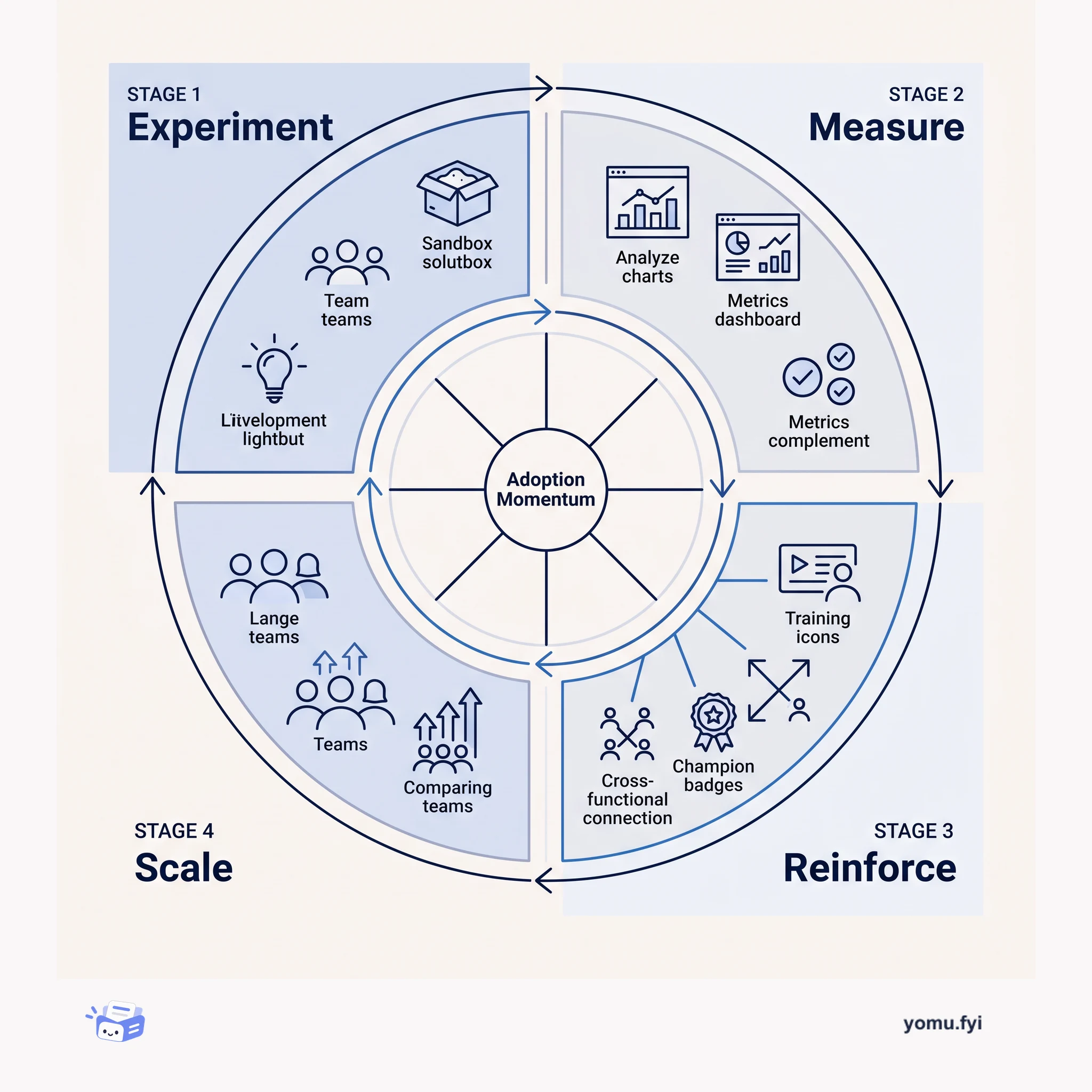
Adoption moves through experimentation, measurement, and reinforcement loops. Learn how leading companies build momentum from pilot programs into enterprise-wide habits and measurable business impact.
The Good Stuff
Paid picks we use ourselves. Links carry a referral code — a subscription through one earns us a commission at no extra cost to you.
Newest first
Cursor Automations are now available in the Agents Window as well as the existing Automations interface, allowing users to create and manage them alongside agents in the same workspace. The release also lets an automation attach multiple repositories, so agents can use context across codebases to deliver, test, and verify tasks, or run with no repository when the work is not code-centered. For no-repo use cases, five Cursor Marketplace templates cover Slack digests, product analytics, FAQ drafting from Slack and documentation context, finance reporting from providers such as Stripe, and customer health monitoring across tools including Granola, Slack, and Databricks. Newly created automations receive a 50% discount on all agent runs for the next seven days, while the release directs users to the documentation for more information.
Agent evaluations often ask what an AI Agent can do, but the larger constraint may be whether an organization is structured to let it act. Across organizations in energy, healthcare, ecommerce, gaming, financial services, and property management, teams found that Agents could often perform actions technically, but stalled on unreliable identification, inaccessible live data, or unreachable vendor systems. The post describes five readiness types—content, scope, procedural, data, and execution—and says deeper automation depends on documented processes, trustworthy connected data, stable APIs, and clear ownership of risk. Teams that lacked these foundations often redesigned toward guiding users rather than executing changes, while teams with standardized operations could trigger tightly controlled actions. The unresolved question is how readiness develops, since the gaps may involve undocumented procedures, fragmented systems, missing APIs, or infrastructure and accountability investments beyond buying a more capable Agent.
Operator is an agent for customer operations that works across Fin and the Intercom helpdesk, addressing the ongoing effort required to manage AI and human support work. It can analyze operational data and conversation samples, explain metric changes and root causes, maintain help-center content from briefs, and identify content gaps with localized drafts. Operator can also debug Fin conversations, propose configuration fixes, build Procedures and other automations, run simulation tests, and support incident response and rep management. Its purpose-built tools and proposal system present structured diffs for review, editing, and approval before changes go live; the announcement says more than 200 early users are trying it and that it is available in early access.
Notion introduces a Developer Platform with Workers, data synchronization, custom agent tools, external agents and a CLI for extending its workspace beyond built-in capabilities. As teams connect agents to more workflows, the platform addresses gaps involving external data, custom logic and agents that cannot otherwise participate in Notion. Workers run custom code in a hosted secure sandbox, enabling database sync, agent tools and webhook triggers without user-managed servers; the CLI supports authentication, Notion actions and Worker deployment from a terminal or IDE. External Agents can work natively alongside teams and Custom Agents, while the External Agent API supports bringing internally built agents into the workspace. The CLI is available on all plans, Workers are in public beta for Business and Enterprise plans, and External Agents are offered through a private-beta waitlist.
Okta’s API Integration Actions let independent software vendors build Provisioning, Entitlements, and Universal Logout integrations in the Okta Integration Network using Workflows, Okta’s low-code builder. The approach maps existing APIs directly to Okta action contracts, allowing developers to avoid building and maintaining a SCIM server while translating API calls into formats Okta can consume. The guide walks through creating an OIN integration, configuring tenant and authentication mappings, adding API Integration Action components, building and validating flows, and submitting them through the OIN Wizard. It also explains how to create and update an org-only test instance before review, noting that submission changes do not automatically update an existing test instance for security reasons.
Notion’s Custom Agents launched in beta in February, and more than one million agents were created in two months before the feature moved out of beta. The post reports that teams scaled fastest when they treated agents as internal products, iterated with workflow experts, and shared operational knowledge rather than relying on engineers alone. Teams also redesigned end-to-end processes, such as Braintrust’s agent that scans competitor updates and Gong transcripts, updates a Notion sales one-pager, and flags relevant launches. Usage costs fell by up to 50%, partly through lighter models including Haiku 4.5 and GPT-5.4 Mini, which use up to 10× fewer credits, while new limits, dashboards, alerts, and pause controls support administration. From May 4, usage-based pricing applies through Notion credits at $10 per 1,000 credits for Business and Enterprise plans.
Uber for Business is a centralized platform that helps organizations manage rides, meal deliveries, incentives, and related programs. Since 2014, it has brought Uber’s technology to organizations across industries, and the page says more than 200,000 companies use it worldwide, including more than half of the Fortune 500. Administrators can create travel and meal programs, set policies, spending limits, approved locations, and user access, while employees and clients use the Uber and Uber Eats apps. Dashboards provide spending, compliance, reporting, ride status, costs, and emissions data, with expense integrations such as Navan. Use cases include airport and event rides, subsidized commutes, courtesy transportation, executive travel, individual or group meals, and customer incentives.
Sales leaders have treated pipeline growth as constrained by headcount, making a 30% increase appear to require 30% more people. The post presents Intercom’s use of Fin, its Customer Agent, for inbound sales as a separate pipeline source rather than merely an efficiency layer for SDRs, with its own metrics, targets, and owner. Fin engages inbound prospects instantly, qualifies and routes high-intent visitors, and keeps lower-intent prospects warm, while SDRs focus on phone qualification, relationship-building, and helping trial users realize value. Drawing on customer-service implementation, the operating model includes dedicated AI ownership and continuous optimization against meetings, pipeline, and revenue. The conclusion is that AI can raise the pipeline ceiling above current headcount capacity, although the constraint shifts to how well the Agent understands the product, customers, and demand qualification.
The Sales Agent Blueprint is a newly announced guide for sales, revenue, and AI transformation leaders seeking to launch and scale AI for inbound sales. It addresses manual inbound workflows in which leads wait in queues, making outcomes depend on team timing and capacity rather than buyer intent, and describes agents that engage buyers, qualify leads, and route high-intent opportunities in real time. The first available track, “Launch it,” covers understanding Sales Agents, building a business case, deciding whether to buy or build, evaluating performance with a five-step framework, planning deployment, and continuously training, testing, deploying, and optimizing the system. A second track, “Scale it,” is coming soon and will focus on redesigning the buyer journey, AI-first systems and ownership models, and pipeline generation and scaling.
Fin for Sales is a new role for Fin Customer Agent that handles inbound sales from initial engagement through qualification, routing, and conversion. It starts conversations across messenger and email, uses page context and smart suggestions, and applies playbooks, knowledge, enrichment, and memory to answer questions, handle objections, and personalize discovery. Fin qualifies prospects in real time by collecting details about use case, budget, fit, and timing, syncing structured context and conversation history to a CRM, and directing leads to sales teams or self-serve paths. It can book meetings through Chili Piper or Calendly, initiate trials or subscriptions, and hand off an AI-generated summary to representatives. The announcement reports early results including Fellow booking 18 previously unreachable meetings in January at around 48% conversion, while positioning Fin for Sales as part of a shared Customer Agent platform.
Launch Week 6 concluded with five feature releases and one announcement covering email automation, content creation, developer tooling, tracking, and community events. Automations orchestrates lifecycle emails from application events with delays, waits, conditions, test runs before publishing, and real-time visibility into runs. The AI-extended editor turns URLs into on-brand drafts, supports inline block editing and mistake detection, and connects to agentic stacks through the Resend MCP server, while CLI 2.0 adds React-file sending, automation and event management, webhook listening, and AI-agent skills across more than 50 API commands. Custom tracking domains support click and open tracking, React Email 6 adds an embeddable editor and extensions API, and Resend Forward was announced as a San Francisco conference scheduled for October 21.
Resend CLI 2.0 gives terminal-based access to the full Resend API and adds four features: sending emails from local React (.tsx/.jsx) files, managing automations and events, one-command webhook listening with automatic tunneling, and Agent Skills for autonomous API interaction. Users can now create automation runs, inspect results, and build multi-step workflows directly from the command line. The webhook listener automatically sets up a tunnel and forwards all event types to a local server, eliminating the need for separate tunneling tools. Agent Skills provide a structured interface enabling AI agents to independently manage their own inbox, sign up for accounts, receive confirmation emails, process attachments, and respond without manual intervention. Other improvements include programmatic log retrieval, enhanced API key storage via the system keychain (macOS Keychain, Linux Secret Storage, Windows Credential Manager), and the deprecation of the team command in favor of auth.
Complex customer-support queries are relatively infrequent but consume disproportionate handling time and shape customers’ memories of service, especially when they require action across systems. The post distinguishes informational, personalized, and action-led queries, then positions Fin Procedures as a way to automate complex cases through configurable multi-step processes using natural-language SOPs, branching logic, data connectors, and AI-powered simulations. Since managed-availability launch, Procedures has handled more than 1.5 million conversations across hundreds of apps, with volume doubling month over month; a randomized 5% holdout found CSAT 28.93% higher when Procedures ran. The product is available to all 8,000+ Fin customers and adds review, failure reporting, rollback, connector monitoring, email simulation, and Agent in the Loop checkpoints for human approval or missing integrations.
Intercom’s Fin teams use cross-functional swarms to identify customer needs while helping customers increase automation and understand the product. In these high-touch engagements, engineers, data scientists, and a product manager analyze conversations, APIs, Procedures, and workflows, using fast feedback to test configuration changes and estimate achievable automation; one manual taxonomy analysis took more than half a day and predicted a 70% rate that the customer achieved. Cockpit then encodes swarm patterns into repeatable workflows, letting customer success managers and Sales assess automation potential, diagnose issues, and suggest next actions across accounts without repeated data-science involvement. It also tests whether ideas generalize before product development. Patterns that prove broadly useful, robust, and scalable can move into product features such as the automation taxonomy in Insights and CX Score, which measures conversation quality; unlike Cockpit, product features must work for every customer without configuration.
Brainlabs CEO Dan Gilbert describes “execution tax” as the gap between a decision and its outcome, where meeting action items are recorded, chased, or lost. He argues that AI has improved engineering productivity while leaving strategists, account managers, and operators with fragmented context and a wide gap between thinking and doing. Brainlabs chose Notion as a company-wide context layer and built “Get Stuff Done,” a factory of Notion Custom Agents that captures action items, assigns owners, and executes suitable work. Its automation uses Notion Custom Agents for native tasks, Notion Workers for external integrations, company-specific Skills and selected LLMs for complex tasks, and human-in-the-loop workflows when judgment remains necessary; Gilbert says some decisions now become completed work in minutes rather than weeks.
AI adoption is widespread in customer service, but the report identifies a deployment gap between organizations experimenting with the technology and those integrating it deeply into operations. Based on a survey of 2,470 global support professionals, it finds that 82% of senior leaders invested in AI in the past year and 87% plan to invest in 2026, while only 10% report mature deployment. Mature teams put AI at the core of workflows, give it meaningful responsibility, and use continuous improvement to achieve higher-quality, more consistent support; 43% report that outcome, nearly double the rate for teams at initial deployment. Lightspeed illustrates the approach by combining tailored training, executive alignment, content investment, and AI operations discipline, reaching 72% Fin resolution without human intervention across 43,000-plus monthly requests and 12-plus languages.
Intercom describes how its Customer Support team adopted an AI-first strategy after a 2022 review exposed rising demand, weak service-level commitments, and plans to broaden support access. The team began with high-volume informational queries, then expanded Fin through deeper documentation, internal procedures, customer-action capabilities, knowledge management, conversation design, skills-based routing, and organizational changes including a dedicated AI Support team. Fin now resolves over 81% of support volume and helped absorb a 300%+ demand increase without proportional headcount growth, while over 90% of customers receive improved first response performance, 24/7 coverage, and outbound phone support. The remaining human work has shifted toward consultative engagements, while Insights, Guidance, Tasks, and Procedures support ongoing optimization. Next, the team plans to use a four-stage Fin Flywheel—Train, Test, Deploy, and Analyze—and continue developing its Agent Blueprint.
February updates for Fin address constraints in complex automation, voice quality, Shopify deployment, and helpdesk operations. Procedures can be drafted from existing source material, edited in natural language with hooks for live data, business logic, and deterministic code, then tested step by step in simulations using conversation data and defined criteria. Voice changes add pronunciation rules, 11 new voices, and automatic background-noise reduction, while Shopify setup connects a store, installs Messenger without code, and deploys Fin in under two minutes. Helpdesk additions include 11 call metrics and automatic public-holiday office hours; the post says 19 improvements shipped in 2026, and concludes that all featured updates are live and available now.
Intercom announces 12 updates to Fin’s Procedures and Simulations, the mechanisms it presents for handling complex customer queries while keeping teams in control. Procedures combine natural-language instructions, deterministic controls such as conditional steps, data connectors, code snippets, checkpoints, and fully agentic behavior; new features include AI drafting, reusable Sub-procedures, explicit switching rules, targeted knowledge-hub references, internal handoff notes, automatic switching, and structured extraction from PDFs and images. The Procedures UI also adds improved authoring and reporting on triggers, resolutions, and handoffs. Simulations support full multi-turn conversations, image uploads, clearer visibility into Fin’s reasoning, and AI-generated tests stored in a central library that can be rerun after changes. Procedures and Simulations are available now, with the stated goal of helping teams train, test, deploy, analyze, and refine complex workflows before and after launch.
Notion describes how Custom Agents are being used internally to automate repetitive questions, triage incoming work, and support communications, security, recruiting, and office operations. Agents are configured by describing a workflow and adding a trigger or schedule; they operate across Notion, Slack, Mail, Calendar, and other tools while using existing knowledge for context. Examples include a CX agent that searches the CX Knowledge Base and enablement docs, a Feedback Router that classifies Slack feedback and creates tasks, and Wilbur, which triages web issues and tags the right person. The company says these workflows make knowledge available beyond individual experts, reduce manual routing and response delays, and shift attention toward complex problems and creative work.
The best engineering reads, once a week.