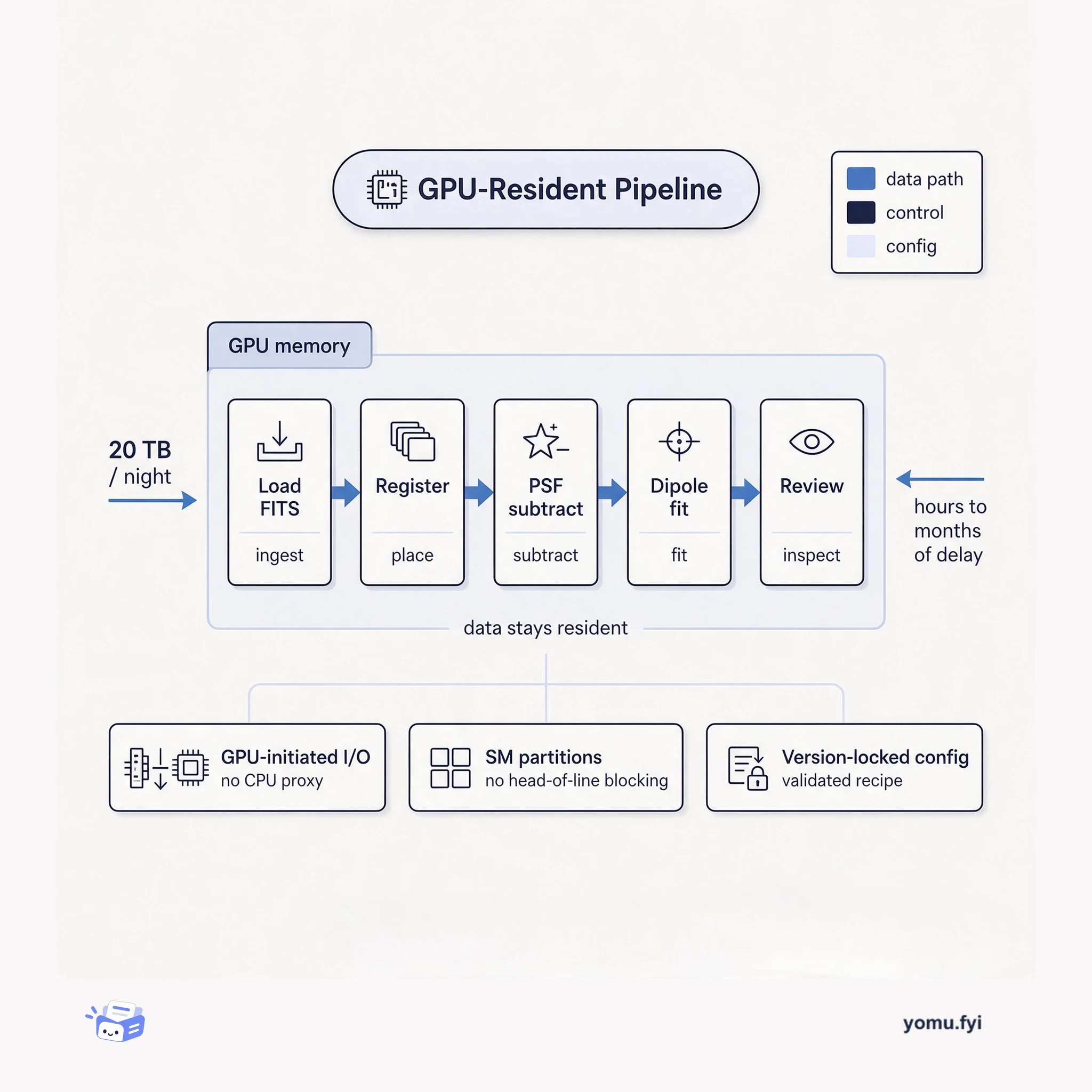
The GPU-Resident Astronomy Pipeline
A GPU-resident astronomy pipeline keeps every stage of image analysis — load, align, subtract, detect, review — inside GPU memory instead of round-tripping through the CPU.
Loading…
Topic
247 posts about Data Pipelines. Every summary links to the original.
See the idea
A GPU-resident astronomy pipeline keeps every stage of image analysis — load, align, subtract, detect, review — inside GPU memory instead of round-tripping through the CPU.
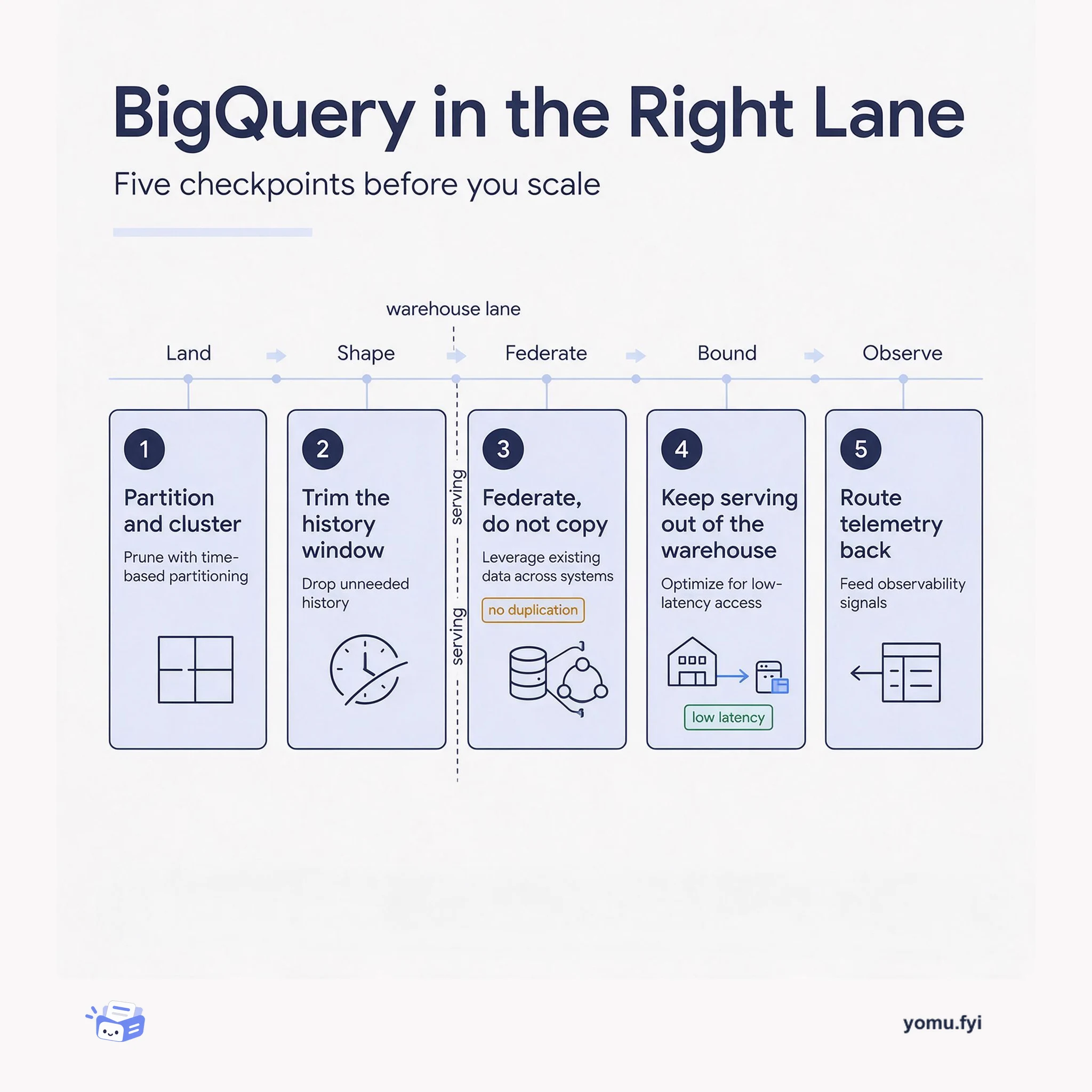
A five-checkpoint workflow for keeping BigQuery in the right lane: land and shape data once, tune partitions and history windows, and federate instead of copying.
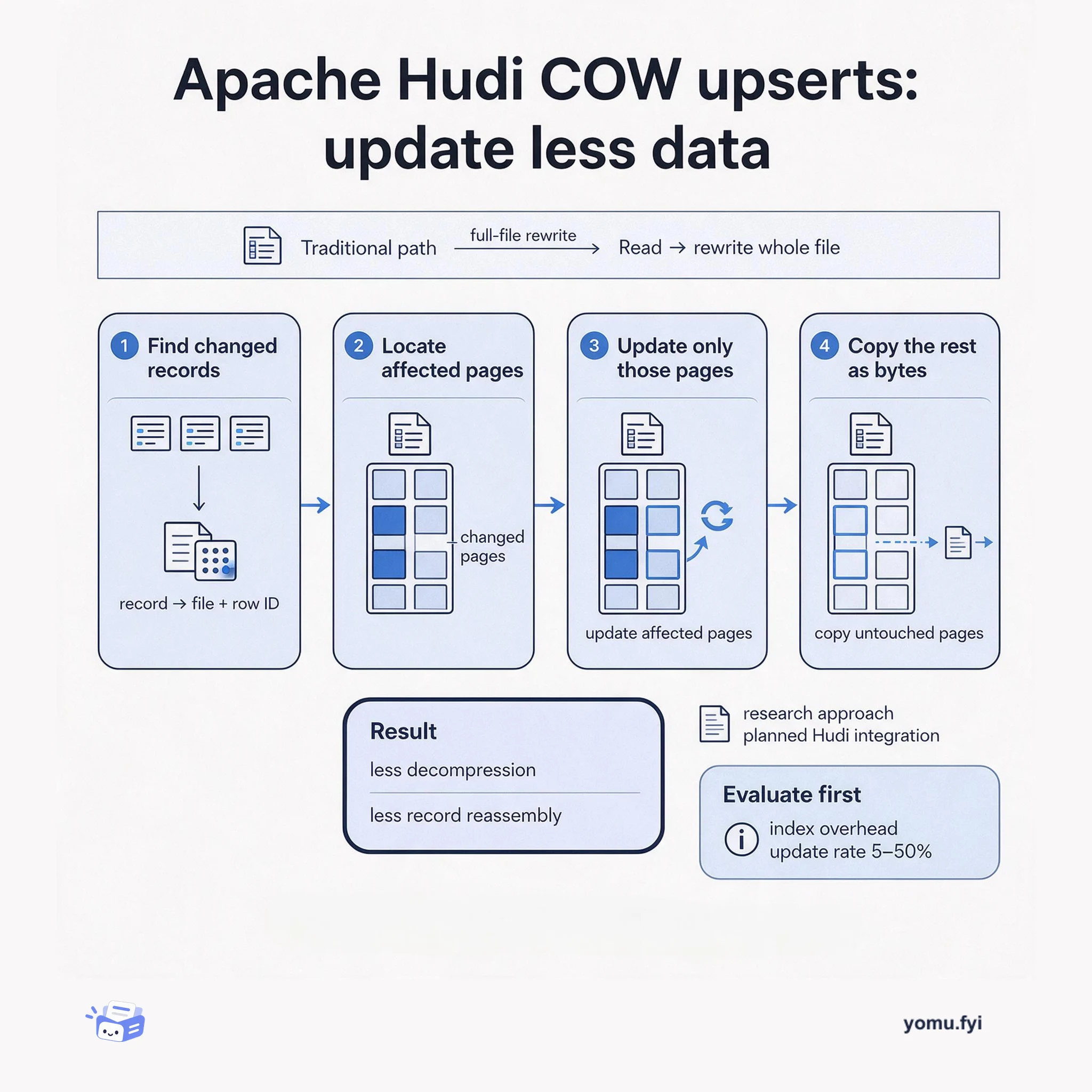
Learn how Apache Hudi copy-on-write upserts can use row-level file and page locations to update changed data while avoiding unnecessary decompression and rewriting.
The Good Stuff
Paid picks we use ourselves. Links carry a referral code — a subscription through one earns us a commission at no extra cost to you.
Newest first
Verihubs rebuilt its data warehouse after a Postgres-based, daily-batch pipeline became slow, unreliable, and difficult to correct when late vendor callbacks required backfills. The new architecture uses Kafka, Kafka Connect, and Debezium for real-time ingestion into ClickHouse, with MergeTree for append-only logs and ReplacingMergeTree for datasets updated through change data capture. Materialized views create daily and monthly rollups, projections accelerate existing query patterns, and Dagster handles complex detection workflows that can notify Slack. The migration, completed in about six months, reduced query times from 20–30 minutes to two or three seconds on datasets up to 18 million rows, representing as much as 98% faster queries and 50% lower infrastructure costs. Verihubs says the resulting real-time OLAP system gives finance and operations fresher data for traffic analysis, reconciliation, performance reporting, and invoicing.
Jua uses ClickHouse Cloud to deliver data from EPT-2, its physics foundation model, to energy traders and grid operators faster than its previous file-based pipeline. Jua’s forecasts combine outputs from multiple models and add roughly four terabytes of new data daily, producing about one petabyte compressed and over 10–12 petabytes uncompressed. Replacing Zarr and other file-based storage plus manual pre-fetching with ClickHouse Cloud reduced flagship forecast delivery from one hour to 20 minutes, with about 20 seconds of upload overhead. The platform also cut compute costs by roughly a third, reduced two-year single-location historical queries from hours to seconds, and supports both point lookups and regional aggregations; Jua selected the managed service for operational simplicity, separated storage and compute, and cost efficiency.
Databricks presents video analysis as a data engineering problem for organizations with terabytes of footage that is difficult and expensive to review manually. An app accepts a video and a natural-language prompt, then triggers a Lakeflow job on Serverless GPU Compute to run Meta’s SAM3 segmentation model frame by frame and retain matching moments. Those clips preserve original timestamps and are sent through the Databricks Foundation Model API for summaries that can be written to tables or passed into downstream workflows. In one example, 26 minutes of traffic footage became one minute and 55 seconds of relevant video. The model-agnostic pipeline uses MLflow signatures to support interchangeable or custom models, while event-driven execution and independent serverless GPUs allow concurrent processing without cluster management or idle GPU costs.
AVL’s Lakehouse for Measurement Data addresses the scale, reproducibility, and governance limitations of desktop tools and isolated scripts used for automotive measurement analysis. Built on Databricks, the platform ingests ASAM MDF4 and other files into a Medallion Architecture, applies configurable DQX quality rules in a hierarchical Silver model, and uses Impulse to compile declarative Python TSAL expressions into distributed Spark execution. Engineers can select channels, create virtual signals with alias resolution, unit conversion, time alignment, and interpolation, define events, and compute duration- or distance-weighted aggregations in about 10 lines of Python. Impulse supports Gold-layer reporting, ad-hoc Spark DataFrames, and ML feature matrices, with Unity Catalog governance and Workflow orchestration. AVL reports reducing analysis time from days to minutes, processing many recordings per run, lowering infrastructure costs versus on-premises solutions, and enabling self-service, reproducible, standardized analysis.
Pinterest's CDC ingestion platform relies on a multi-stage pipeline built with Kafka, Flink, Spark, and Iceberg, where upstream schema updates risk disrupting data transformations and offline storage. To prevent pipeline failures and schema drift, Pinterest introduced an automated schema evolution framework based on a staged convergence model. Upstream changes are detected via push-based DDL messages and daily pull-based validation checks. The workflow automatically restricts automated updates to additive changes and numeric precision widening, updating Iceberg table definitions and regenerating Flink and Spark code through auditable pull requests. By decoupling schema divergence, code deployment, and data convergence, the system maintains continuous ingestion availability while working toward eventual schema consistency across all storage layers.
Daikin Applied Americas needed to scale reliable data pipelines across growing analytics and AI use cases involving operational, manufacturing, and service data while coordinating development across teams. It adopted Databricks Genie Code within a structured operating model, using Unity Catalog context, reusable MECE skills, and explicit checkpoints across Bronze, Silver, and Gold layers to guide planning and execution. The framework defines competencies such as source grain, transformation patterns, canonical alignment, governance, and business-entity modeling, moving standards out of long prompts and into the development environment. The team reports that pipelines that once took days to prototype could be generated in minutes, with faster iteration, more consistent outputs, less structural correction, reduced architectural drift, and greater trust in AI-assisted results.
Visa used ClickHouse Cloud to modernize reporting on Authorize.net payments data, replacing multi-day analyst-led turnaround with natural-language queries for internal teams. The solution pairs LibreChat, an open-source conversational interface, with the ClickHouse MCP server and runs on ClickHouse Cloud on AWS, allowing agents to explore and query a roughly 40 PB data footprint containing millions of rows. ClickHouse materialized views pre-compute and incrementally update results, reducing scanned data and bringing example analyses down to 100–200 milliseconds, with reported speedups of roughly 30–70 times. The platform also uses encrypted transfers, Amazon S3, VPC PrivateLink, change data capture, and federated access controls, while Visa reports identifying millions of dollars in revenue risk and reclaiming 8–10 hours per user each week.
CostBench compares Snowflake and ClickHouse Cloud as end-to-end real-time analytics systems rather than measuring reads on a static, prepared dataset. It evaluates continuous ingest, raw-data organization, pre-aggregation freshness, and continuous query serving while background work continues, testing Snowflake’s standard-table and Interactive Tables paths alongside ClickHouse. The benchmark is designed around fresh data becoming query-ready as it arrives and distinguishes sustained real-time ingest from bulk loading or backfill. In the reported results, ClickHouse achieved 969× better cost-performance than Snowflake’s standard materialized-view setup and 180× better than its Interactive Tables setup; among the tested paths, only ClickHouse incremental materialized views kept pre-aggregations continuously synchronized without lag.
DataOps is presented as a collaborative practice that applies DevOps principles—continuous integration, automated testing, and rapid delivery—to the full data lifecycle, from ingestion and transformation through trusted data-product delivery. It treats data as a continuously delivered product, with technical and non-technical participants sharing an operational cadence to improve quality and shorten time-to-insight. The recommended operating model standardizes source onboarding, enforces schemas at ingestion, uses idempotent jobs, version-controls transformations, and promotes them through tested staging and production environments, with the Bronze, Silver, and Gold layers serving as quality gates. Automated unit, data-contract, and regression tests, alongside observability, anomaly detection, SLAs, lineage, and documented rollback procedures, support reliable delivery and faster incident diagnosis. Organizations with mature DataOps practices report up to 99% fewer data-downtime incidents and 30–50% less reactive maintenance.
Scientific instruments and high-bandwidth sensors generate immense data volumes, but traditional architectures rely on a store-then-analyze model that bottlenecks real-time discovery and forces extensive data discarding. NVIDIA DAQIRI shifts data acquisition to a software-centric pipeline that connects streaming detectors directly to GPU computing. Built as part of the NVIDIA Holoscan Platform, DAQIRI uses DPDK to bypass the Linux kernel and move UDP and RoCE v2 traffic directly from the NIC into GPU DMA buffers at line rates exceeding hundreds of gigabits per second. The system automates packet reordering, flow steering, and on-GPU data conversions such as mapping wire int4 payloads into fp16 tensors using YAML configuration files and simple C++ or Python APIs. This enables real-time edge processing, filtering, and model inference across experimental pipelines like CERN ATLAS.
Spyne’s CDC pipeline streamed changes from MySQL and MongoDB through self-managed Debezium, Kafka, and ClickHouse, but table onboarding required 1 to 1.5 hours of manual work and schema drift could silently exclude new columns. The team migrated to ClickPipes and ClickHouse Cloud, where pipelines can be configured in minutes and automated schema evolution applies upstream changes to corresponding ClickHouse tables without manual intervention or restarts. To manage snapshot pauses, Spyne isolated about 10 critical historical tables in dedicated ClickPipes and grouped lower-priority tables separately. The migration also required using FINAL in downstream queries to handle ReplacingMergeTree eventual consistency, while binlog gaps may still require full table resynchronization and higher costs. Spyne reports less operational toil, faster feature and analysis workflows, and improved data consistency, accepting reduced recovery control and query-time CPU trade-offs.
A manual mitigation action during an incident corrupted a data feed for a subset of titles, causing playback issues and catalog service failures that existing code canary systems failed to catch. To protect streaming reliability, Netflix built an automated data canary system that validates transformed catalog metadata prior to publication. The architecture utilizes a dedicated orchestrator alongside permanent baseline and canary service clusters to coordinate validation using real production traffic. By leveraging custom chaos experiment thresholds, sticky session affinity, and Starts Per Second playback metrics, the system detects regressions in under ten minutes and blocks publication automatically. Controlled failure injection experiments routing approximately 0.2% of global traffic confirmed that issues could be identified in 2.5 to 4 minutes.
METRO Markets outgrew its self-hosted Impala and Kudu-based Hadoop stack as the marketplace expanded, with parallel stores, inconsistent reporting, and too much maintenance burdening a lean data team. They evaluated BigQuery, Snowflake, and ClickHouse against production queries, finding faster ClickHouse performance, including one response falling from four seconds to under 200 milliseconds, while its pricing supported more predictable costs. Airbyte moves CDC data from MySQL and Postgres into ClickHouse; ReplacingMergeTree handles deduplication during background merges, and BigQuery-hosted Google Analytics data enters through cloud storage and external tables. The resulting warehouse consolidates company data and supports seller analytics, credit risk features through Query API endpoints, observability, and emerging AI use cases, while teams query a shared dataset through compatible tools; planned Kafka and Flink integration would extend it to streaming workloads.
Appcues replaced an analytics stack that included Snowflake and Airflow after rising scale pushed queries to 20 seconds or more and limited reports to 10-minute windows. The company evaluated ClickHouse Cloud on AWS for real-time segmentation, exporting Snowflake data to Parquet in S3 and testing complex email segments with nested conditions, historical events, and negative logic. Production events now pass through Kafka and a clickwriter consumer, while a clickclient library built on Elixir’s Ecto generates controlled ClickHouse queries; SharedReplacingMergeTree, table engines, and materialized views were tuned during a one-year migration. Across 1.31 PB and 410 billion events, P95 queries fell below two seconds, ingestion latency dropped to about five seconds, and analytics costs decreased 23%, while new funnel reports and AI-powered insights were added.
Modern data pipelines move raw data from source systems through transformation and storage to downstream consumers, with batch, streaming, or hybrid operation selected according to latency needs. The guidance places service-level agreements first, defining acceptable latency, uptime, and error rates before architecture choices, and compares ETL, ELT, and zero-ETL patterns. It recommends immutable raw landing zones, CDC for transactional sources, schema registries, event replay, incremental loads, and idempotent writes using techniques such as MERGE operations. Performance and reliability practices include partitioning, clustering, data-quality checks, observability, automated CI/CD testing, and cost controls such as autoscaling and storage tiering. Adoption guidance advises piloting a representative pipeline, measuring telemetry and cost, then iterating through regular architecture reviews.
Postgres managed by ClickHouse, which entered public beta in May, received a broad update covering console operations, per-service RBAC, Terraform, Stripe provisioning, ClickPipes migrations, billing, capacity reservations, and extensions. The redesigned console adds service health, resource, and query views, while RBAC provides View and Manage roles across the console and public REST API; the alpha Terraform provider covers lifecycle operations including resizing, HA, replicas, restore, and password rotation. Postgres-to-Postgres ClickPipes now automate schema migration, usage is integrated into ClickHouse Cloud’s metering and billing, and AWS capacity reservations are allocated dynamically across availability zones. Underneath, pg_clickhouse and pg_stat_ch moved to the header-only clickhouse-c library, removing a C++ exception conflict, using Postgres memory contexts, and reducing the x86-64 Linux extension binary from 4.9 MB to 1.4 MB; the update shipped less than a month after beta, with Terraform and extensions still evolving.
SQL ETL pipelines are presented as repeatable workflows that extract data from sources, transform it, and load it into warehouses, lakes, or lakehouses for analysis and machine-learning use. The guide addresses source connectivity, extraction patterns, transformation logic, loading targets, governance, performance, testing, and operational design, while contrasting ETL with ELT and broader data pipelines. It explains that SQL can serve as the primary implementation language for transformations and load operations, with techniques including JOIN and GROUP BY, window functions, MERGE upserts, and deduplication with ROW_NUMBER() or DISTINCT. It also covers full versus incremental extraction, batch and streaming needs, schema-on-write versus schema-on-read, and layered validation using row counts, checksums, business rules, and schema-drift monitoring.
Data engineering for AI extends traditional ETL by adding requirements for model-ready data, unstructured inputs, feature engineering, governance, and production monitoring. The guide addresses data professionals building or scaling AI infrastructure, covering ingestion, architecture, data quality, privacy compliance, generative AI, and career development. It emphasizes shared feature schemas, pipeline data contracts, lineage, statistical validation, drift detection, and PII stripping or anonymization as responsibilities shared across data engineering and data science. For generative AI systems, it describes preparing RAG pipelines by ingesting and chunking documents, creating vector embeddings, and indexing them for semantic retrieval, while evaluating vector databases for latency, scale, and integration. It concludes that reliable AI depends on fresh, accurate, compliant data and ongoing operational and architectural review.
A data warehouse is a centralized repository for structured data, supporting complex queries, reporting, and business intelligence rather than transaction processing. The guide compares architectures by scale, latency, cost, scope, ownership, and governance. Enterprise data warehouses integrate organization-wide sources through ETL, apply cleansing and validation, and provide a governed source of truth, while data marts focus on departmental analysis and may be dependent or independent. Operational Data Stores replicate current or recent operational data for reporting refreshed from minutes to hours, whereas virtual, cloud, hybrid, and lakehouse designs trade physical consolidation, scalability, flexibility, and governance differently. The comparison also frames lakehouses as combining open-format data lake flexibility with warehouse-style governance and transactional reliability.
ClickHouse’s June 2026 newsletter marks the project’s ten years as open source, noting more than 2,000 contributors and community projects alongside engineering updates. It profiles Vasily Chekalkin’s 26.5 improvements to WebAssembly user-defined functions, including the DETERMINISTIC keyword and visibility in system.functions, and covers native Jaeger storage, the ClickCannon benchmark tool, and Open House announcements. The 26.5 release reports Top-N optimizations that make ORDER BY … LIMIT through JOIN 20.4× faster with 175× less memory on TPC-H SF100, while GROUP BY … LIMIT is 11.9× faster with 185× less peak memory. Other featured systems include a 15-million-rows-per-hour KPI pipeline, join-engineering work yielding a 26× improvement on join-heavy TPC-H workloads, and community guidance on inserts, columnar storage, ArrowStream, and RAG ingestion.
The best engineering reads, once a week.