Car Rental: A Search Layer, a Contract, and a Handover
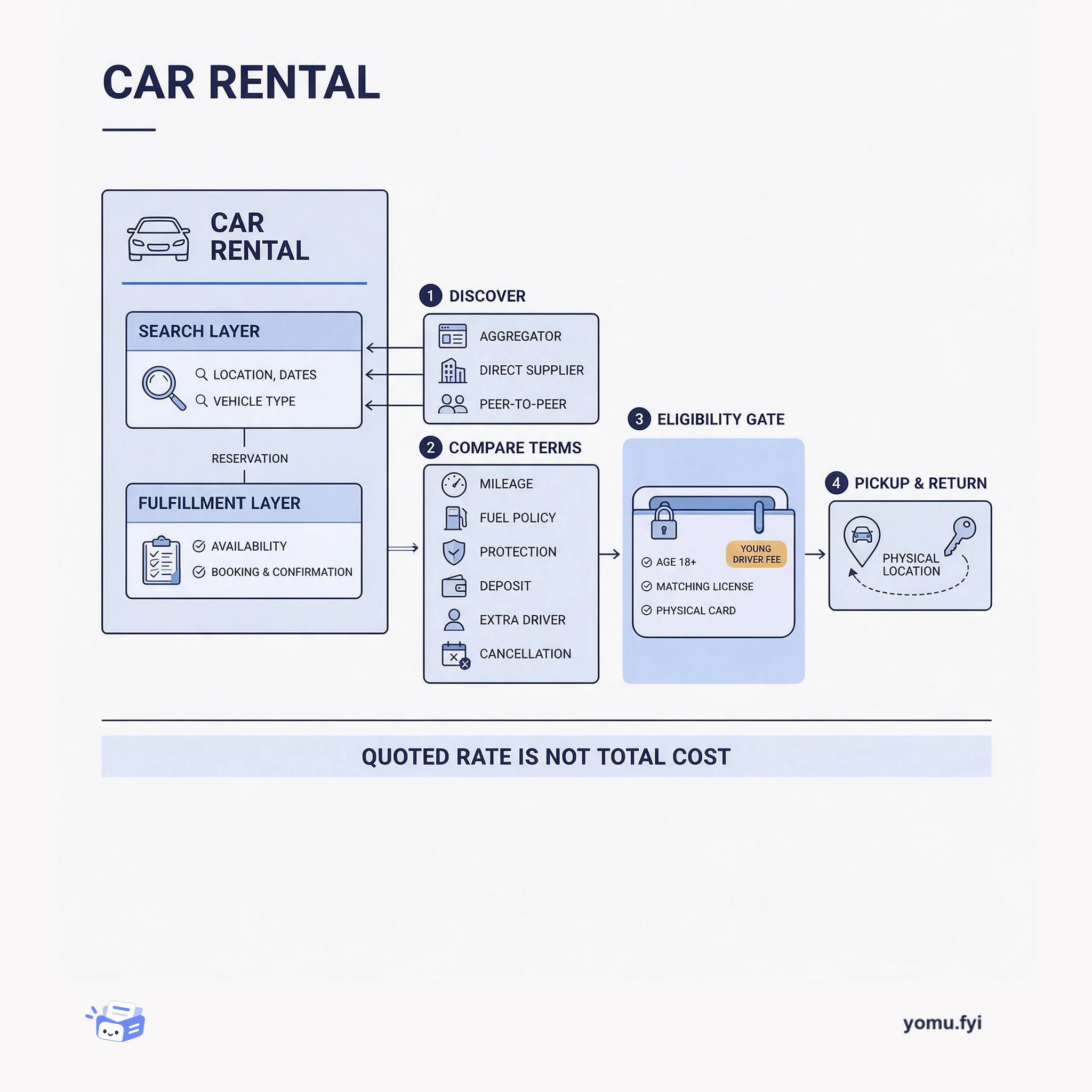
A car rental is a search layer over many fleets plus a contract enforced at the counter. This explainer maps its four parts and why the advertised daily rate never equals the total cost.
A GPU-resident astronomy pipeline keeps every stage of image analysis — load, align, subtract, detect, review — inside GPU memory instead of round-tripping through the CPU.
An astronomy pipeline turns raw instrument frames into candidate detections. A GPU-resident pipeline keeps that whole chain — FITS loading, image registration, PSF matching and subtraction, dipole fitting, and candidate review — inside GPU memory, so data is not copied back to the CPU between stages. The payoff is throughput: high-rate instruments can produce roughly 20 TB of images per night, and CPU-bound stages turn that into delays measured in hours or months. The same mental model extends to the surrounding system, where GPU-initiated networking, resource partitioning, and version-locked cluster configuration decide whether the GPU path actually stays saturated.
Because the bottleneck is data movement, not arithmetic. CPU-bound pipelines create delays of hours to months on high-rate instruments, while keeping frames resident on the GPU lets the same analysis run end to end; cuPhoton reports nine months of analytics collapsing to four hours and individual operations speeding up by thousands of times.
Three things show up repeatedly. GPU-initiated networking lets kernels drive Ethernet and RDMA without a CPU proxy, green contexts partition SMs so a latency-critical kernel is not blocked by bulk work, and version-locked cluster recipes pin drivers, runtimes, and operators into one validated combination.
A single GPU works while the working set and latency budget fit one device. Multi-GPU becomes necessary when the problem exceeds memory or time limits, as with cuOpt's mPDLP, which distributes a memory-bound sparse solver across NVLink-connected GPUs and uses min-cut partitioning to cut communication and peak memory per GPU.
The posts behind it
 NVIDIA · · Announcement
Supply chain and energy grid planning problems now exceed the memory and time limits of single-GPU solvers. NVIDIA cuOpt introduces mPDLP, a multi-GPU primal-dual hybrid gradient solver that distributes linear programming problems across NVLink-connected GPUs. The algorithm’s hot loop is a sparse matrix-vector multiplication, a memory-bound operation that benefits from the increased bandwidth of multiple GPUs. Min-cut partitioning reduces communication overhead by keeping tightly connected dependencies on the same GPU, enabling up to 6x lower peak memory per GPU. On the benchmark problem zib03 with over 104 million nonzeros, mPDLP achieved a solve rate nearly 10x faster than the previous year, and partners Kinaxis and PSR demonstrated 3.3x and 5x speedups on real-world models.
NVIDIA · · AnnouncementNVIDIA cuPhoton is an open-source CUDA-X toolkit of GPU-accelerated building blocks for scientific image analysis, from sensor read through classification, covering spectral and optical astronomy and time-domain laser/X-ray analysis. High-throughput instruments like the Vera C. Rubin Observatory generate up to 20 TB of images per night, but CPU-bound pipelines create delays of hours to months. cuPhoton keeps data on the GPU end-to-end, collapsing nine months of data analytics to four hours on GPU-accelerated Python. The toolkit includes modules for FITS loading, image registration, PSF-matching and subtraction, dipole fitting, and candidate review. Benchmarks on multi-GPU systems show individual operation speedups of up to 14,900x for loading and 14,550x for processing.
NVIDIA · · ExplainerNVIDIA DOCA GPUNetIO is a GPU-centric networking SDK that enables CUDA kernels to drive Ethernet, RDMA, Verbs, and DMA operations with the CPU removed from the application critical path. It unifies previously fragmented GDA-KI-style RDMA implementations from libraries such as NCCL, NVSHMEM, UCX, and the Aerial 5G SDK into a single shared foundation. The framework provides both a full DOCA SDK version and a lighter open-source Verbs-focused implementation; the open-source version can optionally dlopen the SDK at runtime. On the data path, CUDA kernels directly post Work Queue Entries, ring the NIC doorbell, and poll for completions without CPU intervention. Benchmarks using NVSHMEM show that the GPU-initiated path avoids the CPU proxy bottleneck, achieving higher bandwidth for small message sizes compared to CPU-mediated communication.
NVIDIA · · AnnouncementGPU-accelerated Kubernetes clusters depend on compatible versions across host kernels, GPU drivers, container runtimes, networking, storage, operators, and workload frameworks, each on its own release cycle. A configuration that works for one service, GPU generation, and Kubernetes release may silently fail for another, and tracing version conflicts after deployment is slow. NVIDIA AI Cluster Runtime (AICR) v1.0 addresses this with version-locked, validated recipes that pin component combinations, render deployment artifacts for Helm, Argo CD, Flux, or Helmfile, and carry signed validation evidence from tested hardware. The release establishes a stable compatibility contract across its CLI, REST API, Go SDK, bundle layout, and artifact schemas, with merge-blocking checks on public interfaces. AICR now has over 100 contributors, with almost half from outside NVIDIA, and integrations from Pulumi Labs and Mirantis demonstrate consuming the same configuration through different tools.
NVIDIA · · ExplainerGreen contexts, available in the CUDA Driver API since 12.4 and the Runtime API since 13.1, let applications explicitly partition GPU execution resources such as SMs and workqueues. They are lightweight to create and destroy, do not implicitly synchronize unrelated work, and allow provisioning workqueues to reduce false dependencies. Streams are created from a green context rather than relying on implicit device state, making targeting explicit. Benchmarks on a Blackwell GPU show a critical kernel completing in 0.007 ms with green context partitioning, compared to 0.140 ms with high-priority streams and 3.727 ms with equal priority. The tradeoff is fewer SMs for the bulk workload, but green contexts are opt-in and can be adopted incrementally alongside existing CUDA code.
More like this
A car rental is a search layer over many fleets plus a contract enforced at the counter. This explainer maps its four parts and why the advertised daily rate never equals the total cost.
An app store is a distribution surface, a versioned contract, and a health loop between a platform and its developers. Here is how those parts fit together and why each one fails loudly if ignored.
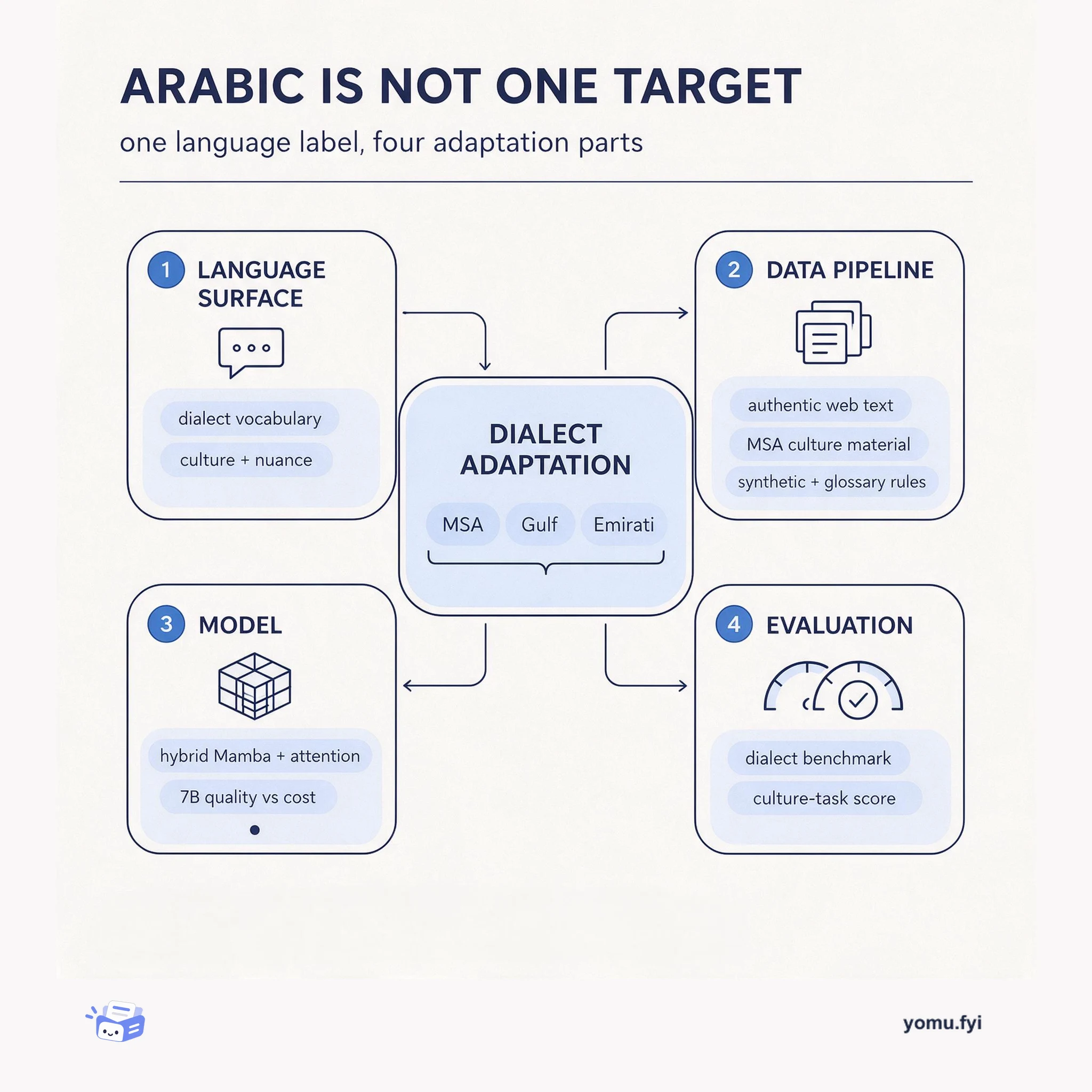
Arabic is not a single target for a language model. This explainer maps its four parts — dialect surface, data pipeline, model, and evaluation — so you can tell where an Arabic feature really succeeds or fails.
The Good Stuff
Paid picks we use ourselves. Links carry a referral code — a subscription through one earns us a commission at no extra cost to you.
One useful email. Unsubscribe anytime.