Asset Management's Four Layers: From Custodian File to Signed NAV
Asset management runs as a layered control plane: custodian and pricing data feed a governed context layer, agents run the overnight fund work, and a human signs off before anything is published.
Asset management is not one system but a stack of layers that each hand work to the next. Sources of record such as custodian files, positions, and pricing feed a governed context layer that fixes metric definitions, fiscal periods, and entity rollups. Agents then automate the overnight work of ingesting, pricing, reconciling, and drafting a preliminary NAV, while a human stays in the loop for every decision. An assurance spine of traceability and role permissions runs through every layer, which is what makes the output defensible to investors and regulators.
FAQ
Why does a governed context layer sit between the raw data and the agents?
Agents need approved metric definitions, fiscal periods, and entity rollups to answer questions the same way a controller would. Without that layer, plain-language queries and reconciliation drift as strategies and fee arrangements change, and answers arrive too late to guide decisions. The context layer is what keeps definitions current and shared across teams.
Where does the human stay in the loop in this architecture?
The agent layer produces a preliminary NAV by ingesting custodian files, pricing positions, and reconciling records, but it does not make investment or valuation decisions. A human reviews every action before anything is final. Every figure remains traceable to its source and permissioned by role, which is what makes the result provable to investors or regulators.
How do you pick the first asset-management workflow to automate?
Score candidates on business impact, demand frequency, data readiness, scope clarity, and governance risk. Scores of 20-25 mean build now, 14-19 need shaping, and under 14 is a poor fit, with an executive champion required regardless. Narrow scope and governed data matter more than an ambitious everything-agent.
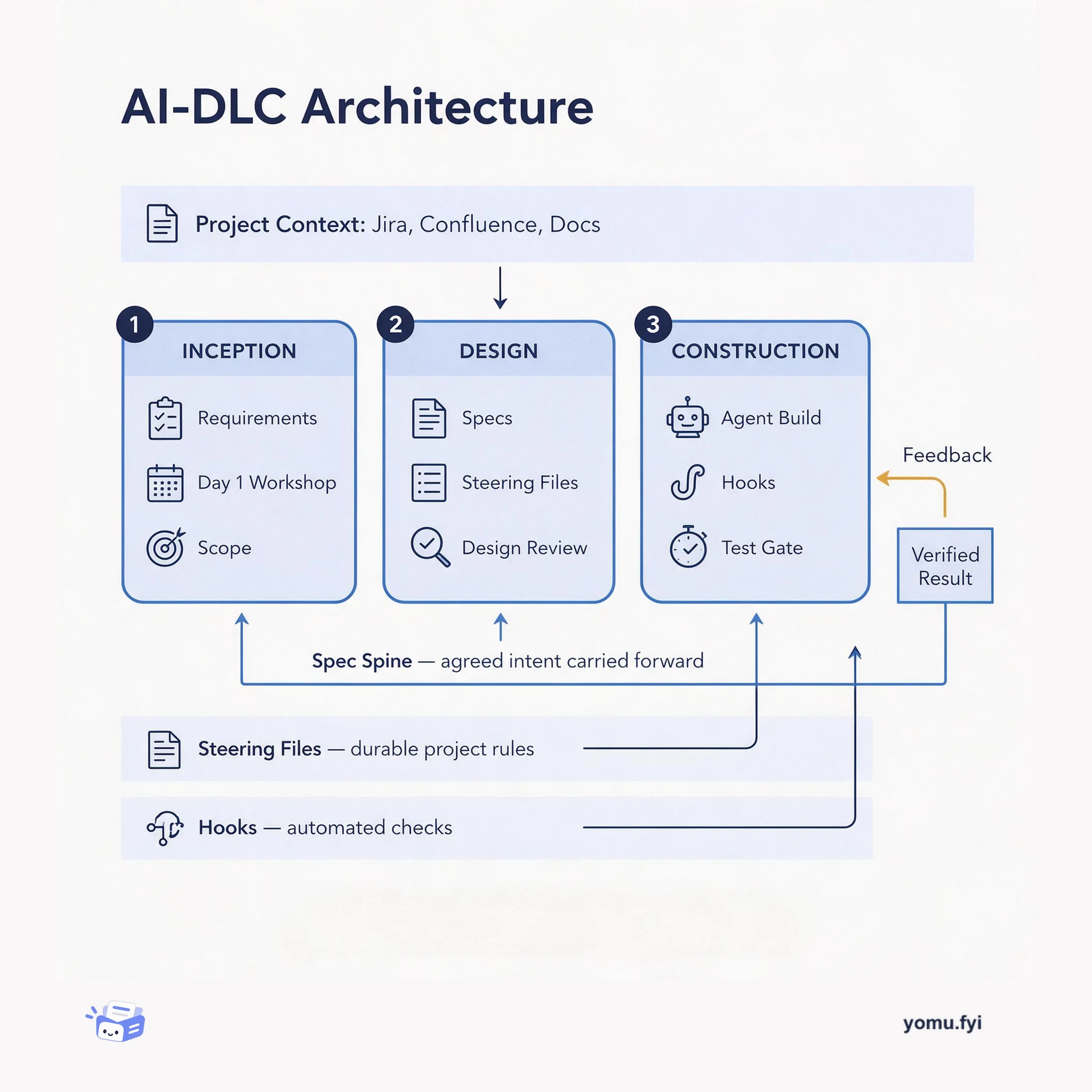
AI-DLC is an AI-driven development lifecycle that runs delivery through Inception, Design, and Construction, with specs, steering files, and hooks keeping agents aligned to agreed intent.
Apple Silicon's defining choice is one shared memory pool for CPU, GPU, and Neural Engine. This diagram maps that fabric, the on-package bandwidth it buys, and the scaling limits it imposes.
Antimicrobial resistance surveillance is a layered data architecture: raw reads and demand signals flow in, get normalized into governed tables, and answer plain-language queries. The diagram maps each boundary.
The Good Stuff
Paid picks we use ourselves. Links carry a referral code — a subscription through one earns us a commission at no extra cost to you.