From Ringing Line to Resolved Contact: How a Call Center Works
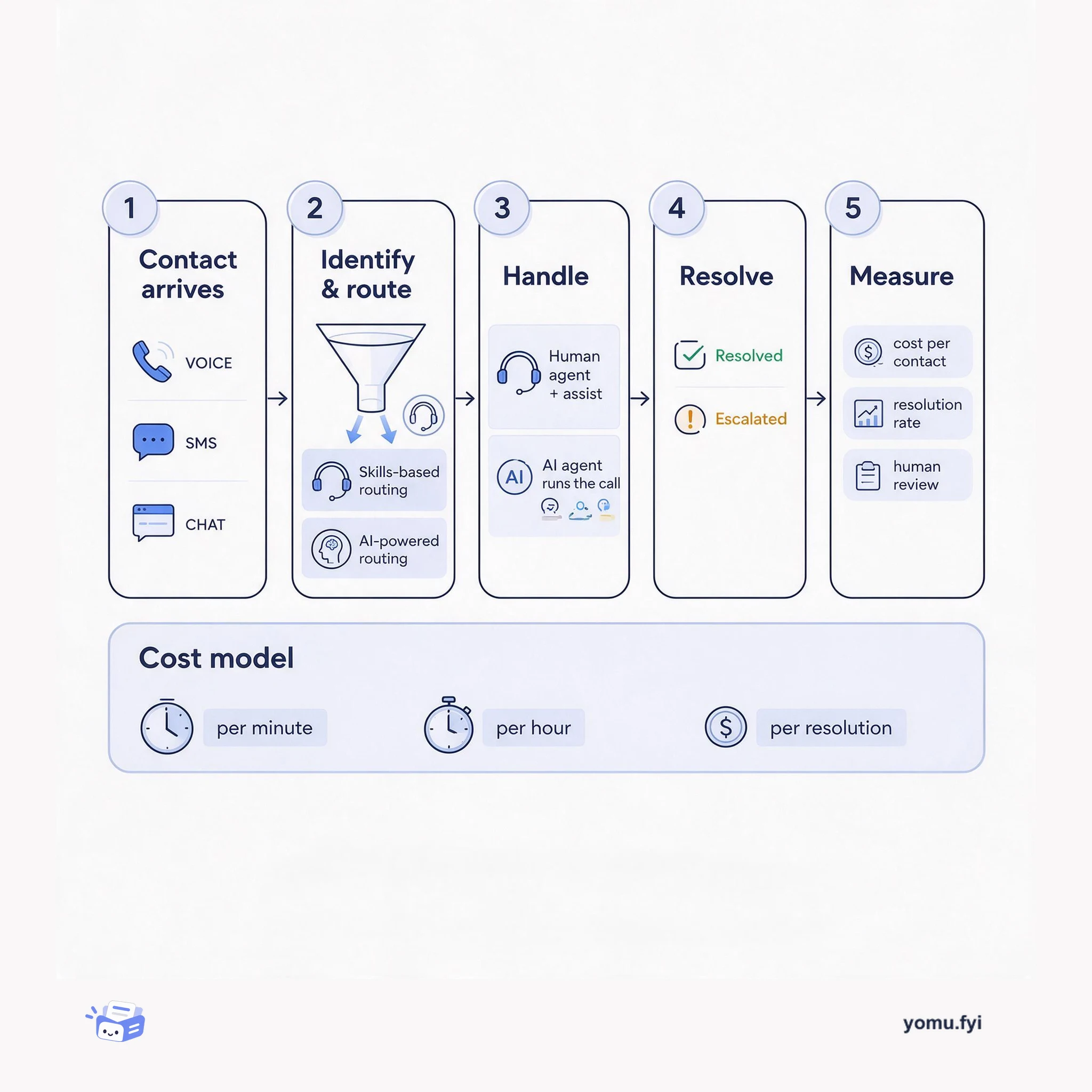
Follow one contact through a call center: arrival, routing, handling by a human or AI agent, resolution, and the cost-per-contact math that decides which path to use.
A walk through a CASB control loop: how a SaaS security finding becomes a queued job, a matched policy, and a bounded remediation action with an audit trail.
A CASB is not just a dashboard of SaaS misconfigurations. It is a control loop that takes a finding, routes it to a policy, executes a bounded action, and records what happened. This explainer follows that loop as four numbered stages: detect the finding, match it against policy by vendor, integration or tenant and finding type, run the remediation through a durable workflow with retries and rate-limit backoff, then log the result. The same shape appears at other enforcement points, such as an agent gateway that authorizes per-tool access and meters request volume. Knowing where each stage sits tells you when automatic remediation is safe and when a notify-only webhook is the honest choice.
The posts behind it
 Red Hat · · Tutorial
Model Context Protocol (MCP) allows an agent to use tools across enterprise systems, but a shared MCP gateway requires a policy boundary beyond authentication. The article describes using Red Hat Connectivity Link (RHCL) AuthPolicy to validate OIDC or JWT credentials and then authorize per-tool access based on roles in the identity provider claims. NetworkPolicy controls which workloads can communicate with the gateway and MCP servers, while RateLimitPolicy limits request volume. Gateway isolation can be achieved with separate gateway instances or a shared gateway with isolated listeners, each with its own MCPGatewayExtension. These controls map to OWASP risks for LLM and agentic applications, including excessive agency, unbounded consumption, tool misuse, and identity abuse.
 Auth0 · · Announcement
Enterprise SaaS providers must differentiate core offerings while meeting enterprise identity security and interoperability requirements for winning RFPs. The Okta Integration Network, a catalog of over 8,000 integrations used by 20,000 Okta customers, allows Auth0-powered SaaS providers to signal enterprise-readiness. By publishing Express Configuration and Universal Logout integrations, companies like Jamf and Augment Code automate onboarding and enhance security without pausing their product roadmap. Express Configuration reduces SSO setup from days of manual OIDC application creation to a few clicks, as Jamf demonstrated for its 78,000 customers. Universal Logout enables instant token revocation across the platform, allowing providers to respond to session hijack immediately, eliminating support ticket workflows.
 Databricks · · Explainer
Enterprise AI cost management is shifting from maximizing raw token volume to maximizing return on investment, requiring teams to measure, attribute, and optimize spend across models, agents, and applications. Granular cost attribution, enabled through request-level tags that map spend to specific teams or projects, is essential because organizations cannot manage what they do not measure. To avoid context bloat, systems should have agents pull relevant context on demand via tools or MCP servers rather than pushing all information upfront, preventing unnecessary token waste. Dynamic model routing assesses task complexity in real time to direct the 90% of tasks suited for cheaper models away from frontier models. End-to-end tracing collects the full exhaust of agent activity including prompts and tool calls, enabling teams to identify abuse, waste, and leaks to inform cost management decisions.
 Jetbrains · · Announcement
JetBrains Air Governance, formerly JetBrains Central, is now generally available as the organization layer of JetBrains Air for managing agentic AI usage. It provides a single console to manage AI agents, models, and providers across teams, set spending limits, and track both costs and outcome metrics like the split between human-authored and AI-generated code. The tool works with Claude Agent, Codex, Gemini CLI, Junie, and other ACP-compatible agents across IDEs, CLI, web, and mobile, and supports multiple vendors without separate contracts. Admins can set AI credit limits per user, team, or service account, manage BYOK providers, approve agents, and configure MCP servers at the company level, combining these into policies for different groups. Air Governance is available to all JetBrains organizational customers with free and paid plans starting at USD 20 per developer per month, and it already manages usage for roughly 2,300 people at JetBrains.
Red Hat · · ExplainerThe operations team troubleshooting production issues on Azure Red Hat OpenShift must already know which tools to reach for, switching between portals, CLI, and dashboards, with tickets arriving incomplete and triage taking hours. The agentic-partners-integration quickstart solves this by connecting a central orchestration layer with domain-specific agents, including a Microsoft Azure MCP Server that exposes Azure resource management operations as MCP tools and an agent that discovers them at runtime. In an OOMKilled investigation, the agent correlates resource health, CPU metrics, and recommendations using a discover-then-execute pattern to produce a data-backed diagnosis. Security is layered: the service principal defaults to Azure Reader role, Open Policy Agent policies gate every request, and each tool call is logged for audit. This pattern extends beyond Azure; any infrastructure backend exposing an MCP server can become an agent capability without framework changes.
 Cloudflare · · Announcement
Cloudflare CASB now supports automatic remediation policies that respond to newly detected SaaS security findings without requiring an administrator to act on each instance. Teams can match policies by vendor, integration or tenant, and finding type, then revoke file-sharing access, send finding details to webhooks, or do both; first-party remediation currently covers Microsoft and Google Workspace file and folder findings. The backend enqueues findings to Cloudflare Queues, uses a Worker to match policy configurations, and runs matched jobs through Cloudflare Workflows, which provides durable execution, retries, and rate-limit backoff. Policies generate administrator-activity and runtime execution logs, while the stated target from detection to completed remediation is five minutes or less; support for Custom Findings is planned for the coming weeks.
More like this
Follow one contact through a call center: arrival, routing, handling by a human or AI agent, resolution, and the cost-per-contact math that decides which path to use.
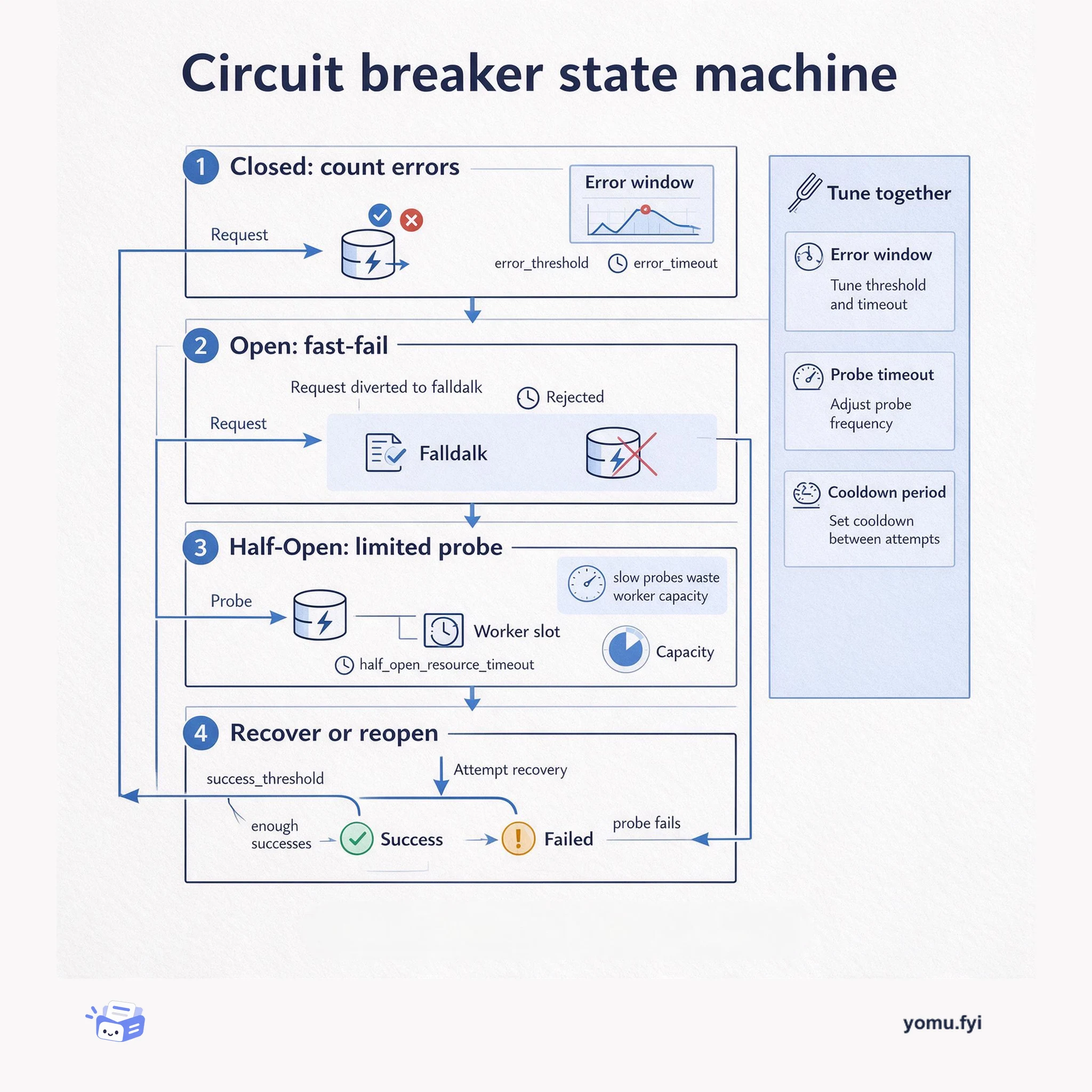
A circuit breaker turns dependency failures into fast failures, then probes for recovery. See the state loop and how half-open probes can quietly consume worker capacity.
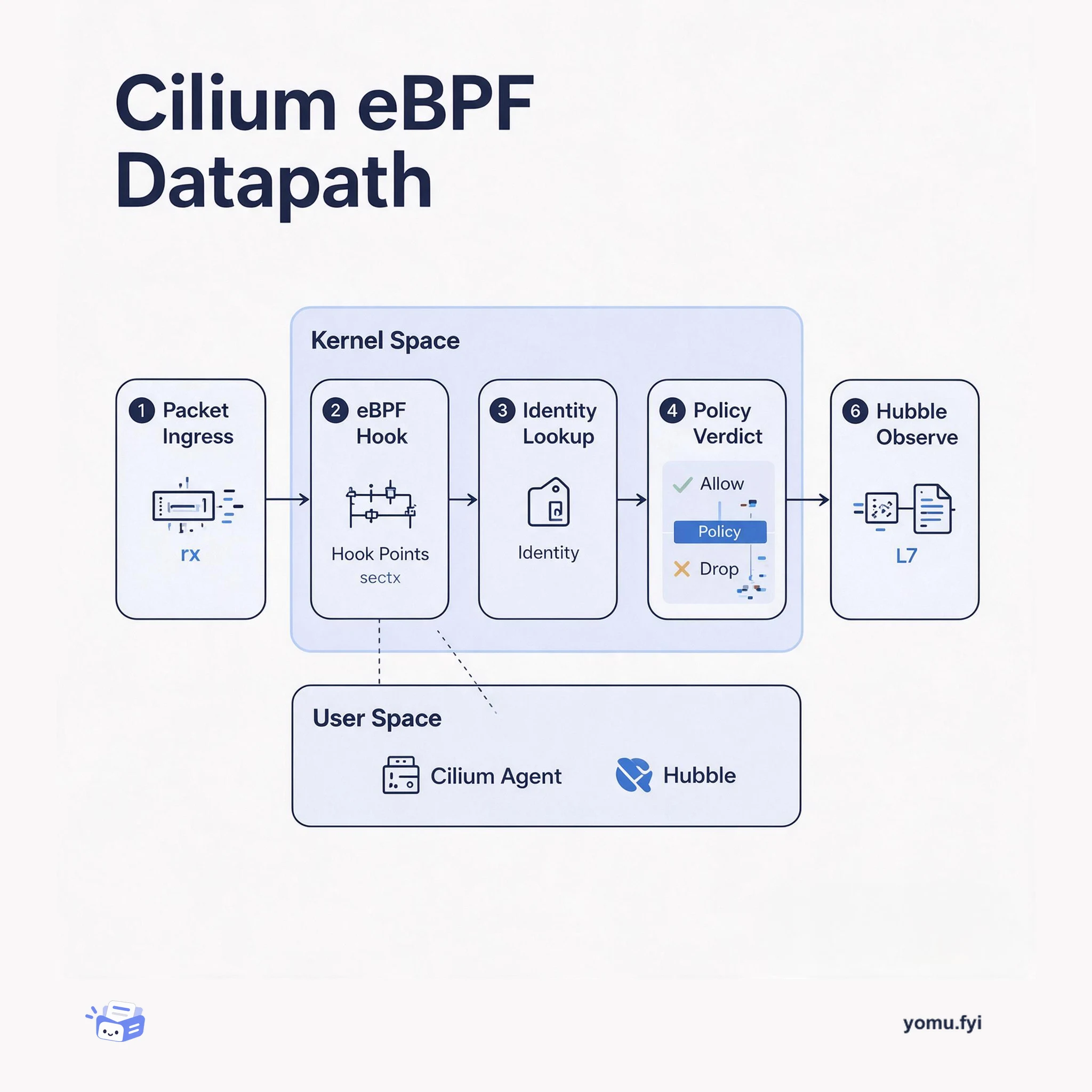
Cilium uses eBPF programs in the Linux kernel to enforce identity-based network policies and capture L7 observability for Kubernetes workloads. This diagram traces the path from packet arrival to policy verdict and Hubble flow.
The Good Stuff
Paid picks we use ourselves. Links carry a referral code — a subscription through one earns us a commission at no extra cost to you.
One useful email. Unsubscribe anytime.