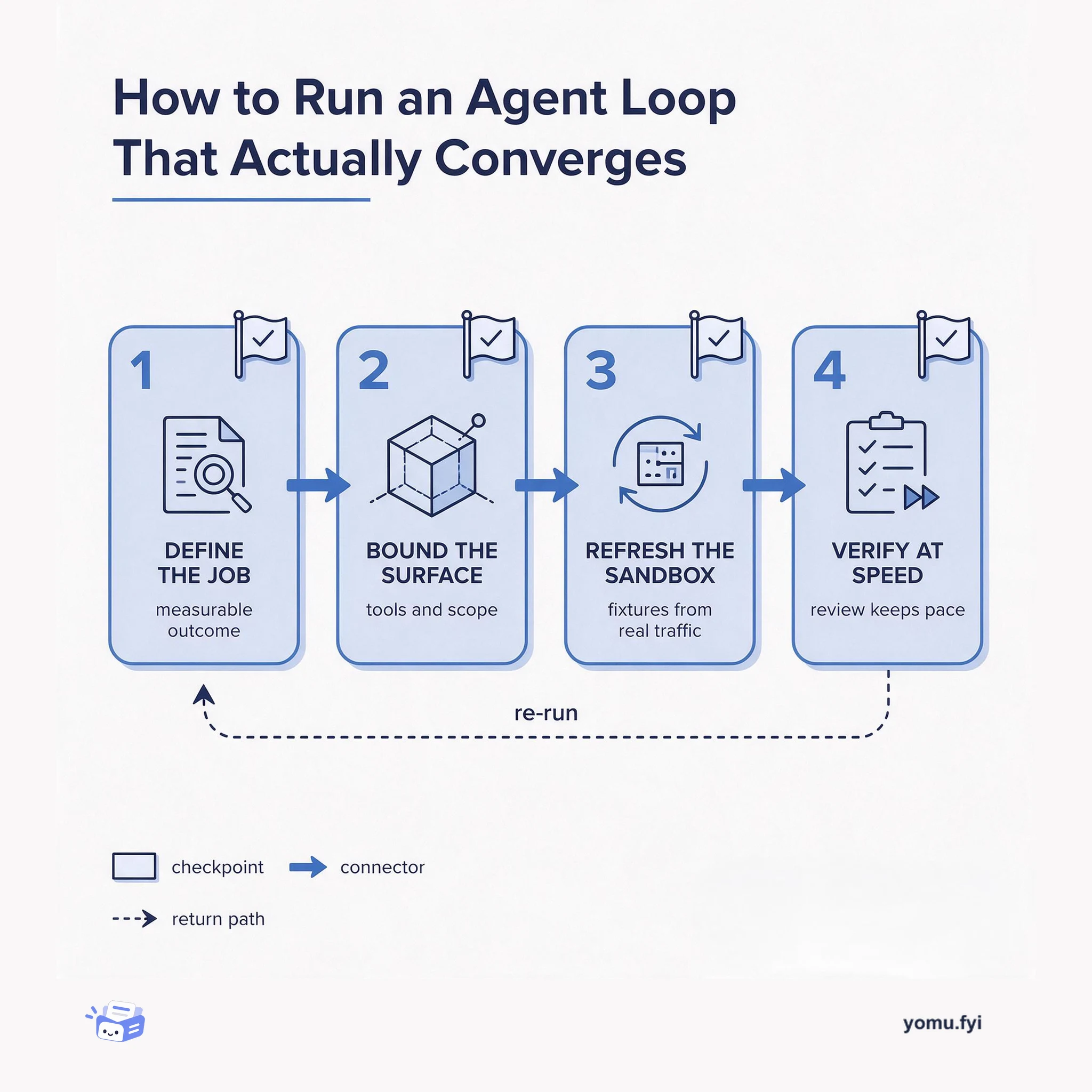
How to Run an Agent Loop That Actually Converges
A four-checkpoint how-to for agent loops: name a measurable job, bound the tool surface, refresh sandbox fixtures from real traffic, and verify at agent speed.
Loading…
Topic
564 posts about AI Agents. Every summary links to the original.
See the idea
A four-checkpoint how-to for agent loops: name a measurable job, bound the tool surface, refresh sandbox fixtures from real traffic, and verify at agent speed.
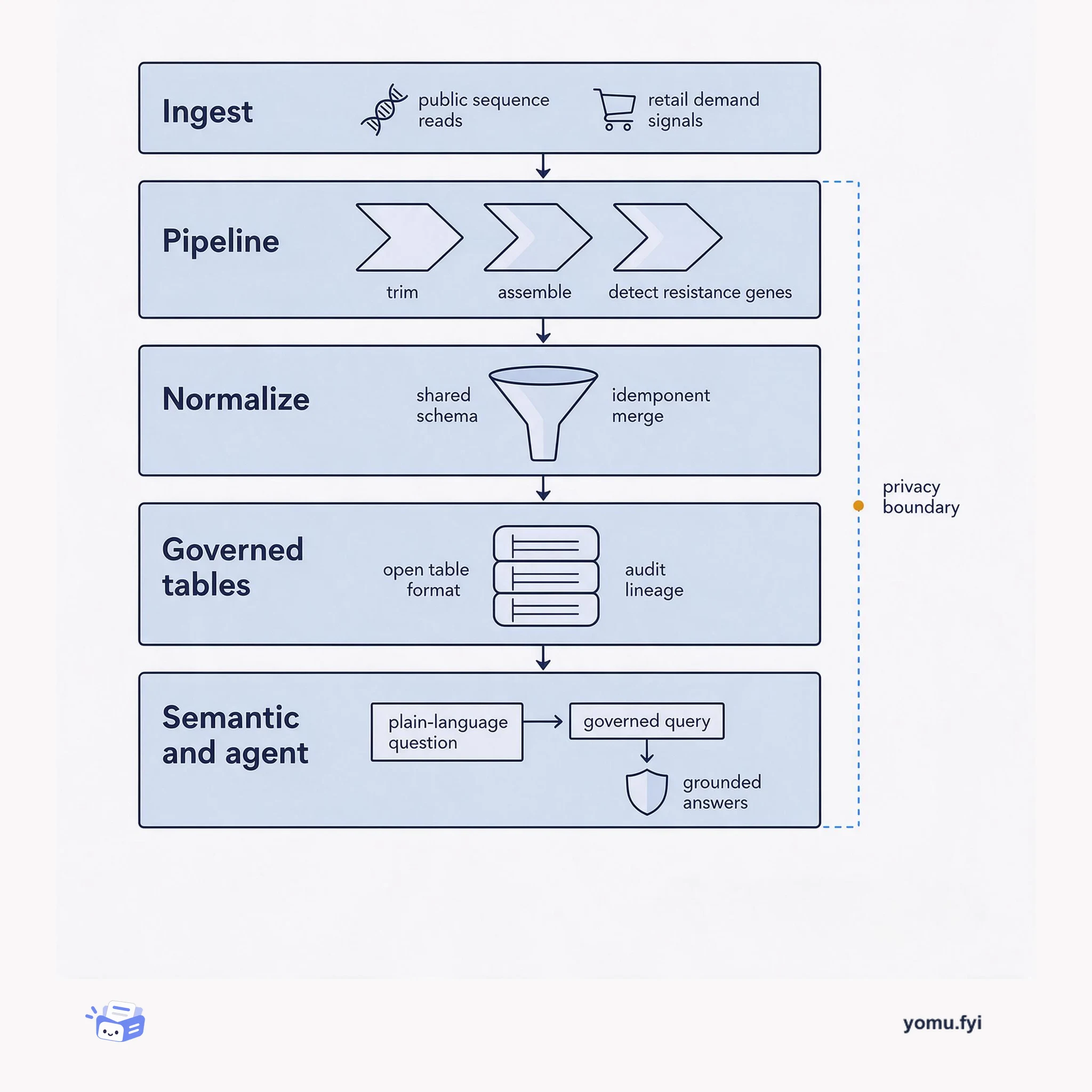
Antimicrobial resistance surveillance is a layered data architecture: raw reads and demand signals flow in, get normalized into governed tables, and answer plain-language queries. The diagram maps each boundary.
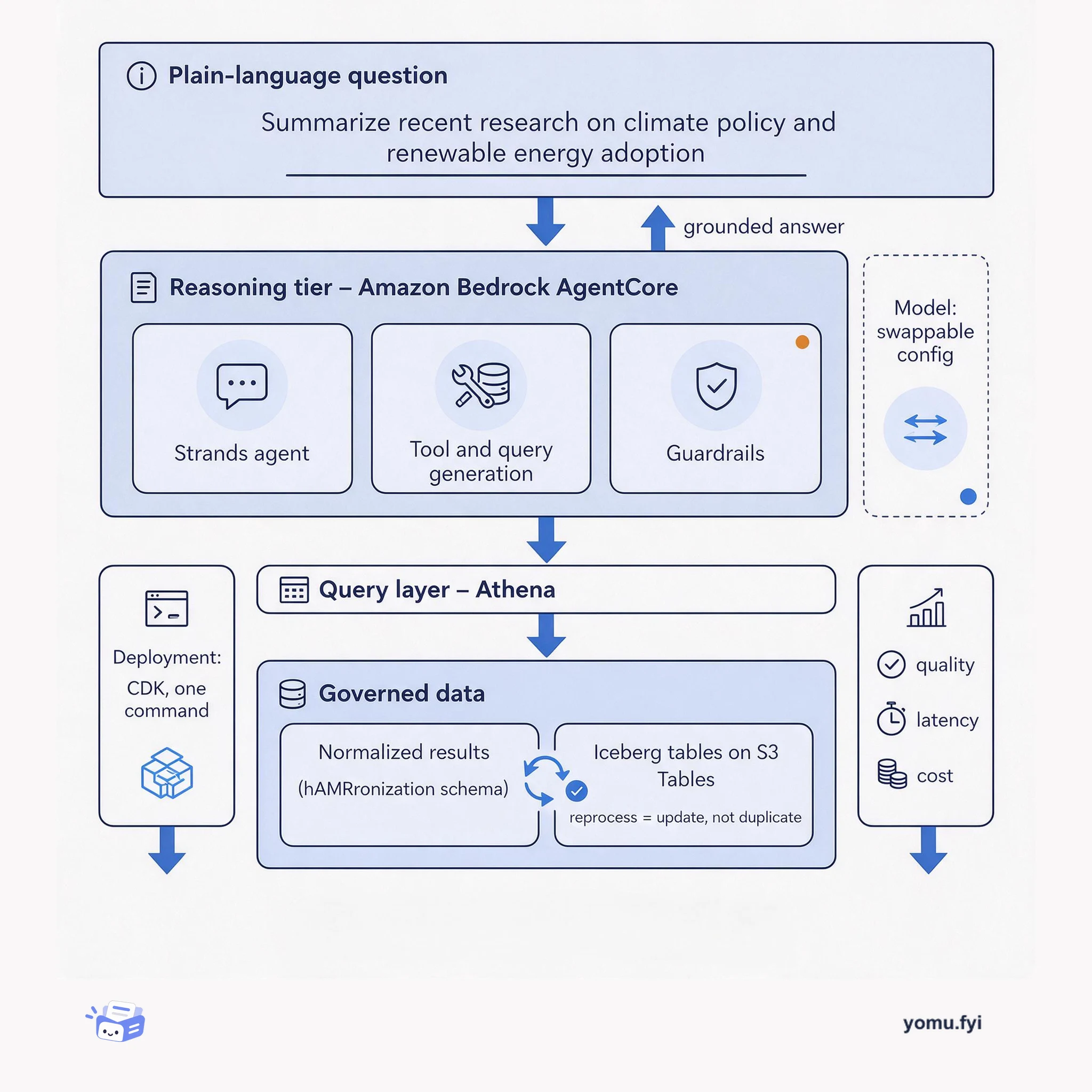
Amazon Bedrock is the managed reasoning tier in an agent architecture, not the whole system. This layered view shows the pipelines, governed tables, query layer, and guardrails around it.
The Good Stuff
Paid picks we use ourselves. Links carry a referral code — a subscription through one earns us a commission at no extra cost to you.
Newest first
Solvency II reporting connects data, actuarial reserving, capital calculation, quantitative reporting templates (QRTs), the ORSA, approvals, and disclosure, but fragmented systems make readiness and cross-process questions difficult to manage. The described Databricks implementation provides a governed workflow and control tower around existing actuarial and capital suites, automating ingestion checks, data-quality review, reconciliation, orchestration, reporting, and audit trails. It uses MLflow-managed reserving models alongside engines such as Prophet, RAFM, and Igloo, while narrow-scope AI agents can investigate QRT mismatches, suggest remediation, route questions, and support human review. An LLM can draft an ORSA from current numbers, while scenario analysis assesses doubling a cyber book over 12 months; reviewers retain decision authority. The workflow is presented as easier to monitor and investigate.
Anthropic and PwC are expanding their strategic alliance to use Claude for technology delivery, deal execution, and AI-led redesign of enterprise functions. PwC will roll out Claude Code and Cowork from U.S. teams toward a global workforce of hundreds of thousands, establish a joint Center of Excellence, and train and certify 30,000 professionals. The collaboration targets agentic technology builds, AI-native deal-making, and production operating models for finance, supply chain, HR, and engineering, alongside a new Claude-based Office of the CFO for regulated industries. Reported deployments include insurance underwriting reduced from ten weeks to ten days, an HR application delivered in under two months, and cybersecurity response accelerated from hours to minutes, with improvements of up to 70%.
Google’s Gemini 3.8 Flash is now available in Junie’s IDE plugin and Junie CLI, accompanied by a limited-time 75% introductory discount. The model targets long, multi-step engineering tasks: it spends more tokens exploring directories, retrying failed code, writing bug-reproduction scripts, running tests through tool calls, and checking changes before completion. Google’s DeepSWE v1.1 testing is described as showing 3.8 Flash outperforming most larger frontier models at significantly lower cost, although the source does not provide specific scores. Gemini 3.7 Flash remains available for minor fixes and small refactorings, where its lower per-token cost may be preferable, while 3.8 Flash can be selected from the model picker without setup or a waitlist.
Consort is introduced as an open-source agentic development framework for test-driven development on branching Lakebase Postgres databases. It addresses the limitations of mocks, shared staging databases, and risky schema-change ceremonies by bringing integration testing into the inner loop. Its build lane runs red/green/refactor cycles against isolated copy-on-write branches of real data, while versioned migrations keep code and schema changes together and pull-request checks test migrations against fresh branches. Consort organizes work through role-based agents and a deterministic conductor, preserving feature artifacts in dedicated directories and supplying scoped context packages. A VS Code plugin pairs Git and Lakebase branches, while an observability dashboard exposes agent turns and human approval gates; the project is community-supported rather than a bundled platform feature with an SLA.
Adaptive Instructed-Retriever addresses the tension between retrieval quality and latency for enterprise data agents, especially on multi-hop questions that benefit from sequential search. It combines parallel single-step retrieval with bounded multi-step search, using a fixed upper limit and an adaptive stopping policy that spends extra steps only when they are likely to improve results. The model is trained with online reinforcement learning using CISPO, a reward that balances trajectory quality against search cost, and synthetic multi-hop data alongside Instructed-Retriever-1 data. Across seven held-out internal and external benchmarks, it matches leading third-party and open-source models while answering in 5.8 seconds, reported as more than twice as fast as the compared alternatives, and substantially improves over single-step search. Varying the step penalty produces checkpoints spanning different quality-latency tradeoffs for production workloads.
YouTrack announces live webinars for teams considering migration from Atlassian after Atlassian’s stated discontinuation of Data Center sales and support. The worldwide English-language session is scheduled for September 30, 2026, at 2:00 pm CET on YouTube, alongside a Japanese Zoom session and a Russian-language regional session hosted by Noventiq on October 28. The agenda covers migrating projects, users, and data from Jira, Confluence, and Jira Service Management, with a live demo, customer stories, pricing, licensing, deployment options, user packs, and partner support. It is aimed at administrators, project managers, and team leads, and presents YouTrack as a place to combine project management, documentation, and customer support. The Japan session additionally covers workflow automation and connecting AI agents through MCP, while registration for the Asia and Caucasus session is not yet open.
Rig is an open-source Rust library that provides a common interface for LLM providers including OpenAI, Anthropic, and Gemini, avoiding application rewrites when switching services. It structures applications around a provider client, completion model, agent, preamble, and registered tools, with async APIs handling provider network requests. In the Rat Code demo, built with Ratatui, separate tools read and write files and run shell commands, while Rig’s streaming API updates the terminal as responses arrive. The library also supports RAG through vector store abstractions, local inference via Ollama, llama.cpp, or Candle, and cassette-based integration tests that replay recorded HTTP interactions in CI; live model quality requires separate scheduled testing.
Ramp built OCA, an AI on-call assistant that investigates incidents, shares findings in Slack, answers follow-up questions, and can ask Inspect to prepare code-fix pull requests for human review. In the past four weeks, it assisted with 575 of 1,220 incident-related merged PRs; among incidents with merged fixes, OCA-assisted fixes averaged 37% fewer engineers and about 50% less estimated engineer time, based on Slack activity. Investigations run in a monorepo through Claude Code or Codex, with Temporal managing workflow, while prompts, custom tools, skills, and six one-shot hooks provide successive evidence and reasoning checks. Session-driven testing exposed errors such as misleading one-hour log windows, leading to just-in-time instructions and interim updates that balance accuracy with response speed. OCA remains human-in-the-loop: it has broad read-only access, narrowly scoped writes, and cannot merge changes, although the team is building toward end-to-end routine incident handling.
Claude Managed Agents runs Anthropic’s Claude as a hosted agent without managing inference infrastructure. Pairing it with MongoDB Atlas provides fast access to operational and vector data through a single pymongo connection, eliminating the need for separate vector, full-text, and graph stores. This tutorial builds a human-in-the-loop fraud review agent that retrieves flagged transactions, runs four retrieval patterns (vector, full-text, hybrid, and graph) against one collection, and escalates risky cases to a human reviewer using Managed Agents’ native pause. The credential-safe integration uses host-side custom tools so the MongoDB connection string never enters the agent sandbox, keeping secrets on your side. The agent verifies a signed authorization mandate, uses $graphLookup to detect mule chains and $rankFusion for hybrid search, writes immutable verdicts and audit events back to the same cluster, and triggers durable human pauses on structuring deposits just under $5,000, wires over $50,000, and ring signals from graph traversal.
The post argues that end-to-end benchmarks such as Terminal-Bench and DeepSWE show overall agent performance but rarely explain why behavior changes. It presents behavioral evaluations as fast, deterministic, unit-style checks of observable intermediate actions, such as asking clarifying questions, running validators, or invoking web search instead of guessing. The proposed workflow starts with a recent failure, uses strict milestone assertions for simple tasks and flexible outcome-based or LLM-as-a-judge checks for complex tasks, then runs batch evaluations to track aggregate pass rates despite model nondeterminism. These evaluations are positioned for the second phase of development, after an agent can dogfood its codebase, and as complementary to macro benchmarks: behavioral tests enable prompt, tool-schema, and model iteration while guarding against regressions.
dotInsights’ September 2026 issue curates recent .NET and software development material from the developer community, alongside JetBrains announcements and a short social-media coffee break. The featured links cover Azure Service Bus filters, .NET 11 performance, Fetch Metadata-based CSRF protection, software-architecture complexity, standalone hosting for the .NET Aspire Dashboard, and several C# and ASP.NET Core topics. Other selections address AI coding agents, local AI models, MCP clients in .NET, Blazor CSV import and full-text search, URI handling, digital signatures, memory usage in Kubernetes, and .NET MAUI. The issue also notes that Roslyn, the C# compiler, is open source, written in C#, and exposes APIs for analyzing and generating code, while JetBrains promotes upcoming events, Rider and ReSharper releases, and Rider’s AI-agent refactoring capabilities.
The report examines how malicious actors used Claude in influence operations, credential scraping, recruitment fraud, and malware development while preserving utility for legitimate users. It details an influence-as-a-service operation in which Claude orchestrated more than 100 social-media bot accounts, selecting likes, shares, comments, or inaction across personas and political objectives. The response used conversation-analysis techniques including Clio and hierarchical summarization, alongside classifiers that assessed user requests and model responses to identify, investigate, and ban accounts. The cases show frontier models accelerating less skilled actors’ capabilities, although successful deployment was not confirmed for the credential, recruitment, or malware efforts, and no content from the influence operation achieved viral status.
In mid-September 2025, an investigation identified a campaign that used Claude Code to target roughly thirty global technology, financial, chemical-manufacturing, and government organizations, succeeding in a small number of cases; the authors assess with high confidence that the actor was Chinese state-sponsored. Attackers jailbroke the model and divided malicious objectives into benign-seeming tasks, allowing an autonomous framework to perform reconnaissance, exploit development, credential harvesting, backdoor creation, data exfiltration, and attack documentation. AI performed 80–90% of the campaign, with humans intervening at perhaps four to six critical decision points, while peak activity reached thousands of requests, often multiple per second. Claude sometimes hallucinated credentials or falsely claimed to have extracted secrets. After ten days of investigation, the organization banned accounts, notified affected entities, and coordinated with authorities; it now describes agentic AI as lowering barriers to sophisticated attacks and calls for stronger detection, threat sharing, safeguards, and defensive adoption.
Conversational AI call-center latency can feel like dead air, and the delay may come less from LLM inference than from the infrastructure moving audio among telephony, media servers, ASR, the agent, and TTS. The described approach uses a unified voice path: ConversationRelay provides a WebSocket API to stream live call audio, handle speech-to-text and text-to-speech in one connected pipeline, connect with a backend agent, and support barge-in. It is model-agnostic, allowing teams to retain their LLM, knowledge bases, AI tools, and third-party voice providers, while Conversation Orchestrator, Conversation Memory, and Agent Connect address context and integration. Twilio’s internal benchmarks report median latency below 0.5 second and below 0.725 second at the 95th percentile, though relevance and context also matter alongside speed.
Auth0 Agent Skills addresses the gap between generic AI coding agents and a tenant’s live Auth0 configuration, plan entitlements, and deployed application settings. Its Auth0 HealthCheck skill uses Auth0 CheckMate to scan security and configuration hygiene, assess capability and plan fit, and produce confidence-weighted scores, prioritized findings, reports, and upgrade guidance. Using the Auth0 CLI, the skill authenticates locally, creates or reuses a narrowly scoped CheckMate machine-to-machine application, and queries the Management API from the developer’s environment. Remediation follows a developer-in-control flow: the skill fetches current settings, previews the proposed tenant-specific change and CLI command, requests explicit approval, then applies and verifies approved updates. The collection also provides framework quickstarts, B2B and B2C architecture guidance, debugging help, and configuration automation through Auth0 CLI, Terraform providers, and Vercel-native integrations.
This tutorial builds an AIOps workflow for diagnosing and remediating a deliberately induced CPU incident in a product catalog application running on an AWS EC2 instance with RHEL. An Ansible investigation playbook collects CPU utilization, top processes, application status, and HTTP health evidence, which Claude Code analyzes through MCP to identify the Python process as the likely contributor and recommend the approved “AIOps - Remediate High CPU” Job Template. AI does not access the host directly: Ansible Automation Platform retains responsibility for credentials, inventory, execution, and remediation. The remediation changes the application from HTTP 503 and degraded to HTTP 200 and healthy, while a final health check confirms recovery and completes the detect-investigate-analyze-recommend-execute-verify sequence.
Marketing teams often have data across campaign, customer, attribution, and pipeline systems but still depend on analysts to answer questions quickly and consistently. Databricks Genie One is presented as a data-smart AI coworker that uses governed business data, organizational context, metric definitions, campaign structures, reporting rules, and access permissions to support marketing analysis. The five described uses cover channel and campaign performance, funnel attribution, customer insights, omnichannel planning, and mobile business reporting, with natural-language follow-ups, reusable skills or Genie Agents, scheduled analyses, dashboards, and shareable outputs. Examples include tracing sourced pipeline changes, identifying declining enterprise-account usage, and finding territories with weakening repeat purchases. The source recommends starting with repeatable, cross-source workflows and preparing data sources, attribution models, fiscal-calendar logic, and team terminology in Databricks; marketers retain responsibility for decisions and campaign plans.
Enterprise agents need more than conversation history to connect decisions, obligations, people, and projects that change over time. Using NVIDIA NemoClaw, the example builds a memory-driven Chief of Staff around a human-readable self model in structured Markdown, a SQLite ledger for obligations and judgments, scheduled maintenance, bounded retrieval, and user correction with append-only auditing. Its architecture separates evidence, knowledge, and governed execution, while NVIDIA OpenShell sandboxes runtime access and keeps managed inference and MCP credentials outside the sandbox; memory can inform an action but cannot authorize it. In the supplied evaluation, the self model reached 90.9% overall accuracy versus 82.8% for an agentic RAG baseline, with larger gains on hard questions, changing facts, point-in-time reasoning, entity disambiguation, and multisource synthesis, but lower scores on corpus-faithful answers and single-hop lookup.
Google Cloud’s Gemini Enterprise developer experience (DevEx) Program pressure-tests enterprise AI tooling by walking fixed developer workflows without internal credentials or shortcuts, logging friction, and working with engineering on fixes. This sprint focused on governance across five dependency-ordered workflows: provisioning an agent identity, registering it, binding it to an Agent Gateway, applying policies and content safety, and verifying an authorized request with auditable decisions. Changes included documenting the Identity-Aware Proxy API prerequisite, fail-closed Model Armor extension examples, automatic allowance for essential Google-managed APIs, Private Service Connect and private Cloud DNS guidance, corrected IAM CEL syntax, clearer bind-time versus runtime evaluation, and ready-made Logs Explorer queries. The program says fixes are rigorously re-verified through continued user-journey testing to improve reliability, security, and end-to-end usability.
Bring your own LLM (BYO LLM) is an architecture in which teams choose the model powering their AI agents while a platform supplies communication infrastructure. The division leaves model selection, prompts, reasoning logic, tool definitions, and called systems with the team, while channels, conversation context, audio streaming, identity resolution, and human escalation remain with the platform. The post explains why bundled models create quality, migration, compliance, and cost-control constraints, including the inability to route simple interactions to smaller models and complex work to frontier models. It describes adding a third-party model to an existing contact center through middleware, a shared message handler, tools and knowledge, channel registration, and context-preserving handoff. Twilio Agent Connect is presented as a self-hosted Python and TypeScript SDK under the MIT License, with voice streaming and integrations for existing contact-center workflows.
The best engineering reads, once a week.