How to Give an Agent a Query Language Instead of a Code Interpreter
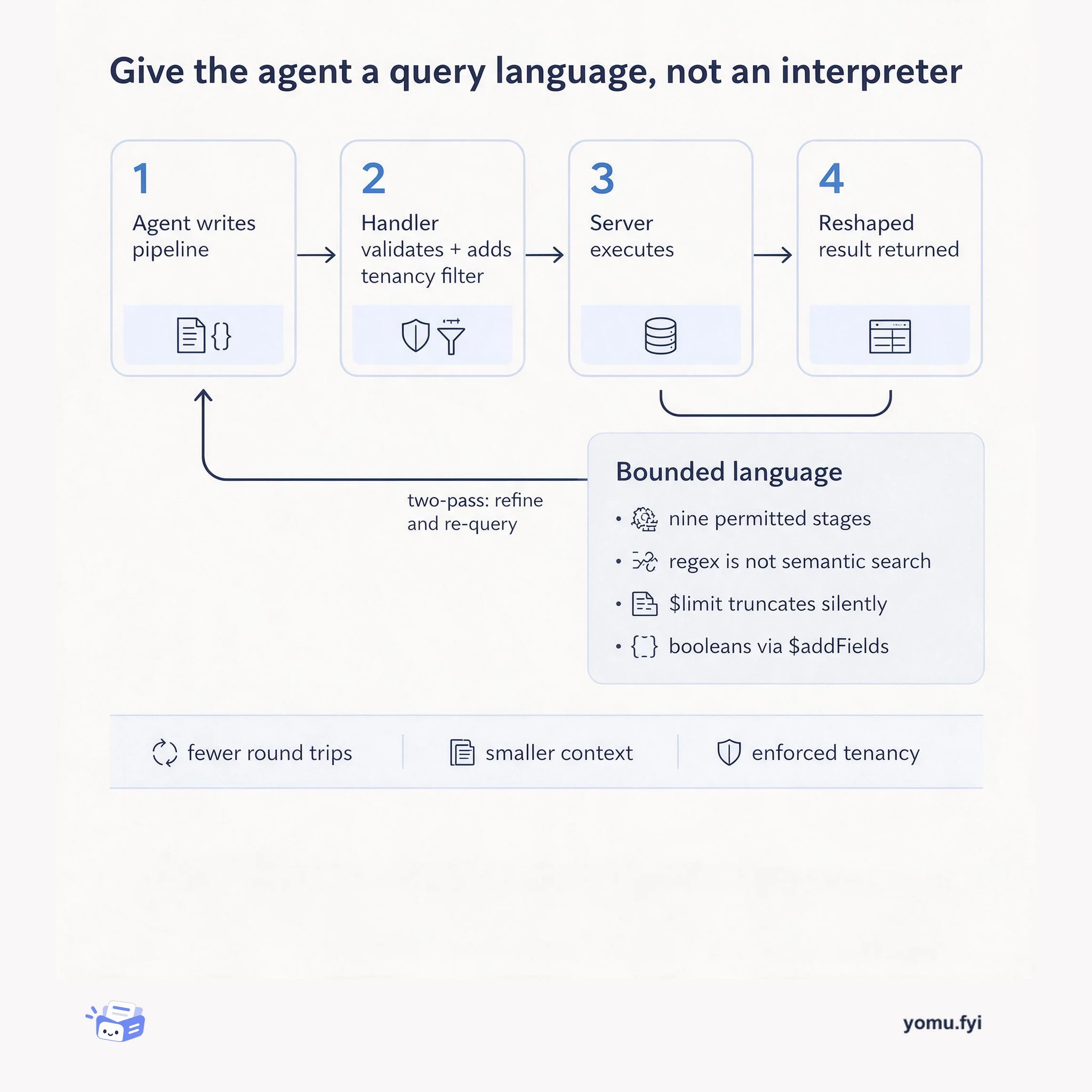
A four-step pattern for letting a document agent write validated aggregation pipelines instead of arbitrary code, so results come back shaped and tenancy stays enforced.
Loading…
Topic
542 posts about AI Agents. Every summary links to the original.
See the idea
A four-step pattern for letting a document agent write validated aggregation pipelines instead of arbitrary code, so results come back shaped and tenancy stays enforced.
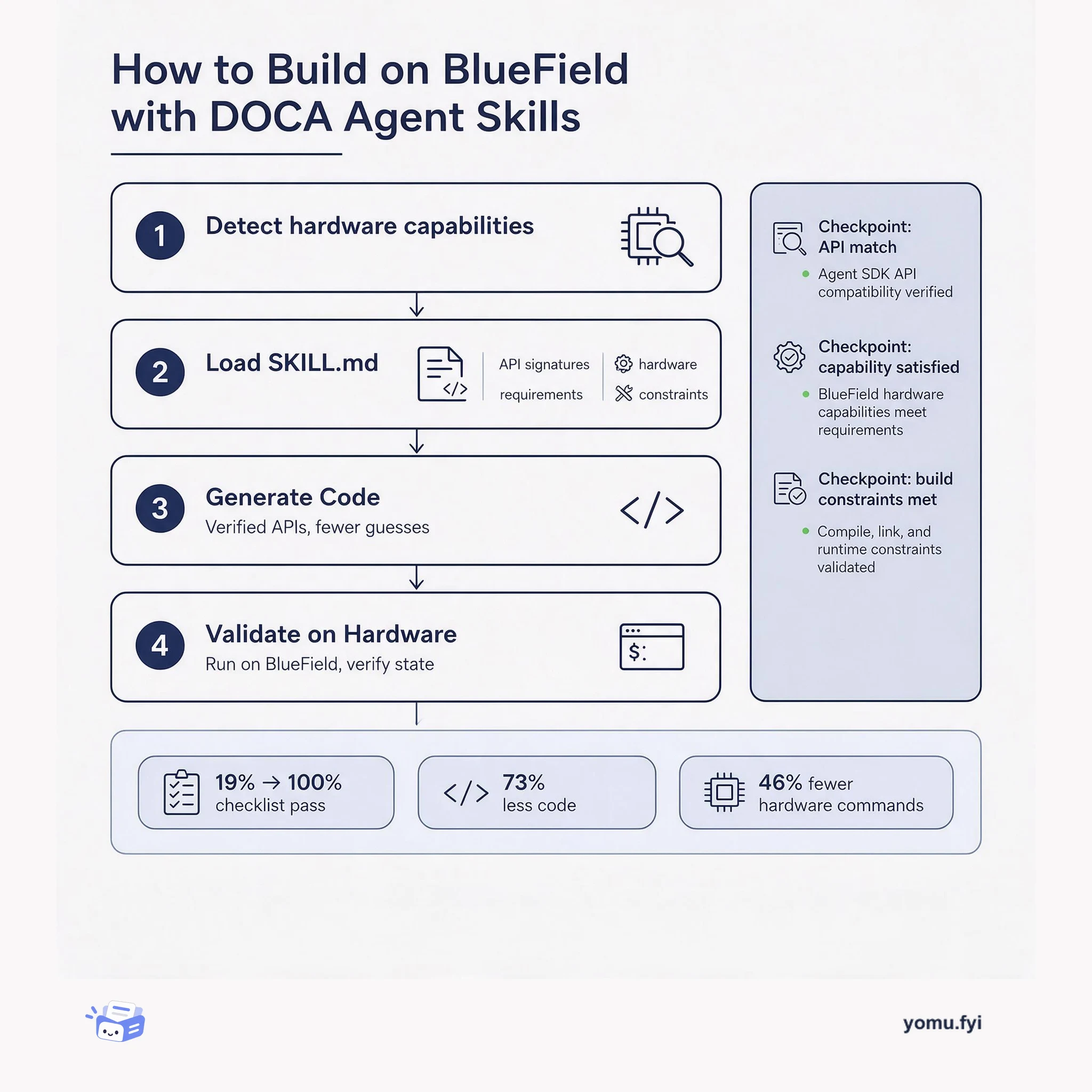
A practical how-to for using NVIDIA DOCA Agent Skills to generate BlueField code with verified APIs and hardware checks, reducing correction cycles and failed builds.
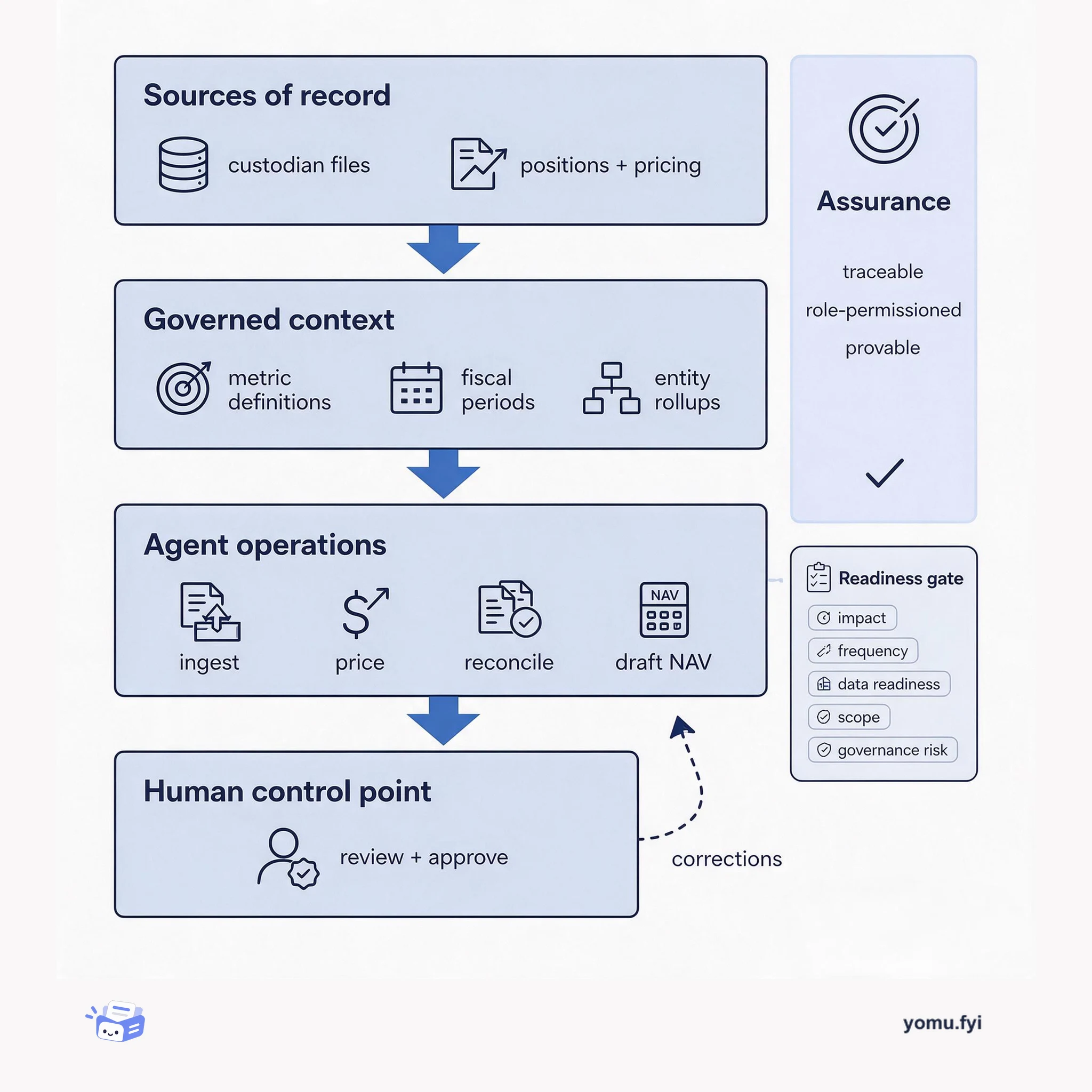
Asset management runs as a layered control plane: custodian and pricing data feed a governed context layer, agents run the overnight fund work, and a human signs off before anything is published.
The Good Stuff
Paid picks we use ourselves. Links carry a referral code — a subscription through one earns us a commission at no extra cost to you.
Newest first
ClickHouse has acquired RunReveal, a company that built a security data platform on ClickHouse, and says the team’s expertise will become part of its work in security. The announcement frames security as a demanding data workload involving cloud audit logs, identity events, endpoint telemetry, and network flows, with continuous high-throughput ingest, years-long retention, and interactive query requirements. ClickHouse says the acquisition will bring sharper reference architectures, guidance on schema and retention design, and a clearer connection between customer requirements and its database roadmap, while RunReveal remains available through a bring-your-own-database model. Existing RunReveal customers will continue to receive platform support under unchanged contract terms, and the team’s work on agentic investigation is expected to inform support for analytics involving agents that hunt across sources, tune detections, and advance investigations.
NVIDIA and CrowdStrike describe an agentic cybersecurity system that links red-agent attack execution with blue-agent detection engineering in a continuous offense-defense testing loop. In an isolated environment modeled on NVIDIA accelerated computing infrastructure, Falcon sensors captured telemetry while Nemotron 3 Ultra orchestrated the defensive workflow and a customized Nemotron 3 Super generated or repaired detections. The harness grounded agents in sensor schemas and attack traces, then applied linting, replay, structured correction, and independent review before deployment. Backtesting raised mean detection of the recorded attack from 16.5% to 41.9% with the optimized open pipeline across independently seeded sessions. In live-fire tests, five of 11 open detections detected an unseen attack, three qualified as gold, and those three covered all eight attacks; the authors call the result a directional case study because it used one scenario family and limited benign traffic.
Becoming an AI team requires more than adding assistants to existing workflows: it changes ownership, planning, roles, and execution. At Pinterest, infrastructure teams face the scale of serving billions of Pins, boards, ads, and real-time signals, making AI adoption an operational necessity for reliability, cost efficiency, and developer productivity. AI code-generation and transformation models can turn a widespread legacy-codebase refactor, such as replacing “foo” with “bar,” from a months-long effort into work completed and verified in a week or less. As routine execution is increasingly augmented or automated, engineers, product managers, and designers are expected to spend more time on strategy, problem definition, and user validation, while managers emphasize vision, trade-offs, mentorship, and collective impact. The conclusion is that teams must continuously optimize an AI-driven operating system rather than treat AI as a side project.
Agentic AI transforms insurance claims processing, underwriting, and customer service by autonomously executing tasks, reducing a routine claims review from eight hours to eight minutes. However, adding AI agents to fragmented data silos of policy details, claims history, and buried email threads multiplies problems because agents work with incomplete views that degrade. Pairing AI with a unified data architecture that creates a single shared context layer is key; MongoDB Atlas powers this by storing all data in a flexible document model. This shared view delivers accelerated resolution through single-motion retrievals, seamless human oversight by basing decisions on the same record, and built-in compliance through an automatic action trail. Insurers who build on this foundation can safely scale AI agents across claims, underwriting, and customer service while maintaining the oversight regulators and customers expect.
Point-in-time authentication treats an initial password, MFA, or passkey check as sufficient trust for the rest of a session, leaving post-login account takeovers, session hijacking, and risky API actions insufficiently evaluated. The proposed model replaces this front-door assumption with continuous context evaluation using passive telemetry such as network, telecommunications, device, behavioral, and transaction signals, then intervenes when risk scores or policy thresholds rise. For AI agents, delegated authority sets temporal, monetary, and API limits through short-lived credentials, while Know Your Agent lineage links execution to the authorizing human and deploying enterprise. High-impact actions can trigger human checkpoints through SMS, push, or voice channels, while immutable logs, transparent scoring, tenant isolation, and session lineage support auditability and compliance. The resulting architecture aims to keep low-risk autonomous work unobtrusive while making sensitive operations controllable and provable.
Uber describes a Software Factory in which AI tools and managed agents support software development, with more than 70% of pull requests attributed to local or cloud agents and over 3,600 agent skills. From February to August 2026, weekly active users grew sevenfold and weekly agentic requests 9.4-fold, while holding a model constant showed cost per 1,000 requests down almost 34% and cost per session down 52% from its June peak. The framework organizes usage into four layers and decomposes session spend into adoption, engagement, input and output workload, token pricing, and related execution factors measured through portfolio, model, driver, and managed-agent outcome metrics. Its optimization program uses real-work benchmarks, Pareto model selection, cheaper subagents, prompt caching, graph-grounded context, batched tool calls, and session-level waste analysis to reduce zero-value token use while improving or maintaining quality.
Agentic commerce is moving from AI-assisted product discovery toward purchases completed by agents, but retail systems often cannot reliably establish the shopper’s identity or spending authority. The post describes four phases—product discovery, checkout functions, delegate-to-buy, and agent-to-agent commerce—and notes standards including UCP, ACP, and AP2. Auth0’s approach combines user authentication, asynchronous authorization, and authentication for MCP, using CIMD-based agent registration, OAuth, and on-behalf-of token exchange to issue temporary, scoped transaction access. It presents third-party shopping agents and retailer-owned agents as two deployment models, with actions tied to an authenticated shopper and recorded for auditability. The proposed identity layer can sit alongside an existing identity provider while supporting emerging protocols and future autonomous purchasing.
Claude Science is used with the NVIDIA BioNeMo Agent Toolkit and NVIDIA NIM microservices to investigate how the predicted Seh1 structure changes alone versus with proposed partner C1HCX1. The workflow retrieves UniProt sequences, generates unpaired and species-paired multiple-sequence alignments with MSA Search, and sends those inputs to OpenFold3 and Boltz-2 for independent monomer and heteromer predictions. Using MSA input, heteromer iPTM reached 0.85 for OpenFold3 and 0.82 for Boltz-2, versus 0.14 and 0.19 without it; five-sample runs had standard deviations no greater than 0.006. Both models placed partner β-strands at Seh1’s WD40 propeller closure, while core Cα-RMSD remained 0.68 Å and 0.65 Å, respectively, but the predicted interaction remains experimentally unverified.
Resolve rate alone can hide how coding agents reach the same outcome. This evaluation compares Claude Opus 4.7, Gemini 3.5 Flash, GPT-5.5, and Qwen 3.6 27B FP8 through a Junie pipeline across four benchmark datasets, combining test results with trajectory, cost, efficiency, patch quality, and process measures. In one private benchmark, Opus and Gemini solved the same number of tasks, but Opus averaged 184 steps at USD 2.79 per run versus Gemini's 271 steps at USD 1.24. Across 523 tasks, Opus resolved 267 (51.1%) and Gemini 254 (48.6%); shared outcomes masked differences in navigation, validation, redundancy, hallucination, and patch scope. The wider comparison found GPT-5.5 had the highest resolve rate and always ran an executable check, Opus led patch-quality metrics, and Qwen delivered lower cost with lower resolution, while the authors caution that profiles depend on the Junie scaffold and LLM judges are diagnostic rather than ground truth.
Twilio research reports a major gap between brands’ and consumers’ accounts of AI-agent disclosure: 81% of brands say agents identify themselves immediately, while only 22% of consumers report that experience. Teams may treat a system-prompt line, widget label, or one-time channel message as disclosure, even though customers can miss it or encounter a different experience on SMS or voice. Recommended practice includes naming “AI agent” at the first turn, repeating disclosure across channels, explaining accessible data and decision logic, and offering an immediate route to a person. It also recommends checking transcripts rather than trusting configuration, using conversation analysis to verify whether disclosure fired. Research cited says 76% expect identification at the start, 49% want data-access transparency, and 54% trust AI more when its logic is explained.
Anthropic and HHMI Janelia Research Campus are opening a research preview of the Model Hardware Standard (MHS), a shared specification for AI agents to operate programmable laboratory and manufacturing devices safely. MHS replaces bespoke integrations with standardized drivers built around read and write primitives, device discovery, natural-language tags, generated reference files, and control through MCP, a command-line interface, or code files. The model-agnostic standard lets agents coordinate instruments, monitor operating data, adjust parameters in real time, and turn exploratory work into deterministic scripts; early projects covered protein assays, qPCR, microscopy, robotics, dose-response experiments, and quantum-laser stabilization. Reported results include serial dilution experiments running about three times faster and a QuEra laser-lock controller recovering 99.3% of the time, while the preview will inform safety evaluations and guidance before an open-source release.
Twilio research cited in the post finds that 78% of consumers have tried to bypass an AI agent to reach a human, while 63% want easy escalation and only 47% of brands provide it. The reported causes are unclear AI disclosure, discomfort with high-stakes tasks, and prior failures: 90% of tested consumers misidentify text-based AI, 80% report a negative AI experience, and failed attempts add 81 seconds before escalation. Consumers are most comfortable with scheduling and reservations, returns and exchanges, and concert seat selection, but pull back on medical inquiries, payments, and loan applications. The proposed operating model combines routine automation with clear disclosure, obvious escalation, persistent customer memory, and real-time detection of sentiment and escalation risk. It argues that trust, rather than wholesale replacement, should determine how humans and AI divide customer-service work.
Claude is being used by scientific research groups as a collaborator across experiment planning, data analysis, and discovery, rather than only for literature reviews or coding. The post describes Biomni, a Stanford platform that gives a Claude-powered agent access to hundreds of biological tools and databases; in an early trial, it completed a genome-wide association study analysis in 20 minutes, while reported validation cases included wearable data and 336,000-cell gene-activity data. Other systems encode expert workflows, including MozzareLLM for interpreting gene-knockout clusters, while a Lundberg lab project uses molecular relationship maps to propose genes for under-studied biological processes. These systems remain imperfect and require guardrails, expert-defined skills, or prospective testing, but the reported examples suggest AI can reduce research bottlenecks and support new approaches to scientific investigation.
Modern biological research generates data at unprecedented scale, but transforming it into validated biological insights remains a fundamental bottleneck. Knowledge synthesis, hypothesis generation, and experimental interpretation still depend on manual processes, while scientific AI systems must provide reasoning researchers can evaluate, trace, and build upon. Anthropic announces partnerships with the Allen Institute and Howard Hughes Medical Institute (HHMI) to extend Claude’s capabilities into frontier research and help scientists plan and execute experiments. HHMI will develop specialized lab agents integrated with scientific instruments and analysis pipelines, while the Allen Institute will build coordinated multi-agent systems for multimodal analysis, including multi-omic integration, knowledge graphs, temporal dynamics, and experimental design. Together, the collaborations aim to compress manual analysis, surface overlooked patterns, and create transparent systems that augment rather than replace scientific judgment while keeping researchers in control.
Anthropic is launching Claude for Small Business, a package of connectors and ready-to-run workflows intended to put Claude inside small businesses’ existing tools. Through Claude Cowork, owners can connect Intuit QuickBooks, PayPal, HubSpot, Canva, Docusign, Google Workspace, and Microsoft 365, choose a job, and approve actions before anything sends, posts, or pays. The package includes 15 agentic workflows and 15 skills covering finance, operations, sales, marketing, HR, and customer service, including payroll planning, month-end close, invoice chasing, campaign preparation, and contract review. Trust controls retain existing permissions, keep users in the approval loop, and state that Team and Enterprise Plans do not train on customer data by default. The launch also includes a free AI Fluency for Small Business course, a multi-city Claude SMB Tour beginning May 14 in Chicago, and partnerships supporting solopreneurs and community development financial institutions.
Claude Science is a beta AI workbench for scientists that brings databases, research tools, computing resources, and domain-specific workflows into one environment. Researchers can analyze literature, run multi-step studies, create figures and manuscripts, and revise them through conversation. Every generated artifact includes its code, environment, plain-language creation description, and message history, while a reviewer agent checks citations, calculations, and consistency between figures and code. A coordinating agent uses more than 60 curated skills and connectors across fields including genomics, single-cell, proteomics, structural biology, and cheminformatics; it can manage jobs on local systems, HPC clusters over SSH, or Modal, scaling from one GPU to hundreds. Beta access is available on macOS and Linux for Pro, Max, Team, and Enterprise users, with reported examples including faster glioma analyses and large literature reviews.
The post reframes cost, latency, and answer quality in agentic AI search as a single retrieval precision problem. Its pipeline embeds with flexible Voyage AI dimensionality and automatic quantization in MongoDB index, with binary reducing RAM by roughly 24x. Hybrid search via $rankFusion combines vector and full-text search with metadata filters in one server-side query, eliminating separate systems. A Voyage reranker then reorders the broad candidate set by true relevance, allowing the LLM to receive only the top few high-signal chunks and drastically shrinking input context. The agentic loop over consolidated Atlas where data, vectors, embeddings, and reranking coexist minimizes network hops per iteration, and an illustrative example shows an 80% reduction in retrieved-context input tokens.
Published in August 2026, this guide compares eight conversational AI platforms amid rapid market consolidation and acquisitions including NiCE’s roughly $955 million purchase of Cognigy. It defines the category as software for building, deploying, and operating agents across voice and messaging, then distinguishes vendor-managed services that own reasoning from infrastructure providers that carry conversations while teams own the reasoning. The evaluation criteria include model flexibility, voice and messaging parity, deployment control, cross-channel context, human handoff, pricing, and integration depth. Twilio is presented as an infrastructure layer for teams choosing their own models, with ConversationRelay, Agent Connect, Conversation Orchestrator, Conversation Memory, and Flex supporting channels, continuity, and escalation; other entries include Google Conversational Agents, Kore.ai, and NiCE Cognigy. The guide argues that portable models and conversation data will matter as the conversation layer separates from agent reasoning.
Agent observability captures the sequence of decisions an agent makes between model calls, not just request-level metrics, and is distinct from monitoring (health) and evaluation (quality). Unlike deterministic database systems, an agent can succeed at every step yet fail overall—for example, looping forever on a failed fix while spans report success. The primary artifact is a trace, a parent-child tree of spans covering agent invocations, model calls, tool executions, and memory reads and writes. OpenTelemetry GenAI conventions define span types like create_agent and execute_tool, but the standards are still in development and change frequently; vendor support includes Datadog, Honeycomb, and frameworks like LangChain and CrewAI. A reasoning trace layer on top of operational telemetry explains why an agent chose that path; in multi-agent systems the trace must span the full coordination chain, not one agent’s output.
ADK now supports native evaluation of live, voice-based agents, addressing regressions in tool use, context continuity, turn-taking, timing, and recovery that may not appear in demos. The walkthrough builds a graph-based workflow of three single-purpose agents running gemini-live-2.5-flash-native-audio, with a mocked date-of-birth tool between stages and session state carried across the open audio stream. It shows how to author scenario-based or fixed conversations, synthesize simulated user turns with Gemini TTS, configure live mode and rubric-based multi-turn trajectory judges, and run evaluations from the CLI or AgentEvaluator. ADK Web then reconstructs the audio as transcripts with playable clips, while configurable voices, languages, invocation limits, thresholds, and per-turn metrics support repeatable debugging and CI/CD regression checks.
The best engineering reads, once a week.