How to Run an Agent Loop That Actually Converges
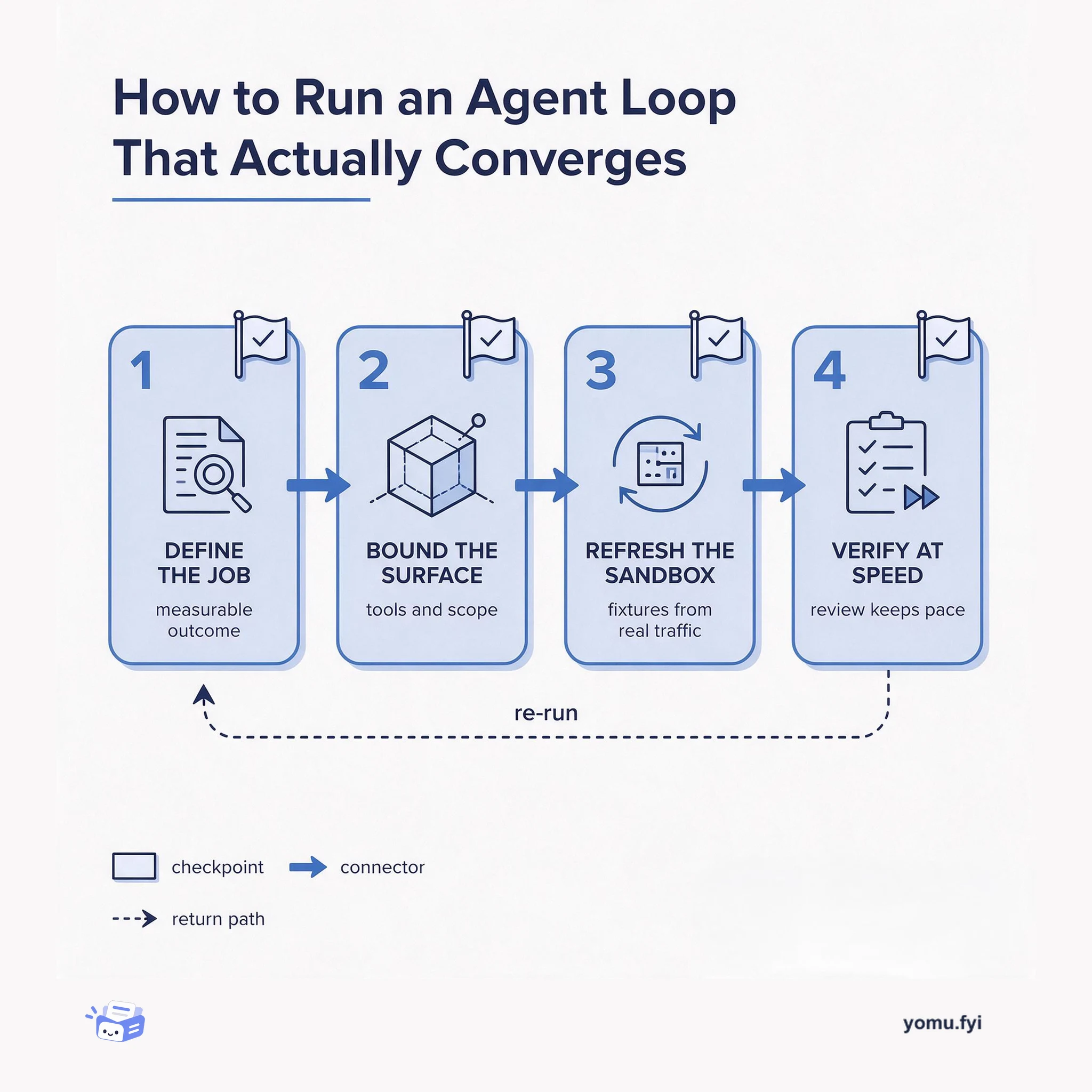
A four-checkpoint how-to for agent loops: name a measurable job, bound the tool surface, refresh sandbox fixtures from real traffic, and verify at agent speed.
Loading…
Topic
549 posts about AI Agents. Every summary links to the original.
See the idea
A four-checkpoint how-to for agent loops: name a measurable job, bound the tool surface, refresh sandbox fixtures from real traffic, and verify at agent speed.
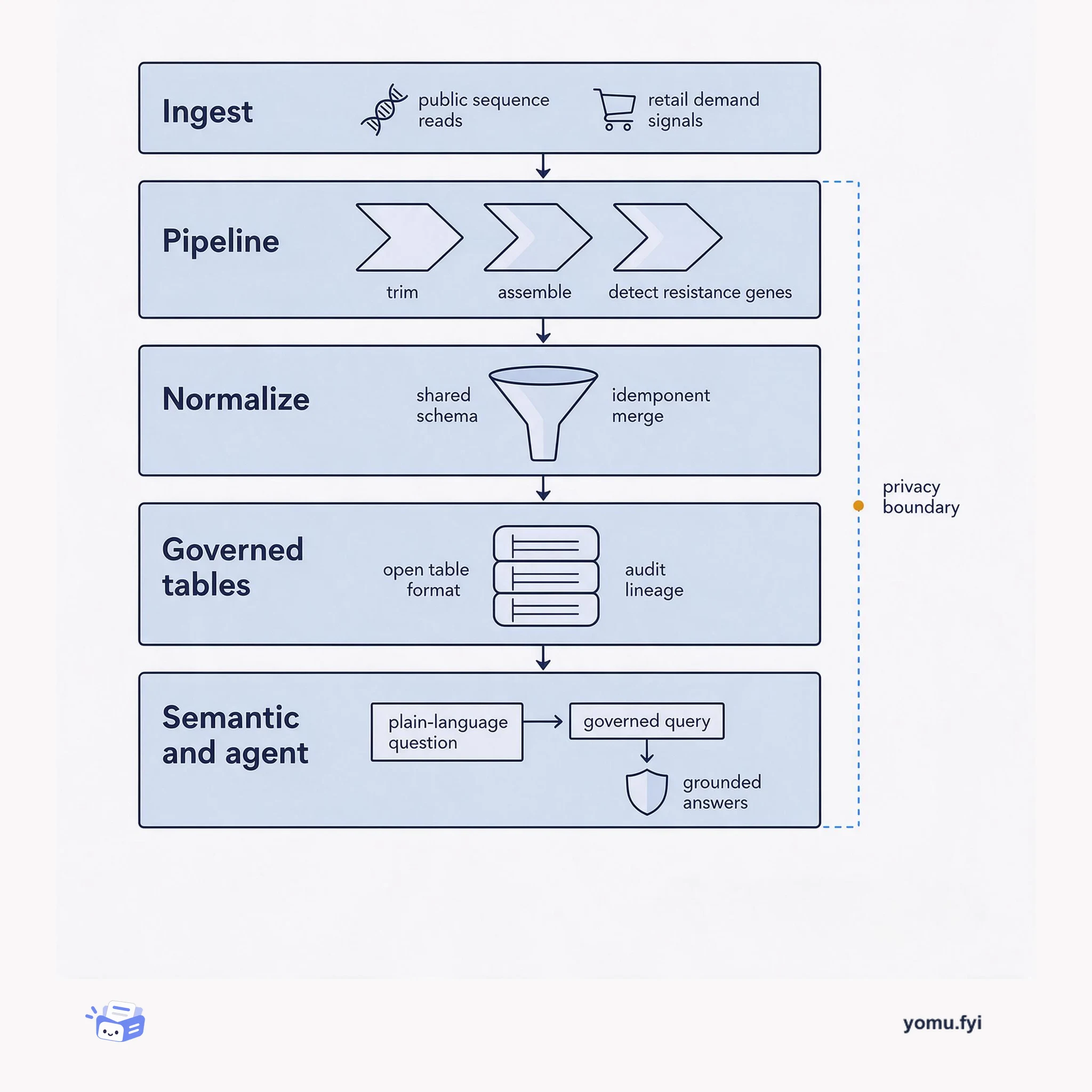
Antimicrobial resistance surveillance is a layered data architecture: raw reads and demand signals flow in, get normalized into governed tables, and answer plain-language queries. The diagram maps each boundary.
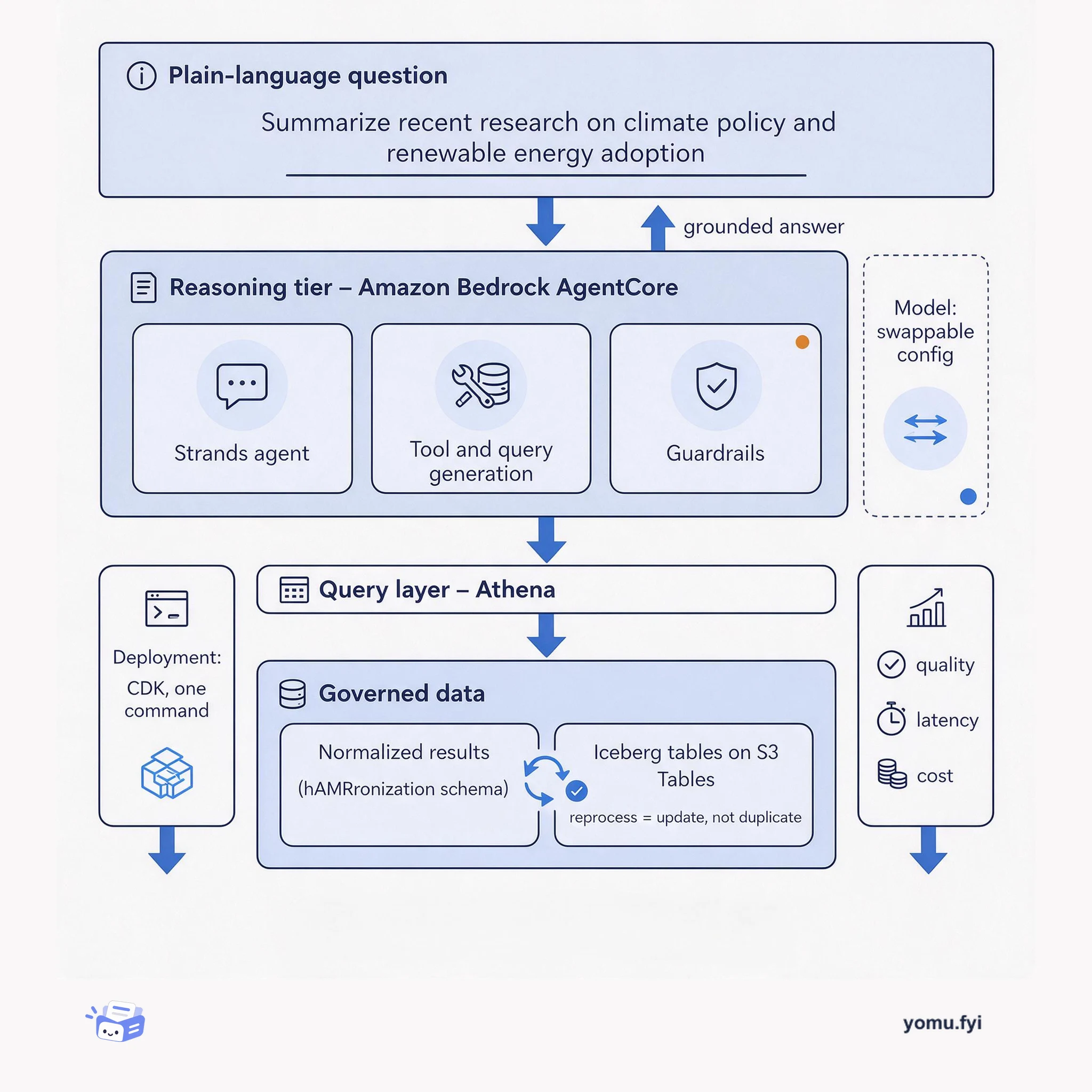
Amazon Bedrock is the managed reasoning tier in an agent architecture, not the whole system. This layered view shows the pipelines, governed tables, query layer, and guardrails around it.
The Good Stuff
Paid picks we use ourselves. Links carry a referral code — a subscription through one earns us a commission at no extra cost to you.
Newest first
Cursor has expanded its long-running agents research preview to all Ultra, Teams, and Enterprise users. The preview targets autonomous work on ambitious projects, using a custom harness designed to address frontier models’ failures on long-horizon tasks. Long-running agents propose a plan for approval before execution and use multiple agents to check work and maintain follow-through. Reported examples include runtimes of 36, 30, and 25 hours, while initial results showed substantially larger PRs with merge rates comparable to other agents. Internal examples include a Rust migration and custom kernels for video rendering, a 10,000-line network-policy PR, and secure sudo prompting for Cursor CLI; the company says agents can now deliver working solutions after hours or days, though safer production deployment and collaboration across agents remain active areas.
Cursor has raised limits for Auto and Composer 1.5 for all individual plans. The update introduces separate first-party models and API usage pools: first-party usage is increased for Auto and Composer 1.5, while API pricing and plan allowances remain unchanged. Composer 1.5 has a standard limit of three times Composer 1’s, with a temporary increase to six times through February 16. Cursor says this supports developers moving from autocomplete toward daily agentic coding while accommodating different preferences for speed, intelligence, and affordability. Composer 1.5 is described as scoring above Sonnet 4.5 on Terminal-Bench 2.0 but below the best frontier models, and both pools reset with the monthly usage cycle; the limits are live for Pro, Pro Plus, and Ultra plans.
Composer 1.5 is the successor to the first agentic coding model, Composer 1, and is positioned for fast, interactive daily use. It was built by scaling reinforcement learning 20x further on the same pretrained model, with post-training compute exceeding the base model’s pretraining compute. In an internal benchmark of real-world coding problems, performance quickly surpasses Composer 1 and continues rising, with the largest gains on challenging tasks. Composer 1.5 generates thinking tokens to reason about codebases and plan next steps, using minimal thinking on easy problems and continuing until it finds a satisfying answer on hard ones. It also recursively self-summarizes when context runs out, a training behavior intended to preserve original accuracy as context length varies; the release is described as significantly stronger and suitable for interactive use.
The post describes research into scaling long-running autonomous coding agents, using a web browser as a complex benchmark and running thousands of agents continuously for one week. An initial single-agent plan failed because the model lost track, stopped prematurely, and stalled on complex details; shared-state coordination then introduced locking contention, while more structured planner, executor, worker, and judge roles improved ownership and throughput. The team built a Rust-based harness on one large Linux VM, logged agent messages and tool activity for replay and analysis, and iterated through designs that eventually favored a more dynamic system with freshness mechanisms and fewer overloaded roles. The research concludes that architecture, prompts, observability, explicit throughput trade-offs, and anti-fragile recovery matter, reporting linear scaling of token throughput with minimal harness overhead while humans retained taste, judgment, and direction.
Customer support has shifted from a perceived cost to a differentiator as expectations rise and companies focus on retention, advocacy, and product feedback. Modern support aims to resolve issues, troubleshoot problems, and help customers get more value through personal, contextual, knowledgeable, and proactive interactions. The post argues that human+AI partnerships can improve speed and efficiency: AI agent Fin handles common questions in more than 45 languages, while human teammates address complex queries empathetically. It also explains why ticketing became necessary for tracking asynchronous work, internal ownership, and customer updates within an all-in-one support platform. Examples from Hospitable and Rebag report faster responses, reduced response times, and higher NPS, while the broader guidance emphasizes clear expectations, robust processes, escalation paths, and a clear route to human help.
First Block features Gerry Giacomán Colyer, Clara’s co-founder and CEO, discussing the company’s founding, rapid growth, and expansion of AI agents for finance operations across Latin America. Clara’s bank partner shut down only months after launch, prompting the team to secure direct issuer licenses with Visa and MasterCard in two weeks and build more robust infrastructure from the outset. The episode connects that resilience to product-led growth: a self-serve onboarding flow supported more than 20,000 customers across three countries, from pre-revenue startups to the Mexican Stock Exchange. The company is now applying its transaction data across Latin American businesses to a financial analyst agent that automates policy enforcement and approval workflows. It also covers the founding lesson from a previous company’s financial-tooling difficulties, early milestones, scaling decisions, and a roadmap across markets, alongside questions about efficiency, resilient infrastructure, and distinctive data advantages.
Okta Developer Connect Bengaluru was Okta’s first flagship Developer Connect event in India, bringing developers, architects, engineering managers, IAM practitioners, and technology leaders together to discuss identity as systems scale and AI agents work alongside humans. Sessions framed identity as foundational infrastructure spanning users, applications, APIs, services, and AI agents, while connecting core standards and practices to platform use cases including the Okta MCP Server, Cross App Access, Okta Integration Network, Okta Workflows, lifecycle management, and Verifiable Digital Credentials. Interactive discussions, audience Q&A, quizzes, surveys, and a research panel complemented talks and enabled exchanges with Okta engineers, product leaders, and advocates. The Bengaluru event begins an ongoing series intended to support practical identity education and open technical dialogue about enterprise-ready systems, identity standards, and AI-driven access and security assumptions.
eBay’s leaders identify five AI-related trends they expect to shape commerce and engineering in 2026, building on the company’s 2025 work in search, recommendations, seller tools, and eBay Live. They predict AI will absorb complexity across translation, compliance, payments, logistics, and risk while enabling continuous verification and agentic commerce that can negotiate, verify provenance, and execute cross-border transactions. Other forecasts include using AI to surface pre-loved goods, identify recyclable materials, deliver company-specific context to models for developer productivity, and make shopping more emotionally engaging. The final theme is uncertainty: because generative models introduce unpredictable behavior, product teams will need guardrails and faster learning from observable failures rather than relying on fully predictable flows.
Bugbot is a code review agent built to identify logic bugs, performance issues, and security vulnerabilities in pull requests before production, as increasingly capable coding agents increased review workload. Its development moved from qualitative assessments to systematic experimentation, using an AI-driven resolution-rate metric, the BugBench benchmark, and online evaluations of real pull requests. An early production flow ran eight parallel passes with randomized diff ordering, majority voting, category filters, validation, and deduplication, while later versions adopted a fully agentic design with tools and dynamic context. Across 40 major experiments, resolution rate rose from 52% to over 70%, bugs flagged per run from 0.4 to 0.7, and resolved bugs per pull request from roughly 0.2 to about 0.5. Newer versions caught more bugs without a comparable rise in false positives, and planned capabilities include Autofix, self-verification, deep research, and continuous scanning.
The post reports experiments running coding agents autonomously for weeks, with hundreds concurrently contributing to projects that typically take human teams months. It describes initial dynamic coordination through shared files, locks, and optimistic concurrency control, then explains why flat peer structures caused bottlenecks, fragility, risk aversion, and stalled progress. The successful design separates recursive planners from task-focused workers, uses a judge between cycles, and lets workers push changes to a shared branch with minimal conflicts. In tests, agents built a browser with more than 1 million lines across 1,000 files, migrated Solid to React over three weeks with +266K/-193K edits, and delivered a 25x faster Rust video renderer; other projects remain underway. The authors say GPT-5.2 models perform better on extended autonomous work, role-specific models and carefully tuned prompts matter, and moderate structure outperforms both flat peer coordination and elaborate controls, though drift and scheduling remain unsolved.
Ramp built Inspect, a hosted background coding agent that writes code and verifies its work using the context and tools available to engineers. For backend tasks it can run tests, inspect telemetry, and query feature flags, while frontend work can be checked visually with screenshots and live previews. Each session runs in a sandboxed Modal VM initialized from repository-specific images and snapshots, with integrations including GitHub, Slack, Sentry, Datadog, LaunchDarkly, Braintrust, and Buildkite. Inspect supports frontier models, MCPs, custom tools, and skills, and provides Slack, web, Chrome extension, pull request, and browser-based VS Code workflows whose changes remain synchronized. Ramp reports that about 30% of merged pull requests in its frontend and backend repositories are written by Inspect.
Cursor's guide presents practices for using coding agents that can run for hours, complete multi-file refactors, and iterate until tests pass. Planning first is emphasized: Plan Mode researches the codebase, asks clarifying questions, creates a reviewable implementation plan, and waits for approval. The guidance recommends letting the agent discover context, starting new conversations when focus declines, and using Rules for persistent project instructions while Skills provide dynamic workflows. It also describes hooks for long-running loops, worktrees for isolated changes, parallel model runs, cloud agents, and Debug Mode's hypothesis-and-instrumentation process. Careful diff review, specific prompts, and verifiable goals remain necessary because generated code can be subtly wrong.
Code And Let Live argues that read-only, ephemeral sandboxes are the wrong abstraction for coding agents, which need durable computers rather than fresh containers for every task. It introduces Sprites, disposable cloud computers that provide root Linux shells, 100GB of initial capacity, HTTPS through an Anycast network, automatic idle shutdown and metering stops, and persistence until explicitly removed. Sprites can be checkpointed and restored in about a second, allowing interactive recovery after changes while retaining installed software and development state across days or months. The argument extends beyond developer workflows: durable agents can keep realistic application context, observe logs, and support personal software whose development and production environments are the same, although the post says Sprites are unsuitable for applications serving millions of users.
Cursor describes dynamic context discovery, a coding-agent pattern that provides fewer details initially and lets the agent retrieve relevant information instead of injecting everything as static context. The approach uses files as a simple interface: long tool responses, chat history, Agent Skills, MCP tool descriptions, and integrated terminal output are stored or synchronized so the agent can inspect only what it needs with tools such as tail, grep, rg, and jq. For MCP, only tool names are included initially, while descriptions are synced into one folder per server; an A/B test found a 46.9% reduction in agent tokens for runs that called an MCP tool, with high variance based on the number of MCPs. Cursor says the design reduces context bloat, preserves information truncation could lose, supports recovery after summarization, and can expose MCP re-authentication status. The changes are planned to become available to all users in the coming weeks.
An analysis of 166 interviews examines how customer service roles, workflows, and team structures changed after adopting Fin or similar AI agents. Using interviews with Intercom customers or prospects, the researchers cleaned conversation transcripts with Python and coded them through the OpenAI API against a closed codebook. Workflow disruption was reported by 94.58% of participants, while 82.53% reported changed responsibilities; 27.71% reported headcount or hiring effects, and 6.02% reported changed team structures or reporting lines. The findings describe hybrid human–AI operations in which AI handles triage, routing, translation, repetitive responses, and some refunds, while people increasingly oversee quality, testing, metrics, and complex or sensitive interactions, although organizational strategies and required skills remain uneven.
The post frames AI as a new “miracle material” that could reshape knowledge work as steel and semiconductors reshaped earlier eras. It argues that coding agents already let one programmer orchestrate several AI coding agents, but broader knowledge work remains constrained by fragmented context across tools and weak verifiability. At the organisational level, it compares AI with steel and steam, suggesting agents could preserve workflow context, surface decisions, and reduce dependence on meetings and hierarchical approvals; Notion is described as using more than 700 agents alongside 1,000 employees for repetitive tasks. At economy scale, it predicts organisations spanning humans and thousands of agents, with continuous workflows and new rhythms, while acknowledging that this transition may be disorienting and requires redesign rather than simply adding chatbots to existing tools.
First Block is a set of conversations with founders and company leaders across legal technology, finance, career access, software development, talent, go-to-market, and developer tools. The episodes feature Gabe Pereyra of Harvey, Gerry Giacomán Colyer of Clara, Garrett Lord of Handshake, Jesse Zhang of Decagon, Fabian Hedin of Lovable, Brendan Foody of Mercor, Varun Anand of Clay, and Michael Truell of Cursor. Topics include deploying AI agents in finance operations across Latin America, democratizing software development and career opportunities, intentional customer discovery, and building for current AI capabilities. The collection also covers founder-led selling, product-market fit, specialized go-to-market platforms, commercial thinking, startup pivots, and departures from conventional startup advice.
Make with Notion Showcase Europe 2025 brought more than 1,300 attendees across four cities during the second year of the in-person conference series. The event centered on three themes: agentic AI taking action, organized knowledge enabling effective AI, and a community building AI-powered work. Notion presented Notion 3.0, whose Agent can handle multi-step workflows, and previewed Custom Agents that can be shared across teams, scoped to databases or teamspaces, and triggered by schedules or events. With MCP integration, Notion content and connected app context can be accessed from other tools; Custom Agents are in early access and planned for broader availability in early 2026. Research cited losses of up to €16,000 per employee annually in the UK, France, and Germany from searching for scattered information, while customer sessions covered knowledge management, AI workflows, and Notion implementations.
AI-first customer service makes capacity planning less predictable because automation changes volume, work mix, human responsibilities, and performance over time. The proposed planning model puts automation rate—AI Agent involvement rate multiplied by AI Agent resolution rate—alongside inbound volume, human output for complex remaining work, and occupancy. It recommends ambitious automation assumptions only when backed by named ownership, content and systems investment, work-type targets, and staged improvement, while modeling lower cases closed per person and more time for off-queue work. Finance should treat the plan as a revisable set of assumptions, review it at least quarterly, and avoid cutting headcount before automation is proven. Surplus capacity should be redirected to AI improvement, product feedback, new channels, or proactive customer experience work rather than automatically reduced.
Debug Mode is an agent loop for coding bugs that combines runtime information with human verification, addressing issues that can stump conventional coding agents. After the user describes a bug, it reads the codebase, proposes multiple hypotheses, and instruments the code with logging statements designed to test them. The user reproduces the issue while the agent collects variable states, execution paths, and timing information, then uses those logs to identify a root cause and produce a targeted fix, often a two- or three-line modification. The user reproduces the bug again with the fix; if it works, the agent removes its instrumentation, while a failed verification prompts additional logging and refinement until the user considers the problem solved.
The best engineering reads, once a week.