How to Give an Agent a Query Language Instead of a Code Interpreter
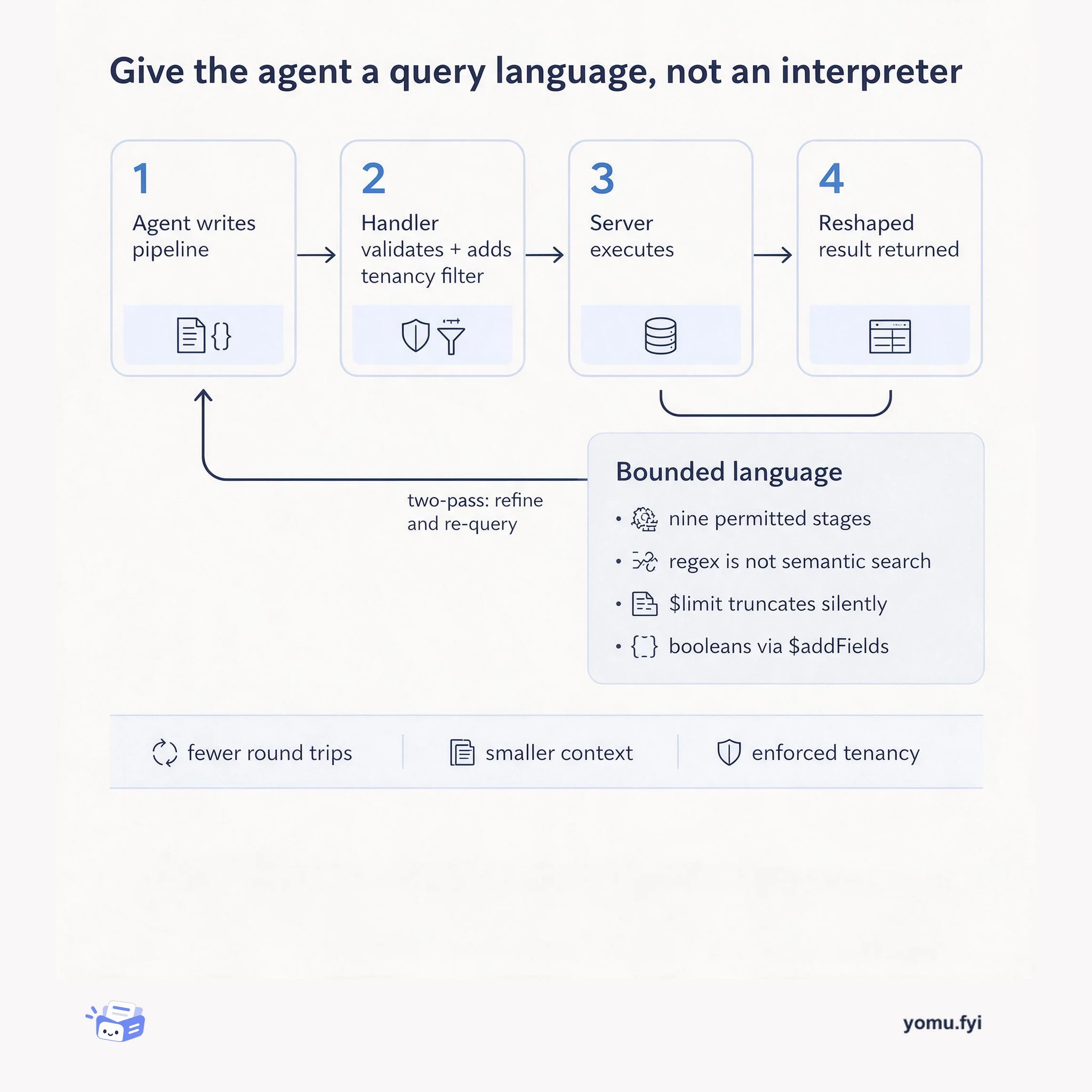
A four-step pattern for letting a document agent write validated aggregation pipelines instead of arbitrary code, so results come back shaped and tenancy stays enforced.
Loading…
Topic
541 posts about AI Agents. Every summary links to the original.
See the idea
A four-step pattern for letting a document agent write validated aggregation pipelines instead of arbitrary code, so results come back shaped and tenancy stays enforced.
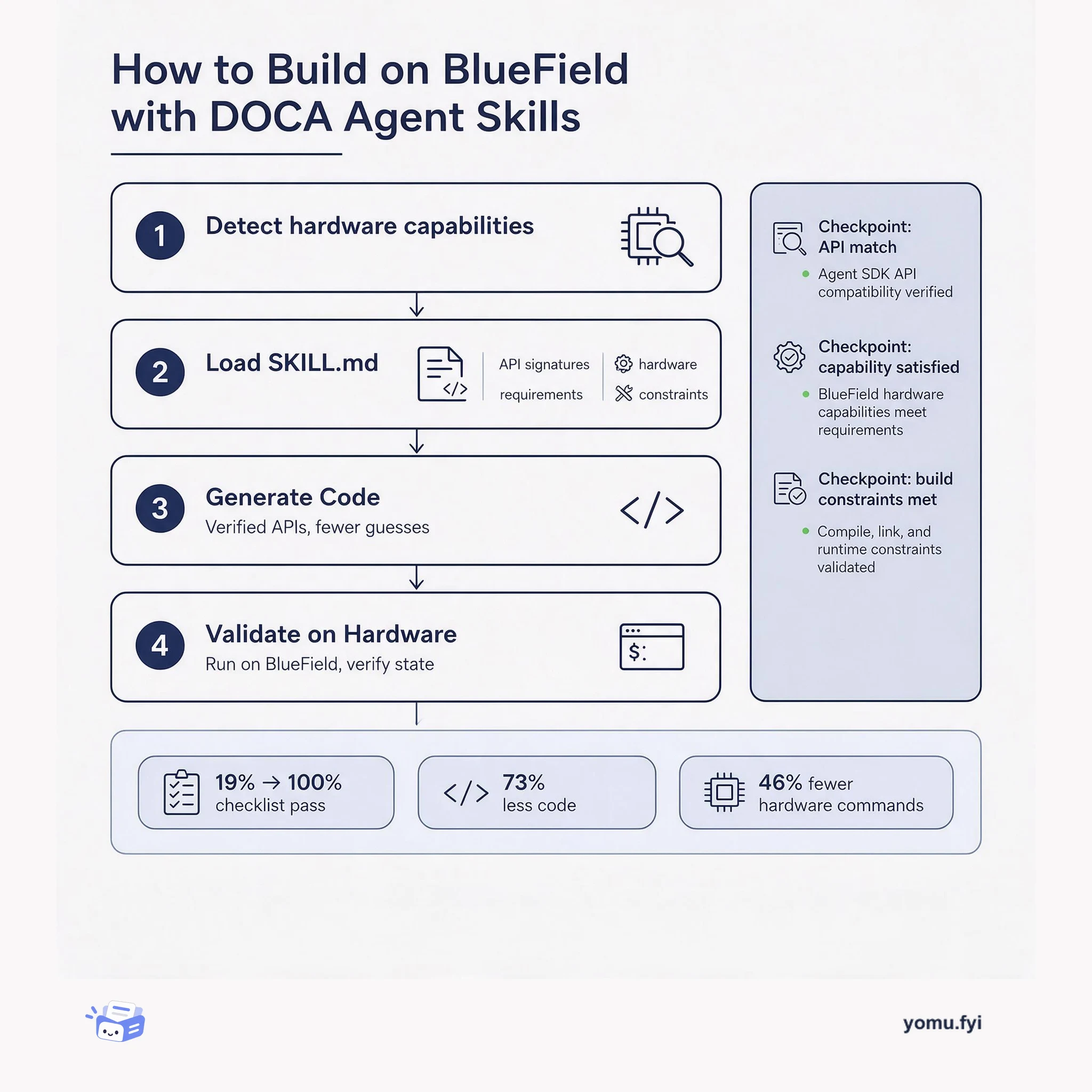
A practical how-to for using NVIDIA DOCA Agent Skills to generate BlueField code with verified APIs and hardware checks, reducing correction cycles and failed builds.
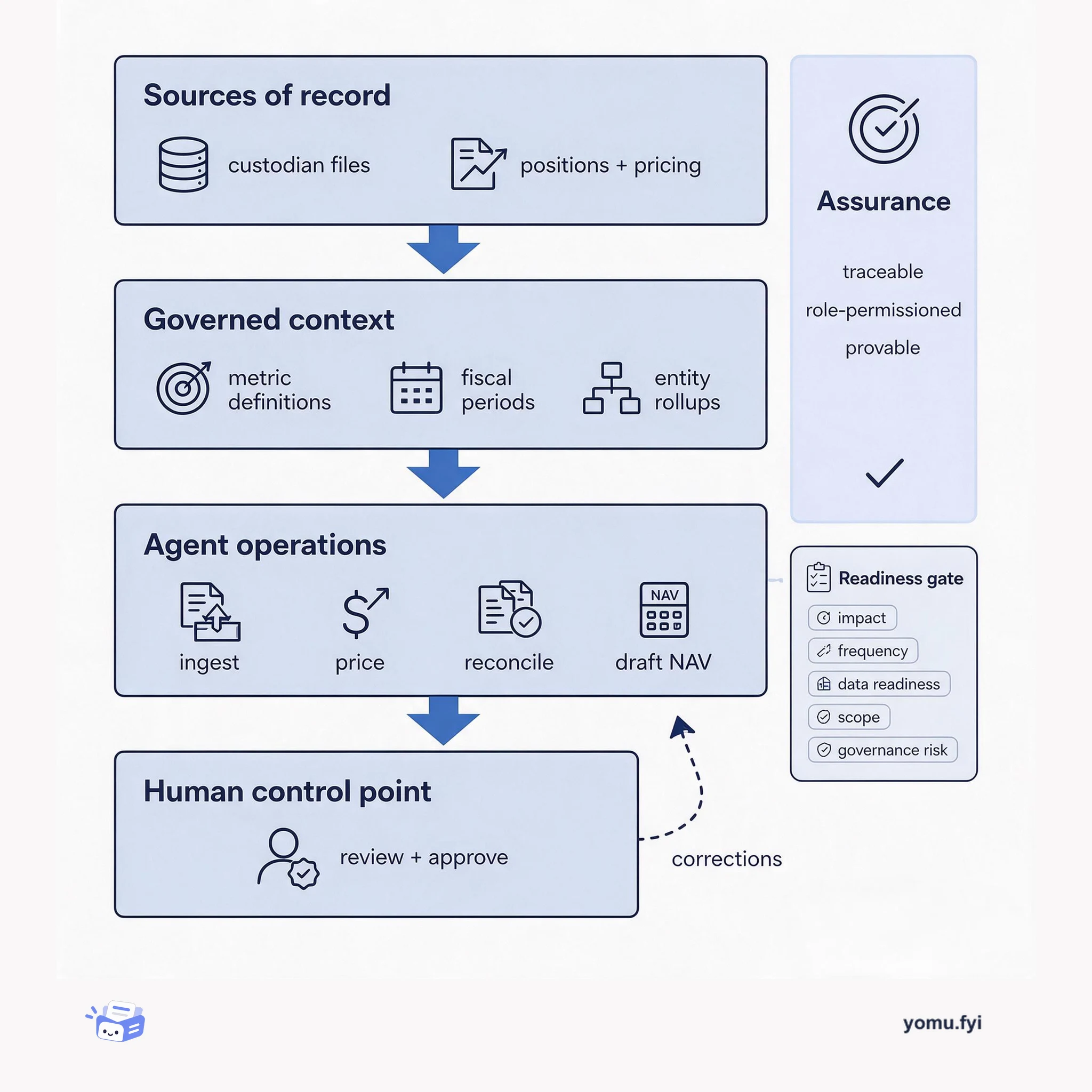
Asset management runs as a layered control plane: custodian and pricing data feed a governed context layer, agents run the overnight fund work, and a human signs off before anything is published.
The Good Stuff
Paid picks we use ourselves. Links carry a referral code — a subscription through one earns us a commission at no extra cost to you.
Newest first
PlanetScale describes code review as the bottleneck created by rapidly increasing agent-generated code, while human review capacity remained fixed. To preserve production reliability, the company adopted Bugbot as a dedicated agentic review layer alongside its existing process. Bugbot surfaces semantic and logical issues that static analyzers, linters, and straightforward frontier-model reviews may miss, including premature completion states, non-converging asynchronous controllers, and database restart edge cases. Across more than 2,000 pull requests reviewed monthly, roughly 80% of Bugbot's comments are addressed before merge. PlanetScale says this prevents potential production downtime, saves the equivalent of two full-time engineers of review effort, and lets engineers focus on complex infrastructure work without sacrificing quality.
Custom Agents were designed for collaborative workspaces where useful access must be balanced against dangerous actions. They use a build-from-nothing model with no default read, write, or interaction permissions, then add resource-level controls such as page-level access, Slack “read and reply,” email confirmation, and selected MCP tools. Runtime safeguards combine permission controls with prompt-injection mitigations, monitoring of external data, warnings, owner confirmation for risky actions, and remediation such as deleting an incorrect Slack message. Alpha testing across Notion and customers produced more than 3,000 internal and 25,000 customer agents, and exposed overly broad Slack write access that could reach #general. That finding led to the custom permission and reinforced the case for first-party integrations, while planned work includes admin-approved broader scopes, Workers integrations, and additional permission modes.
AI is changing customer service operations by shifting human agents away from queue-level work such as triage and FAQs toward training systems, complex escalations, and strategic improvement. In research from The 2026 Customer Service Transformation Report, 45% of teams updated job descriptions with AI-related responsibilities, 40% said agents focus more on training AI systems, and 27% primarily handle complex escalations and edge cases. Interviews with 166 customers found nearly 95% reporting meaningful workflow changes, while 83% saw roles become more strategic and supervisory; mature teams also reported less time handling support volume. New positions including AI knowledge managers and conversation designers are emerging, while existing staff can move into AI-focused work such as optimizing knowledge, monitoring outputs, and improving customer journeys. The source recommends transparent communication, agent participation, dedicated time outside inbox, and metrics such as resolution rate as teams build operating models with AI at their core.
The post describes a third era of AI-assisted software development, in which autonomous agents handle larger tasks over longer timescales while developers define problems and review results. It traces a progression from Tab autocomplete, to synchronous prompt-and-response agents, and then cloud-based agents running on separate virtual machines. These agents can iterate and test for hours, returning logs, video recordings, and live previews that make parallel work and artifact-based review practical. Cursor reports that 35% of its internally merged pull requests are created by agents operating autonomously in cloud VMs, and that agent users now outnumber Tab users two-to-one after usage grew more than 15x in a year. The post says broader adoption still depends on reliable tests, environments, tools, and context, while developers shift toward decomposition, review, and feedback rather than line-by-line guidance.
Bugbot Autofix extends the code review agent so it can find issues in pull requests and automatically propose fixes. It spawns cloud agents in independent virtual machines that test software, and more than 35% of its changes are merged into the base PR. Now out of beta and available to all Bugbot users, the feature adds proposed fixes to the pull requests Bugbot reviews once enabled. Bugbot’s average issues identified per run has nearly doubled over six months, while the user resolution rate rose from 52% to 76%, indicating more bugs are caught and fewer false positives are flagged. Future work includes configurable automations, self-verification, deeper research, and continuous codebase scanning.
Intercom announces 12 updates to Fin’s Procedures and Simulations, the mechanisms it presents for handling complex customer queries while keeping teams in control. Procedures combine natural-language instructions, deterministic controls such as conditional steps, data connectors, code snippets, checkpoints, and fully agentic behavior; new features include AI drafting, reusable Sub-procedures, explicit switching rules, targeted knowledge-hub references, internal handoff notes, automatic switching, and structured extraction from PDFs and images. The Procedures UI also adds improved authoring and reporting on triggers, resolutions, and handoffs. Simulations support full multi-turn conversations, image uploads, clearer visibility into Fin’s reasoning, and AI-generated tests stored in a central library that can be rerun after changes. Procedures and Simulations are available now, with the stated goal of helping teams train, test, deploy, analyze, and refine complex workflows before and after launch.
Notion describes how Custom Agents are being used internally to automate repetitive questions, triage incoming work, and support communications, security, recruiting, and office operations. Agents are configured by describing a workflow and adding a trigger or schedule; they operate across Notion, Slack, Mail, Calendar, and other tools while using existing knowledge for context. Examples include a CX agent that searches the CX Knowledge Base and enablement docs, a Feedback Router that classifies Slack feedback and creates tasks, and Wilbur, which triages web issues and tags the right person. The company says these workflows make knowledge available beyond individual experts, reduce manual routing and response delays, and shift attention toward complex problems and creative work.
Notion has made Custom Agents available to Business and Enterprise plans as autonomous AI teammates for recurring work across Notion, Slack, Mail, Calendar, Figma, Linear, and custom MCP servers. Users describe a job and set triggers, while agents can answer questions, route tasks, compile updates, and run workflows across connected tools; setup includes an agent-written instruction set and tool configuration. The announcement describes enterprise controls including permissions, version control, usage analytics, logged runs, reversible changes, alerts, auto-pause, and administrative connection controls, while noting prompt-injection risks and planned guardrails. Custom Agents are free through 3 May 2026, then consume Notion credits based on work, with the seat price and other listed AI features unchanged; early testers have built over 21,000 agents.
Cursor describes cloud agents running in isolated virtual machines with full development environments, letting them use and test the software they create rather than stopping at code generation. Available through the web, mobile, desktop, Slack, and GitHub, the agents onboard onto codebases, produce merge-ready pull requests, and attach videos, screenshots, and logs as validation artifacts. Each agent receives an isolated VM for parallel work and can interact directly with browsers, desktop applications, and other tools; users can control its remote desktop and edit without checking out the branch locally. Examples include implementing and verifying Marketplace source links, reproducing a clipboard-exfiltration vulnerability, testing lint-label changes in Cursor, and walking through cursor.com/docs. Cursor reports that more than 30% of its merged PRs are created by autonomous cloud-sandbox agents, while its next goals include coordinating agents, learning from past runs, and eventually managing production changes end to end.
Ramp Security Engineering describes a six-day experiment in which home-grown agents found, validated, and fixed nearly 100 latent backend security issues, including some high-severity findings, without human involvement until pull-request review. The issues had not been uncovered by penetration testing, bug bounty testing, static analysis, or trials of 10+ code-scanning vendors, and all were patched within a week of discovery. The pipeline used specialized vulnerability detectors, adversarial manager agents that rejected 40% of initial proposals in sample testing, integration tests for validation, and an internal coding agent that generated patches. Live interactive validation struggled with complex preconditions, so test-based validation became the main approach; a human team member still reviewed and landed each pull request.
Cursor now supports plugins, allowing agents to connect to external tools and acquire new knowledge. Plugins bundle MCP servers, skills, subagents, rules, and hooks to add custom functionality. The initial curated set includes Amplitude, AWS, Figma, Linear, Stripe, Cloudflare, Vercel, Databricks, Snowflake, and Hex, covering planning, design, payments, infrastructure, data, and analytics workflows. Users can install prebuilt plugins from the Cursor Marketplace or create and share their own, while plugin primitives let agents discover domain-specific skills, run subagents in parallel, connect through MCP servers, observe behavior with hooks, and follow rules. The announcement also introduces the Cursor Team Kit for internal CI, code review, and testing workflows, and says private team marketplaces with governance and security controls are coming.
Box selected Cursor as its enterprise agentic coding platform after evaluating data privacy, security, and agent-quality controls. More than 85% of Box developers, or over 800 people, now use Cursor daily, while the company reports a 30–50% increase in product-roadmap throughput and migrations completed 80–90% faster. Box encodes agent guardrails in custom Cursor rules and commands, including a frontend AI toolkit, automated test-coverage work, and rules for React and design-system migrations. A mentorship program pairing power users with newer adopters increased Cursor usage by 75% and power users by 25% in six weeks, while Box says it can move faster without compromising product quality, security, or accessibility.
Cursor has expanded its long-running agents research preview to all Ultra, Teams, and Enterprise users. The preview targets autonomous work on ambitious projects, using a custom harness designed to address frontier models’ failures on long-horizon tasks. Long-running agents propose a plan for approval before execution and use multiple agents to check work and maintain follow-through. Reported examples include runtimes of 36, 30, and 25 hours, while initial results showed substantially larger PRs with merge rates comparable to other agents. Internal examples include a Rust migration and custom kernels for video rendering, a 10,000-line network-policy PR, and secure sudo prompting for Cursor CLI; the company says agents can now deliver working solutions after hours or days, though safer production deployment and collaboration across agents remain active areas.
Cursor has raised limits for Auto and Composer 1.5 for all individual plans. The update introduces separate first-party models and API usage pools: first-party usage is increased for Auto and Composer 1.5, while API pricing and plan allowances remain unchanged. Composer 1.5 has a standard limit of three times Composer 1’s, with a temporary increase to six times through February 16. Cursor says this supports developers moving from autocomplete toward daily agentic coding while accommodating different preferences for speed, intelligence, and affordability. Composer 1.5 is described as scoring above Sonnet 4.5 on Terminal-Bench 2.0 but below the best frontier models, and both pools reset with the monthly usage cycle; the limits are live for Pro, Pro Plus, and Ultra plans.
Composer 1.5 is the successor to the first agentic coding model, Composer 1, and is positioned for fast, interactive daily use. It was built by scaling reinforcement learning 20x further on the same pretrained model, with post-training compute exceeding the base model’s pretraining compute. In an internal benchmark of real-world coding problems, performance quickly surpasses Composer 1 and continues rising, with the largest gains on challenging tasks. Composer 1.5 generates thinking tokens to reason about codebases and plan next steps, using minimal thinking on easy problems and continuing until it finds a satisfying answer on hard ones. It also recursively self-summarizes when context runs out, a training behavior intended to preserve original accuracy as context length varies; the release is described as significantly stronger and suitable for interactive use.
The post describes research into scaling long-running autonomous coding agents, using a web browser as a complex benchmark and running thousands of agents continuously for one week. An initial single-agent plan failed because the model lost track, stopped prematurely, and stalled on complex details; shared-state coordination then introduced locking contention, while more structured planner, executor, worker, and judge roles improved ownership and throughput. The team built a Rust-based harness on one large Linux VM, logged agent messages and tool activity for replay and analysis, and iterated through designs that eventually favored a more dynamic system with freshness mechanisms and fewer overloaded roles. The research concludes that architecture, prompts, observability, explicit throughput trade-offs, and anti-fragile recovery matter, reporting linear scaling of token throughput with minimal harness overhead while humans retained taste, judgment, and direction.
Customer support has shifted from a perceived cost to a differentiator as expectations rise and companies focus on retention, advocacy, and product feedback. Modern support aims to resolve issues, troubleshoot problems, and help customers get more value through personal, contextual, knowledgeable, and proactive interactions. The post argues that human+AI partnerships can improve speed and efficiency: AI agent Fin handles common questions in more than 45 languages, while human teammates address complex queries empathetically. It also explains why ticketing became necessary for tracking asynchronous work, internal ownership, and customer updates within an all-in-one support platform. Examples from Hospitable and Rebag report faster responses, reduced response times, and higher NPS, while the broader guidance emphasizes clear expectations, robust processes, escalation paths, and a clear route to human help.
First Block features Gerry Giacomán Colyer, Clara’s co-founder and CEO, discussing the company’s founding, rapid growth, and expansion of AI agents for finance operations across Latin America. Clara’s bank partner shut down only months after launch, prompting the team to secure direct issuer licenses with Visa and MasterCard in two weeks and build more robust infrastructure from the outset. The episode connects that resilience to product-led growth: a self-serve onboarding flow supported more than 20,000 customers across three countries, from pre-revenue startups to the Mexican Stock Exchange. The company is now applying its transaction data across Latin American businesses to a financial analyst agent that automates policy enforcement and approval workflows. It also covers the founding lesson from a previous company’s financial-tooling difficulties, early milestones, scaling decisions, and a roadmap across markets, alongside questions about efficiency, resilient infrastructure, and distinctive data advantages.
Okta Developer Connect Bengaluru was Okta’s first flagship Developer Connect event in India, bringing developers, architects, engineering managers, IAM practitioners, and technology leaders together to discuss identity as systems scale and AI agents work alongside humans. Sessions framed identity as foundational infrastructure spanning users, applications, APIs, services, and AI agents, while connecting core standards and practices to platform use cases including the Okta MCP Server, Cross App Access, Okta Integration Network, Okta Workflows, lifecycle management, and Verifiable Digital Credentials. Interactive discussions, audience Q&A, quizzes, surveys, and a research panel complemented talks and enabled exchanges with Okta engineers, product leaders, and advocates. The Bengaluru event begins an ongoing series intended to support practical identity education and open technical dialogue about enterprise-ready systems, identity standards, and AI-driven access and security assumptions.
eBay’s leaders identify five AI-related trends they expect to shape commerce and engineering in 2026, building on the company’s 2025 work in search, recommendations, seller tools, and eBay Live. They predict AI will absorb complexity across translation, compliance, payments, logistics, and risk while enabling continuous verification and agentic commerce that can negotiate, verify provenance, and execute cross-border transactions. Other forecasts include using AI to surface pre-loved goods, identify recyclable materials, deliver company-specific context to models for developer productivity, and make shopping more emotionally engaging. The final theme is uncertainty: because generative models introduce unpredictable behavior, product teams will need guardrails and faster learning from observable failures rather than relying on fully predictable flows.
The best engineering reads, once a week.