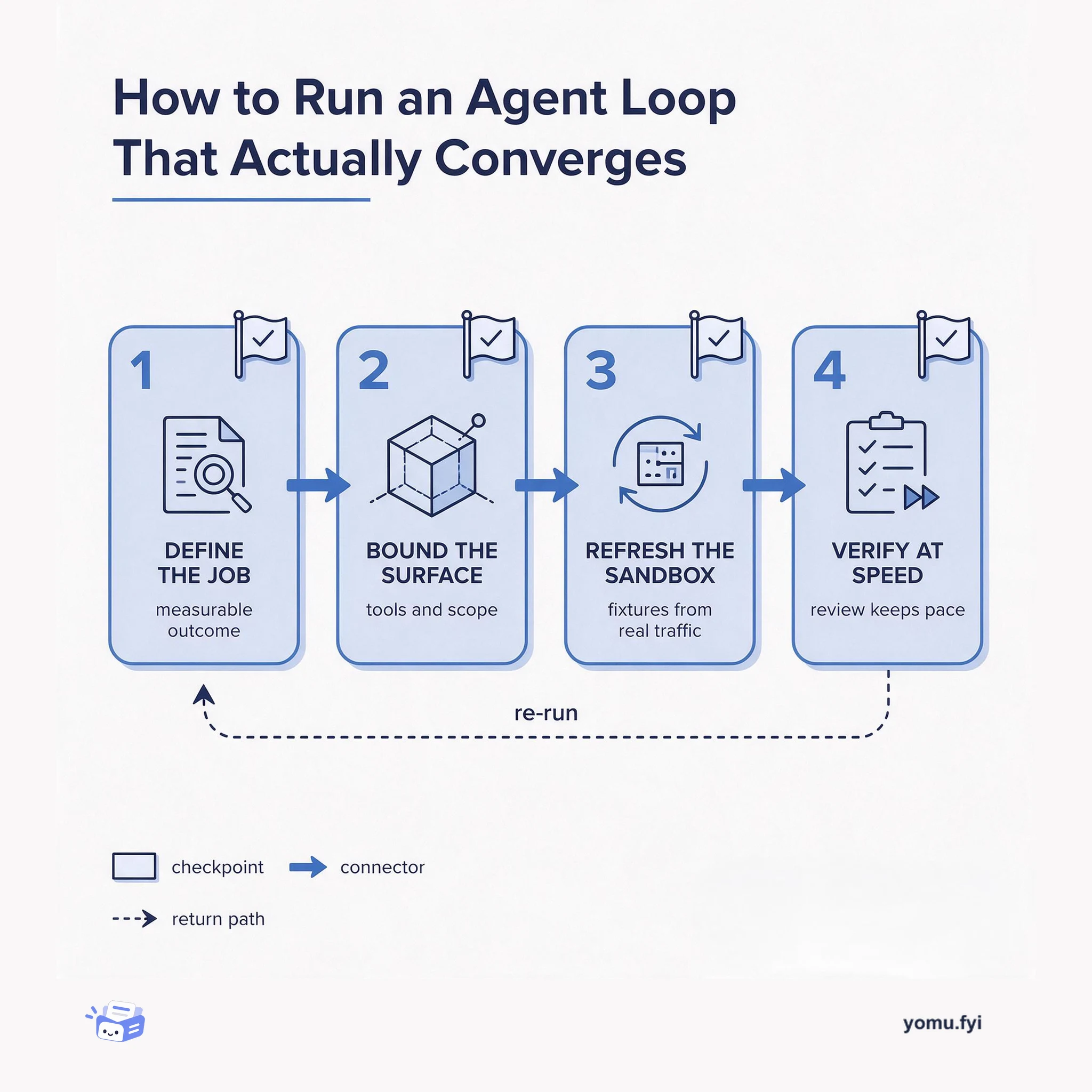
How to Run an Agent Loop That Actually Converges
A four-checkpoint how-to for agent loops: name a measurable job, bound the tool surface, refresh sandbox fixtures from real traffic, and verify at agent speed.
Loading…
Topic
553 posts about AI Agents. Every summary links to the original.
See the idea
A four-checkpoint how-to for agent loops: name a measurable job, bound the tool surface, refresh sandbox fixtures from real traffic, and verify at agent speed.
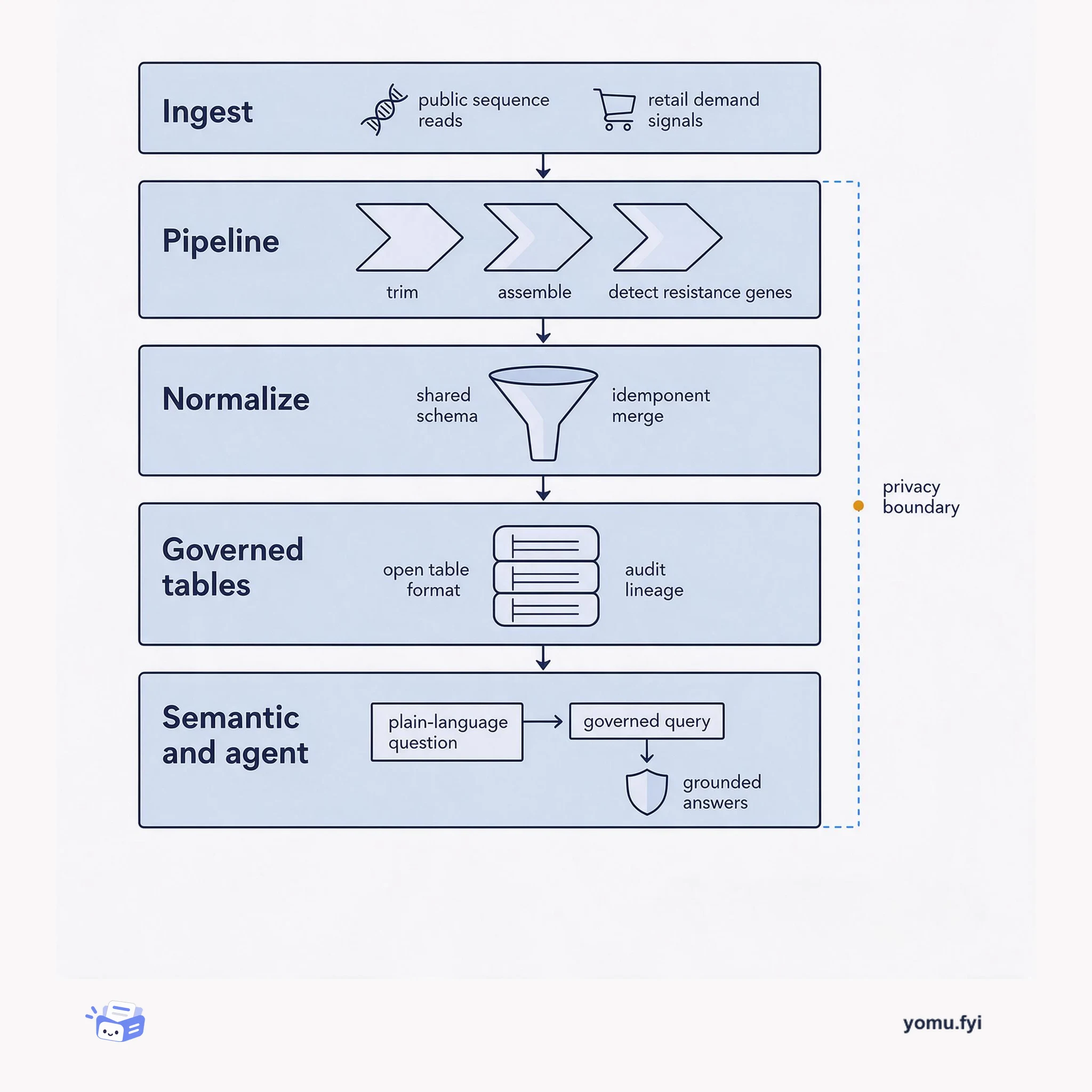
Antimicrobial resistance surveillance is a layered data architecture: raw reads and demand signals flow in, get normalized into governed tables, and answer plain-language queries. The diagram maps each boundary.
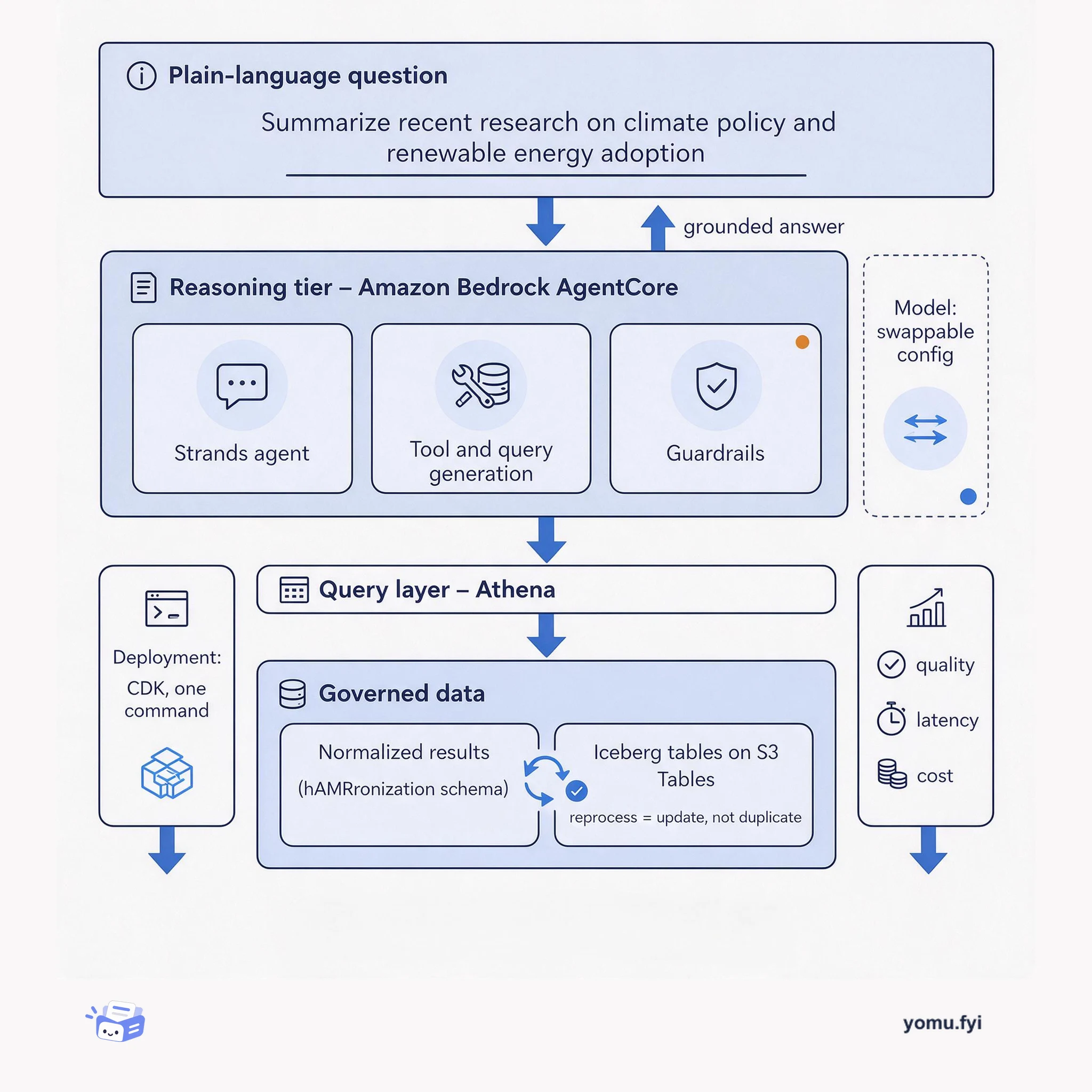
Amazon Bedrock is the managed reasoning tier in an agent architecture, not the whole system. This layered view shows the pipelines, governed tables, query layer, and guardrails around it.
The Good Stuff
Paid picks we use ourselves. Links carry a referral code — a subscription through one earns us a commission at no extra cost to you.
Newest first
First Block is a set of conversations with founders and company leaders across legal technology, finance, career access, software development, talent, go-to-market, and developer tools. The episodes feature Gabe Pereyra of Harvey, Gerry Giacomán Colyer of Clara, Garrett Lord of Handshake, Jesse Zhang of Decagon, Fabian Hedin of Lovable, Brendan Foody of Mercor, Varun Anand of Clay, and Michael Truell of Cursor. Topics include deploying AI agents in finance operations across Latin America, democratizing software development and career opportunities, intentional customer discovery, and building for current AI capabilities. The collection also covers founder-led selling, product-market fit, specialized go-to-market platforms, commercial thinking, startup pivots, and departures from conventional startup advice.
Make with Notion Showcase Europe 2025 brought more than 1,300 attendees across four cities during the second year of the in-person conference series. The event centered on three themes: agentic AI taking action, organized knowledge enabling effective AI, and a community building AI-powered work. Notion presented Notion 3.0, whose Agent can handle multi-step workflows, and previewed Custom Agents that can be shared across teams, scoped to databases or teamspaces, and triggered by schedules or events. With MCP integration, Notion content and connected app context can be accessed from other tools; Custom Agents are in early access and planned for broader availability in early 2026. Research cited losses of up to €16,000 per employee annually in the UK, France, and Germany from searching for scattered information, while customer sessions covered knowledge management, AI workflows, and Notion implementations.
AI-first customer service makes capacity planning less predictable because automation changes volume, work mix, human responsibilities, and performance over time. The proposed planning model puts automation rate—AI Agent involvement rate multiplied by AI Agent resolution rate—alongside inbound volume, human output for complex remaining work, and occupancy. It recommends ambitious automation assumptions only when backed by named ownership, content and systems investment, work-type targets, and staged improvement, while modeling lower cases closed per person and more time for off-queue work. Finance should treat the plan as a revisable set of assumptions, review it at least quarterly, and avoid cutting headcount before automation is proven. Surplus capacity should be redirected to AI improvement, product feedback, new channels, or proactive customer experience work rather than automatically reduced.
Debug Mode is an agent loop for coding bugs that combines runtime information with human verification, addressing issues that can stump conventional coding agents. After the user describes a bug, it reads the codebase, proposes multiple hypotheses, and instruments the code with logging statements designed to test them. The user reproduces the issue while the agent collects variable states, execution paths, and timing information, then uses those logs to identify a root cause and produce a targeted fix, often a two- or three-line modification. The user reproduces the bug again with the fix; if it works, the agent removes its instrumentation, while a failed verification prompts additional logging and refinement until the user considers the problem solved.
After defining team roles, an operating model is needed to make progress part of customer-support work and keep an AI Agent improving over time. The stated goal is that “the first time you answer a question should be the last,” with each resolution improving the system so fewer issues repeat, quality compounds, and support scales. The post emphasizes clear ownership, risk-aware guardrails, feedback loops, and a culture that values improvement work; it identifies ambiguity as a common cause of performance plateaus. An AI ops lead, often located in support operations or developed from an existing role, owns performance and drives change, illustrated by Dotdigital’s dedicated specialist after resolution volume held at about 2,800 conversations per month for three months; lightweight governance is presented as a way to keep iterating without excessive bureaucracy.
Spain’s proposed customer service law would impose stricter requirements on regulated providers and sufficiently large companies, covering response times, human access, complaint handling, accessibility, and auditability. It would require 95% of support calls to be answered within three minutes, free lines, 24/7 support for continuity issues in essential services, and complaints resolved within 15 days or five days for undue charges. The source also describes protections against spam calls, centralized complaint records, multilingual support obligations for some large companies, and simpler subscription cancellation. It presents AI Agents such as Fin as a way to reduce avoidable volume, answer calls, preserve human escalation, structure complaints, communicate outages, and support reporting. The stated conclusion is that early modernization may ease pressure on human teams while helping organizations adapt to rising regulatory and customer expectations.
Intercom announces that it has achieved AIUC-1 certification, describing it as the first standard designed specifically for AI Agents. The certification complements broader frameworks such as ISO 42001 and addresses enterprise concerns spanning security, customer safety, system reliability, data and privacy, society, and accountability. Organizations seeking AIUC-1 undergo independent third-party audits and quarterly adversarial testing across more than a thousand enterprise risk scenarios, while the standard itself evolves quarterly through the AIUC-1 Consortium. Intercom says the certification extends its governance approach to Fin, its AI Agent, providing independent validation that its AI systems are safe, resilient, regularly tested, safeguarded, and enterprise-ready; it also identifies Intercom as a founding technical contributor to the standard.
Cursor describes adapting its agent harness for OpenAI's latest frontier coding model, GPT-5.1-Codex-Max, by pairing model-familiar instructions with Cursor-specific tools and tuning against Cursor Bench. The Codex integration adopts a more shell-forward design, aligns tool names with commands such as rg, explicitly prefers tools over shell commands, and uses sandboxing to limit unauthorized file and network access. It also limits reasoning summaries to one or two sentences, gives literal guidance for invoking read_lints after substantive edits, removes mid-turn user-communication language, and biases the agent toward taking action unless a plan is requested. Preserving Responses API reasoning items is treated as critical: Cursor reports a 30% performance drop for GPT-5-Codex when traces were removed, compared with OpenAI's observed 3% SWE-bench degradation for GPT-5, while prompt-ordering lessons led it to remove wording that discouraged ambitious work.
AI performance in customer support can drift without clear ownership, even when the underlying model is capable. This part of a 2026 planning series presents four roles: AI operations lead, knowledge manager, conversation designer, and support automation specialist. The roles cover monitoring and guardrails, structured and compliant knowledge, conversational tone and flow, and reliable action through backend systems, with the AI operations lead coordinating reporting and improvement. The post describes an operating loop in which performance patterns drive knowledge fixes, interaction changes, and expanded automation, while phased ownership moves from part-time assignments to formal roles and hiring. It says dedicated specialization becomes essential when AI handles 50–70% of incoming volume, and frames these roles as the backbone of an AI-first support organization.
When AI Agents resolve most customer conversations, support organizations need to move beyond tiered models centered on queues, handoffs, and volume-based productivity. The proposed AI-first operating model distributes four foundational responsibilities: an AI operations lead monitors and improves performance, a knowledge manager maintains structured content, a conversation designer shapes communication and handoffs, and a support automation specialist builds executable workflows. Existing enablement, QA, workforce management, and leadership roles also evolve, with player-coach leaders managing both AI performance and people. Examples from Dotdigital, Clay, Lightspeed, and Intercom illustrate dedicated roles and an Intercom structure organized around Human Support, AI Support, and Support Operations and Optimization.
SpellVault began as Grab’s no-code platform for building LLM apps, using Retrieval-Augmented Generation (RAG) and plugins to connect applications with knowledge sources and external systems. Users could ground responses in Wikis, Google Docs, text, and PDFs, invoke custom HTTP endpoints, and access apps through the web, Slack, or APIs. The platform later added citations, Python execution for mathematical problems, scheduled actions, and drag-and-drop Workflows combining LLM calls, code, and Knowledge Vault lookups, while its executor moved toward graphs with nodes, edges, and states. SpellVault now exposes apps and RAG through MCP, allowing external agents and compatible clients to invoke apps and search, retrieve, or add Knowledge Vault information; TinyMCP adds MCP capabilities to FastAPI as a router.
Intercom announces that it is now a certified Shopify Plus Partner on the Technology Track. The program recognizes technology providers whose product quality, service, performance, privacy, and support meet advanced requirements for Shopify Plus merchants. Intercom says its integration is vetted and optimized, and describes recent additions including Data Connector templates for Fin, multi-store support, inbox order actions, EU workspace support, and updated data mapping and custom fields. The announcement also lists planned expanded Fin Tasks, Model Context Protocol support, and smarter product search powered by Shopify data, positioning these capabilities as ways to resolve ecommerce support requests faster and personalize conversations at scale as merchants prepare for peak season and rising customer expectations.
The episode profiles Jesse Zhang, co-founder and CEO of Decagon, whose AI agents support customer service and reportedly achieve 70–80% deflection rates and 3x improvements in customer satisfaction. In its first 18 months, Decagon prioritized short-term execution and customer deployment, then shifted toward longer-term thinking; the source says this helped it move from stealth to unicorn status in a year. Zhang also describes intentional customer discovery, Agent Operating Procedures (AOPs), enterprise trust, and the need to pair technical excellence with commercial thinking. He credits senior generalists from his network with establishing an early team foundation that supported growth from 12 to 200 people in 18 months, while cautioning against applying generic advice instead of judging personal strengths and timing.
Part one of a five-part 2026 customer service planning series argues that support organizations must be redesigned around AI rather than adding AI to existing tools, processes, and org charts. It frames AI Agents as end-to-end resolution engines and infrastructure that can serve as the first and last touchpoint, manage workflows, orchestrate handoffs, and take actions. The proposed mindset shift includes planning for changing work distribution, treating support as a product function, measuring resolution, impact, and system reliability, and assigning clear ownership for agent performance and continuous feedback. The post also says teams should give AI increasingly complex workflows while people improve the system, creating compounding returns. It concludes that adaptability will be essential as AI evolves, and previews a future edition on designing the resulting support organization.
The study examines how developers use Cursor’s agent and how its adoption affects software productivity across tens of thousands of users. After the agent became the default for eligible organizations, the rate of merged pull requests increased 39% relative to time trends in a baseline group, while revert rates did not change significantly, bugfix rates slightly decreased, and average lines edited and files touched per merged pull request were unchanged. Agent acceptance varied with experience: each standard-deviation increase in years of experience corresponded to an approximately 6% increase in acceptance relative to the mean, and experienced developers were more likely to plan before coding. In a sample of 1,000 users, about 61% of conversation-starting requests concerned implementation, with others focused on explanation or planning. The authors say no single metric yet captures AI’s economic impact on software engineering.
AI demonstrations fall into two categories: polished “Hollywood demos” and raw “real-world demos,” with the latter showing how customer-service AI agents perform under messy, complex interactions rather than edited presentation. Voice provides an especially demanding test because timing, tone, turn-taking, latency, interruptions, and real-time adaptation all shape the experience. At Pioneer, Paul Adams called Fin Voice live; within 90 seconds, it verified identity, retrieved account data, handled an interruption, offered options, completed the workflow, and sent a follow-up email. The demonstration exposed brief pauses for backend work, natural conversational flow, tone changes, and unscripted behavior, while later updates added voice customization, escalation guidance, deployment controls, integrations, support for 28 languages, and roughly 30–40% lower latency since launch.
Cursor describes semantic search as a complement to grep for helping coding agents locate relevant code in large codebases. Its evaluation used Cursor Context Bench across widely used models, comparing tool sets with and without semantic search, and found an average 12.5% accuracy improvement, with gains ranging from 6.5% to 23.5%. In an online A/B test, semantic search increased code retention by 0.3% overall and 2.6% on codebases with at least 1,000 files, while its absence produced a 2.2% increase in dissatisfied follow-up requests. The retrieval system uses a custom embedding model trained from agent session traces, with an LLM ranking helpful content and training aligning embedding similarity scores to those rankings. The conclusion is that combining semantic search with grep produces the best outcomes, especially for large codebases.
Thomas Ptacek argues that people should build an LLM agent before forming strong opinions about the technology, because implementation reveals how simple and surprising the underlying system can be. The example starts with a Python loop around the OpenAI Responses API, storing user and assistant messages in a context list to simulate conversation with a stateless model. Adding a JSON-defined ping function and a tool-calling loop lets the model choose and execute multiple network checks, demonstrating behavior not explicitly hard-coded in the loop. The discussion extends this pattern to coding agents, contexts persisted in SQLite, sub-agents, and design choices involving nondeterminism, ground truth, interchange formats, and token costs. It concludes that these remain open software-engineering problems whose practical behavior can be understood by building and iterating on agents.
Cursor is introducing enterprise features intended to make its coding agents more capable, transparent, and secure for organizations already using the product. Hooks expose the agent loop to custom scripts that can log actions and tool calls, enforce compliance or command allowlists, scrub sensitive material, connect external systems, and trigger automations; they can be distributed through MDM or Cursor’s cloud option. Team Rules provide shared context and can recommend or require standards such as API schemas, conventions, and workflows, while upgraded analytics report activity, adoption, AI lines of code, directory-group filters, and exportable data with updates every two minutes. The release also adds an Audit Log covering 19 event types and Sandbox Mode, which restricts network and file access by default, with administrators controlling availability and team-wide Git and network access.
An overloaded solo content designer built VERBI, an AI content design agent, to scale standardized work without replacing human judgment or filling products with generic copy. The agent runs in Glean, using a curated collection of Intercom’s style guide, tone of voice, product and monetization glossaries, messaging guides, research, and official websites as retrieval-augmented generation sources. The system prompt defines its role, use cases, tone, and component rules, while a Glean Indexing API connection makes Storybook’s Surge design-system guidance available as a live source. Additional instructions tell VERBI to challenge users, avoid guessing when sources lack an answer, and keep responses concise. After 700+ triggers, the reported benefits are consistent content rules, faster drafts and iteration, fewer repetitive questions and errors, and more time for higher-impact design review.
The best engineering reads, once a week.