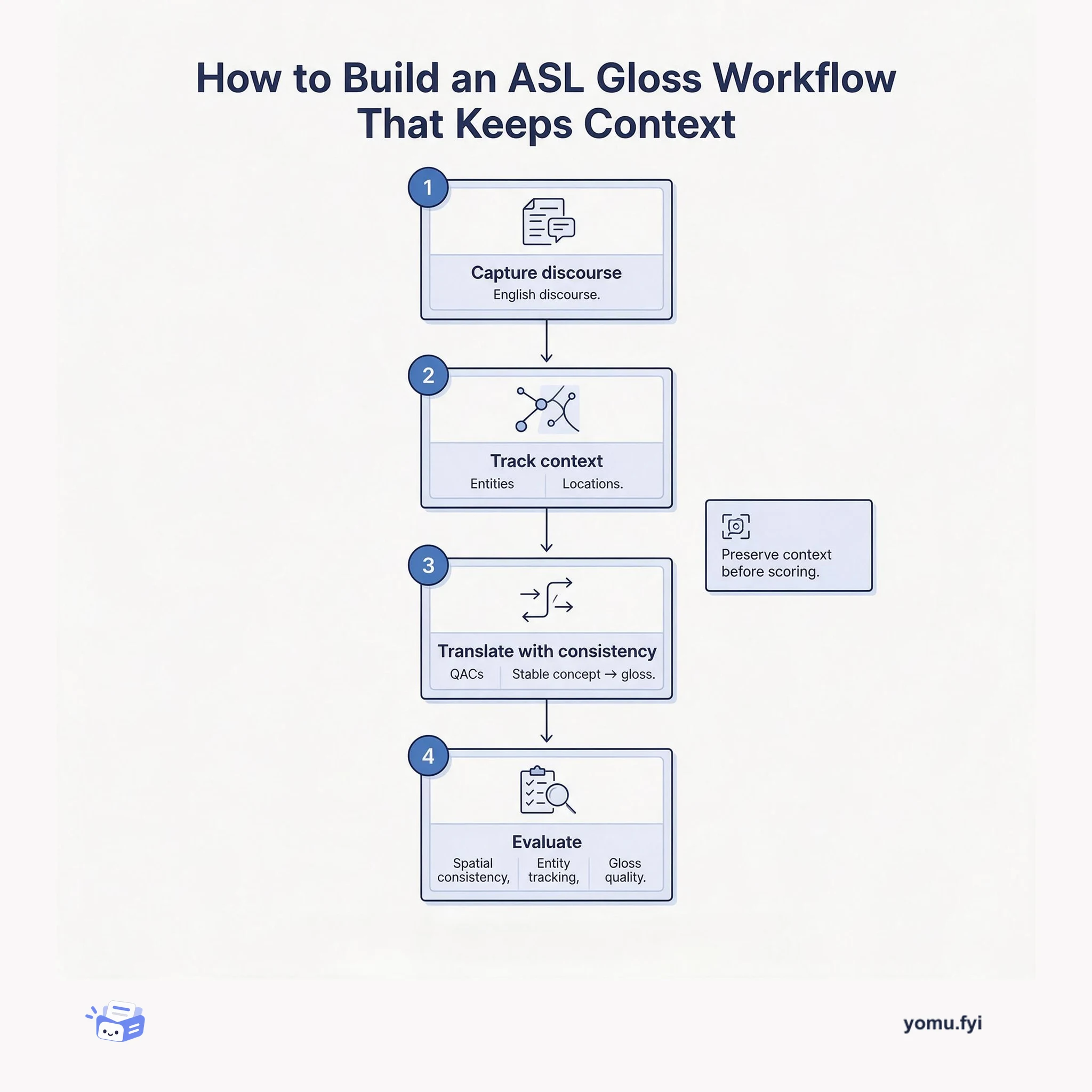
How to Build an ASL Gloss Workflow That Keeps Context
Learn a practical workflow for translating English discourse into ASL gloss while preserving spatial references, question-answer structure, and consistent concept-to-gloss mappings.
Loading…
Topic
480 posts about AI. Every summary links to the original.
See the idea
Learn a practical workflow for translating English discourse into ASL gloss while preserving spatial references, question-answer structure, and consistent concept-to-gloss mappings.
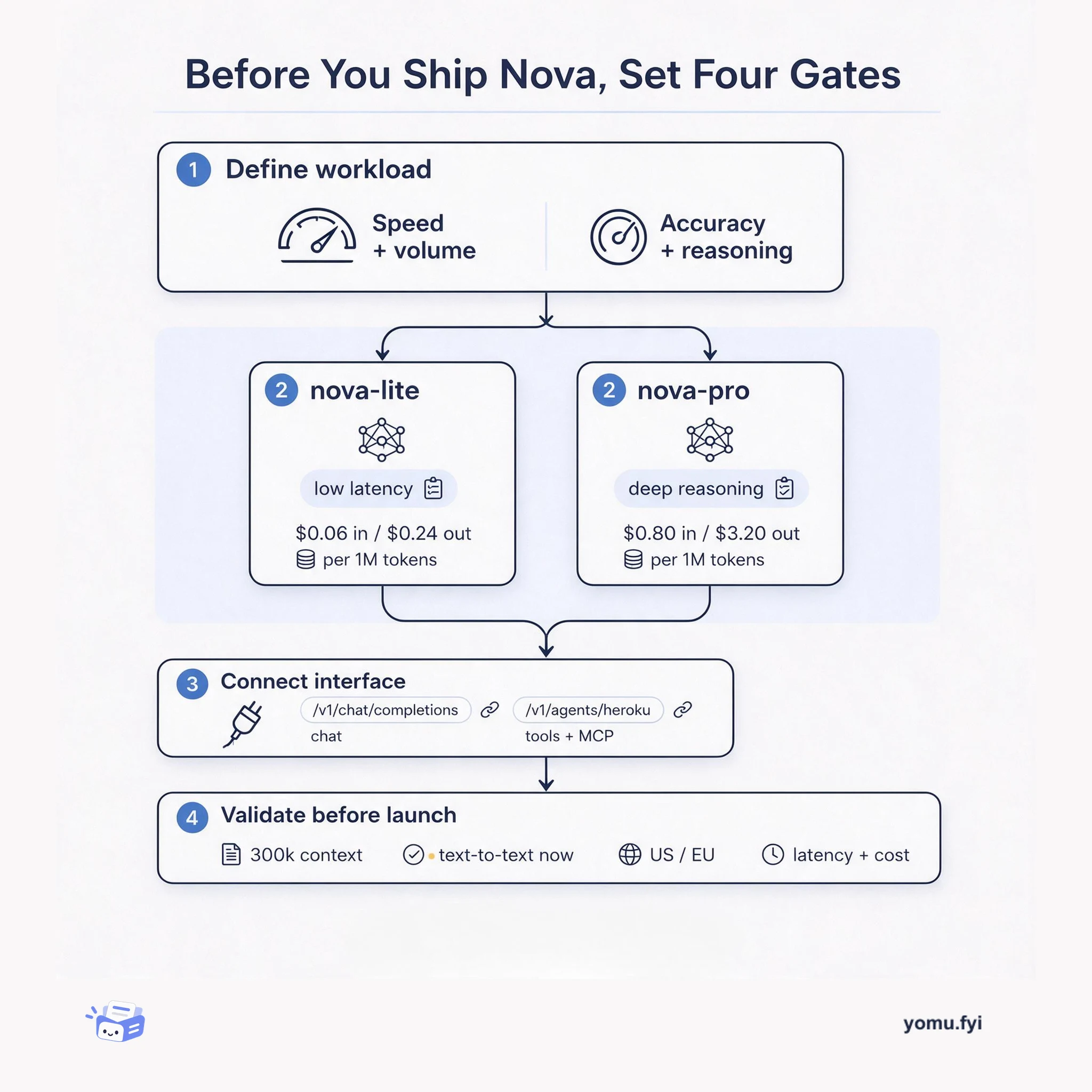
A practical checklist for putting Amazon Nova into an application: choose nova-lite or nova-pro by workload, expose tools, and verify context, modality, region, and cost constraints.
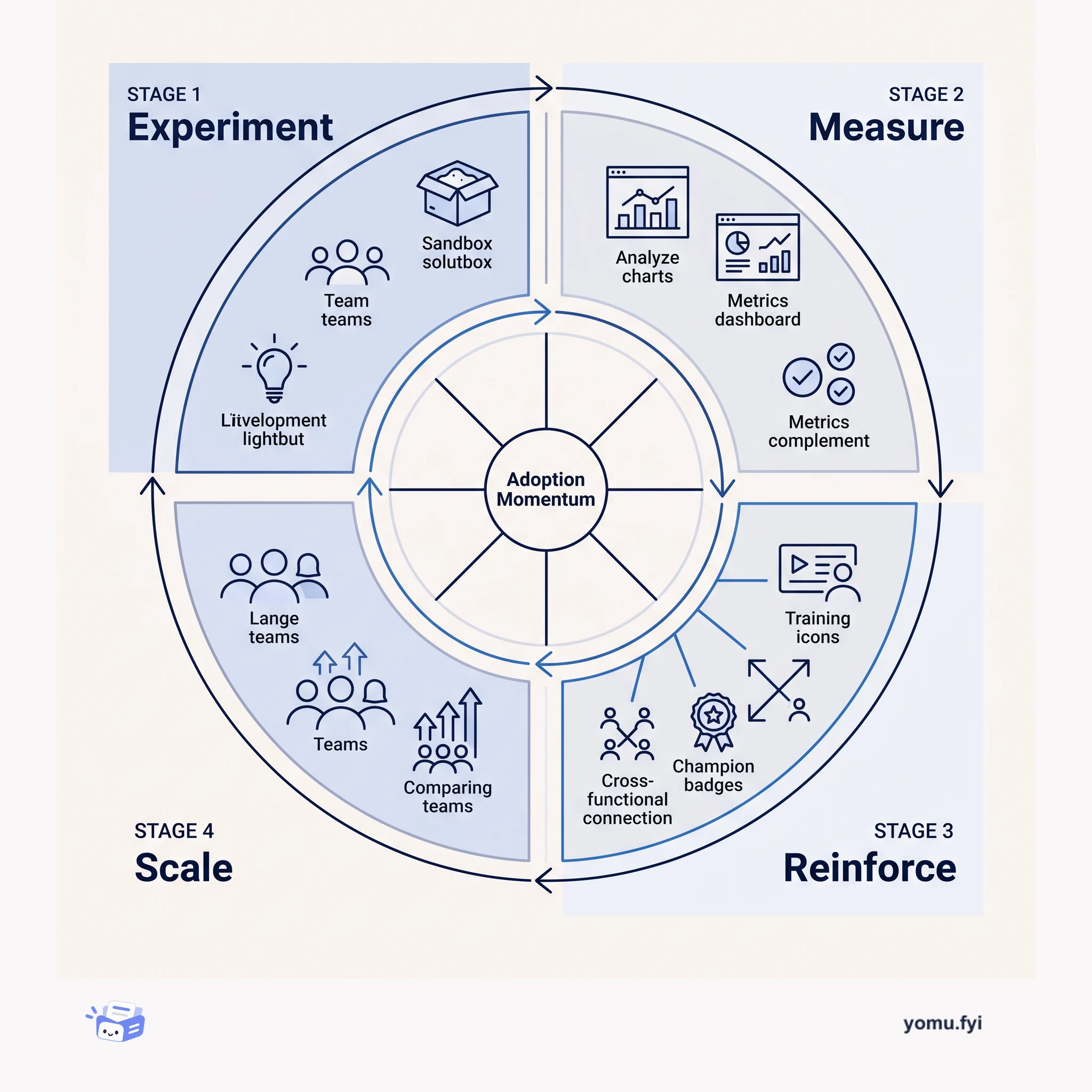
Adoption moves through experimentation, measurement, and reinforcement loops. Learn how leading companies build momentum from pilot programs into enterprise-wide habits and measurable business impact.
The Good Stuff
Paid picks we use ourselves. Links carry a referral code — a subscription through one earns us a commission at no extra cost to you.
Newest first
Frontier threats red teaming applies adversarial testing to evaluate whether AI models could create national-security risks, using biology as a test project. Anthropic worked with biosecurity experts to define threat models, probe models for more than 150 hours, learn jailbreak techniques, and build quantitative, repeatable evaluations in a secure interface without public-deployment safety monitoring. The project found that frontier models can sometimes produce sophisticated, accurate, detailed biological knowledge, with capability increasing alongside model size and potentially with tool access; the authors assess unmitigated risks as possibly near-term. Training changes and classifier-based filters reduced harmful outputs or access to chained expert information, and these mitigations were deployed in the public-facing frontier model. Future work will test LLM speedups over search engines, examine newer and smaller adapted models, and expand collaboration, disclosure, and independent evaluation.
Anthropic argues that AI could have an impact comparable to the industrial and scientific revolutions, potentially within the coming decade, because scaling laws link increased training computation with predictable capability improvements. It says progress may continue toward systems matching or exceeding human performance across many intellectual tasks, while society faces disruption and competitive pressure to deploy systems that are not reliably helpful, honest, and harmless. The company’s safety strategy is empirically driven and multifaceted, emphasizing scalable supervision, mechanistic interpretability, process-oriented learning, and research into how systems learn and generalize. It also studies capability evaluation, red teaming, harmful behavior, economic effects, and policy implications. The stated goal is a broad portfolio of safety work that can adapt as evidence clarifies which future scenario is unfolding, including less optimistic possibilities.
At Cannes Lions 2026, Uber Advertising presented commerce media as a way for brands to connect with consumers across real-world journeys, from discovery and ordering to mobility and post-event decisions. Its EMARKETER session with Sarah Marzano and Kristi Argyilan framed commerce media as expanding beyond traditional retail environments, while announcements including Offsite Ads, Mobility Offers, Deal Drops, Reorder Rewards, Uber Marketing Manager, and APIs addressed what advertisers can activate and how they can manage and measure it. Programming also examined AI’s effects on search, shopping, planning, recommendations, and marketing leadership, alongside sports-fan behavior and cultural moments. Across the Uber Villa and activations involving flights, airport screens, rides, dining, boats, and shuttles, the company positioned movement as the connective thread between media, commerce, and everyday experience.
Resend is sunsetting new.email, which will remain available for template exports until August 7, 2026, before stopping new prompts and sends. Launched in February 2025, the tool let anyone create email templates with natural language, using React Email components and deliverability lessons from sending millions of emails daily; its goal was consistent, beautiful, responsive email. Resend says the core bet was right, but a separate brand and stack—repository, infrastructure, deployment, and operational conventions—made the product harder to maintain, while market feedback showed users did not need new templates constantly. The product’s ideas are moving into the Resend editor, which offers URL-based brand extraction, AI block rewriting, LLM content review, and email creation and editing through the Resend MCP server.
At Sonoma Raceway, Google Developer Experts built an AI-powered race coach to turn vehicle telemetry into split-second driving advice, extending an earlier pilot that handled basic telemetry. The system uses Antigravity for stateful orchestration and ingestion, Python and Jetpack Compose for mobile processing and display, Agent Development Kit for agent coordination, and hybrid Gemma 4 edge reasoning plus Gemini API cloud analysis. A custom USB interface connected a Pixel 10 directly to the vehicle telemetry network, providing a 10 Hz stream from hundreds of sensors, while an activated on-device TPU reached 40 tokens per second for local coaching alerts delivered through text-to-speech. The test identified a throttle application zone in Turn 2 associated with a 0.1-second gain, and the initiative is scheduled to continue at Interlagos, Brazil.
Cursor and SpaceXAI are releasing Grok 4.5, a mixture-of-experts model designed for long-running computer tasks beyond software engineering, including data science, finance, and legal work. It was trained jointly on trillions of tokens of Cursor data, alongside high-quality STEM tasks, research papers, and other knowledge work, then improved with reinforcement learning in realistic environments where it must investigate, use tools, recover from mistakes, and verify results. A distributed agent system built and refined these training environments at scale, using engineers’ problem definitions and verification methods. Grok 4.5 is available in Cursor’s desktop, web, iOS, CLI, and SDK products, with individual and team plans receiving significant usage and double usage during the first week; base pricing is $2 per million input tokens and $6 per million output tokens. Cursor notes that an accidental training-data inclusion gives the model an advantage on CursorBench.
AI spending has moved from experimental pilots into a recurring operating expense, reaching $1.5 trillion globally in 2025, while only 39% of organizations in a cited McKinsey study could trace AI investment to enterprise-level EBIT impact. The launch introduces the Cursor CFO Council, a quarterly forum for finance leaders that will develop shared frameworks for AI productivity, returns on intelligence, model allocation, and cost management. Analyses using Cursor data found higher token usage associated with higher median year-over-year revenue growth, while usage rose after model improvements, especially for high-complexity work. Yet adoption and benefits are concentrated: p99 developers produced 46x more AI-assisted lines per day than median active users, and agent-request costs varied nearly ninefold across model families. With usage-based pricing making intelligence a less predictable variable cost, the council will meet beginning in August to advance measurable and efficient AI economics.
Anthropic announces its Responsible Scaling Policy (RSP), a set of technical and organizational protocols for managing catastrophic risks from increasingly capable AI systems, including deliberate misuse and autonomous behavior contrary to designers’ intent. The policy introduces AI Safety Levels (ASL), loosely modeled on biosafety levels, with requirements for safety, security, and operations increasing alongside a model’s potential for catastrophic risk; current LLMs, including Claude, are described as ASL-2. ASL-3 would require unusually strong security and no deployment when adversarial testing by world-class red-teamers finds meaningful catastrophic misuse risk, while ASL-4 measures remain unwritten and may depend on unresolved interpretability research. Approved by Anthropic’s board, the RSP is presented as an initial, revisable framework that may temporarily pause scaling when safety procedures cannot keep pace, while incentivizing solutions needed for further development and leaving current Claude uses and product availability unchanged.
Claude Fable 5 has been redeployed globally, accompanied by additional detail about its cybersecurity safety classifiers and a proposed AI jailbreak severity framework. The classifiers distinguish prohibited use, high-risk dual use, low-risk dual use, and benign use, with intended responses ranging from blocking to allowing with monitoring; the model uses a larger safety margin than previous models, accepting more false positives to increase protection against harmful outcomes. Other safeguards include access controls, model safety training, and offline monitoring, while a HackerOne program invites researchers to submit potential cyber jailbreaks. The draft framework measures capability gain against the available baseline and illustrates scoring with Log4Shell cases, where severity changes as discoverability and existing tools change.
Claude Fable 5 and Claude Mythos 5 are presented as a joint launch of the same underlying model, with Fable 5 intended for general use and Mythos 5 initially reserved for selected cyberdefenders and infrastructure providers. Fable 5 uses conservative safeguards that route some sensitive queries to Claude Opus 4.8, while Mythos 5 lifts safeguards in selected areas through Project Glasswing and a planned trusted-access program. The post reports strong results in software engineering, knowledge work, vision, long-context tasks, cybersecurity, protein design, molecular biology, and genomics, including a reported 50-million-line Ruby migration completed in a day. Both models are priced at $10 per million input tokens and $50 per million output tokens, with Fable 5 available through the Claude API and staged subscription access.
CSAT captures fewer than 10% of conversations, and its responses skew toward delighted or furious customers. Most customers say nothing, leaving teams to assess customer experience from an unrepresentative sample that compresses product, policy, and service issues into one score. As AI handles more conversations end-to-end, the post argues for scoring every AI and human interaction on service quality, resolution, customer effort, and related attributes rather than relying on survey responses alone. Fin’s CX Score assigns each interaction a 1–5 score and surfaces reasons behind it, providing roughly five times more coverage than CSAT for most teams. Fin sets targets from CX Score attributes, operational correlations, historical performance, modelling, and team ambition, then uses recurring patterns to route fixes to support, product, or workflow owners.
Meta describes how its BLOB-storage architecture evolved to address AI workloads' storage bottlenecks, which can stall GPUs and slow research iteration as datasets and GPU deployments expand. Legacy requests traversed multiple stateful metadata layers, sometimes across regions, producing latencies of hundreds of milliseconds even when flash made millisecond access possible. The redesign consolidates metadata into a flat schema backed by ZippyDB for O(1) path resolution, removes the dataplane proxy in favor of a fat client SDK, and deploys regional BLOB-storage stacks beside GPUs. For data loading, Meta combines host memory and flash with regional flash and global HDD-backed storage as tiered caches, using ordinary and deep prefetch, on-demand hydration, and TTL or LRU eviction policies. Production rollout saw rapid adoption, while both data-loading paradigms remain supported.
Together AI announces an $800M Series C to accelerate its open-source AI platform as production demand for inference grows. The company says the round includes $800 million from investors including Aramco Ventures, NVIDIA, Vista Equity, General Catalyst, and others, plus commitments for more than 500 MW of compute capacity to be capitalized independently by new investors. Together argues that closed frontier-model economics become unsustainable as agents and workflows scale, while open-weights models such as DeepSeek, Nemotron, MiniMax, Kimi, and GLM can provide equal or better performance at lower cost. Its full-stack approach spans models, kernels, compilers, inference systems, training infrastructure, hardware utilization, and software, with cited work including FlashAttention-4, Together Megakernel, together.compile, and expanded post-training APIs for tool calling, reasoning, and vision-language models.
Together AI says nine papers from its researchers and peers were accepted to ICML 2026 in Seoul, spanning frontier agents, model shaping, algorithmic and systems optimization, and kernels. The collection is presented as a full-stack view of AI research, with work ranging from DSGym’s unified evaluation and training API for more than 1,000 data-science tasks to ThunderAgent’s program-aware scheduling, TTT-Discover’s test-time reinforcement learning, and RARO’s verifier-free adversarial training. Reported results include up to 3.6× agent throughput, state-of-the-art discoveries from an open 120B model, a 25% expert-response win rate without a verifier, and 5M-token context on one node for Untied Ulysses. Aurora illustrates the research-to-production loop: its adaptive speculative-decoding work ships as the ATLAS speculator on the Together platform.
The team formerly known as Developer Advocacy, within Developer Success, has been renamed Builder Advocacy within Builder Experience (BX). The change responds to an expanded definition of who builds with technology: alongside traditional developers, AI builders and no-code or low-code automators are creating production-level experiences and mission-critical infrastructure. The organization says its advocacy will serve developers, prompt engineers, LLM integrators, AI-agent creators, ML practitioners, and automation-focused builders, while continuing support for traditional coders, engineers, and architects. The announcement cites GitHub’s 180 million developers, 36 million new developers in 2025, and Stack Overflow’s finding that 84% use or plan to use AI tools. The rename is effective immediately and begins broader investments in resources, content, and community programs for this wider builder community.
TCS and Anthropic are partnering to bring Claude to regulated industries, with TCS providing access to 50,000 employees across 56 countries and developing client offerings. As the partnership’s “customer zero,” TCS will use Claude across engineering, finance, legal, marketing, and sales, then apply those lessons through a dedicated practice of consultants, engineers, and industry specialists. The practice will package and operate industry-specific systems, including claims processing for insurers and lending advisory for banks, while TCS teams contribute reusable Claude Code skills and plugins focused initially on claims adjudication and lending advisory. Other announced work includes Diligenta using Claude for more than 22 million policyholders and TCS iON delivering training and certification after conducting more than 75 million annual assessments.
Anthropic has opened its Seoul office and announced partnerships with Korean enterprises, startups, researchers, and the Ministry of Science and ICT. Through an MOU, the company will collaborate on AI safety and cybersecurity, including Korean-language model-safety evaluation with the Korea AI Safety Institute and information exchange on AI-enabled cyber threats. Korean deployments described include Claude Code across NAVER’s engineering organization, Claude at LG, Hanwha, Samsung SDS, and Nexon, plus Claude-powered products and nonprofit use. Anthropic will provide Claude access to up to 60 NAIRL-affiliated researchers, launch Claude for Startups in Korea, and support developer events and a hackathon. The office is led by KiYoung Choi and is hiring across a range of roles.
Grab is migrating from heavy base images to Distroless images to reduce security risks, despite runtime failures caused by missing shared objects, utilities, or expected directory structures. Its medium tests run services in Docker, leave internal dependencies unmocked through Testcontainers, mock external dependencies with a network proxy, and execute in CI to catch Dockerfile regressions before deployment. For services without this setup, an agentic workflow detects candidates, scaffolds tests, fixes repository-specific failures, raises GitLab merge requests, and monitors CI while processing batches in parallel. Claude Code uses MCP integrations for GitLab, Glean, and Sourcegraph, with guardrails limiting changes to test files and CI configuration and humans reviewing every draft merge request. In roughly 1.5 months, the agent raised more than 100 medium-test merge requests and reduced work for 400 services from 400–1,200 engineer-days to approximately 0.1 days per service; Distroless adoption also grew substantially.
The post argues that a large AI bill does not show excessive use: companies can overspend on routine work while using too little AI where advanced models could create value. It proposes measuring work in atomic tasks—such as invoices coded or pull requests reviewed—rather than tokens, with cost defined by tasks attempted and value by successful tasks. The operating model uses defaults that pair routine work with the cheapest model meeting quality benchmarks, medium reasoning, and flexible latency, while escalating ambiguous, high-stakes work to frontier models at higher effort. It also recommends attributing spend by provider, product, team, and workflow, finding concentrated costs, benchmarking repeated tasks, repricing after model releases, and centralizing controls in one gateway. The conclusion is that efficiency should be treated as an engineering achievement, so cheaper routine execution funds ambition on rare tasks where extra intelligence can materially change outcomes.
Cart Assistant addresses grocery requests that begin as lists, recipe images, or vague plans and turns them into draft carts shoppers can review and edit. It uses a multi-prompt state graph that assigns planning, candidate retrieval, semantic relevance, constraint enforcement, quantity selection, guardrails, assembly, and content refinement to focused stages. LLMs handle ambiguity and structured outputs, while backend APIs, deterministic arithmetic, validation, optimization, and aggregation manage inventory, pricing, eligibility, sellable units, and cart construction. The design separates retrieval language from reasoning context, preserves quantity provenance, supports parallel item processing, and uses deterministic checks plus an LLM judge against synthetic and production-derived cases. According to the conclusion, this decomposition makes the system more controllable and inspectable while producing useful draft carts without removing shopper review, editing, and decision-making.
The best engineering reads, once a week.