How to Build an ASL Gloss Workflow That Keeps Context
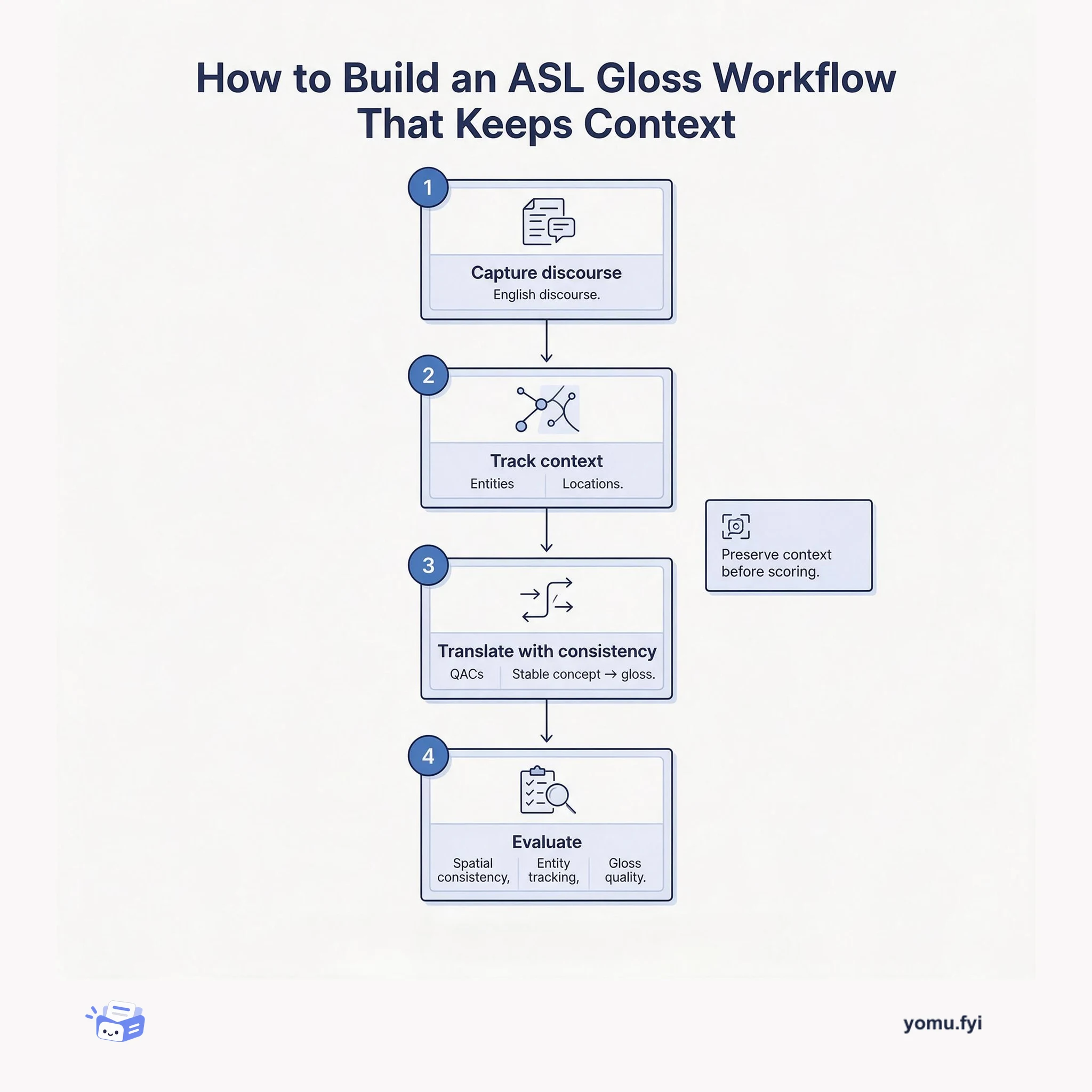
Learn a practical workflow for translating English discourse into ASL gloss while preserving spatial references, question-answer structure, and consistent concept-to-gloss mappings.
Loading…
Topic
470 posts about AI. Every summary links to the original.
See the idea
Learn a practical workflow for translating English discourse into ASL gloss while preserving spatial references, question-answer structure, and consistent concept-to-gloss mappings.
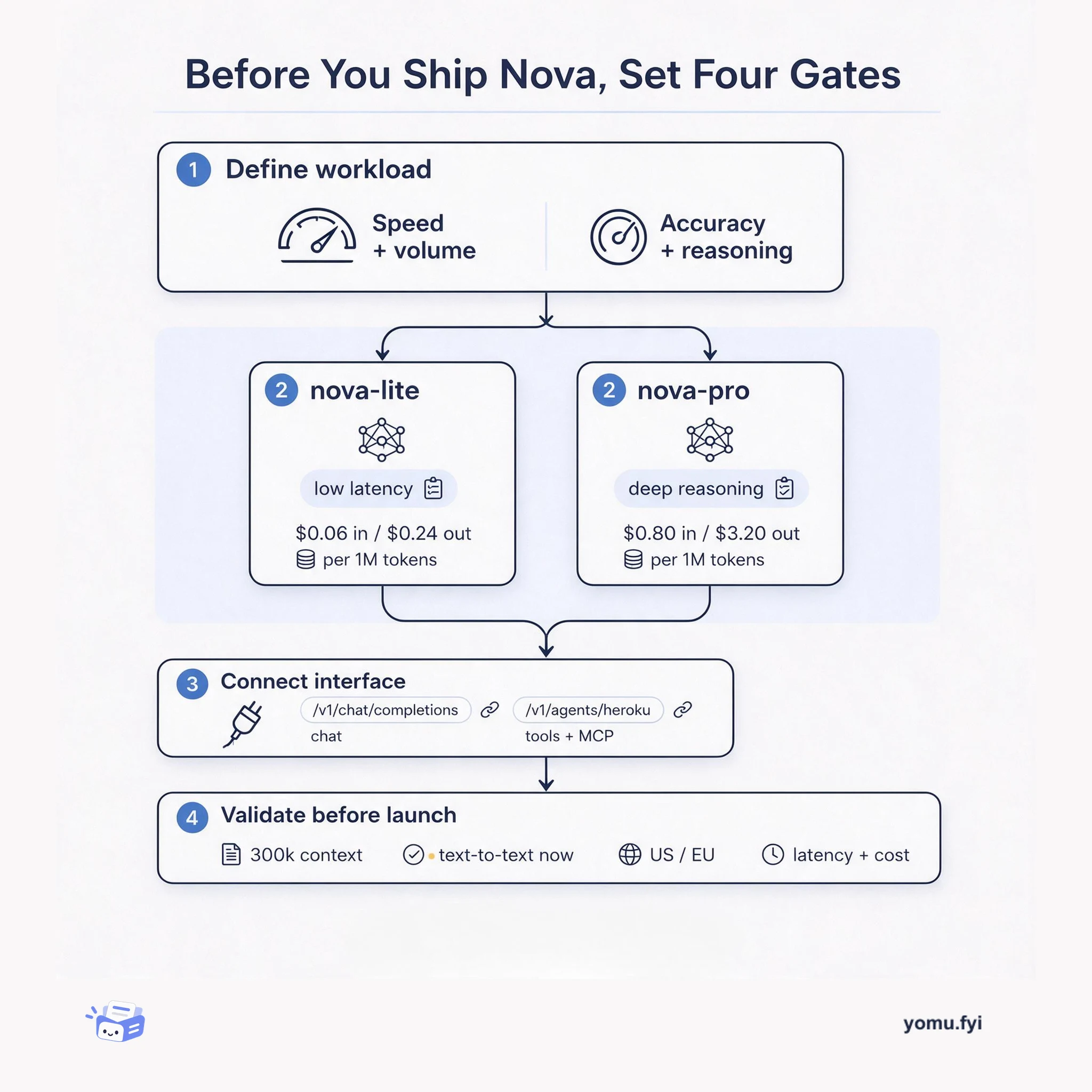
A practical checklist for putting Amazon Nova into an application: choose nova-lite or nova-pro by workload, expose tools, and verify context, modality, region, and cost constraints.
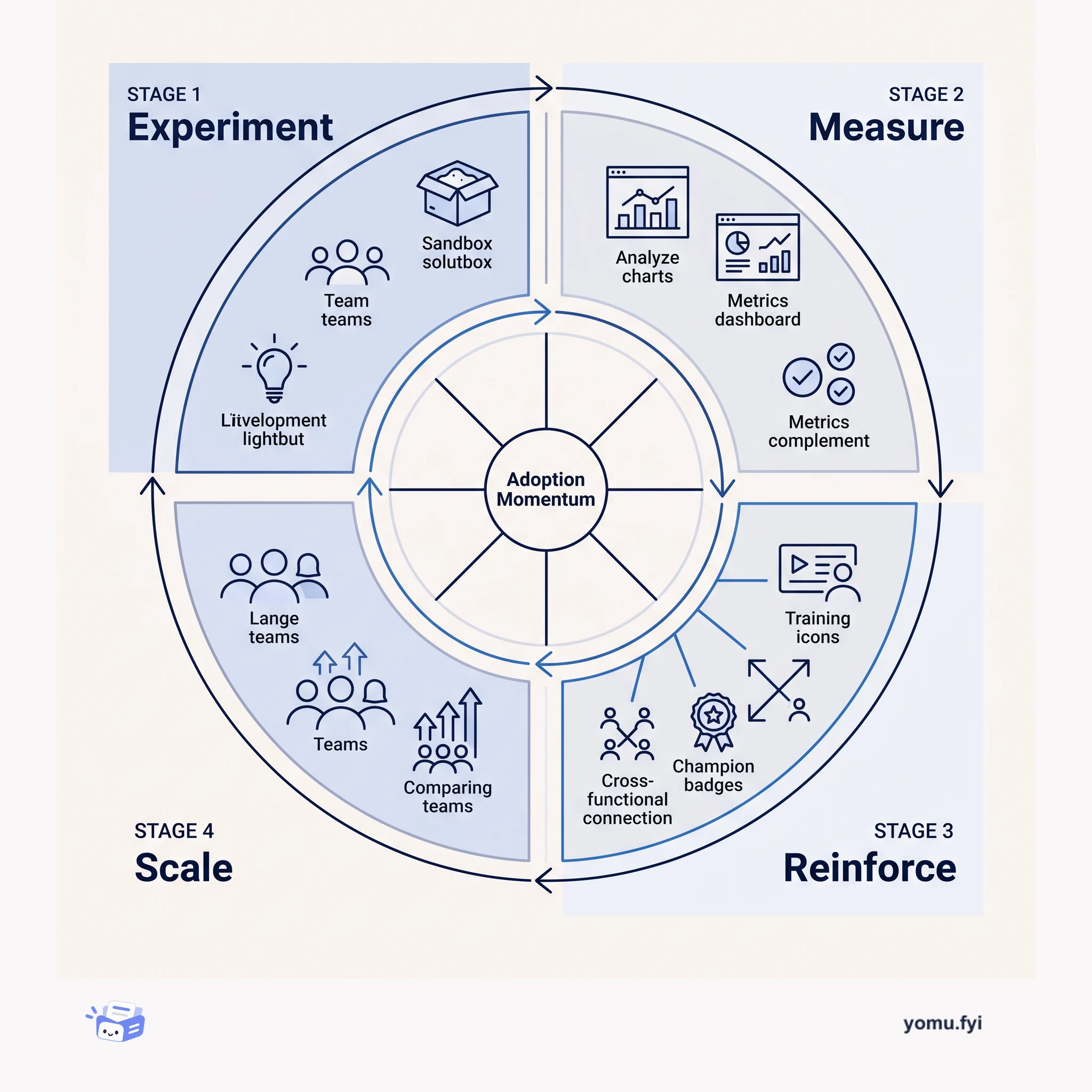
Adoption moves through experimentation, measurement, and reinforcement loops. Learn how leading companies build momentum from pilot programs into enterprise-wide habits and measurable business impact.
The Good Stuff
Paid picks we use ourselves. Links carry a referral code — a subscription through one earns us a commission at no extra cost to you.
Newest first
An Economist survey of 1,220+ executives across eight industries finds that digital native companies lead in ambition and breadth of AI deployment, but not in full operational maturity. At 18%, they are the most likely group to prioritize embedding AI across core processes at scale, and nearly 92% report AI ROI ahead of plan. Yet they lead fully embedded AI—defined as use by 100+ users, SLAs, and performance and impact monitoring—in only one of eight functions, R&D/product development; they rank seventh in finance and sixth in operations and supply chain. Telecom, media and entertainment, manufacturing, and energy outperform them in selected functions despite lower stated scaling priority. The proposed response is to build shared, production-grade foundations for data, governance, workloads, models, agents, and applications, with security, lineage, monitoring, and performance measurement treated as reusable capabilities.
Parametric insurance pays automatically when objective thresholds—such as wind speed, rainfall, or earthquake magnitude—are met, replacing lengthy loss assessments with event-based payouts. Modern catastrophe modeling combines geospatial data, weather observations, engineering insights, and historical loss records to estimate extreme-event probability and impact and define reliable triggers. Operationalizing these programs requires near-real-time processing of satellite imagery, weather feeds, exposure datasets, and model outputs. Databricks’ Geospatial Lakehouse unifies those sources on Delta Lake while Spark runs spatial joins and catastrophe modeling pipelines. When thresholds are crossed, the system identifies eligible policies, calculates tiered payouts, and surfaces results through dashboards, Lakehouse Apps, and Genie; aerial imagery and multimodal AI can support damage validation and fraud detection, while Unity Catalog governs access and Delta Sharing supports controlled data exchange.
Albertsons Companies describes a centralized AI strategy for scaling decisions across merchandising, labor, supply chain, and customer experience across approximately 2,300 stores. The model combines one central AI core, the Databricks Data + AI Platform, and a shared operating model spanning data engineering, ML, governance, and analytics. Reusable ingestion pipelines, templates, feature-store patterns, model monitoring, performance observability, and governance wrappers support local execution, while a company-wide governance committee sets shared standards. Albertsons reports accepting 1.38 million lines of AI-generated code in nine months, with more than 90% of engineers using AI tools, and it provides low-code dashboards, prompt libraries, and conversational agent generation for nontechnical teams. Success is measured through reuse rates, time to deployment, responsible AI compliance, and business outcomes linked to AI uplift, with initiatives required to demonstrate impact before scaling.
Anthropic, Blackstone, Hellman & Friedman, and Goldman Sachs announced a new AI services company that will help mid-sized organizations bring Claude into core operations. The firm will combine its engineering team with Anthropic Applied AI engineers to identify high-impact opportunities, build custom Claude-powered systems, and support customers over the long term; it is backed by additional alternative asset managers including General Atlantic, Leonard Green, Apollo Global Management, GIC, and Sequoia Capital. Engagements will start with a small team working with customer staff, then tailor systems to existing workflows, such as documentation, medical coding, prior authorizations, and compliance reviews in healthcare. The company will also join Anthropic’s Claude Partner Network, extending delivery capacity alongside systems integrators that serve large enterprises.
This guide distinguishes artificial intelligence, a broad field covering systems that perform tasks associated with human intelligence, from large language models (LLMs), specialized generative AI models for language and code. It places LLMs within generative AI and deep learning, and explains how transformer self-attention processes tokens while training data, parameter scale, and context windows shape capability and limitations. Examples include content drafting, code generation, translation, customer-service chatbots, sentiment analysis, extraction, summarization, and tool-connected agentic workflows, while traditional machine learning remains suited to structured labels and numeric predictions. It recommends retrieval-augmented generation, human review, bias testing, privacy controls, and evidence-based pilots with defined workflows, metrics, budgets, realistic data, and logged outputs.
The guide maps AI applications for data scientists, machine learning engineers, and technical leaders, covering predictive AI, generative AI, conversational AI, and autonomous agents across consumer, developer, and enterprise settings. It distinguishes consumer-facing tools from developer platforms and describes production concerns including model lifecycle management, vector search, data lineage, deployment, monitoring, governance, and evaluation. Generative systems create text, images, code, audio, and video from prompts, while large language models and mixture-of-experts architectures are presented as important foundations for enterprise applications; open models offer control over weights, governance, and deployment. The guide recommends defining use cases, assessing data readiness, and building privacy, bias-auditing, and monitoring controls before production, while noting that agents coordinate multi-step workflows across tools, APIs, and databases.
Agentic AI and generative AI differ primarily in whether a system autonomously pursues a multi-step goal or produces content in response to a prompt. The post defines agentic systems through a perceive-plan-act cycle: agents maintain memory and state, decompose goals, call tools or sub-agents, evaluate conditions, and recover from errors, while generative AI typically performs bounded, reactive inference. It presents workflow examples such as sales follow-up and market-intelligence summarization, showing how APIs connect agents to CRMs, databases, communication platforms, and news services while LLMs provide text generation or reasoning at individual steps. RAG can ground generative outputs in external knowledge, but agentic deployments add operational concerns around repeated inference loops, human oversight, provenance logging, and access controls. The conclusion recommends choosing by task structure: generative AI for single-turn creation or summarization, agentic AI for autonomous coordination, and both together for complex enterprise workflows.
SAP Business Data Cloud now offers generally available semantic metadata synchronization with Databricks Unity Catalog for mounted SAP BDC Delta Shares. When a table is accessed, Unity Catalog receives table-level business-friendly display names, descriptions, context, and governance tags, while SAP BDC remains the single source of truth and subsequent changes are reflected. The capability builds on BDC Connect and Delta Sharing, allowing governed SAP data products to be discovered and combined with other enterprise sources without recreating business context or governance separately. Column descriptions, table relationships such as primary and foreign keys, and PersonalData namespace tags give Databricks AI Assistant and AI/BI Genie explicit context for natural-language questions and join-ready queries. The stated result is more understandable, discoverable, and AI-ready SAP data, with automated classification signals supporting compliance, access control, and responsible AI.
Product organizations can ship features in days while taking weeks to understand their behavioral impact, because fragmented analytics stacks depend on analysts, BI expertise, or SQL skills. The post argues that this architectural bottleneck slows the insight-to-ship cycle, causing roadmap decisions to rely on instinct, anecdotes, and lagging indicators. It presents Databricks AI/BI Genie as a conversational interface to event-level behavioral data, with experiment integration, cohort analysis, and product-specific growth-metric definitions. According to the post, product leaders can ask questions in plain language without filing analyst requests, while governed data access supports faster follow-up and feature-impact decisions. It reports that Genie users across 3,300+ Databricks customers cited a 49% productivity gain, 41% faster speed to market, and 5x faster ad-hoc analysis, though these are reported customer results.
Manufacturing OEE dashboards can look healthy while omitting recurring downtime that supervisors recognize, because relevant facts are split across SCADA, MES logs, maintenance tickets, and shift reports. OEE combines Availability, Performance, and Quality, but extracting those inputs often requires SQL or an analyst, delaying root-cause analysis after throughput drops. Databricks Genie is presented as a conversational AI layer over a unified data platform that leaves MES and SCADA in place while allowing business leaders to ask plain-language questions such as OEE by line against maintenance windows. Its semantic-layer awareness maps terms to actual fields, while governed access and logged, source-cited answers support different visibility levels and traceability. The proposed shift is from static reporting to faster operational questioning about production status, forecast risk, line performance, and quality signals.
Gas turbines produce millions of daily readings—vibration, temperature, pressure, flow rates, and electrical output—but maintenance teams may learn about warning signals only when an unplanned outage occurs. The post argues that predictive maintenance has struggled less because of model capability than because decision-makers lack fluid access to model findings and operational context. Databricks Genie provides a conversational interface to sensor, maintenance, dispatch, cost, and regulatory data, allowing questions about elevated vibration against maintenance baselines and timing maintenance around outage cycles. It is presented as decision support, not automation, with time-series analysis, maintenance history, integrated costs, and compliance context helping asset managers investigate fleets and act with more confidence.
Trinity Industries’ experience is presented as a case for treating the data layer, rather than models or dashboards, as the foundation of enterprise AI. The railcar manufacturer migrated 95% of its enterprise data to a single Databricks lakehouse, adopted Medallion architecture, moved transformations upstream, and retired legacy dashboards containing nearly 600 measures. That consolidation supports streaming ETA predictions, procurement agents, and Genie conversational analytics: the ETA model is reported as 50% more accurate than industry ETAs, agents helped increase on-time material delivery by 15%, and Genie handles more than 1,000 questions monthly. The migration took close to a year, followed by six to eight months of additional work, but the account argues that trusted, standardized data enables experimentation, automation, and broader employee access to analysis.
The discussion defines AI-native cybersecurity applications as systems architected with intelligence at their core, rather than traditional products with AI added later. It links tool sprawl to slower threat detection and response and argues that proprietary, context-rich security telemetry is the foundation for adaptive defense. Barracuda uses Databricks to consolidate fragmented data, normalize schemas, support real-time streaming detection, run ML operations through MLflow, and power natural-language log search across billions of security events with strict data isolation. The work began by defining customer outcomes, then progressed through incremental delivery; normalized data enabled models and agents to use cross-domain context. This approach extended across WAF-as-a-service, automated configuration, API security, and bot protection while shared outcomes aligned product, data science, engineering, and business teams.
KPMG UK is evolving its Audit data platform with Databricks to support AI-enabled analytics while preserving governance, rigour, and professional standards. The program converges structured data, advanced analytics, and AI on a unified cloud-native Lakehouse, with Databricks SQL replacing core SQL Server workloads and Delta underpinning the platform. Lakebridge assessed migration complexity, while Databricks-hosted large language models including Claude Sonnet and Genie Code helped convert T-SQL, refactor stored procedures, modularize queries, and suggest Delta-based optimizations under engineer review. This reduced refactoring time by around 60% and enabled modernization of more than 400 scripts and stored procedures in roughly three months. Databricks SQL Serverless provides elastic compute for spiky workloads, while Genie offers traceable, version-controlled SQL and Delta Sharing supports governed data exchange.
The page presents a collection of Notion content about teams, tools, workplace practices, and the use of AI in organizational work. Its entries cover Custom Agents for automating repetitive busywork, teamwork skills, launch orchestration, and the changing role of team size. Several pieces focus on disconnected company knowledge, describing Notion AI as a way to bring information together and turn knowledge into action, while other entries examine AI operating systems and workflows. The page also includes survey-based perspectives from Notion, including research involving more than 3,000 global knowledge workers, 85-plus interviews, and 650 European business leaders, alongside customer stories from companies such as Merge, Ramp, Chronicle, Toyota, Affirm, and Mercury.
Databricks announces native support for OpenAI’s GPT-5.5, making it available for coding workflows with Codex, enterprise agents, document pipelines, and data-driven employee workflows. Access is governed through Unity AI Gateway, which provides permissions and rate limits, configurable guardrails for PII, prompt injection, and content safety, MCP tool-call auditing, failover, and request-level observability for model and Codex interactions. The announcement describes GPT-5.5 use with Genie for natural-language analytics, Agent Bricks Custom Agents for multi-step workflows, and Lakeflow Spark Declarative Pipelines for document-focused GenAI ETL involving summarization, extraction, and classification. GPT-5.5 is available on Databricks across AWS, Azure, and GCP, with entry points including AI Playground, governed Codex endpoints, Agent Bricks, and the Foundation Model API.
Business intelligence (BI) reporting turns data from operational systems and analytical repositories into structured reports, dashboards, and visualizations for organizational decision-making. The guide explains managed and ad hoc reporting, then traces a typical workflow through data sources, ETL, deduplication, normalization, validation, data modeling, visualization, and automated distribution. It compares established platforms such as Microsoft Power BI, Tableau, SAP BusinessObjects, Qlik, and Looker with newer AI-native tools, while noting evaluation criteria including connectivity, scale, governance, usability, and cost. It also addresses dashboard overload, stale semantic models, and specialist bottlenecks, and cites reports of 10x faster query creation from AI-assisted natural-language querying alongside recommendations to start with one decision, one primary source, and three to five KPIs.
Databricks announces the Public Preview of Lakeflow Designer, a visual, no-code, AI-native experience for data preparation and analytics built directly into the Databricks platform. It targets analysts, domain experts, and other less technical users with drag-and-drop workflows and natural-language authoring, while representing each transformation as an operator with previews. Genie Code can use Unity Catalog metadata, descriptions, lineage, popularity, and example queries to generate or modify workflows, inspect transformation results, and iterate when needed. Every visual transformation produces production-ready Python code that can be reviewed, versioned in Git, and scheduled through Lakeflow Jobs, while users pay for compute rather than per-user licenses. The preview is available in all workspaces, although an administrator may need to enable Visual data prep in the preview portal.
The interview presents conversational analytics as a way to move beyond fixed dashboards and turn governed data into decisions and workflows. Databricks’ Genie lets nontechnical users ask open-ended questions in plain language across Lakebase, Lakehouse, and federated sources, while Unity Catalog applies shared definitions and access controls. Lakebase provides transactional storage, instant provisioning, environment forking without copying underlying data, and scale described as billions or trillions of records; examples include real-time matchmaking, routing, and purchase decisions. The discussion stresses that human oversight, refreshed data, business context, and controls against hallucination remain necessary, citing Fox Sports’ chatbot deployment as an example. It concludes that organizations combining trusted semantics with operational data systems can make faster decisions and automate work, while the competitive gap may compound for slower adopters.
Financial-services CFOs are being asked to act as Strategists and Catalysts, but fragmented legacy systems, T+1 batch processing, opaque reporting logic, and mismatched business semantics keep them focused on stewardship and retrospective operations. The proposed answer is Databricks as a unified, governed platform combining real-time streaming, centralized lineage, data and AI, with Unity Catalog, Lakeflow, Genie, and Agent Bricks addressing trust, latency, access, and model reproducibility. Unity Catalog can connect semantic definitions and end-to-end lineage from transactions through regulatory reports and models, while Lakeflow supports continuous ledger and liquidity processing. The post cites a global bank reducing liquidity-reporting processing from 10 hours to 8 minutes and Nationwide Insurance reporting a 5-point combined-ratio improvement and 3-point expense-ratio improvement. It presents a Lakehouse-based CFO stack as a shift from reporting historical results toward real-time capital management and previews AI-driven deposit and PPNR modeling.
The best engineering reads, once a week.