API Versioning as a Translation Layer
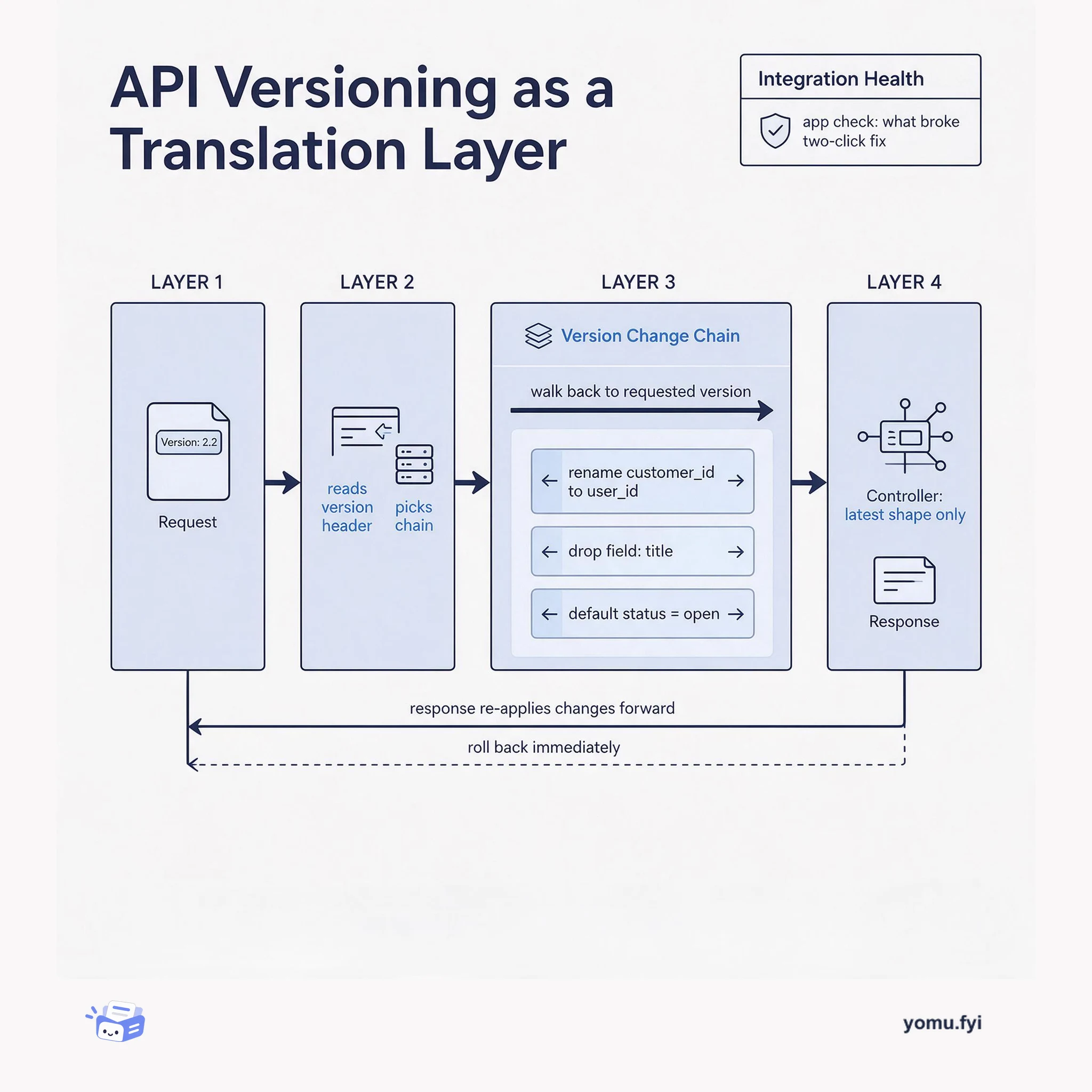
API versioning as an architecture: requests enter through a version header, pass through a chain of reversible version changes, and reach controllers that only ever see the latest model.
Loading…
Topic
830 posts about Architecture. Every summary links to the original.
See the idea
API versioning as an architecture: requests enter through a version header, pass through a chain of reversible version changes, and reach controllers that only ever see the latest model.
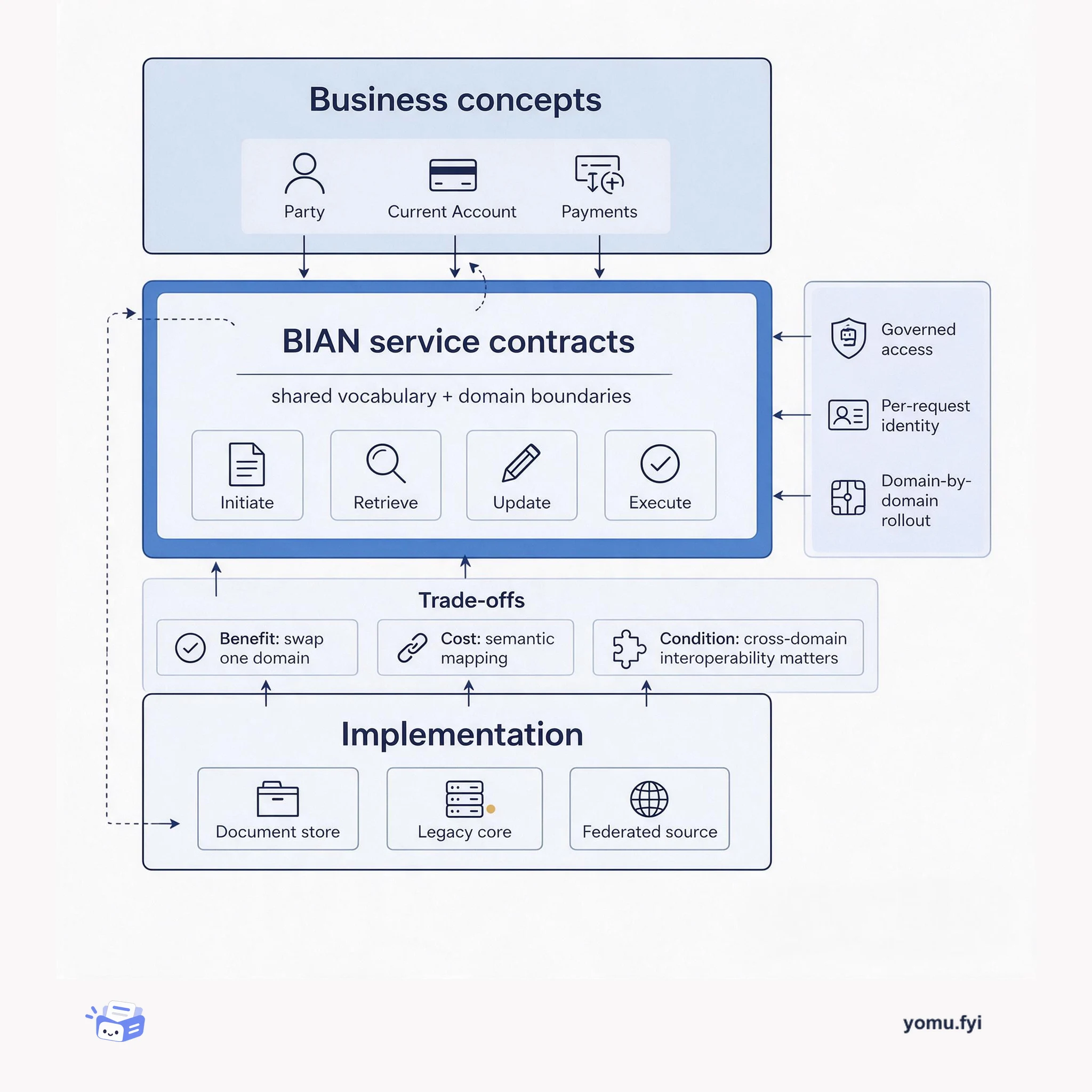
BIAN gives banks a shared vocabulary and service-domain contracts that sit between business concepts and the systems implementing them. See how domains, contracts, and governed access stack into one architecture.
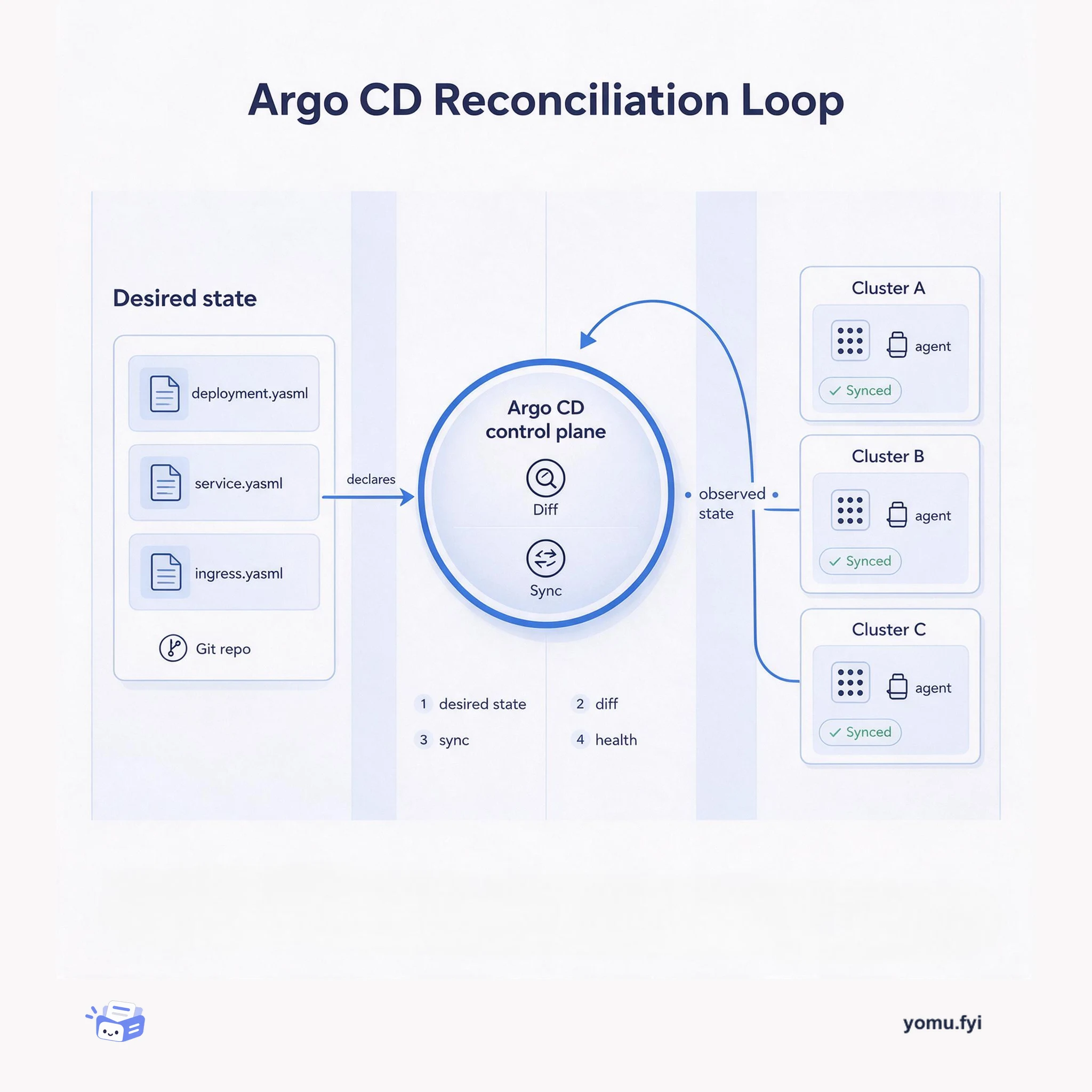
Argo CD is a GitOps controller that treats Git as the desired state and continuously reconciles it against what actually runs in each cluster. It maps the parts of that loop and why pull-based agents change its scale.
The Good Stuff
Paid picks we use ourselves. Links carry a referral code — a subscription through one earns us a commission at no extra cost to you.
Newest first
NVIDIA announced the launch of NVIDIA Halos for Robotics, a full-stack functional safety system designed for industrial robots, humanoids, and autonomous mobile robots. The platform extends NVIDIA's functional safety architecture from autonomous vehicles into robotics, utilizing NVIDIA IGX Thor and the NVIDIA Holoscan Sensor Bridge as its hardware foundation. On top of this hardware, Halos OS provides the base Halos Core safety operating system and application blueprints, including an Outside-In Safety Blueprint that leverages external worksite cameras and safety decision modules. Platform hardware safety features include an isolated IEC 61508 SIL 3 capable Safety Island alongside extensive fault-detection mechanisms. To accelerate compliance, the accredited NVIDIA Halos AI Systems Inspection Lab assesses partner integrations before final third-party certification.
Observability vendors are increasingly betting on a universal SRE agent that combines a platform, telemetry, and natural-language investigation. The post argues that debugging depends on team-specific systems, trusted signals, failure history, runbooks, workflows, and institutional knowledge that cannot be packaged into one vendor’s agent. Agents can compare more time windows and pursue more hypotheses than human investigators, creating demand for low-latency query infrastructure and more complete, high-fidelity historical data. It proposes a more open model in which teams build specialized agents on headless observability foundations, with APIs, data storage, and an observability MCP, while persistent investigation surfaces preserve work for collaboration and reuse. Humans remain responsible for direction, judgment, and action, so the near-term future is presented as human-agent collaboration rather than autonomous incident resolution.
OpenClaw receives hundreds of issues and pull requests daily, creating a triage problem for maintainers who need near-real-time filtering without consuming a paid closed-model quota. The system uses Gemma and Qwen local models inside a Pi-based agent harness: each item is normalized, enriched with GitHub context, classified into finite topic labels, and required to return structured output. For pull requests, the agent can inspect the repository through reposhell, a read-only command-restricted shell, while localpager, SQLite, a worker queue, and deterministic notification policy handle orchestration and Discord delivery. Tests described for gemma-4-26b-a4b and qwen3.6-35b-a3b report hundreds of tokens per second and good zero-shot classification accuracy without fine-tuning, while an LLM audit loop monitors errors; the authors present the pattern as agentic classification for high-throughput triage.
Stripe describes integrating stablecoin settlement into its existing Global Payments and Treasury Network (GPTN), rather than creating a parallel system. GPTN models accounts, wallets, and payment rails as a directed graph, allowing routing, netting, cross-entity settlement, FX, reconciliation, and liquidity management to span fiat and blockchain flows. For a payout, Stripe records a pending stablecoin obligation, Bridge draws from a stablecoin liquidity pool to credit the recipient within seconds to minutes, and fiat replenishment proceeds asynchronously over traditional rails; reverse flows work similarly. A direct mode bypasses the usual few-minute planning cycle for urgent wallet funding, trading netting efficiency for speed, while standard flows continue batching. The live infrastructure handles real traffic, with ongoing work focused on forecast-driven liquidity, faster replenishment through RTP and SEPA Instant, and broader product and corridor coverage.
High-stakes AI agents capable of mutating external state often face governance failures when relying on system prompts or manual Human-in-the-Loop approval queues that quickly degrade into alert fatigue. The Responsibility-Oriented Agent architecture addresses this operational bottleneck by shifting system design from open-ended capability framing to deterministic, contract-enforced responsibilities. Under this model, underlying orchestration frameworks like LangChain operate in User Space with their side-effecting tools removed, isolating the agent to epistemic reasoning. The agent expresses its intended action exclusively by emitting a structured policy proposal to a privileged Kernel Space runtime. The runtime deterministically evaluates the proposal against versioned YAML contracts registered in an agent registry, ensuring that only genuine policy exceptions are escalated to human supervisors.
ClickHouse’s ten-year open-source history is presented through a stained-glass analogy: many contributors remain visible as distinct pieces, while shared infrastructure holds the project together. The article connects that community account to production use through cBioPortal at Memorial Sloan Kettering, where moving heavy filtering into ClickHouse SQL made relevant paths about ten times faster, changing waits from minutes to seconds and supporting continued exploration. It also describes a demonstration built from bare-clone git history, one month of GH Archive events, and the shipped system.contributors table, all queried in ClickHouse. The account reports 100,000 issues and pull requests crossed on March 19, 2026, with 83% of issues and 99% of pull requests resolved at the time of the talk, and presents contributor credit and repair as operating parts of the project.
A data warehouse is a centralized repository for structured data, supporting complex queries, reporting, and business intelligence rather than transaction processing. The guide compares architectures by scale, latency, cost, scope, ownership, and governance. Enterprise data warehouses integrate organization-wide sources through ETL, apply cleansing and validation, and provide a governed source of truth, while data marts focus on departmental analysis and may be dependent or independent. Operational Data Stores replicate current or recent operational data for reporting refreshed from minutes to hours, whereas virtual, cloud, hybrid, and lakehouse designs trade physical consolidation, scalability, flexibility, and governance differently. The comparison also frames lakehouses as combining open-format data lake flexibility with warehouse-style governance and transactional reliability.
Payment fraud detection is presented as a real-time practice for identifying and blocking unauthorized transactions amid evolving card-not-present, account takeover, authorised push payment, friendly, and card-testing attacks. Modern systems combine predefined rules, machine learning, behavioral analytics, device fingerprints, geolocation, transaction history, and velocity signals to calculate risk scores within milliseconds, declining or routing high-risk payments to review. Rules are fast and interpretable but require continual tuning, while machine-learning and behavioral models can identify complex or user-specific patterns that static thresholds miss. The source also emphasizes prevention controls such as MFA, tokenization, 3D Secure, and device binding, alongside unified real-time data infrastructure that supports cross-channel signals, continuous retraining, and deployment into payment authorization flows.
An AI agent harness is the software infrastructure around a large language model (LLM) that lets it act on tasks rather than only answer prompts. The model reasons and chooses actions, while the harness connects tools, execution environments, memory, external systems and safety controls. Many agents follow a reason–act–observe loop: the model proposes an action, the harness executes it, captures the result and returns that result as context for the next decision. Production harnesses typically include system prompts, tool execution, sandboxes, filesystems and durable storage, context management, feedback and self-verification, guardrails, human-in-the-loop approvals, and observability; their design increasingly shapes reliability as model capabilities converge.
Data warehouse modernization addresses legacy systems that cannot scale efficiently with growing data volumes, real-time analytics, machine learning, and self-service access. The proposed roadmap spans two to four years for large estates, moving from assessment and architecture design through high-impact workload migration, governance embedding, and optimization rather than relying on a risky big-bang cutover. Its target architecture favors a lakehouse or enhanced cloud data warehouse, with open formats such as Apache Iceberg or Delta Lake, separate compute and storage, and Bronze, Silver, and Gold layers supporting incremental ELT and lineage. The source says modernization can reduce infrastructure maintenance costs by 30–50%, compress query latency from hours to seconds, and halve redundant ETL pipelines, while also improving governance for sensitive data and enabling BI, machine learning, and generative AI workloads on a shared foundation.
Attackers recently compromised over twenty thousand Instagram accounts by manipulating Meta's AI support assistant to rebind recovery email addresses without verifying account ownership. This incident illustrates the classic confused deputy security problem, where a privileged process is persuaded by an unprivileged user to perform unauthorized operations. Because large language model interfaces operate purely on natural language and cannot distinguish instructions from data, the model itself cannot serve as an authorization boundary. Securing AI agents requires verifying caller identity through external policy checks against authenticated sessions rather than relying on chat context or prompt engineering. Teams must enforce least privilege with short-lived scoped credentials, place irreversible actions behind hard policy gates or human approvals, and maintain audit trails of agent actions.
The Partner Well-Architected Framework (PWAF) has moved partner guidance from static PDFs to AI-ready guidance spanning Built-On, Connected, and Data Collaboration architectures. It combines an architecture center with technical standards, patterns, and instrumentation guidance intended to align integrations with partner-engineering validation while making adoption and DBU impact measurable. Since February, Databricks has added a Dev Kit containing 15+ tested AI-developed skills, new or refreshed guidance for Clean Rooms, software-defined storage, Marketplace apps, Genie, Lakebase, and MCP server onboarding, and an open-source Firefly Analytics reference implementation. The framework is positioned as an evolving, agent-compatible way to shift routine integration work to AI tools, freeing partner and Databricks engineers to focus on complex architecture; more patterns, skills, reference implementations, and demos are planned.
Open Electricity uses ClickHouse to serve live Australian energy data through a public platform and API spanning roughly one billion records. Migrating from Postgres and TimescaleDB addressed queries that could take more than five minutes, reducing a benchmark to just over three seconds and to 60 milliseconds with a materialized view. The new setup keeps heavy relational workloads in Postgres while ClickHouse handles analytics, using ReplacingMergeTree base tables and more than 20 materialized views for different aggregation patterns. It also uses substantially less hardware than the previous configuration: four cores, four GB RAM, and 200 GB disk versus 16 cores, 32 GB RAM, and 1.6 TB, while serving data added daily and API users.
Strands Robots integrates Hugging Face’s LeRobot stack with Strands Agents to connect dataset recording, policy execution, simulation, hardware deployment, and fleet coordination in one agent loop. Its integration keeps LeRobot responsible for hardware drivers, calibration, recording, and dataset handling, while Strands supplies AgentTools, a shared Robot abstraction, policy providers, and a Zenoh peer mesh; simulation and hardware use the same LeRobotDataset format. The walkthrough records demonstrations in MuJoCo, optionally pushes them to the Hub, runs policies through a common interface, and switches from simulation to a physical SO-101 with mode="real". The companion script and notebook run the default simulation workflow on a laptop without hardware, a GPU, or Hugging Face credentials, although the default Mock policy produces structurally valid but behaviorally unhelpful random demonstrations.
Agentic UIs must balance deep customization with seamless integration: MCP Apps provide standard-web flexibility in an iframe, while A2UI renders declarative JSON through the host application's native components. The post presents three architectural patterns for combining them, including A2UI over MCP, where MCP servers return application/a2ui+json resources for native rendering and can separate static MCP Resources from dynamic Tool calls. This arrangement avoids iframe-related visual fragmentation, keeps backend tool access separate from frontend rendering, and supports rendering across React, Flutter, or Angular through a predefined component catalog. The broader combination also reserves MCP Apps for highly tailored experiences and describes A2UI in MCP Apps, where an embedded app can process A2UI responses and route user actions through an AppBridge; the conclusion recommends choosing among patterns according to project constraints.
Building AI experiences for augmented reality and wearable devices requires bridging hardware with live media streams, multimodal models, enterprise tools, and runtime infrastructure. NVIDIA XR AI provides an open-source, modular framework connecting extended reality headsets and smart glasses to GPU-accelerated services across cloud, edge, and workstations. In this architecture, camera frames and microphone audio ingest into an XR Media Hub that routes data while keeping raw video pixels in shared memory to minimize overhead. The ecosystem uses NVIDIA Cosmos models for vision-language grounding, NVIDIA Nemotron models for reasoning and tool invocation, and the Model Context Protocol for enterprise integrations. Optional agent orchestration via NVIDIA NeMo Agent Toolkit and spatial streaming through NVIDIA CloudXR support complex workflows across healthcare and manufacturing.
Data pipeline architecture is the end-to-end blueprint for collecting, processing, storing and delivering data from source systems to people, applications and models. It distinguishes logical design, which defines stages and responsibilities, from physical design, which assigns tools and infrastructure to those stages. The common four layers are ingestion, processing and transformation, storage, and serving and consumption, with orchestration and observability spanning the pipeline. The brief compares batch, streaming, Lambda, Kappa and medallion patterns, explaining trade-offs involving freshness, cost, complexity and operational burden. It also contrasts ETL with ELT and presents governance, monitoring and right-sized processing as reliability practices, concluding that architecture should match the use case and balance freshness, cost and reliability.
NVIDIA submitted results across all MLPerf Training v6.0 benchmarks, setting performance records on workloads including the DeepSeek-V3 and GPT-OSS-20B Mixture of Experts models. To scale training up to 8,192 Blackwell GPUs, NVIDIA combined hardware cluster designs with scale-out networking via Spectrum-X Ethernet and Quantum InfiniBand. The engineering team eliminated CPU-GPU synchronization bottlenecks in token-dropless MoEs by implementing full-iteration CUDA graphs with synchronization-free operators and paged stashing. Further software optimizations included CuTe DSL kernel fusions, an MXFP8 attention block in the Transformer Engine, and transitioning router elementwise math to FP32. Across these benchmarks, the GB300 NVL72 platform achieved the fastest time to train at scale and the highest normalized per-accelerator performance.
OpenSharing SecureConnect addresses the networking burden of sharing live data from provider storage behind private networks, where providers and recipients otherwise exchange firewall and egress details manually. It is a Databricks-managed proxy that routes recipient storage access through Databricks endpoints after a one-time provider setup, while the data remains in the provider’s bucket. Providers allowlist Databricks Serverless Data Plane endpoints and enable SecureConnect for a metastore; serverless recipients require no configuration, while classic and open recipients allowlist stable inbound IPs. Optional NCC provides private link connectivity, and mutual TLS is available for recipients. SecureConnect is in Public Preview and supports cross-region, cross-cloud sharing plus customer-managed and Databricks Default Storage.
Cart Assistant addresses grocery requests that begin as lists, recipe images, or vague plans and turns them into draft carts shoppers can review and edit. It uses a multi-prompt state graph that assigns planning, candidate retrieval, semantic relevance, constraint enforcement, quantity selection, guardrails, assembly, and content refinement to focused stages. LLMs handle ambiguity and structured outputs, while backend APIs, deterministic arithmetic, validation, optimization, and aggregation manage inventory, pricing, eligibility, sellable units, and cart construction. The design separates retrieval language from reasoning context, preserves quantity provenance, supports parallel item processing, and uses deterministic checks plus an LLM judge against synthetic and production-derived cases. According to the conclusion, this decomposition makes the system more controllable and inspectable while producing useful draft carts without removing shopper review, editing, and decision-making.
The best engineering reads, once a week.