Databricks
Business leaders often have access to plenty of data but still cannot get a reliable answer to a simple question like why net revenue declined 8% at their largest account last week. The answer may span sales, finance, promotions, inventory, and account data, with each source potentially correct in isolation yet different in definitions, detail, relationships, and authority. Without the right business context, general-purpose agents cannot reliably determine what metrics mean, which sources are authoritative, how data should connect, or what each user is allowed to see. Genie One MCP gives governed context to any MCP-compatible AI agent, connecting assistants like ChatGPT, Claude, Microsoft Copilot, and coding agents to Genie One. This lets them answer business questions using approved definitions, trusted data relationships, and permission-aware access controls, with traceable, permission-aware answers grounded in governed business context.
Databricks
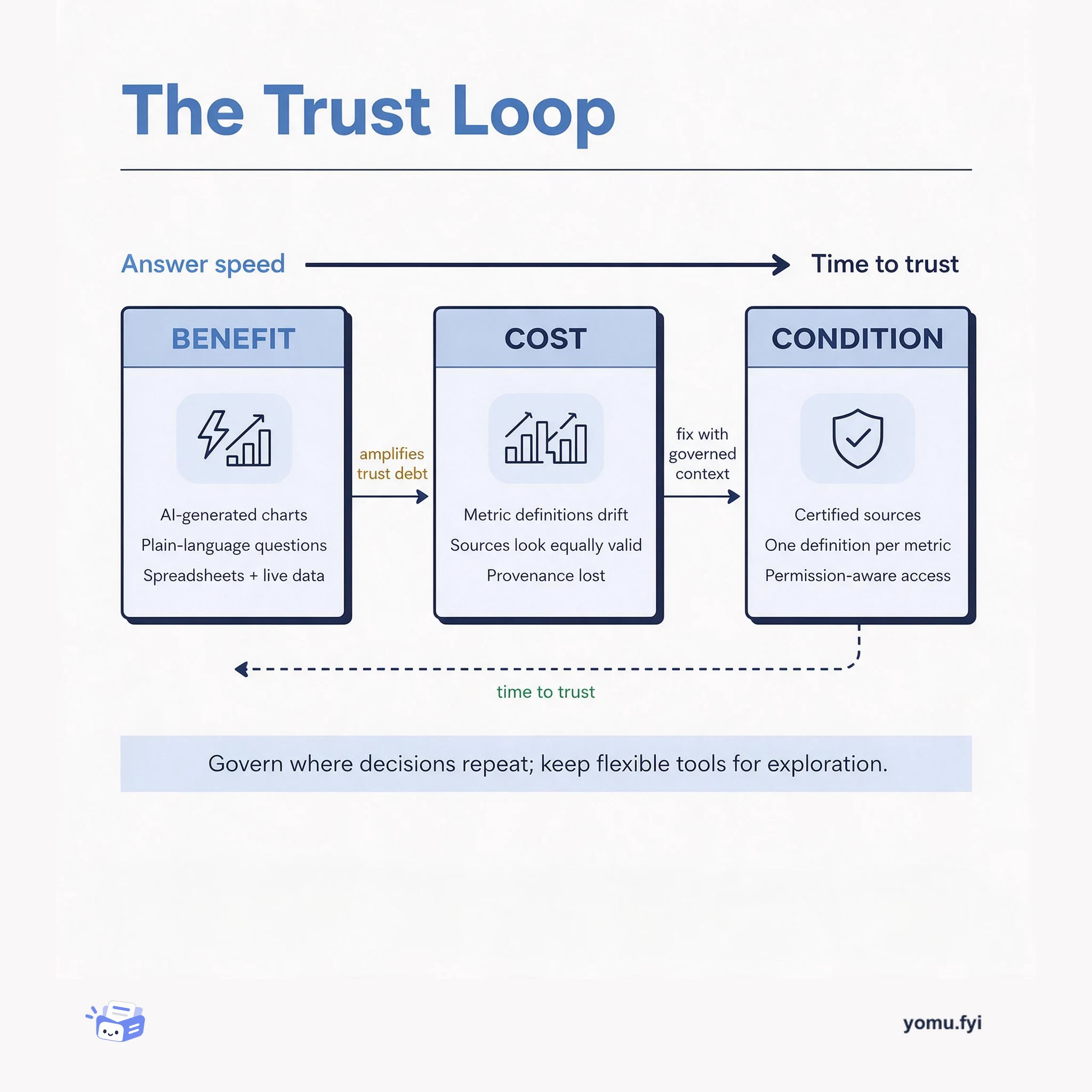
AI analytics applies AI and machine learning to data analysis, enabling natural-language queries and automated insights without manual query-building, shifting from retrospective dashboards toward agentic investigations. Unlike traditional BI, which requires users to navigate predefined dashboards and filters, AI analytics systems understand intent, determine relevant data and business context, and can conduct multi-step investigations on behalf of the user. A key challenge is that AI analytics only works when grounded in governed data: without shared metric definitions, authoritative sources, and permission-aware execution, the system produces untrustworthy results. Trust in AI analytics is a system property, not a model property; it requires governed data, shared business context, permission enforcement, and verifiability of queries and calculations. Better AI models do not eliminate the need for business context; as AI becomes more autonomous, semantic definitions and governance become more critical.