One IDE vs. the Right Tool: Android Studio's Boundary Trade-off
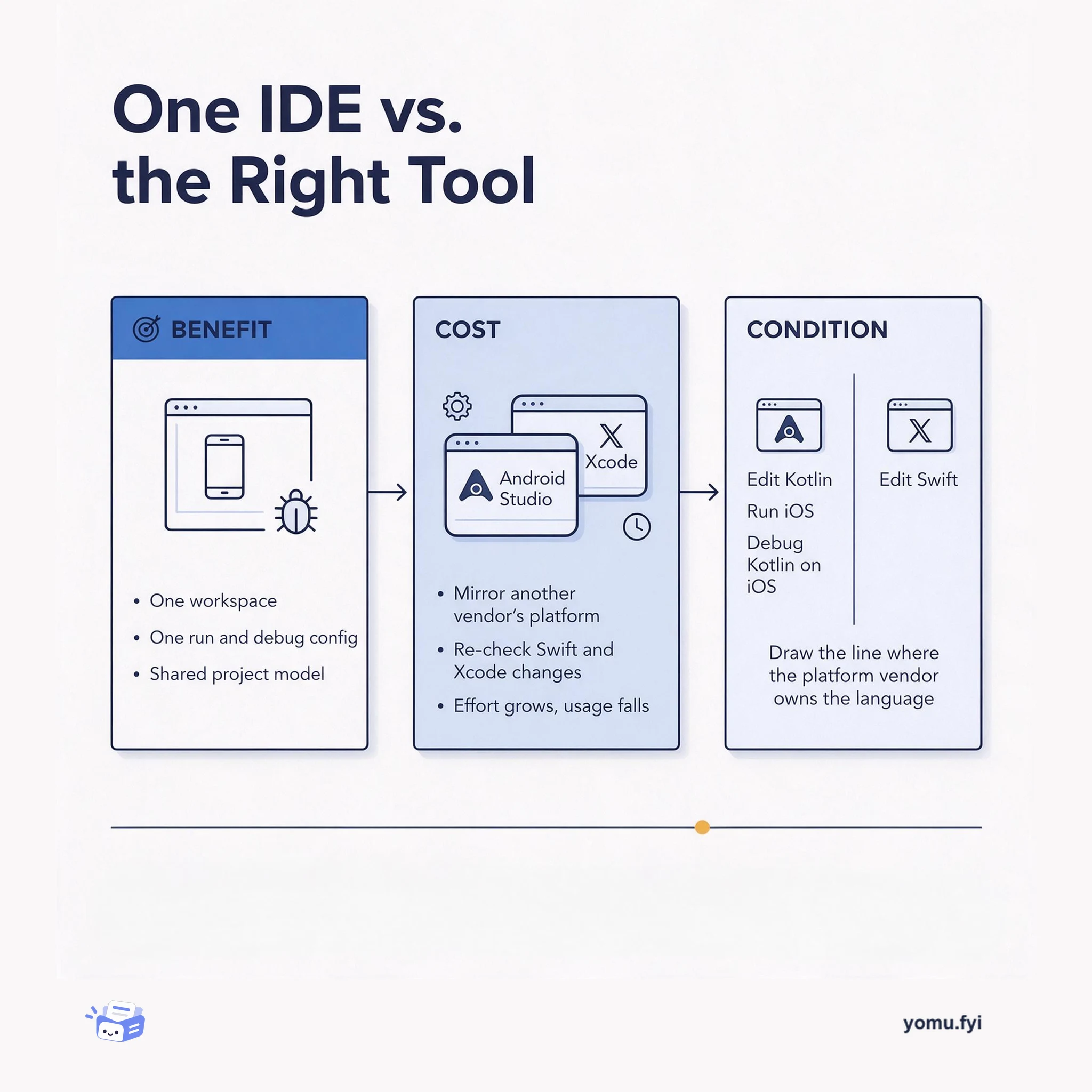
Android Studio keeps cross-platform Kotlin run and debug in one workspace but hands Swift editing to Xcode. This explainer maps the benefit, cost, and condition behind that boundary.
Loading…
Topic
441 posts about Developer Experience. Every summary links to the original.
See the idea
Android Studio keeps cross-platform Kotlin run and debug in one workspace but hands Swift editing to Xcode. This explainer maps the benefit, cost, and condition behind that boundary.
Bun packs a runtime, package manager, bundler, and test runner into one binary. Here is how those four parts fit together and where the seams still show.
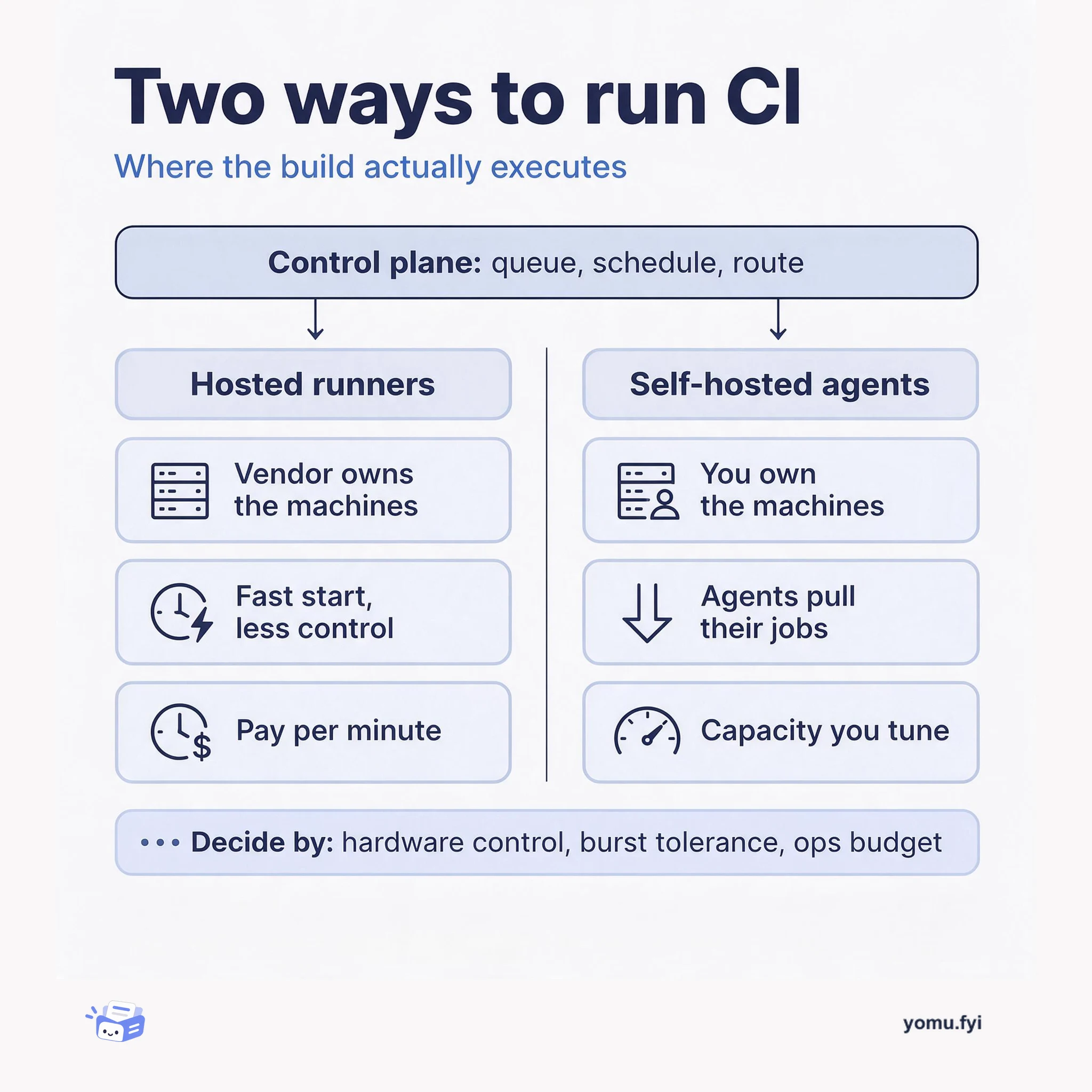
Buildkite splits CI into a hosted control plane and agents you run on your own machines. This comparison weighs that self-hosted agent model against fully hosted runners so you can pick the right fleet.
The Good Stuff
Paid picks we use ourselves. Links carry a referral code — a subscription through one earns us a commission at no extra cost to you.
Newest first
First Block is a set of conversations with founders and company leaders across legal technology, finance, career access, software development, talent, go-to-market, and developer tools. The episodes feature Gabe Pereyra of Harvey, Gerry Giacomán Colyer of Clara, Garrett Lord of Handshake, Jesse Zhang of Decagon, Fabian Hedin of Lovable, Brendan Foody of Mercor, Varun Anand of Clay, and Michael Truell of Cursor. Topics include deploying AI agents in finance operations across Latin America, democratizing software development and career opportunities, intentional customer discovery, and building for current AI capabilities. The collection also covers founder-led selling, product-market fit, specialized go-to-market platforms, commercial thinking, startup pivots, and departures from conventional startup advice.
Cursor has released a visual editor for its Browser that combines a web app, codebase, and visual editing tools in one window. Users can drag rendered elements across the DOM tree, inspect React component props, adjust styles and design-system color tokens, and interactively test layout, typography, and component variants. Point-and-prompt interactions let users select interface elements and describe changes such as resizing, recoloring, or reordering; agents run these prompts in parallel and make changes live within seconds. Once a visual arrangement is settled, the agent locates relevant components and updates the underlying code. The release positions the editor as a way to connect visual design and coding more directly, with features documented for Cursor 2.2.
Hugging Face Skills equips AI coding agents like OpenAI Codex to execute end-to-end machine learning workflows. By reading AGENTS.md files and interfacing via the Model Context Protocol, Codex automates dataset validation, training script updates, and job submissions to Hugging Face Jobs. The workflow supports methods including supervised fine-tuning, direct preference optimization, and reinforcement learning for models ranging from 0.5B to 7B parameters. Throughout execution, Codex tracks live metrics via Trackio, records benchmark evaluations against baselines, and maintains Markdown reports. Once training concludes, Codex merges LoRA adapters, applies GGUF quantization, and publishes the resulting models to the Hugging Face Hub for local deployment.
Stripe Workflows previously required teams to edit live workflow definitions directly, leaving no draft state, historical definitions, straightforward rollback, or reliable way to inspect which configuration shaped an older run. Versioning addresses this with a dedicated draft for iteration, immutable numbered published versions, and version history that can include descriptions, authors, status, and run counts. Publishing creates a complete snapshot containing steps, branches, conditions, variable references, calls, and configuration; new runs use it immediately, while in-progress runs finish on the version they started with. Each run records its exact version and exposes the workflow definition, including taken and untaken branches, while a past version can seed a new draft for rollback; versioning is available in Stripe Workflows, where new workflows include a draft by default.
Hugging Face released swift-huggingface, a dedicated Swift package offering complete Hub API integration, reliable file downloads, and inference provider access. The library addresses previous limitations in swift-transformers 1.0, where interrupted multi-gigabyte model downloads could not resume and cache structures differed from Python. To resolve cache duplication, swift-huggingface implements a Python-compatible content-addressed storage layout using symlinks and flock file locking. Authentication is standardized through a TokenProvider pattern supporting auto-detection, Keychain integration, static CI/CD tokens, and OAuth 2.0 sign-in with automatic token refresh. The package also provides URLSession-backed snapshot downloads with granular progress tracking and will soon replace the HubApi implementation inside swift-transformers.
Kiro's Stripe power is presented as a way to build a production-ready SaaS subscription flow while avoiding the fragmented output common with generic coding assistants. Using a natural-language specification for three monthly tiers and a three-month one-time option, Kiro creates a React frontend, Node.js backend API, CDN-hostable static assets, and server-side Stripe Checkout Session creation. The integration includes Stripe-specific steering files, MCP servers, and hooks, while the webhook handler preserves the raw request body, verifies HMAC signatures with stripe.webhooks.constructEvent(), rejects invalid events with HTTP 400, and routes lifecycle events such as checkout completion and subscription cancellation. The post concludes that this provides a secure, scalable foundation while leaving teams to customize business logic, including access provisioning and deprovisioning, instead of building payment infrastructure from scratch.
Hugging Face Skills equips coding agents like Claude Code, OpenAI Codex, and Google's Gemini CLI to manage end-to-end language model fine-tuning. Using the hf-llm-trainer skill, an agent validates dataset formats, selects cloud hardware, configures authentication, and submits jobs to Hugging Face Jobs. Supported techniques include Supervised Fine-Tuning (SFT), Direct Preference Optimization (DPO), and Group Relative Policy Optimization (GRPO) for models ranging across various parameter sizes. The integration incorporates Trackio for real-time monitoring and automates LoRA configuration for larger models. Once training completes, the agent pushes artifacts to the Hugging Face Hub and can convert models to GGUF format for local execution.
The guide explains how Stripe developers can add USDC stablecoin payments without managing private keys, gas estimation, network selection, or wallet connection flows. Stripe supports USDC on Ethereum, Solana, Polygon, and Base, settles transactions as fiat in the merchant’s Stripe balance, and charges a 1.5% fee; the described feature is currently limited to US businesses. Integration can use payment_method_types: ['card', 'crypto'], although Stripe recommends automatic_payment_methods for Dashboard-managed configuration, filtering, ordering, and testing. Stripe Checkout and Elements expose crypto without frontend changes, while confirmation, webhook handling, monitoring, and familiar failure processing remain aligned with existing payment flows. The guide also describes Sandbox testing without testnets or fake cryptocurrency and presents crypto payments as a way to offer global settlement and potentially lower processing costs.
Apple developers frequently face integration friction when trying to support a mix of local and cloud language models across disparate APIs. To resolve this fragmentation, AnyLanguageModel introduces a unified Swift package that acts as a drop-in replacement for Apple's Foundation Models framework. The package standardizes interactions across local backends such as Core ML, MLX, and llama.cpp alongside cloud providers like Anthropic and OpenAI. To avoid dependency bloat from multi-backend support, the library employs Swift 6.1 package traits so projects only import the specific runtime engines they require. Furthermore, the library extends beyond current Foundation Models limitations by adding prompt image support for vision-language models.
The Hugging Face Hub team released huggingface_hub v1.0, marking the library's transition into a mature foundation for open machine learning after five years of development. The major update migrates the underlying network backend to httpx and replaces the legacy hf_transfer tool with the hf_xet binary package to enable chunk-level file deduplication across repositories. In addition, the release introduces a redesigned Typer-based CLI using the streamlined hf command alongside explicit authentication functions and expanded inference primitives. Legacy components, including the Git-based Repository class and the older InferenceApi interface, have been removed to establish a cleaner and more maintainable architecture. Most dependent machine learning libraries remain compatible across versions, though transformers requires v0.x for version 4 and v1.x for its upcoming version 5 release.
Canva conducts AI-assisted programming interviews designed to evaluate candidates' engineering fundamentals amplified by artificial intelligence tools. Successful candidates structure their interviews across planning, development, and discussion phases, clarifying architectural assumptions before writing code and critically reviewing AI-generated output. Interviewers evaluate engineering problem-solving, technical depth, code ownership, and the effective collaboration with AI assistants rather than isolated prompting mechanics or rushed feature completion. Ineffective strategies include treating models as hands-off solution generators, rushing unvetted features, and prioritizing demonstrations of advanced prompting over core technical judgment. Preparation involves setting up project structures in advance, exploring requirements aloud, and remaining ready to justify architectural trade-offs and production scalability.
Arm announced its schedule and offerings for the PyTorch Conference on October 22–23, focusing on building and deploying AI applications using PyTorch and ExecuTorch. The company is hosting one-on-one workshops with design experts to improve product usability and introduce Yellow Teaming practices for mitigating fairness, transparency, privacy, and security risks. Additionally, Arm is running 30-minute Voice of the Developer sessions to gather feedback on real-world challenges, including migrating from NVIDIA or x86 to Arm, debugging models at scale, and running large language models on edge devices. At Booth P1, attendees can view interactive demonstrations featuring neural graphics training, speech recognition, audio generation, vLLM, Mixture of Experts, and ExecuTorch edge deployments.
Assessing AI-generated code via static inspection is error-prone and fails to reflect whether code functions correctly across real-world environments. BigCodeArena addresses this evaluation bottleneck as a human-in-the-loop platform that executes model outputs in real time inside isolated sandbox environments across ten programming languages and eight execution frameworks. Users interact directly with live applications, refine implementations through multi-turn conversations, and submit pairwise preference votes to generate Elo ratings via the Bradley-Terry model. In five months of community testing covering over 14,000 conversations, proprietary models including o3-mini and o1-mini led overall Elo rankings, while open models like Qwen2.5 and Llama-3.3-70B trailed closed competitors. The project has open-sourced its full evaluation pipelines, conversation datasets, and related benchmarks to support community-driven code generation assessment.
Vibe coding games often fails as projects grow because large context sizes degrade model performance. After evaluating Roblox MCP, Unity MCP, and open web libraries with Claude Code, the author found web tooling offered the strongest model proficiency but lacked high-level game abstractions. To bridge this gap, the author created VibeGame, an open-source declarative game engine built on three.js, rapier, and bitecs. VibeGame uses an Entity-Component-System architecture, XML-like markup, and bundled documentation in an llms.txt file to keep project context lean. While effective for basic physics and rendering mechanics, the engine requires further development for complex features like inventories, multiplayer, and interactions.
MongoDB has released the general availability of the MongoDB SQL Interface for MongoDB Enterprise Advanced on self-managed deployments running MongoDB 6.0 or higher. Previously, teams relying on SQL-based business intelligence tools faced maintenance bottlenecks when learning MongoDB Query Language or creating custom extract, transform, and load pipelines. The new interface translates standard SQL queries into native MongoDB operations in real time using MongoSQL, a SQL-92 compatible dialect. Users utilize a Schema Builder CLI to generate JSON schemas that map nested document structures and store them alongside data for query validation. This native query translation replaces the MongoDB BI Connector, which will remain supported until September 2026, while offering improved performance and direct connectivity via JDBC and ODBC drivers.
Enterprise AI agent initiatives frequently stall after pilot phases due to technology-first thinking, governance gaps, infrastructure complexity, and poor alignment with business needs. To bridge this divide, development teams are shifting away from data-first pipelines toward a product-first methodology structured as product, agent, data, and model. The Canvas framework provides a phased workflow moving from quick proof-of-concept validation to model orchestration and operational hardening. In Phase 4, developers focus on API management, external provider orchestration, cost optimization, and evaluation pipelines. Phase 5 adds necessary governance, compliance, user experience, and security layers required to transform working agent prototypes into sustainable production deployments.
Stripe Workflows can automate additional compliance safeguards by flagging transactions that need review before order processing. The described pattern starts when a Payment intent succeeded event occurs, retrieves the customer, and checks whether the customer’s custom_status metadata is not “Approved” while the payment amount exceeds $5,000. When these conditions are met, the workflow emails one or more designated team members with instructions for assessing the order. The examples motivating review include unusually high order values, unfamiliar sales regions, and behavioral patterns commonly associated with fraud, such as a new customer order above a monetary threshold. Workflows uses a visual building interface in the Stripe dashboard to sequence actions across multiple Stripe products, helping enforce business rules, reduce manual effort, and support risk management.
Together AI and Hugging Face have introduced an integration enabling developers to fine-tune compatible Hugging Face Hub models directly on Together AI's managed infrastructure. To launch a fine-tuning job via the Python SDK, users provide a base model from Together's catalog as a configuration template alongside the target Hugging Face repository identifier. This base model template dictates GPU allocation, memory configuration, training pipelines, and inference setup for custom models with matching architectures and sizes. The workflow operates bidirectionally, pulling from public or token-authenticated private repositories and optionally pushing completed checkpoints back to the Hub upon completion. Geared toward CausalLM models under 100 billion parameters, the capability enables faster iteration cycles and domain adaptation without custom DevOps infrastructure.
Hypermode Agents and Stripe can be combined to create domain-specific financial operations agents from natural-language descriptions rather than conventional code. The workflow uses Hypermode’s Concierge to generate a system prompt, then connects the agent to Stripe through the Stripe Model Context Protocol (MCP) server and optionally to services such as Notion, Slack, and Google Calendar. With a restricted Stripe API key and sandbox data, the agent can retrieve policies, inspect customer and transaction history, apply refund rules, process payments, create invoices, and analyze subscriptions for metrics such as MRR. The examples describe partial refund decisions, onboarding workflows, campaign suggestions, and populated test environments, while the guidance recommends prompt iteration, human approval for high-value transactions, and monitoring and logging for compliance and improvement.
Model Context Protocol (MCP) can let AI agents search catalogs, interpret reviews, build carts, and support purchases, but a text-only flow does not provide the visual and interactive details central to commerce. Shopify presents MCP UI as an extension that returns embedded UI resources for components such as product cards, with delivery through inline HTML, remote resources in sandboxed iframes, or Remote DOM. Its intent-based message system keeps components from directly modifying state: actions such as view_details, checkout, notify, and ui-size-change are surfaced for the agent to interpret, while render data lets hosts provide CSS for adaptive styling. The open-source, deliberately extensible protocol is demonstrated in a Shopify Storefront MCP UI Server prototype and is intended for commerce as well as data visualization, form builders, and media players.
The best engineering reads, once a week.