Brand: Artifact vs Operating System
Compare two mental models for brand: a static artifact (logos, guidelines, centralized control) and a living operating system (values, APIs, support, trust). See which choices fit your engineering team.
Loading…
Topic
446 posts about Developer Experience. Every summary links to the original.
See the idea
Compare two mental models for brand: a static artifact (logos, guidelines, centralized control) and a living operating system (values, APIs, support, trust). See which choices fit your engineering team.
An app store is a distribution surface, a versioned contract, and a health loop between a platform and its developers. Here is how those parts fit together and why each one fails loudly if ignored.
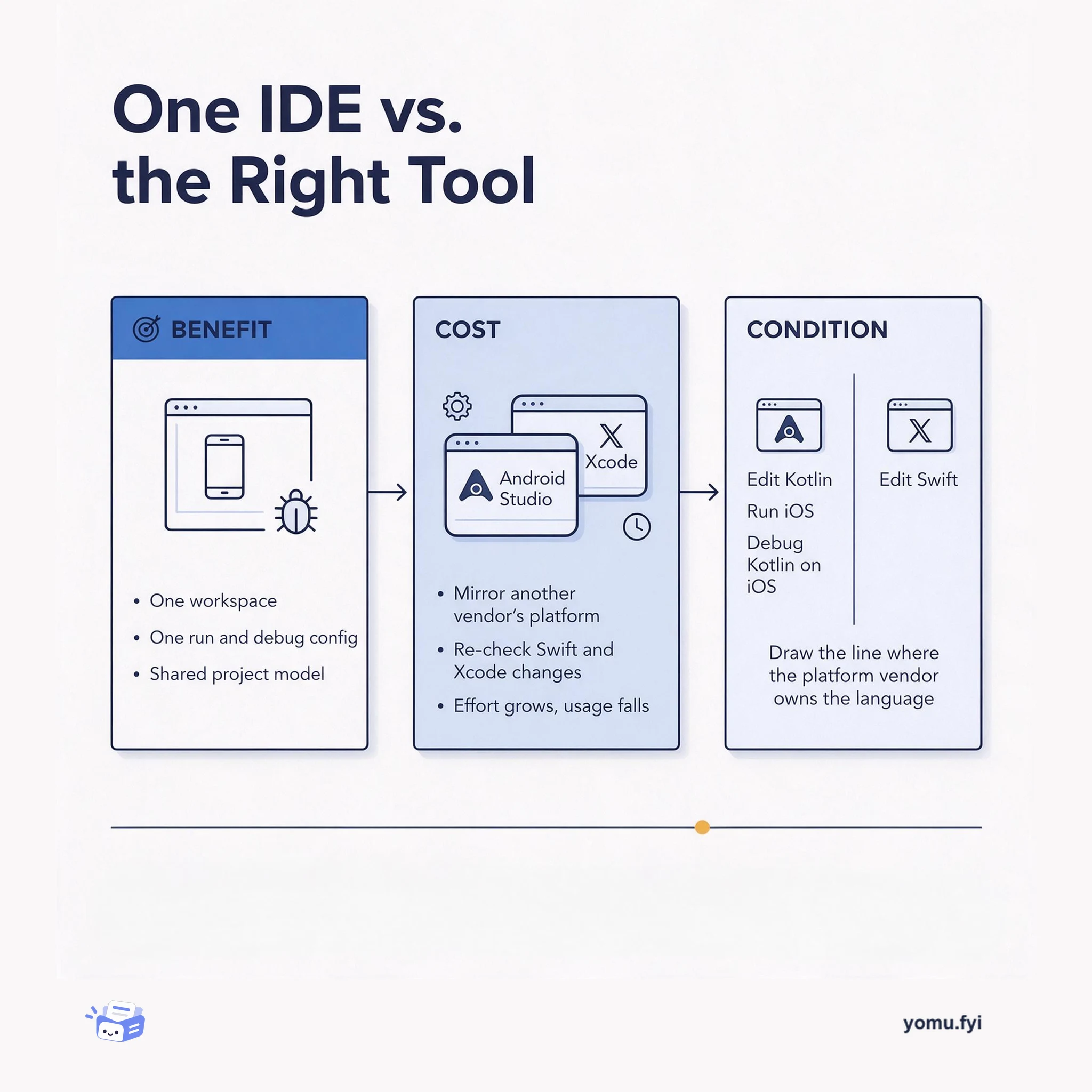
Android Studio keeps cross-platform Kotlin run and debug in one workspace but hands Swift editing to Xcode. This explainer maps the benefit, cost, and condition behind that boundary.
The Good Stuff
Paid picks we use ourselves. Links carry a referral code — a subscription through one earns us a commission at no extra cost to you.
Newest first
Enterprise AI agent initiatives frequently stall after pilot phases due to technology-first thinking, governance gaps, infrastructure complexity, and poor alignment with business needs. To bridge this divide, development teams are shifting away from data-first pipelines toward a product-first methodology structured as product, agent, data, and model. The Canvas framework provides a phased workflow moving from quick proof-of-concept validation to model orchestration and operational hardening. In Phase 4, developers focus on API management, external provider orchestration, cost optimization, and evaluation pipelines. Phase 5 adds necessary governance, compliance, user experience, and security layers required to transform working agent prototypes into sustainable production deployments.
Stripe Workflows can automate additional compliance safeguards by flagging transactions that need review before order processing. The described pattern starts when a Payment intent succeeded event occurs, retrieves the customer, and checks whether the customer’s custom_status metadata is not “Approved” while the payment amount exceeds $5,000. When these conditions are met, the workflow emails one or more designated team members with instructions for assessing the order. The examples motivating review include unusually high order values, unfamiliar sales regions, and behavioral patterns commonly associated with fraud, such as a new customer order above a monetary threshold. Workflows uses a visual building interface in the Stripe dashboard to sequence actions across multiple Stripe products, helping enforce business rules, reduce manual effort, and support risk management.
Together AI and Hugging Face have introduced an integration enabling developers to fine-tune compatible Hugging Face Hub models directly on Together AI's managed infrastructure. To launch a fine-tuning job via the Python SDK, users provide a base model from Together's catalog as a configuration template alongside the target Hugging Face repository identifier. This base model template dictates GPU allocation, memory configuration, training pipelines, and inference setup for custom models with matching architectures and sizes. The workflow operates bidirectionally, pulling from public or token-authenticated private repositories and optionally pushing completed checkpoints back to the Hub upon completion. Geared toward CausalLM models under 100 billion parameters, the capability enables faster iteration cycles and domain adaptation without custom DevOps infrastructure.
Hypermode Agents and Stripe can be combined to create domain-specific financial operations agents from natural-language descriptions rather than conventional code. The workflow uses Hypermode’s Concierge to generate a system prompt, then connects the agent to Stripe through the Stripe Model Context Protocol (MCP) server and optionally to services such as Notion, Slack, and Google Calendar. With a restricted Stripe API key and sandbox data, the agent can retrieve policies, inspect customer and transaction history, apply refund rules, process payments, create invoices, and analyze subscriptions for metrics such as MRR. The examples describe partial refund decisions, onboarding workflows, campaign suggestions, and populated test environments, while the guidance recommends prompt iteration, human approval for high-value transactions, and monitoring and logging for compliance and improvement.
Model Context Protocol (MCP) can let AI agents search catalogs, interpret reviews, build carts, and support purchases, but a text-only flow does not provide the visual and interactive details central to commerce. Shopify presents MCP UI as an extension that returns embedded UI resources for components such as product cards, with delivery through inline HTML, remote resources in sandboxed iframes, or Remote DOM. Its intent-based message system keeps components from directly modifying state: actions such as view_details, checkout, notify, and ui-size-change are surfaced for the agent to interpret, while render data lets hosts provide CSS for adaptive styling. The open-source, deliberately extensible protocol is demonstrated in a Shopify Storefront MCP UI Server prototype and is intended for commerce as well as data visualization, form builders, and media players.
FlashList v2 is a ground-up rewrite of the React Native list component, aimed at removing v1’s dependence on item-size estimates, native layout corrections, and imprecise scrolling. Built for React Native’s New Architecture, it uses synchronous layout measurements to correct positions before paint and eliminates the need for native code. Its algorithm combines progressive rendering, predictions updated by item type, and rapid corrections, while adaptive rendering responds to scroll velocity, direction, and device performance. The new scrolling system progressively refines target positions for precise scrollToIndex operations, and horizontal lists can contain resizable items and coordinate with parent lists. The release also adds scroll-position maintenance, improved masonry support, recycle-pool controls, helper hooks, and better web support; benchmarks report up to 50% less blank area while scrolling than v1 on the new architecture.
Stripe Workflows can customize Stripe objects with metadata, adding contextual key-value information without changing the core data model or storing it separately. The example targets customers associated with successful Payment Intents that include a tip, so a customer can be labeled for business use, such as reconciliation, reporting, or internal integrations. To build it, the workflow retrieves the customer from the Payment Intent, emails a team member, checks whether the successful Payment Intent contains a non-empty tip amount, and updates that customer with the metadata key Tier and value VIP. Workflows runs a trigger and sequential actions or conditions in a visual Stripe Dashboard builder, while metadata can carry information to later workflow steps and support automation, analytics, and debugging.
Stripe Workflows can automate responses to early fraud warnings so potentially fraudulent charges receive refunds when disputing them would be more costly. The workflow starts when an early fraud warning is created in Radar, retrieves the related charge using its Charge ID, and checks whether the amount is less than 15 USD. If the condition is met, it creates a refund; if it is not met, an optional branch can email a team member for manual review. Workflows uses a visual builder in the Stripe dashboard, where triggers, actions, and conditions run sequentially across multiple Stripe products, while Stripe Radar provides real-time fraud protection and Radar for Fraud Teams adds customization and deeper insights.
Furever, a test Connect platform for pet grooming, needs to onboard connected accounts and keep them compliant and activated while reducing friction. It first creates Custom accounts with card_payments and transfers requested, then contrasts Stripe-hosted account links with an embedded flow built from Account Sessions, loadConnectAndInitialize, and ConnectAccountOnboarding. The integration supports appearance variables for branding, disable_stripe_user_authentication when the platform owns losses and requirement collection, and onStepChange analytics for onboarding progress. A shared connectInstance can also render ConnectPayments, which provides payment listing, refunds, and dispute management without building that interface; the source also notes localization, framework support beyond React, and additional components.
Shopify rebuilt its Admin architecture to address inconsistent loading, duplicate requests, and fragmented route knowledge across a TypeScript codebase serving 67 million daily page views. With 101 teams contributing about 350 pull requests daily and the codebase containing 3,184,248 lines of TypeScript, the work adopted Remix with Vite and SPA mode. Typed route manifests, globbed by Vite, now define metadata and a single source of truth for 1,017 routes, while Remix loaders start data fetching before large component bundles finish loading. Idle-time prefetching warms the Apollo cache, and persistent IndexDB storage helps frequently visited pages load between sessions. The changes delivered a 30% improvement in perceived load times, standardized transitions, and created an architecture in which Remix actions and zod schemas let Sidekick discover forms, validate inputs, and submit tasks without loading unnecessary JavaScript.
Canva needed a scalable, standardized way to calculate the commercial impact of thousands of annual experiments on key business metrics like Monthly Active Users and Annual Recurring Revenue. Previously, disparate teams spent over six hours per experiment performing manual, error-prone calculations across fragmented spreadsheets and inconsistent data models. To resolve this, Canva built the IMPACT app using Snowflake, Streamlit, Snowpark, and Cortex to provide a self-serve platform tied directly to its central finance model. The application scales local uplift by actual audience exposure and supports pre-experiment scenario modeling alongside post-experiment tracking. A custom deployment workflow generates pull-request-isolated Streamlit environments in Snowflake stages, reducing time-to-insight to under ten minutes while enabling multiple developers to safely build and demo features in parallel.
Shopify’s Augmented Engineering Developer Experience team built and open-sourced Roast to make AI-assisted developer workflows more reliable than free-form agents operating across large codebases. Roast is a convention-oriented orchestration framework that combines non-deterministic AI behavior with ordinary code execution through YAML workflows, Markdown prompts, shell commands, Ruby steps, and parallel or conditional control flow. Its shared context, built-in tools, Claude Code integration through CodingAgent, and automatic session replay support workflows that are version-controlled, testable, resumable, and adaptive within defined guardrails. Shopify reports using it to analyze test quality at scale, add Sorbet annotations through the Boba workflow, aggregate competitive intelligence, and research code history, while the project is distributed as a Ruby gem and supports AI providers through Raix.
Michael Truell, co-founder and CEO of Cursor, recounts the company’s path from an initial mechanical-engineering AI project to an AI code editor and developer tool. He describes the pivot, the decision to fork VS Code, and the challenge of building AI-native coding tools while balancing speed with control. Cursor initially prioritized product quality over networking, speaking events, and hiring, then added roughly one person every two to three months while scrutinizing its first hires for belief in the vision and dissatisfaction with the current state. Truell argues that founders should question startup orthodoxy rather than follow universal rules, citing Cursor’s solution-first origin, four-person founding team, and deliberately slow hiring before its reported rapid growth.
Traditional point-of-sale workflows often collect signatures, contact details, receipt preferences, and other customer information through separate devices, verbal input, or manual entry, creating errors, delays, and clutter. Stripe Terminal’s on-screen input collection lets businesses request this data on a compatible reader, supporting selection, signature, email, phone, text, and numeric fields before or after payment. Developers configure forms with the Stripe API or Terminal SDKs, can sequence multiple inputs and attach metadata, and receive responses through terminal.reader.action_succeeded webhooks; signature files are returned by file ID and need to be downloaded within 24 hours. The rental-car example uses selection and email forms for reservation lookup, followed by an on-reader agreement signature, replacing a separate signature pad and manual transcription while giving the POS more accurate data for receipts, lookups, and loyalty interactions.
Canva has updated its technical hiring process to require backend, machine learning, and frontend engineering candidates to utilize artificial intelligence tools such as Copilot, Cursor, and Claude during interviews. The transition addresses the limitations of traditional computer science fundamentals tests, which focused on writing algorithmic code from scratch even though AI assistants can generate complete solutions in seconds. To better evaluate on-the-job engineering capabilities, the company replaced its legacy screening with an AI-assisted coding competency that features complex, ambiguous product challenges such as designing an airport control system. Interviewers assess how candidates clarify requirements, guide tools on subtasks, debug flawed output, and verify that AI-generated code meets production quality standards. Candidates receive advance notice of these expectations, helping ensure prospective hires demonstrate strong engineering judgment when collaborating with assistive coding technologies.
Docusign’s Stripe extension app addresses agreement workflows that continue beyond eSignature, where customer and billing data previously required manual transfer or complex integrations between platforms. The post shows how to install the app, start from the “Send new customer data to Stripe for invoicing” Maestro workflow template, and map web-form data to Stripe Customer, Invoice, InvoiceItem, and Email Invoice steps. It also explains how developers can switch the workflow to an API trigger, retrieve trigger requirements, and launch an instance with two authenticated API calls: one GET and one POST. The resulting flow collects customer information, creates a Stripe customer and draft invoice, adds an invoice item, and sends the invoice, while the returned instance URL can be opened or embedded for participants.
Tinder faced significant agility and build performance challenges caused by an iOS codebase monolith containing over 1,000 files and 150,000 lines of code. Manual extraction efforts risked creating massive, unmanageable pull requests that would require constant rebasing against the main branch. To systematically decompose the target into Swift sub-modules, the team mapped declarations and references via the Swift compiler into a directed graph. They iteratively extracted leaf nodes with an in-degree of zero across sequential phases and automated common code adjustments, including module dependencies, imports, access control levels, and dependency injection. The automated decomposition completed in under six months with zero P0 incidents, reducing monolith build times by 78% and disallowing future additions to the monolith target.
Stripe’s Organizations customer and payment method sharing addresses the difficulty of giving customers a unified checkout when a business uses separate accounts for business lines or countries. After access is enabled, all new and existing customers and their saved card payment methods can be shared between selected accounts, using the same IDs, so a saved card can be charged in another account without recollection. Only selected customer fields—such as name, email, phone, tax IDs, and preferred locales—are shared; metadata, shipping, and other fields remain account-specific, while non-card payment methods cannot be charged cross-account. The guide demonstrates testing in an organization sandbox, creating Checkout Sessions with the shared customer ID, viewing organization-wide transactions, and using a single organization webhook; sharing is in preview and requires customer consent.
Stripe introduces Stripe Workflows, a Dashboard-based system for orchestrating Stripe products and APIs through responsive, end-to-end automation. It addresses the complexity of coordinating multiple Stripe products by replacing custom event-handling and dependency-management code with visual workflows that support real-time triggers, branching logic, dynamic fields, and more than 600 event triggers. Workflows includes execution monitoring with event-payload and step-level tracing, 30-day default log retention, exponential-backoff retries, built-in idempotency, and recursion protection capped at a depth of five. The post describes applications including reducing chargeback risk, routing high-value transactions for compliance review, and creating custom-priced subscriptions from finalized quotes without additional infrastructure.
Stripe announces its new public preview release channel, which provides early access to API features before their General Availability launches. Preview features are described as operationally stable and production-ready, but they may receive breaking changes more often than GA features and may have geographic, onboarding, or approval restrictions. Each preview uses a distinct API version ending in preview, such as 2025-04-30.preview, selected through the Stripe-Version header; preview versions also appear in the API reference and changelog. Beta SDKs will use these preview versions and include preview features, with releases differentiated from GA counterparts by suffixes such as 5.2.0-beta.1. The example shows that a feature released only in preview is rejected by a GA version, requiring an explicit version change before use; this separation lets teams integrate earlier and provide feedback while avoiding unintended adoption of features with known restrictions.
The best engineering reads, once a week.