Brand: Artifact vs Operating System
Compare two mental models for brand: a static artifact (logos, guidelines, centralized control) and a living operating system (values, APIs, support, trust). See which choices fit your engineering team.
Loading…
Topic
446 posts about Developer Experience. Every summary links to the original.
See the idea
Compare two mental models for brand: a static artifact (logos, guidelines, centralized control) and a living operating system (values, APIs, support, trust). See which choices fit your engineering team.
An app store is a distribution surface, a versioned contract, and a health loop between a platform and its developers. Here is how those parts fit together and why each one fails loudly if ignored.
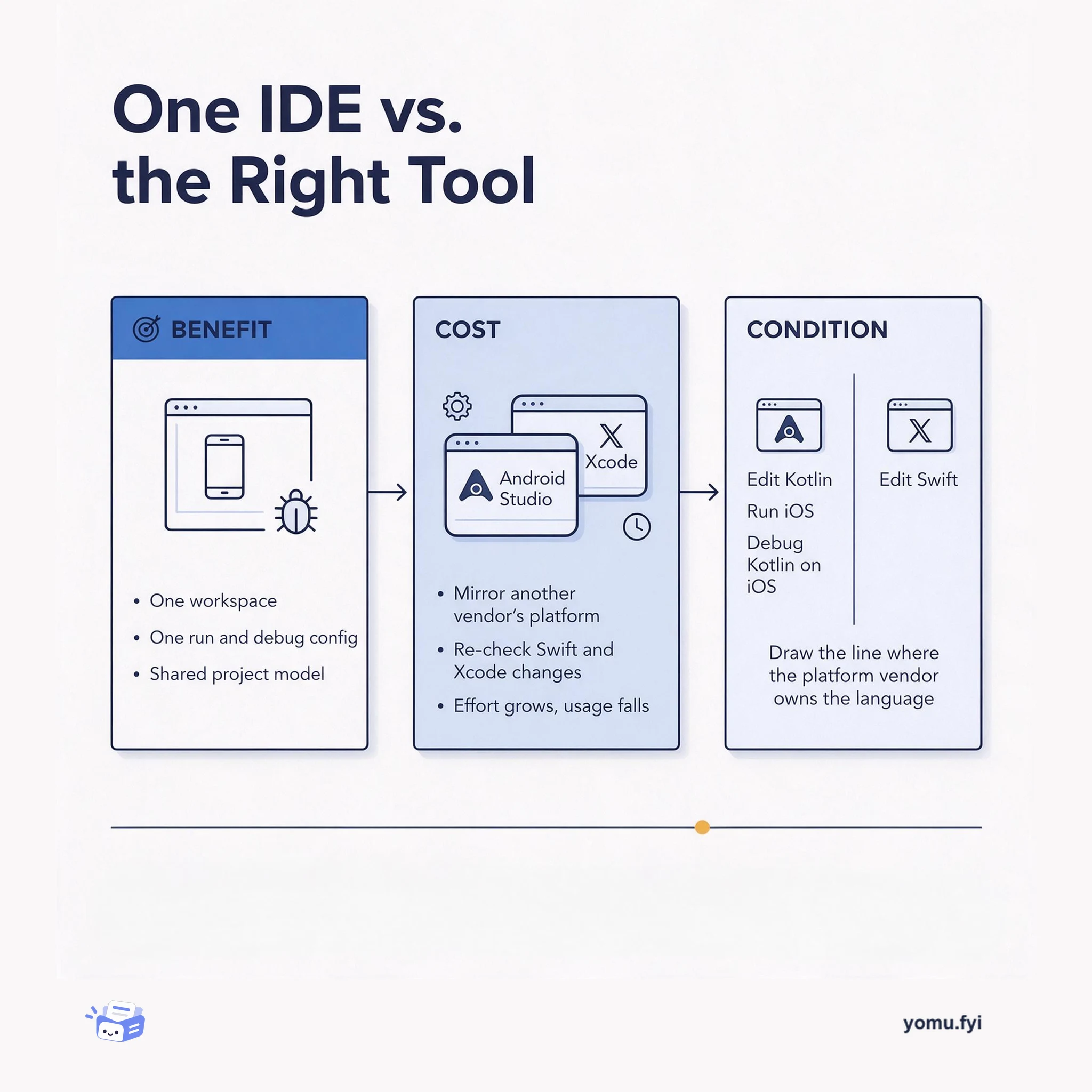
Android Studio keeps cross-platform Kotlin run and debug in one workspace but hands Swift editing to Xcode. This explainer maps the benefit, cost, and condition behind that boundary.
The Good Stuff
Paid picks we use ourselves. Links carry a referral code — a subscription through one earns us a commission at no extra cost to you.
Newest first
Industry perspectives on AI coding agents remain divided between dismissal and excessive automation claims. ClickHouse integrated agentic coding across internal workflows, progressing from simple boilerplate scripts to active backend C++ development. Engineers primarily use command-line agents such as Claude Code with Claude Opus 4.5 and Codex CLI alongside observability platforms like Langfuse and Librechat. While agents effectively investigate continuous integration logs, generate internal dashboards, and assist with small C++ tasks, they lack architectural competence and require rigorous code review. ClickHouse treats agents as pair programmers for contained tasks, retaining human ownership over product strategy, attention to detail, and core code quality.
HyperDX introduced AI Summarize, a feature designed to translate raw logs, traces, and log patterns into narrative summaries directly within its observability interface. Instead of relying on backend large language models, the tool runs entirely client-side using OpenTelemetry-aware data extraction combined with hand-written phrase pools. The generation logic inspects Kubernetes and OpenTelemetry attributes—such as service names, endpoints, exception details, and query durations—to tailor tone across detective noir, Shakespearean drama, and nature documentary themes. Because processing occurs inside the browser tab without external API calls, the system avoids third-party latency, token expenses, model hallucinations, and data privacy risks. Users can access summaries across logs, spans, and pattern drawers or re-enable the interface toggle via URL parameter through April 2026.
Thumbtack required a faster, emulator-free method to execute over 1,500 Android screenshot tests during continuous integration. Previously, running UI tests on physical devices or emulators proved too slow for code review verification jobs, causing tests to run post-merge and allowing regressions to persist. After evaluating Paparazzi and Google's experimental Compose Preview Testing, the team selected Roborazzi, which runs on top of Robolectric's native graphics engine within a standard JVM. This headless setup accommodates custom Activities, Dagger field injection, and legacy View systems while executing alongside standard unit tests. Moving screenshot tests to the unit test level enabled gating merges on passing tests, colocating tests inside feature modules, and increasing total CI job runtime by only twenty percent.
Coding agents often default to relational patterns, resulting in over-normalized schemas, underused compound indexes, and misconfigured search indexes in production MongoDB environments. To address these pitfalls, MongoDB launched official MongoDB Agent Skills alongside integrated plugins for tools including Claude Code, Cursor, Gemini CLI, and VS Code. These skills provide agents with discoverable instructions, schema design heuristics, indexing strategies, and operational safeguards across the development lifecycle. The skills operate alongside the MongoDB MCP Server, which handles database connectivity, authentication, and permission-based governance. Teams can install these bundled extensions directly or manage them via the Vercel Skills CLI to embed MongoDB architectural standards into automated workflows.
Stripe Projects, a new tool in the Stripe CLI, addresses the manual, fragmented work of turning a local prototype into a production-ready environment. It manages a project manifest and Stripe-backed record for attached services, provider accounts, and required credentials, while an integration protocol standardizes provisioning, plan selection, upgrades, and credential handoff. The developer preview supports services from providers including Vercel, Railway, Supabase, Neon, PlanetScale, Turso, Chroma, PostHog, Clerk, and Runloop; resources remain in accounts owned by the developer, and credentials can be synced to local development, CI, or a team secret manager. Through CLI commands such as stripe projects init, add, upgrade, and env --pull, developers or coding agents can repeat setup, audit changes, and upgrade supported plans using tokenized payment credentials, although payment handoff is limited to supported providers and plans in the US, EU, UK, and Canada.
Dropbox reduced its core server monorepo size from 87GB to 20GB after approaching GitHub's 100GB limit and suffering from hour-long clone times. The excessive bloat was traced to Git's delta compression heuristics interacting poorly with internationalization directory paths, generating inefficient diffs across different languages. By collaborating with GitHub to run an aggressive server-side repack with tuned window and depth settings, Dropbox cut clone times to under 15 minutes.
Supabase has joined the Stripe Projects developer preview, a Stripe CLI workflow for provisioning real services and obtaining working credentials with a single command. The integration provisions a complete Supabase project—including Postgres, Auth, Storage, Edge Functions, and Realtime—without requiring dashboard interaction, while supporting both developers and AI agents through deterministic, repeatable steps. After installing the Stripe CLI and adding supabase/project, stripe projects env --sync writes credentials to a local .env file and stores them in the Stripe Project for agent access; existing Supabase users can link their account. Projects remain in the user’s Supabase account with dashboard, connection-string, and data access, and database credentials can be rotated with stripe projects rotate supabase/project. The feature is a developer preview, and Stripe and Supabase are requesting feedback through Discord or GitHub.
ClickHouse has launched AI Notebooks for Managed ClickStack in private preview to assist site reliability engineers during system investigations. Instead of isolating interactions in a standard chat window, the platform embeds Anthropic's Claude models directly into a cell-based notebook canvas. The system connects the model to internal ClickStack APIs, translating natural language questions into structured queries that leverage ClickHouse optimizations like materialized views and query chunking. Engineers can inspect reasoning, edit generated SQL queries, add manual visualizations, and branch investigations to evaluate multiple hypotheses independently. While currently utilizing a last-write-wins model for shared canvases, the roadmap includes true concurrent editing, customizable context, and external tool integration via an MCP server.
MongoDB announced the general availability of an enhanced data browsing experience within the MongoDB for Visual Studio Code extension. The update introduces a paginated tree view that automatically detects human-readable fields like names or emails to create descriptive document titles instead of showing standard ObjectId hashes. An integrated action header inside the tree view enables developers to insert documents, refresh queries, sort by ObjectId, paginate results, and execute bulk deletes directly from the sidebar. Individual documents support hover-based contextual action menus for native deletion, copying, cloning, and editing. Furthermore, the extension now defaults to standard Shell syntax rather than Extended JSON across insert, clone, edit, and clipboard operations to maintain application code compatibility.
ClickStack introduced several platform updates and query performance enhancements across both open-source and Cloud environments for February 2026. ClickHouse Cloud OpenAPI now exposes ClickStack resources including dashboards, alerts, sources, and webhooks to support automated configuration-as-code workflows. In addition, ClickHouse 26.2 embeds the ClickStack UI directly into the database binary with a 4.1 MB footprint for local exploration and diagnostics. Visualizations now support native SQL mode for tables, allowing users to join disparate datasets like logs and traces across injected dynamic time variables. Finally, query execution speeds improve through streaming skip indexes, index pruning on disjunctions, and an expanded 100,000-row lazy materialization limit alongside new threshold alerting on number charts.
chDB 4 introduces Data Store, a native component that allows users to write Pandas-like code that executes on the ClickHouse OLAP SQL engine. Standard Pandas workflows suffer from eager execution, excessive memory materialization, and lack of automatic query optimizations. To solve this, Data Store implements a four-layer architecture that lazily records operations as a chain of LazyOp objects and compiles them into optimized ClickHouse SQL plans upon evaluation triggers. When encountering operations unsupported by ClickHouse, the QueryPlanner splits the pipeline into segments, routing tasks between ClickHouse and Pandas while using Python's memoryview to minimize data copying overhead. This release also integrates natively into Hex notebooks.
ClickHouse 26.2 introduces an embedded distribution of the ClickStack observability UI packaged directly inside the ClickHouse binary. Designed for local exploration and instance inspection, this distribution allows developers to visualize internal query logs, traces, and system metrics without deploying external services. To preserve build integrity and keep the added binary footprint around 4.1 to 4.2 MB, the team avoided a Node.js dependency by embedding a pre-built static Next.js application using CMake-generated C++ structs. Supporting components such as MongoDB, Express, and the Pyodide WebAssembly runtime were omitted, disabling alerting and persistent dashboards in favor of simplicity. Users can access the interface directly over HTTP to monitor local databases and query performance out of the box.
The post describes a third era of AI-assisted software development, in which autonomous agents handle larger tasks over longer timescales while developers define problems and review results. It traces a progression from Tab autocomplete, to synchronous prompt-and-response agents, and then cloud-based agents running on separate virtual machines. These agents can iterate and test for hours, returning logs, video recordings, and live previews that make parallel work and artifact-based review practical. Cursor reports that 35% of its internally merged pull requests are created by agents operating autonomously in cloud VMs, and that agent users now outnumber Tab users two-to-one after usage grew more than 15x in a year. The post says broader adoption still depends on reliable tests, environments, tools, and context, while developers shift toward decomposition, review, and feedback rather than line-by-line guidance.
Hugging Face announces that GGML, the creators of llama.cpp, are joining the company to support the ggml and llama.cpp community as local AI advances. Georgi Gerganov and his team will continue dedicating 100% of their time to maintaining llama.cpp, retaining autonomy and leadership over its technical direction and community, while the project remains fully open-source and community driven. The technical focus is tighter integration between llama.cpp’s local-inference stack and Transformers’ model definitions, aiming to make shipping new models from Transformers’ “source of truth” nearly single-click, alongside better packaging and user experience for ggml-based software. The longer-term goal is an efficient inference stack that runs on devices and helps make open-source superintelligence accessible, with llama.cpp becoming ubiquitous and easier for casual users to deploy and access.
Stripe’s minions are an unattended agentic coding flow whose pull requests are human-reviewed but contain no human-written code; more than 1,300 merge weekly. The system runs agents in AWS EC2-based devboxes that are prewarmed to become usable within about 10 seconds, providing parallel, predictable, and isolated environments. Its custom harness uses code-defined blueprints that combine deterministic nodes, such as linting and pushing changes, with agent loops for tasks such as implementation and fixing CI failures. Minions receive automated feedback through local linting, one full CI iteration, and a possible second repair attempt, while devbox isolation and security controls limit destructive actions; Stripe presents the approach as an extension of long-running investments in human developer productivity.
The post presents Gradio 6’s gr.HTML as a way to build interactive web components in a single Python file, combining custom HTML templates, scoped CSS, and JavaScript interactivity without a separate build step. It describes applications including a Pomodoro timer, contribution heatmap, Kanban board, spinning wheel, and machine-learning viewers for detection, 3D camera control, and speech transcription. Within the component API, ${value} injects Python state into the template, props.value updates that state from JavaScript, and trigger('change') synchronizes it back to Python; CSS keyframes and native HTML5 drag events supply richer behavior. For reuse, a gr.HTML subclass packages the templates and script so the result can be used like built-in Gradio components, while reload mode and Spaces deployment support rapid iteration from generated code to a live app.
Stripe rolled out Cursor to more than 3,000 engineers while preserving its standards for developer experience and API uptime. The company preloaded Cursor on every machine, taught it in onboarding labs alongside VS Code and IntelliJ, and used Cursor Rules to supply codebase and coding-standard context, with teams able to add local rules. Adoption was reinforced by power users, while code review evolved to use LLMs to flag complex methods and risky files so reviewers could focus attention without sacrificing quality. An internal survey found developer sentiment at a five-year high, and MacVicar observed the largest productivity gains among longest-tenured engineers rather than junior developers. That finding has prompted exploration of letting new hires learn the codebase before receiving Cursor access, reinforcing MacVicar’s advice to start before every AI-workflow question is settled.
Writing CUDA kernels that integrate with diffusers and transformers involves GPU-specific optimization, library integration, PyTorch registration, and environment compatibility. It presents a cuda-kernels agent skill that packages architecture guides, integration patterns, kernel templates, troubleshooting material, benchmarks, and Kernel Hub examples for coding agents. Claude and Codex used it to generate RMSNorm, RoPE 3D, GEGLU, and AdaLN kernels for LTX-Video in diffusers, and an RMSNorm kernel for Qwen3-8B in transformers, including CUDA source, PyTorch bindings, build configuration, and benchmark scripts. On H100 80GB HBM3, the LTX-Video RMSNorm tests averaged 1.88x speedup and the optimized pipeline with torch.compile reached 1.43x the listed baseline, while Qwen3-8B RMSNorm averaged 1.94x and reached 2.47x at 8192 tokens. The skill supports packaging kernels for precompiled distribution through the Hub, where get_kernel selects a matching binary across Python, PyTorch, and CUDA variants.
Stripe’s Minions are homegrown, fully unattended coding agents designed to complete tasks in a single run, beginning with an invocation such as a Slack thread and ending with a pull request ready for human review. More than 1,000 pull requests merged weekly at Stripe are minion-produced and contain no human-written code, although engineers review them and can provide follow-up instructions. Each run uses an isolated, pre-warmed devbox and a customized fork of Block’s coding agent goose, combining agent loops with deterministic operations for version control, linting, and testing. Minions use curated MCP tools, including Stripe’s Toolshed with more than 400 tools, to retrieve internal context before and during work. Local checks and selective CI provide feedback, with no more than two CI rounds, balancing correction against token, compute, and time costs.
SyGra 2.0.0 introduces Studio, an interactive environment for building, previewing, executing, and debugging synthetic data generation flows on a visual canvas. Users can configure connectors and models, preview source rows, reference automatically created state variables in prompts, define structured outputs, and inspect the generated YAML or JSON graph configuration. Studio streams node-level execution status, token usage, latency, cost, logs, and guardrail outcomes, while storing run history in .executions/runs/*.json and autosaving drafts. It also runs existing workflows, including a Glaive Code Assistant example with conditional revision loops, tunable dataset and batching inputs, and observable intermediate critiques; generated outputs can support training, evaluation, or annotation workflows.
The best engineering reads, once a week.