Anka CI Architecture: From Layered Images to Disposable macOS Builds
Anka is a Docker-like macOS virtualization layer for disposable CI environments. This architecture shows how images, Mac hosts, snapshots, build agents, and artifacts connect.
Anka packages macOS build environments as layered images that can be pushed to registries and pulled across MacStadium data centers. Buildkite agents clone temporary snapshots onto Mac hosts, boot suspended VMs, run the build, upload artifacts, and delete the environment. The architecture makes the isolation and horizontal-scaling model visible while highlighting the remaining operational constraint: capacity is manually adjusted, so spiky demand can still create queue time.
FAQ
Why use temporary VM snapshots instead of a shared macOS build environment?
The Anka setup clones temporary snapshots, runs each build in a disposable VM, uploads artifacts, and deletes the VM afterward. Shopify’s reported design avoids the shared-storage single point of failure and makes Xcode and macOS upgrades easier.
Where does Anka CI scaling still need operational attention?
The architecture can scale across Mac hosts and two MacStadium data centers, but capacity remains manually adjusted. Spiky demand can therefore increase queue times even when VM boot is reported to take under a second.
What is the role of layered images and local storage?
Layered macOS images are pushed to registries and pulled across data centers, while the described Mac Mini setup uses local storage for its VM. Agents then clone snapshots rather than rebuilding each environment from scratch.
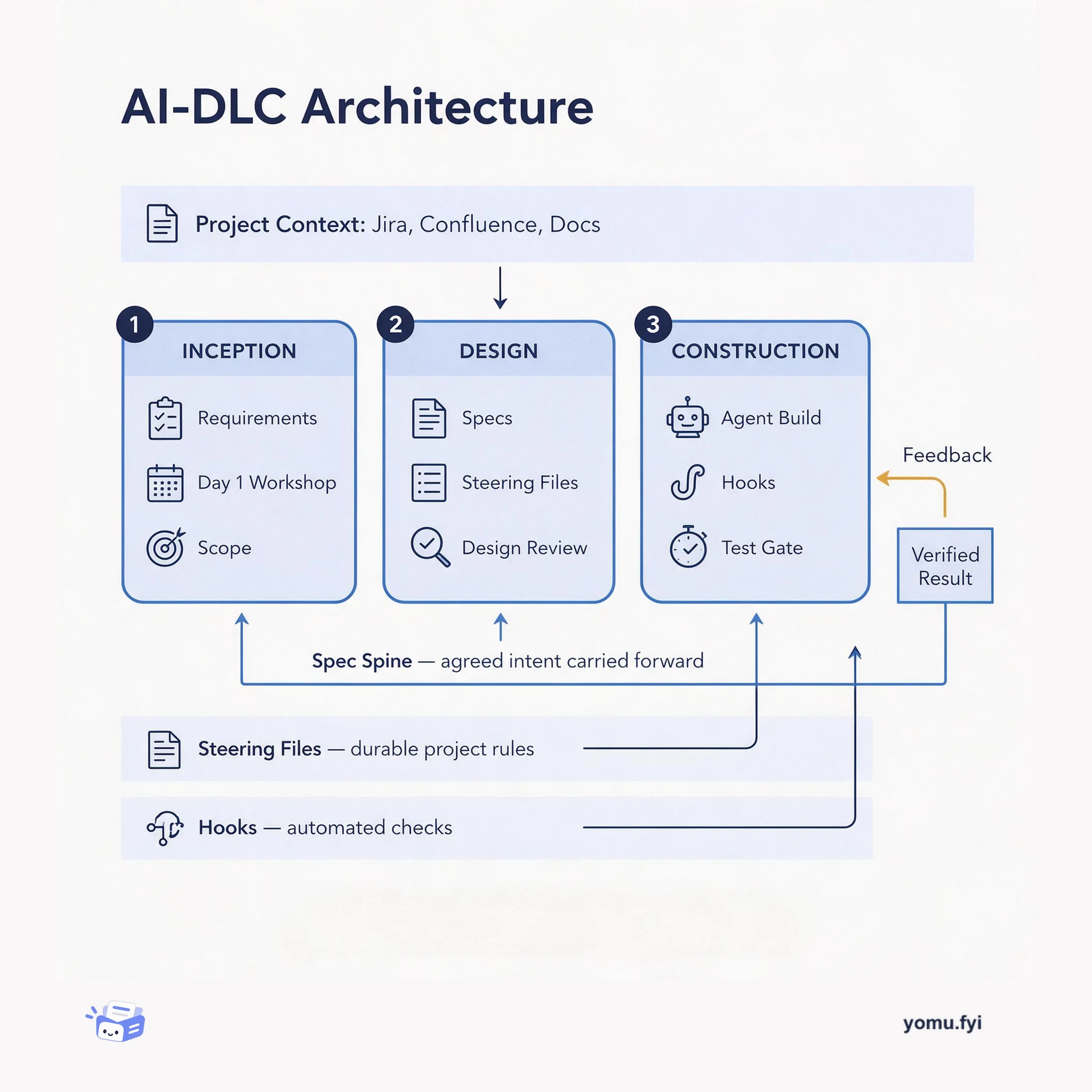
AI-DLC is an AI-driven development lifecycle that runs delivery through Inception, Design, and Construction, with specs, steering files, and hooks keeping agents aligned to agreed intent.
Apple Silicon's defining choice is one shared memory pool for CPU, GPU, and Neural Engine. This diagram maps that fabric, the on-package bandwidth it buys, and the scaling limits it imposes.
Antimicrobial resistance surveillance is a layered data architecture: raw reads and demand signals flow in, get normalized into governed tables, and answer plain-language queries. The diagram maps each boundary.
The Good Stuff
Paid picks we use ourselves. Links carry a referral code — a subscription through one earns us a commission at no extra cost to you.