Streaming ASR vs. Batch ASR: The Buffer-Latency Trade-off
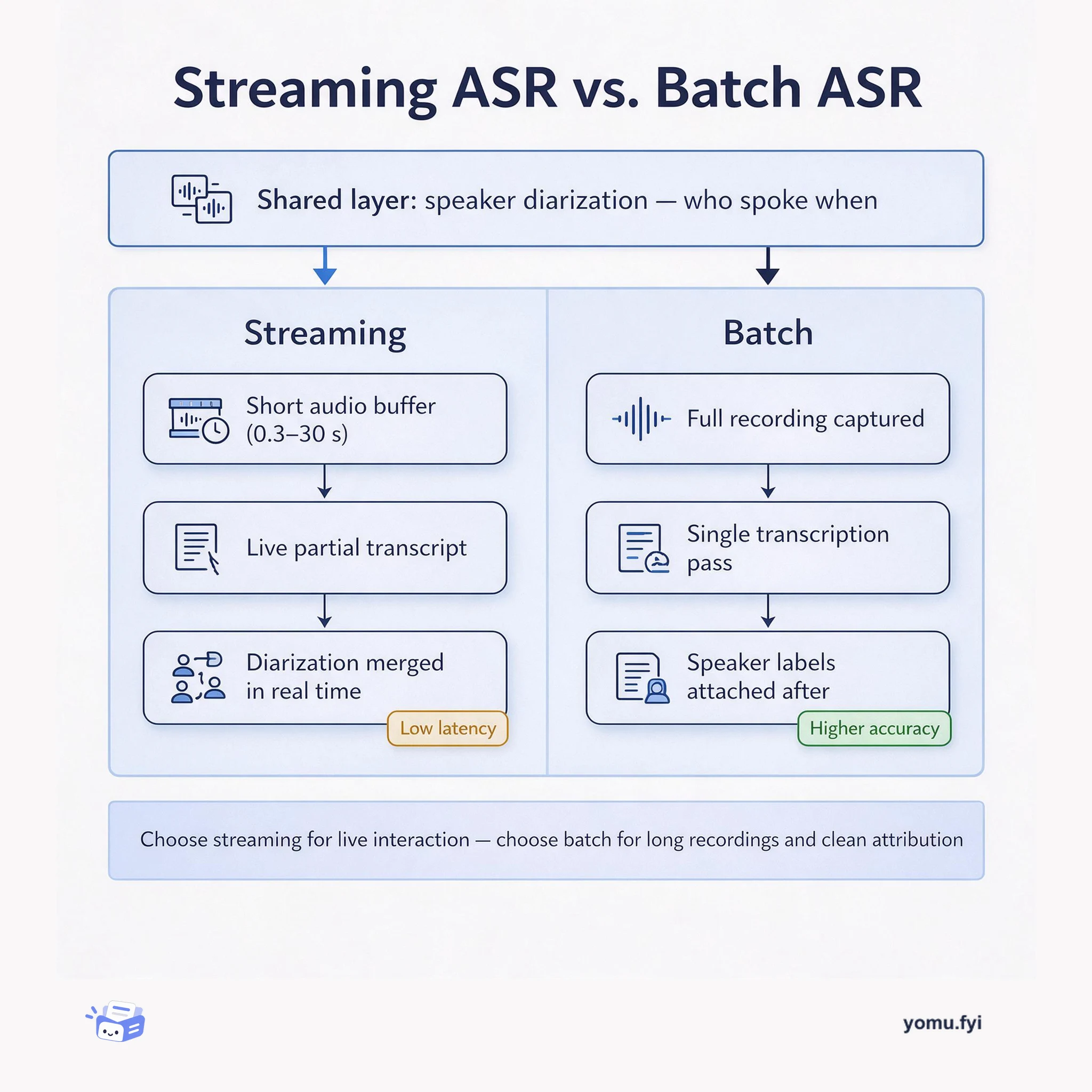
Streaming and batch ASR pipelines compared: how input buffer length, speaker diarization, and where audio is processed trade latency against transcript quality and privacy.
 Hugging FaceFrancesco, Ivan Medennikov, Taejin Park, Jagadeesh Balam, Adi- margolin, Maryam MotamediAnnouncement
NVIDIA Nemotron 3 Diarization is an open-weight, 100M-parameter model that ranks #1 on VoiceArena’s Diarization-Bench leaderboard with a 14.72% Diarization Error Rate (DER). It classifies who spoke when in conversations, handling overlapping speech and supporting up to eight speakers across live and recorded audio. The model uses a Sortformer approach with arrival-order speaker labeling, a 31-layer Transformer encoder, and two memory mechanisms for streaming inference. It accepts 16 kHz single-channel audio and outputs a floating-point tensor of speaker-activity probabilities at a configurable time step. Developers can combine its timestamps with automatic speech recognition to produce speaker-attributed transcripts, with recommended input-buffer latencies ranging from 0.32 to 30.4 seconds.
Speaker diarization classifies who spoke when in conversations, enabling speaker-attributed transcripts for meetings, customer calls, and podcasts. Without it, transcripts lack speaker attribution, reducing the usefulness of search, summaries, action items, and voice-agent memory.
The model uses a Sortformer architecture with arrival-order speaker labeling, a 31-layer Transformer encoder with rotary positional embeddings, and two memory mechanisms (Arrival-Order Speaker Cache and FIFO queue) to support both offline and streaming diarization for up to eight speakers.
Nemotron 3 Diarization achieves a 14.72% DER on VoiceArena’s Diarization-Bench, a ~24% relative reduction over the next-ranked system.
The model uses arrival-order speaker labeling to maintain stable speaker channels across streaming chunks, avoiding the need to solve new speaker permutations per chunk.
Adding licensed David AI multi-speaker data to training decreased compound DER by 0.77 absolute points, from 11.19% to 10.42%.
The model supports up to eight speaker channels. If a recording contains more speakers, speech can be missed or assigned to the wrong channel.
The model uses anonymous labels (e.g., speaker_2) based on arrival order, not real-world identities. Downstream applications must map these to explicit identities using meeting metadata, user profiles, or active speaker verification models.
The model supports input-buffer latencies of 30.4, 1.04, 0.64, and 0.32 seconds. Shorter buffers reduce latency but generally lower accuracy and throughput. The 0.32-second configuration is the lowest recommended.
Summaries are generated from the original by a language model. Check the original before relying on it.
See the idea
Streaming and batch ASR pipelines compared: how input buffer length, speaker diarization, and where audio is processed trade latency against transcript quality and privacy.
Keep reading
The Good Stuff
Paid picks we use ourselves. Links carry a referral code — a subscription through one earns us a commission at no extra cost to you.
One useful email. Unsubscribe anytime.
