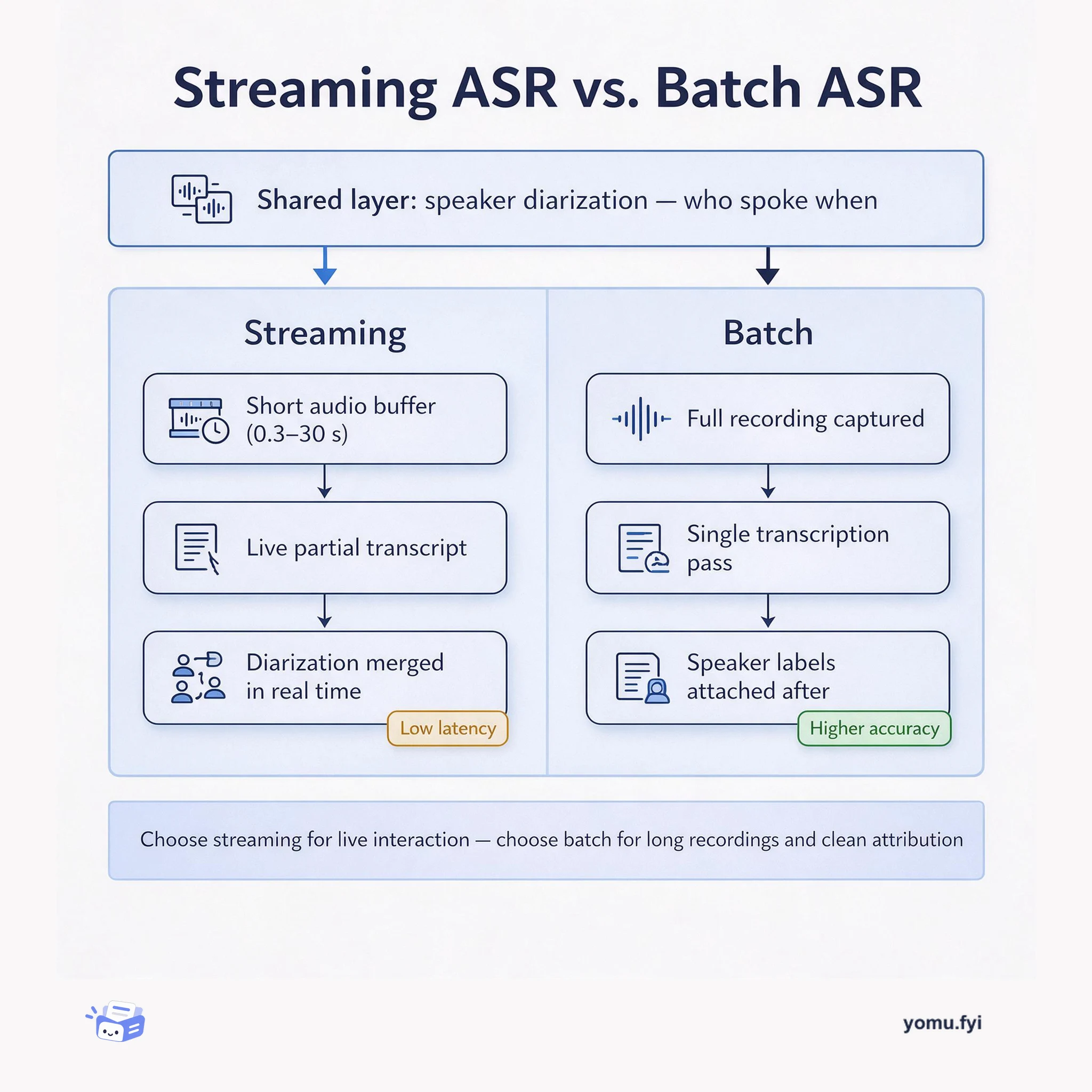
Streaming ASR vs. Batch ASR: The Buffer-Latency Trade-off
Streaming and batch ASR pipelines compared: how input buffer length, speaker diarization, and where audio is processed trade latency against transcript quality and privacy.
Loading…
Topic
3 posts about ASR. Every summary links to the original.
See the idea
Streaming and batch ASR pipelines compared: how input buffer length, speaker diarization, and where audio is processed trade latency against transcript quality and privacy.
The Good Stuff
Paid picks we use ourselves. Links carry a referral code — a subscription through one earns us a commission at no extra cost to you.
Newest first
The Technology Innovation Institute in Abu Dhabi released Falcon-ASR, a 1.6 billion parameter speech recognition model focused on Arabic, especially the Emirati dialect, while also supporting English, French, Spanish, and Portuguese. On the Open Universal Arabic ASR Leaderboard, Falcon-ASR achieved a 20.92% average word error rate across six test sets, outperforming the best published average of 23.17% in the reference snapshot. The model recorded a 22.73% word error rate and 10.19% character error rate on an internal Emirati evaluation, 4.07% better in word error rate than the next best system compared. Training data included background noise, overlapping speech, music, reverberation, telephony effects, speed, and pitch variations to handle diverse recording conditions. Falcon-ASR builds on the Falcon3-Audio architecture and provides word-level timestamps linking transcribed words to audio positions.
Semi-supervised federated learning (SSFL) for ASR uses a teacher to generate pseudo-labels on unlabeled client data while the server trains on a small labeled seed. The paper finds that pseudo-label errors compound across the output sequence and training rounds, causing divergence and a large gap to fully-supervised FL. Two coupled design axes close this gap: the teacher type (per-client online, global broadcast, or transitioning) and the anchor (server-side labeled-data updates that stabilize training). A per-client online teacher diverges on its own but, once stabilized, matches or beats the global teacher in-domain and under domain shift. The server must keep training on labeled data between rounds; otherwise the online teacher drifts, and this interleaving governs convergence more than the seed model does. The proposed guidelines improve over the strongest prior method on 9 of 11 pairs, by 20.8% in-domain and 10.0% cross-domain on average.
NVIDIA Nemotron 3 Diarization is an open-weight, 100M-parameter model that ranks #1 on VoiceArena’s Diarization-Bench leaderboard with a 14.72% Diarization Error Rate (DER). It classifies who spoke when in conversations, handling overlapping speech and supporting up to eight speakers across live and recorded audio. The model uses a Sortformer approach with arrival-order speaker labeling, a 31-layer Transformer encoder, and two memory mechanisms for streaming inference. It accepts 16 kHz single-channel audio and outputs a floating-point tensor of speaker-activity probabilities at a configurable time step. Developers can combine its timestamps with automatic speech recognition to produce speaker-attributed transcripts, with recommended input-buffer latencies ranging from 0.32 to 30.4 seconds.
The best engineering reads, once a week.


