How to Give an Agent a Query Language Instead of a Code Interpreter
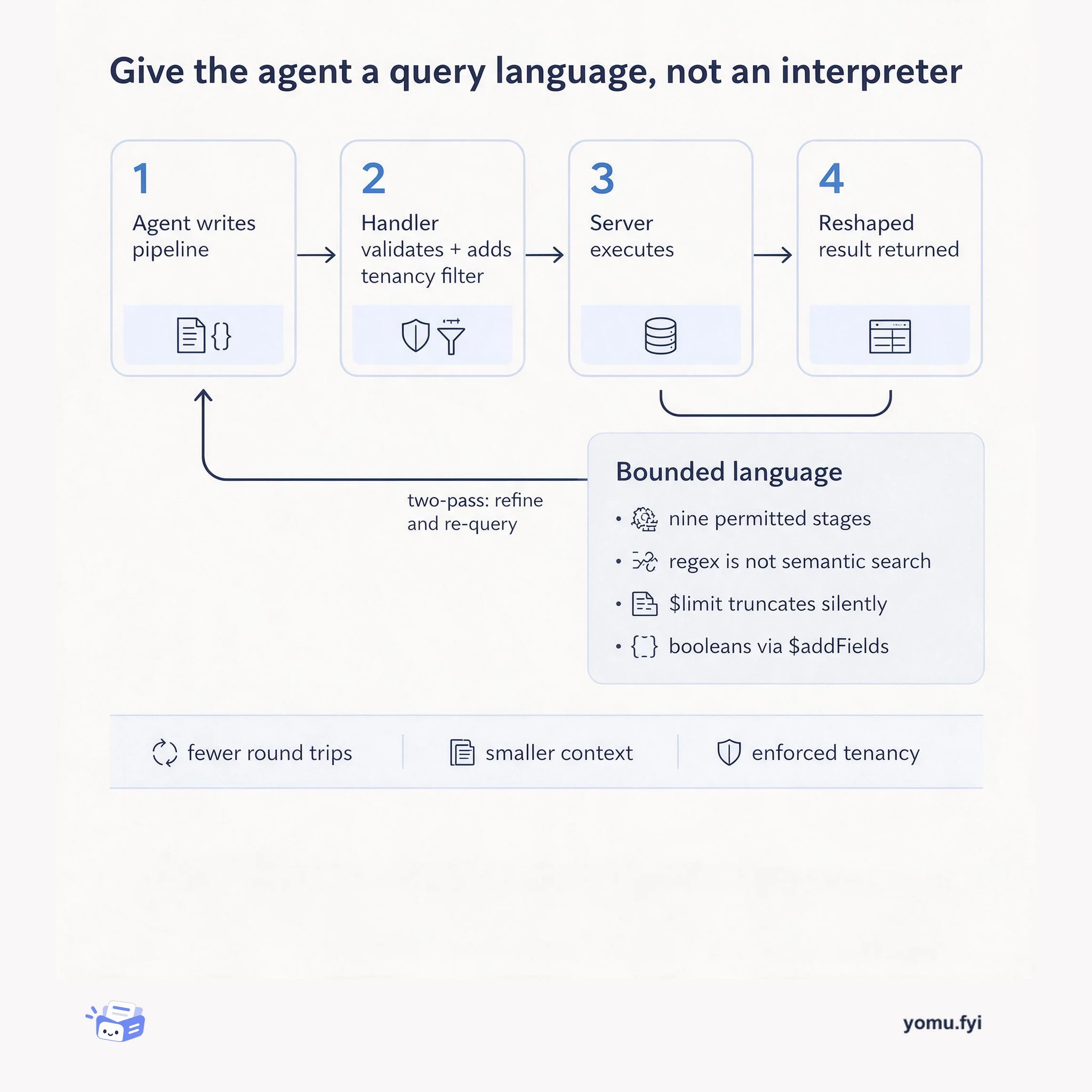
A four-step pattern for letting a document agent write validated aggregation pipelines instead of arbitrary code, so results come back shaped and tenancy stays enforced.
Loading…
Topic
542 posts about AI Agents. Every summary links to the original.
See the idea
A four-step pattern for letting a document agent write validated aggregation pipelines instead of arbitrary code, so results come back shaped and tenancy stays enforced.
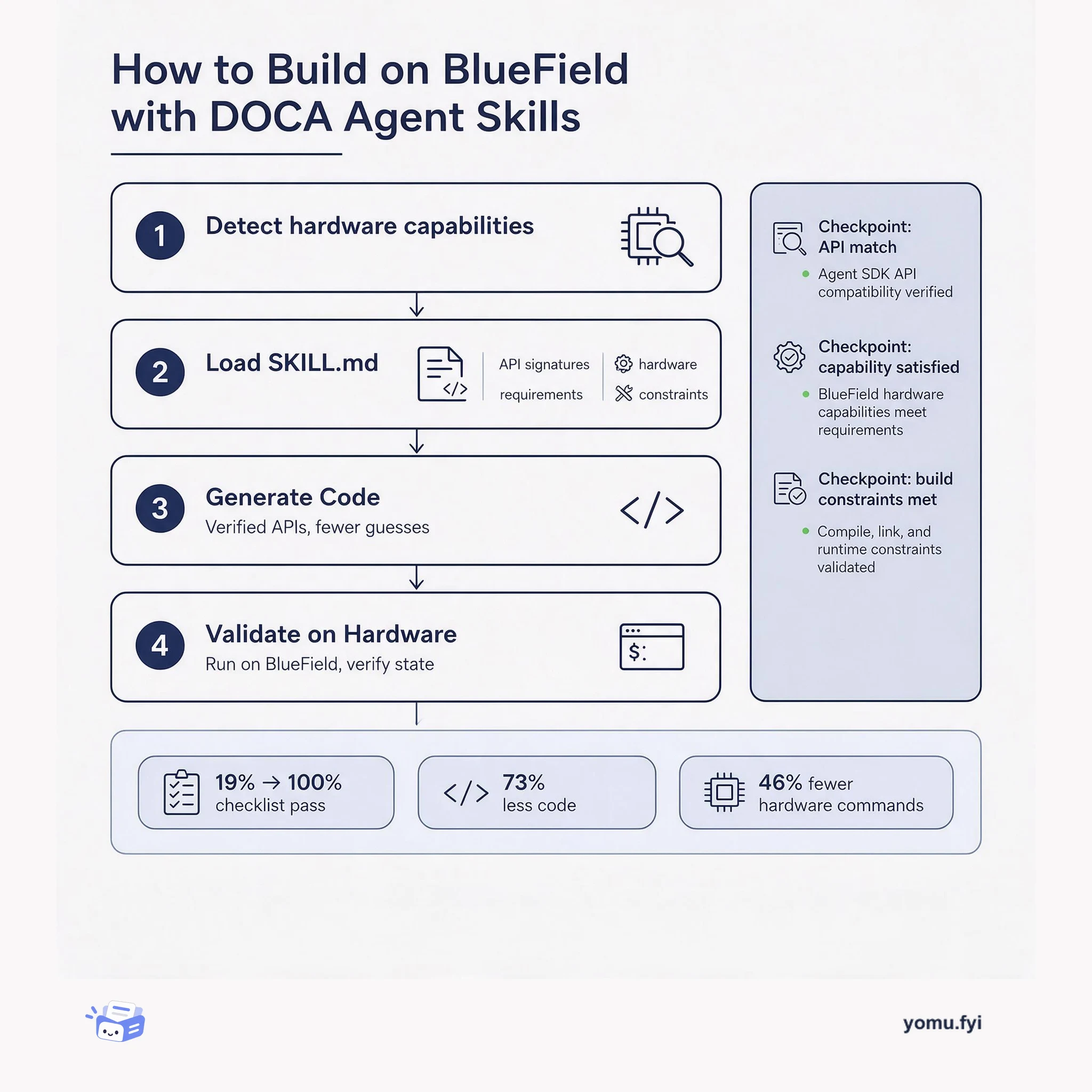
A practical how-to for using NVIDIA DOCA Agent Skills to generate BlueField code with verified APIs and hardware checks, reducing correction cycles and failed builds.
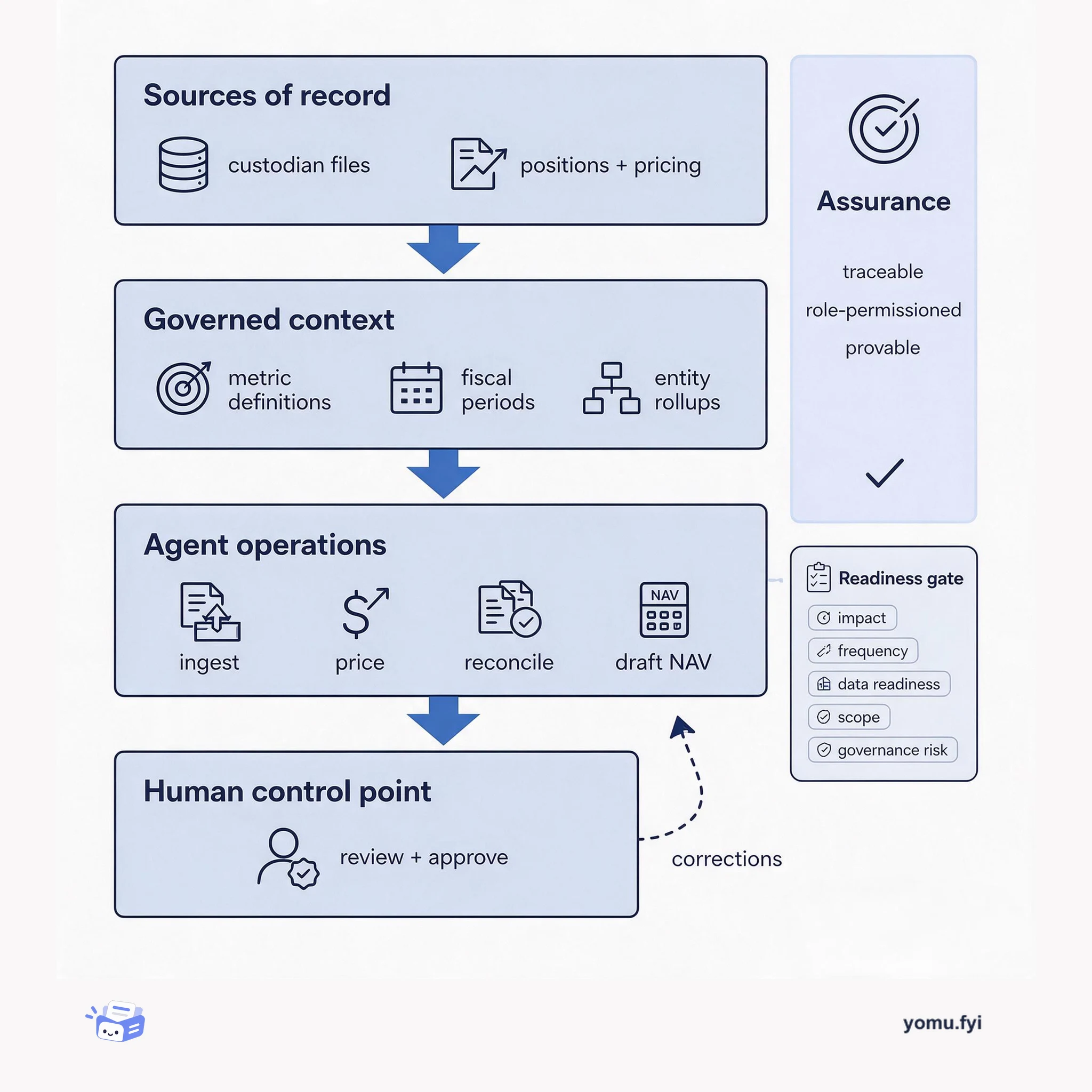
Asset management runs as a layered control plane: custodian and pricing data feed a governed context layer, agents run the overnight fund work, and a human signs off before anything is published.
The Good Stuff
Paid picks we use ourselves. Links carry a referral code — a subscription through one earns us a commission at no extra cost to you.
Newest first
Claude Opus 4.6 improves on Opus 4.5 with stronger coding, planning, debugging, code review, long-running agentic work, and performance in large codebases. It is the first Opus-class model with a beta 1M-token context window, while API features include adaptive thinking, four effort levels, context compaction, and up to 128k output tokens. In reported evaluations, it achieves the highest score on Terminal-Bench 2.0, leads frontier models on Humanity’s Last Exam and BrowseComp, and exceeds GPT-5.2 by around 144 Elo points and Opus 4.5 by 190 points on GDPval-AA. The release also adds Claude Code agent teams, upgraded Excel capabilities, a PowerPoint research preview, and availability on claude.ai, the API, and major cloud platforms, with base pricing of $5/$25 per million tokens.
Claude Sonnet 4.6 is introduced as an upgrade across coding, computer use, long-context reasoning, agent planning, knowledge work, and design. It adds a 1M token context window in beta, becomes the default for Free and Pro users in claude.ai and Claude Cowork, and keeps Sonnet 4.5’s starting price of $3/$15 per million tokens. Early testing reports that users preferred it over Sonnet 4.5 in Claude Code roughly 70% of the time and over Opus 4.5 59% of the time. The release also reports gains on OSWorld computer use, prompt-injection resistance, OfficeQA document comprehension, and long-horizon planning, while adding adaptive and extended thinking, beta context compaction, and generally available code execution, memory, programmatic tool calling, tool search, and tool-use examples.
Modern data platforms and sophisticated marketing systems can still fail to produce timely customer experiences when no bridge connects first-party data to campaign activation. The post explains Scott Brinker’s “composable canvas,” a five-ring architecture centered on a unified data core, with semantic layer, CaaS, decisioning, and apps and agents operating on shared data without repeated movement. In contrast, batch files, dashboards, and disconnected teams can leave autonomous agents unable to trigger campaigns or propensity models unused. It recommends closing this last mile through activation-ready data architecture, self-service marketing analytics, and one narrowly scoped AI agent tied to a measurable campaign outcome. Examples in the post include a 4X model conversion rate, a four-week account scoring launch, and grocery offer flows that changed weekly preparation from hours to minutes.
Databricks announces the Public Preview of Domains and the Discover page, powered by Unity Catalog, to help people and agents identify relevant, high-quality, and safe data and AI assets. Domains organize tables, dashboards, notebooks, queries, metric views, Genie Agents, and apps by business structure, while Discover provides an internal marketplace with search, certification signals, popularity and trending indicators, and AI-powered recommendations. Data stewards can create domains and subdomains, certify assets, add descriptions and contacts, and curate page sections and pinned content. Domains extend Unity Catalog Semantics and feed Genie Ontology, giving agents business context for narrowing retrieval, prioritizing trusted assets, and interpreting metrics within each user’s existing permissions. The features are available in Public Preview through a Databricks workspace, where organizations can create domains and curate assets.
Devin, an AI software engineer by Cognition, plans, writes, tests, and ships code semi-autonomously. Cognition now extends Devin with Outposts, moving execution into user-controlled environments while reasoning stays in Cognition’s cloud. Modal is a launch partner with modal-devin, an open-source integration running Outpost sessions in Modal Sandboxes with pre-built custom images, fast cold-starts, snapshotting, and cost-efficient bursting. For example, a task that requires a GPU fails immediately in the default sandbox but succeeds on a Modal-backed Outpost that spins up a GPU on demand and scales to zero when done. One command, uvx modal-devin init, sets up secure infrastructure with a scheduler and worker functions, and each team can have its own outpost with separate credentials.
Tunix is presented as a post-training library for scaling agentic reinforcement learning, where multi-turn tool use and environment latency can leave TPUs idle. Its design combines an asyncio-based, high-concurrency trajectory collector with asynchronous vLLM-TPU and SGLang-Jax integration, then streams variable-length trajectories through a producer-consumer queue rather than waiting for a complete synchronous batch. Composable agent and environment abstractions expose APIs for custom tools, benchmarks, and external systems while preserving multi-turn token handling and lifecycle management. Lightweight RL-specific metrics correlate rollout, training, weight synchronization, model-call, and environment stages with TPU timelines, complementing targeted XProf traces. The stated outcome is a more observable pipeline intended to reduce stalls, keep accelerators utilized, and support agentic RL natively in the JAX/TPU ecosystem.
The piece argues that retail, travel, and consumer-goods companies face one problem in three forms: signals are not trusted, arrive too late, or cost too much to process at scale. It contrasts business intelligence, which depends on structured schemas, predefined questions, and dashboards, with AI systems that read unstructured data, reason probabilistically across signals, and connect decisions to action. Examples include reported improvements from Harmons’ shelf scanning, faster consumer-insight work at a health and hygiene company, and travel applications spanning maintenance, pricing, and concierge services. Its proposed architecture combines broad ingestion and open storage with governance, evaluation, model and agent controls, and applications that operate on a substrate, presenting current, coherent data as the foundation for organizations that can act.
Agent swarms are evaluated as a way to scale software work beyond what a single long-running agent can reliably manage. The test revisits building SQLite in Rust from its documentation, comparing old and new swarms with identical models and time budgets against a held-out SQL suite; the new system performed better in every configuration, reaching 80% with Grok 4.5 in four hours. Planners decompose task trees while workers execute narrower pieces, supported by a purpose-built version control system and mechanisms for design conflicts, merge collisions, megafiles, intentional breakage, and review. Reported results include a full-suite pass using 9,908 engine-code lines versus 64,305 for the old harness, while costs ranged from $1,339 for an Opus 4.8 hybrid to $10,565 for GPT-5.5 alone, indicating that cheaper models can perform most execution after frontier planning resolves ambiguity.
AI agent orchestration coordinates multiple specialized agents by managing task assignment, shared state, communication, and execution sequencing across complex enterprise workflows. The guide contrasts autonomous agents, which reason about subtasks and adapt to intermediate results, with fixed workflows, and recommends decomposing processes into single-responsibility agents with documented input/output contracts and least-privilege access. It describes centralized, decentralized, hierarchical, hybrid, federated, and emergent patterns, noting that pattern selection trades control, resilience, scalability, and auditability according to risk. Implementation guidance includes assigning human owners, defining accuracy, latency, and escalation targets, establishing failure paths, instrumenting a minimal prototype, and measuring a pilot against documented baseline processes. Organizations using multi-agent systems report 35% faster task completion and a 30% efficiency increase with specialized agents, while high-risk or irreversible actions still require human approval gates and audit trails.
AI-native tech companies must protect unit economics as agents accelerate changes in compute consumption, pricing, and revenue recognition, while gross margins remain below classic software levels. Finance teams built around extracts, spreadsheets, and monthly reconciliation can miss repricing changes, metering errors, and compute-commitment risk. The proposed foundation is an evolving ontology that keeps product, plan, usage, and cost meanings current, with Stripe data entering Unity Catalog through OpenSharing and Lakebase providing transactional Postgres on the lakehouse. Genie One uses that ontology to answer governed, sourced questions about gross margin, consumption revenue at risk, and compute spend, while people retain decision authority. The post describes organizations using Databricks to consolidate reporting, forecasting, workflows, and finance applications, positioning a shared data-and-AI platform as the path from an initial answer to an ongoing finance platform.
Coach’s Corner, also called La Pizarra, turns high-frequency soccer tracking data into a bench-side application for replay, tactical analysis, scouting, standings, and agent-generated dossiers. Built as a Databricks App, it ingests NDJSON feeds at 25 frames per second through Auto Loader and Spark Declarative Pipelines, enforcing 46 data-quality expectations across bronze, silver, and gold layers. Liquid clustering supports 1–3-second DBSQL queries, while Lakebase synchronizes gold data to Postgres for millisecond replay reads and separates sequential playback from exploratory analytics. The scouting layer grounds Genie, Vector Search, a Unity Catalog-registered xG model, and an Agent Bricks supervisor in governed data, with Claude calls routed through the Unity AI Gateway, MLflow tracing, and a deterministic fallback. Together, these components are presented as a way to deliver traceable insights within seconds without forcing coaches to interpret raw tables or analysts to relay every result.
Swiggy’s mobile engineering teams faced operational overload as releases, production signals, and reviews required switching among Jira, Confluence, Bitrise, Play Console, Crashlytics, New Relic, Google Sheets, ImageKit, and Slack. The response was an operating layer built around Slack-native agent workflows, reusable AI skills, MCPs, and scheduled jobs connected to release, observability, QA, cost, and internal mobile systems. It can generate readiness updates, group Jira work, identify missing owners and blockers, summarize vitals, analyze alerts, follow up TRM actions, and recommend RAMP, HOLD, or ROLLBACK for staged rollouts by correlating Crashlytics, Play Vitals, and adoption. Humans still approve rollout actions, while recurring channel reports make observability and accountability more consistent and reduce clerical integration work. The stated model lets agents handle mechanical load while engineers retain judgement, ownership, product quality, architecture, and execution.
Databricks introduced the Databricks Certified Context Engineer Associate beta exam to validate skills for building reliable, production-grade AI agent systems as organizations scale agentic AI. Context engineering is presented as the practice of curating, maintaining, and filtering tokens, memory banks, and tool parameters so an LLM can solve a task; the certification is intended to benchmark that technical skill set. Databricks also added AI Agent Fundamentals, Building Retrieval Agents on Databricks, and Agent Evaluation, covering agent reasoning, retrieval-augmented architectures, and systematic performance testing and improvement. Its AI-first certification-prep guide is available on every certification page, works with free tiers of major LLMs, includes guardrails and disclaimers about hallucinations, and shows candidates how to use Free Edition for hands-on practice; registration for the Context Engineer Associate is open, with the first exam scheduled for July 29, 2026.
Enterprise AI assistants often produce fluent answers yet fail to improve forecast calls, deal reviews, and operational standups because decision context is scattered across systems, teams, and competing definitions. Genie One addresses this by using a shared context layer spanning Databricks data, documents, SaaS applications, and operational systems, allowing questions and follow-up work to retain business meaning. Genie Ontology organizes terms, metrics, entities, and relationships into a living knowledge graph, learning from data, dashboards, queries, documents, and connected applications while ranking definitions and signals using usage and certified-asset links. Together with Unity Catalog, it applies permissions, certified data, shared definitions, and governance controls to answers, actions, and agents. The stated outcome is faster movement from decision preparation to action, with less manual reconciliation while preserving accuracy and control.
Monolithic system prompts become difficult to reason about, test, and change as teams add safety policies, domain rules, formatting requirements, and escalation behaviors. The proposed approach treats prompts as software artifacts: modular skill files are composed with includes, variables, and macros, then transpiled into deterministic artifacts. Build-time validation checks missing imports, undefined variables, and circular dependencies, while dependency graphs and CI/CD golden-file comparisons catch drift before deployment. At runtime, progressive disclosure keeps a stable control plane loaded while agents retrieve task-specific skills, reducing context exhaustion and noise. Agents can propose new skill modules or import changes through pull requests, but human review and evaluation remain part of the merge process.
Gemini Enterprise Agent Platform now natively integrates Parallel Web Systems as a web-grounding provider, expanding developers’ choice of sources for real-time, verifiable information. Grounding with Parallel Web Search connects Gemini models to Parallel’s structured, LLM-optimized search results, combines the provider’s web index with Gemini’s prompt decomposition and synthesis, and adds precise citation annotations. The capability is available through the Gemini API and Agent Studio, and can be subscribed to through Google Cloud Marketplace with usage charged on an existing Google Cloud invoice; zero data retention is available for sensitive workloads. Developers can make programmatic calls at scale, extract and cache web data, post-process results with other LLMs, and build catalog enrichment, autonomous-agent, and multi-agent workflows. Setup requires subscribing, accepting the terms, reviewing pricing, and selecting Parallel Web Search under Agent Studio’s partner-grounding settings.
Anthropic is releasing ten ready-to-run agent templates for financial services, targeting work such as pitchbook creation, KYC screening, and month-end close operations. Each template packages task-specific skills, governed data connectors, and subagents, and is available as a plugin for Claude Cowork or Claude Code, or as a cookbook for Claude Managed Agents. Claude add-ins for Excel, PowerPoint, Word, and, soon, Outlook carry context between applications, while new connectors and a Moody’s MCP app provide access to market, research, credit, and company data. The announcement says the updates pair best with Claude Opus 4.7, which leads Vals AI’s Finance Agent benchmark at 64.37%, and states that templates are available today through the financial services marketplace.
Databricks announces that Inkling, Thinking Machines Lab’s first open-weights model, is available to enterprise customers through the Unity AI Gateway. The model is positioned for coding and agentic reasoning workflows, supports multi-modal inputs, and can be applied to enterprise data, including proprietary codebases, internal documentation, and domain-specific data. Unity AI Gateway provides centralized security, permissions, audit logging, policy enforcement, cost controls, budgets, and observability, while data remains within the governed environment; Inkling is invoked through a REST API, with SQL query support planned. Teams can try it in AI Playground, deploy a governed endpoint, connect coding agents such as Cursor, OpenCode, or Pi, and build agents with Agent Bricks, with open weights enabling customization and inference-cost optimization without per-token API pricing.
Higher-education call centers face costly, limited-coverage monitoring of advisor conversations and brittle, slow methods for identifying student concerns from transcripts. The proposed workflow deploys OpenAI Whisper on Databricks Model Serving, applies AI Functions for sentiment, topics, intent, and rubric scoring, and uses Unity Catalog to govern the resulting data. For advisor quality, an LLM-as-a-judge evaluates every transcript against a reference-table rubric, returns a weighted 1–5 overall score and per-criterion scores, and routes flagged calls for targeted QA review instead of random sampling. For student insights, quarterly transcript enrichment feeds an Agent Bricks Knowledge Assistant for cited reasoning over raw calls and a Genie Space for structured trend queries, while LangGraph orchestrates UC SQL functions as tools. Together, these components let non-technical advisors, mentors, and QA managers query student interactions without reaching out to a data SME.
Enterprise AI pilots often move data into separate vector databases, SaaS LLMs, or serving layers, creating governance gaps, compounded latency, fragmented costs and observability, and duplicated lifecycle work. The post advocates data-native agents: models, agents, tools, retrieval, and memory run inside the governed data platform, with policy enforced during query planning and computation rather than after responses are produced. It argues that post-hoc controls cannot undo sensitive information encoded in aggregations and can trigger token-burning retry loops. For state and memory, it presents Lakebase, managed PostgreSQL within Databricks, as transactional storage and a shared source of truth for multi-agent swarms. The described platform pattern combines Unity Catalog, Unity AI Gateway, Model Serving, MLflow 3, AI Search, Lakebase, and business-context services, and recommends inventorying workloads already outside the perimeter before closing seams incrementally.
The best engineering reads, once a week.