How to Give an Agent a Query Language Instead of a Code Interpreter
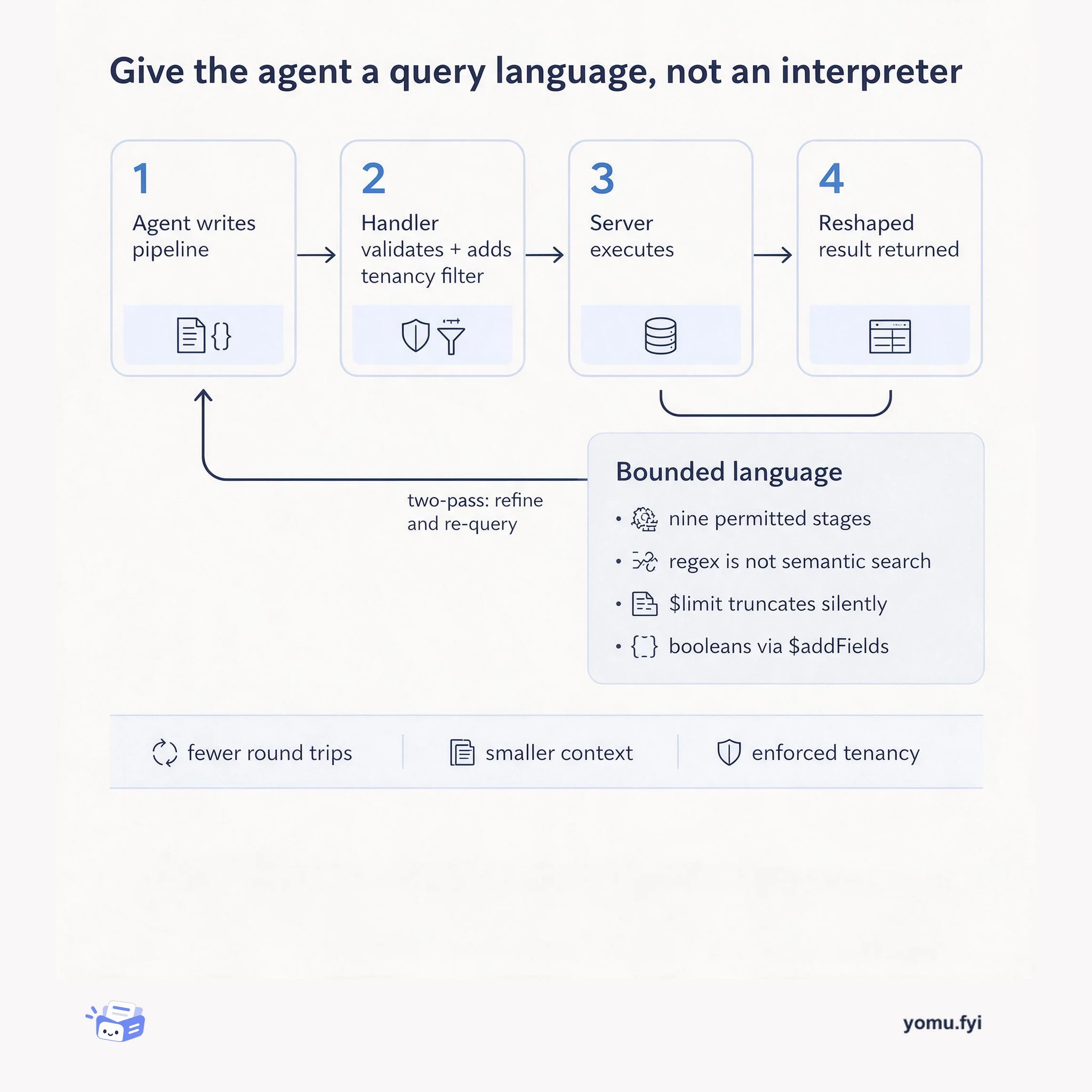
A four-step pattern for letting a document agent write validated aggregation pipelines instead of arbitrary code, so results come back shaped and tenancy stays enforced.
Loading…
Topic
542 posts about AI Agents. Every summary links to the original.
See the idea
A four-step pattern for letting a document agent write validated aggregation pipelines instead of arbitrary code, so results come back shaped and tenancy stays enforced.
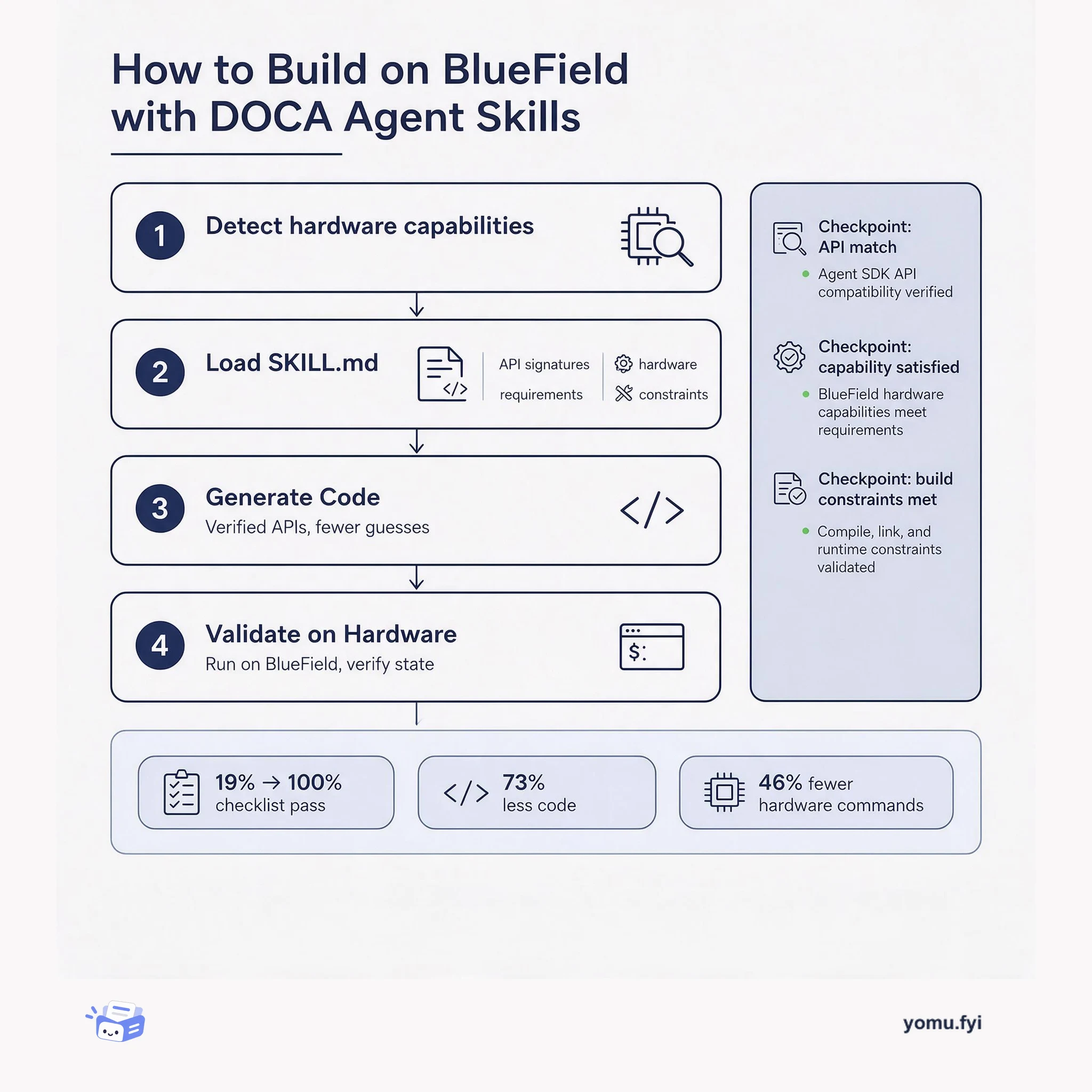
A practical how-to for using NVIDIA DOCA Agent Skills to generate BlueField code with verified APIs and hardware checks, reducing correction cycles and failed builds.
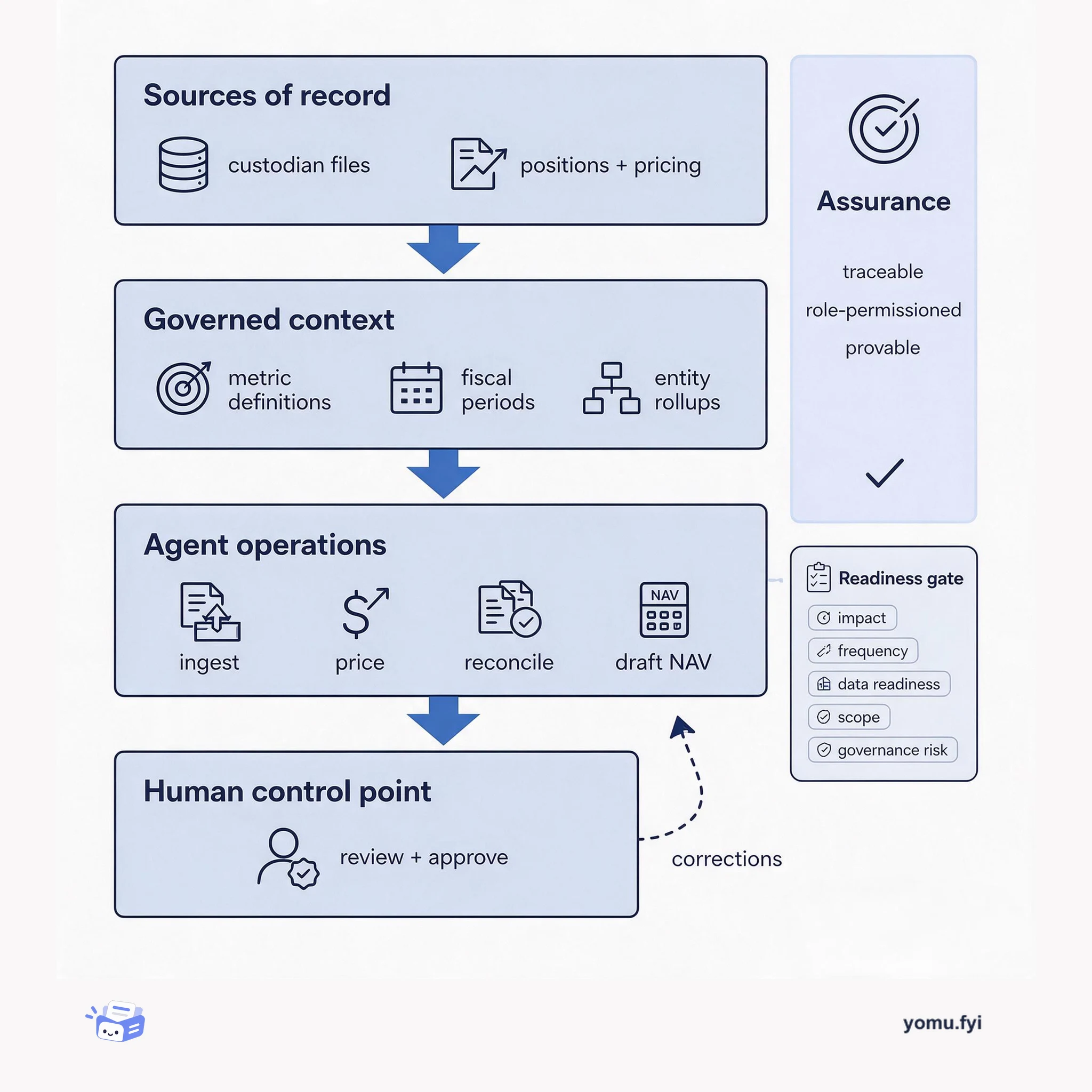
Asset management runs as a layered control plane: custodian and pricing data feed a governed context layer, agents run the overnight fund work, and a human signs off before anything is published.
The Good Stuff
Paid picks we use ourselves. Links carry a referral code — a subscription through one earns us a commission at no extra cost to you.
Newest first
Real-time AI agents require infrastructure that manages continuous, bidirectional conversations rather than isolated requests, including interruptions that halt speech generation and update context without dropping the connection. The post argues that QPS and instantaneous CPU utilization are insufficient because they miss long-lived committed work and silent sessions that can become active simultaneously. It proposes application-level active-session tracking around the stream lifecycle, with cleanup in finally blocks and consistent snapshots, then combines session pressure with CPU and memory utilization in a hybrid routing model. The model normalizes session counts into a rate and uses target utilization, smoothed utilization, cost per session, and a safety scaler to estimate effective capacity and regulate new assignments. Validation should use long-lived, varied workloads and metrics such as session distribution, overloaded assignments, startup latency, dropped sessions, and counter behavior; high-concurrency trackers may require sharded or LongAdder-style aggregation.
Supabase found that coding agents increasingly use its documentation to configure projects, creating risks when pages omit or bury critical instructions. To measure this, the team built an evaluation for the Row Level Security (RLS) guide, running an agent through realistic tasks and grading outcomes with checklist-based and agent-based judges. The initial runs found unauthenticated anon access with write privileges across tables and showed that test guidance was skipped when separated from the policy code. Supabase responded by adding procedural revocation steps, explicit policy snippets, and colocated test examples; the eval then passed the affected checks. The project concludes that agents and humans both benefit from selective-reading-aware structure, clear sections, explicit signposting, and recurring documentation evaluations, with the RLS scenario moving into the public supabase/evals benchmark.
Grab describes analytics as central to business decisions and presents AI agents as a way to democratise access to trustworthy answers. Over two years, increased model capability has enabled agents to prepare data, write and run queries, analyse opportunities, design experiments, interpret results, and draft commentary in minutes rather than a week. The proposed ladder ranges from AI-assisted work through human-planned and agent-planned workflows to end-to-end autonomy, while people retain accountability for framing, definitions, causal interpretation, decisions, and stakeholder relationships. Grab describes Spartan, which routes natural-language Slack requests across more than 50 skills and 120 analysis frameworks, plus Scarlet for pipeline failure triage and recovery. The programme also maintains agent context through ContextIQ and reports lower analyst intervention, a roughly 33% reduction in cycle times, and greater self-serve resolution in its support channel.
Etsy uses Kafka streams to provide fresh features and embeddings for machine learning models, which infer shopper intent and listing meaning from visits and listing data. Previously, engineers manually assembled Java and YAML applications, selected schemas and base classes, and handled testing and local execution. Etsy introduced conversational Kafka Skills that use language models to interpret requests, pass structured inputs into versioned scaffolding and validation tools, run applications locally, and open pull requests. Telemetry records Skill invocation and pull-request completion through protobuf messages in Kafka and BigQuery, while least-privilege ACLs, repository permissions, and deployment controls constrain agent actions. Initial adoption was low because developers did not know the Skills existed, so Etsy added vocabulary-specific and repository-level entry points; it now has Skills for seven Kafka workflows and is focusing on discoverability.
Agent Skills in Genkit Go address the prompt-context problem caused by loading every procedure, guide, and document into an agent’s persistent context. The tutorial defines skills as discoverable knowledge packs organized around a SKILL.md file, whose frontmatter is exposed first and whose instructions, references, assets, and scripts are loaded through progressive disclosure when needed. It integrates the Skills middleware with Genkit’s wrapper architecture, scans SkillPaths for metadata, matches descriptions, and invokes the use_skill tool before injecting the selected skill into active context; Go examples use ai.WithUse during Generate or GenerateText. Recipe and image-restoration examples show skills activating for matching requests, while the post notes that the restoration skill may require several attempts because model behavior is non-deterministic.
Agent and model evaluations in Agent Platform are now generally available, providing one engine and consistent metrics for measuring agents and models during development and against live production traffic. The service offers more than 20 pre-built metrics across quality, safety, grounding, tool use, trajectories, and reference-based tasks, plus adaptive rubrics that generate case-specific criteria and a versioned, org-wide registry for custom code-based or LLM-as-a-judge metrics. Experiments can run locally or server-side, with Cloud Storage artifacts supporting auditability and reproducibility, while case generation, user simulation, and environment simulation expand coverage and model slow or failing backends. Online monitors grade sampled production traces, chart scores over time, and issue drift alerts through configured channels. Access is available through the SDK, REST API, agents-cli, console, and ADK; model-based metrics incur standard model-call charges, while code-based and computation metrics add no additional cost.
Setting up a cloud-agent environment for the Cursor monorepo required treating development infrastructure as a product for agent users. The team aligned cloud VMs with local development by adapting utilities and setup scripts for Ubuntu, adding dependencies to a Cursor-defined Dockerfile, and introducing security controls for secrets and network access. To make the repository easier to operate, it built anydev to start services, route utility scripts, explain subcommands, and supervise long-running builds. Cursor Cloud MCP and Cloud Doctor then inspect environments, distinguish transient from salient failures, perform root-cause analysis, open high-confidence fixes, and improve workflows using traces. The resulting end-to-end testing and recorded demos helped cloud agents grow from about one in ten merged PRs in December to more than half, with the post identifying tool parity, documented skills, and core-workflow verification as readiness checks.
Cursor has launched Cursor Start, a monthly plan for developers in India priced at ₹649, with tax included and payment through UPI or card. The plan responds to requests for India-specific pricing and UPI support, and follows a reported tripling of Cursor’s Indian user base to more than 3M developers, making India its third-largest market globally. Start provides generous access to Grok 4.5 and Composer, more agent requests than the Free plan across desktop, web, iOS, and CLI, plus always-on cloud agents, Cursor for iOS, and workflow extensions through plugins, MCP servers, hooks, and skills. It sits between Free and Pro, offering everyday building capabilities while Pro adds broader model access and features such as Bugbot, Auto mode, Automations, and the Cursor SDK.
Anthropic is expanding its partnership with Cognizant, a technology services company, to deploy Claude more broadly across enterprise work. Cognizant is embedding Claude in its business and engineering platforms, scaling a Claude-certified workforce through its Frontier Certified model, and becoming a Global Premier Partner in the Claude Partner Network. Its Flowsource platform runs Claude Code alongside engineers in a Spec-Driven Development module, directing outputs with project specifications, coding standards, and architectural blueprints before evaluating them for production. The company reports more than 30,000 associates have completed Claude training and describes client deployments including a contract-intelligence system that cut review time by up to 40% and raised extraction accuracy above 88%, plus a risk-navigation tool that saves underwriters roughly eight hours a week. The collaboration combines Cognizant’s industry context, engineering scale, and delivery capabilities with Claude for production enterprise use.
AI in supply chain management applies machine learning, generative AI and AI agents to demand forecasting, inventory optimization, supplier-risk assessment and logistics orchestration. It connects ERP records, point-of-sale feeds, supplier communications and external signals to support continuous decision-making rather than periodic planning. The guide maps use cases to required data foundations, covering demand-sensing pilots, warehouse task prioritization, agent guardrails, cross-system APIs and generative-AI grounding. It recommends starting with a product category or region, comparing model output with a baseline, and expanding only when accuracy and bias improve consistently. Reported figures include up to 85% forecast-accuracy improvement, up to 15% lower inventory carrying costs, and 23% lower fulfillment costs among organizations that deployed AI at scale.
AI in finance spans machine learning, natural language processing, and generative AI for credit scoring, fraud detection, algorithmic trading, finance automation, and decision support across banking, capital markets, and insurance. Finance teams rank use cases by revenue impact, risk reduction, and implementation effort, while data scientists clean and validate the underlying data. Credit scoring can combine traditional and alternative data, with confidence thresholds routing uncertain cases to human underwriters; trading strategies use historical backtests, monitoring, and versioned audit trails. Fraud systems monitor transactions in real time and prioritize alerts, while finance automation uses machine learning, rules-based logic, exception queues, and ERP integration. The guide recommends 90-to-120-day pilots with predefined metrics and ROI measurement before scaling, alongside explainable AI, model governance, and logged decisions for responsible deployment.
Grab’s AI support bot grew from an internal GPT-powered Level-0 service into the foundation for LLM-Kit, an internal framework now used by more than 500 services, alongside over 50 registered remote MCP servers and a company-wide LLM gateway handling billions of tokens monthly. The bot used a single-agent reasoning loop and a tool plane spanning Glean, Kibana, GitLab, Slack, and HTTP plugins, but scaling exposed missing evaluations, fragmented observability, provider-switching friction, and costly production plumbing. LLM-Kit addresses those problems with generated FastAPI services, LangGraph agent templates, OpenTelemetry tracing, configuration and secret-management integrations, evaluation routes, remote MCP tool discovery, and gRPC contracts, clients, health checks, and channel selection. The post concludes that framework concerns became platform concerns at 500 agents, leading to a gateway, remote MCP framework, and evals platform described as the series continues.
Fly.io announces a strategic shift toward Sprites, its “computers for agents,” after concluding that AI-driven software development changes the needs its public-cloud platform should serve. The company says coding agents increasingly run in cloud-hosted workstations because laptops stop when closed, while conventional cloud resources impose too much commitment for semi-disposable agent workloads. Sprites are designed to be created rapidly in large numbers, retain 100GB durable disks, use metered utility billing that pauses during inactivity, and host Internet-accessible applications. The post says a new iteration adds scaling and orchestration work plus the Sprite Block Device, while Fly Machines and platform-as-a-service features will continue. Fly.io also announces new funding and Scott Johnston as CEO, with the founder moving to an advisor role.
The FDA built ELSA, a generative AI platform for its 16,000 staff, on Halo, a governed Databricks data foundation created to address fragmented systems across eight centers. Those centers had separate chatbots and data stores; consolidating 50 to 60 sources enabled faster sharing, real-time streaming, and centralized access controls through Unity Catalog. Within roughly two months, ELSA adoption rose from less than 1% to 85%, while staff began building hundreds of agents weekly from standard operating procedures, regulatory guidance, and center-specific documents. MCP servers layered over Unity Catalog make governed data and tooling accessible beyond data scientists, and Databricks ML and NLP capabilities through MLflow extracted starting materials and product-supplier-manufacturer relationships from millions of submission pages. A reviewer can now request grounded starting-material information for a drug application in about three minutes instead of days, while the FDA adapts center-specific MCP tools and extends the model across its organization.
Omnigent’s intent-based authorization addresses a gap in identity-based access control: an agent with valid credentials may follow indirect prompt injections embedded in data and perform authorized actions unrelated to the user’s task. It binds each session to a human-declared purpose and evaluates that intent before every tool call, producing permitted, consent-required, or denied verdicts. In a data-quality example, reading a customers table is allowed, dashboard publication requires approval, and an injected request to grant external access is denied despite the agent’s identity permitting that tool. The intent is fixed at design time for autonomous agents or approved by a human at session start for interactive agents, and cannot be broadened by the agent. Omnigent combines this policy with session-risk scoring and other contextual policies in a single engine where any denial wins.
An evaluation compared Genie Code with three widely used coding agents from major AI labs on 401 real internal data tasks, using a shared 20-minute wall-clock budget and independent grading. Genie Code achieved 76.6% accuracy at an estimated $0.55 per task, outperforming rivals at 55.9–72.1% accuracy and $0.91–$1.16 per task. Its advantage is attributed to semantic search across catalog and workspace assets, persistent memory of tables and business logic, and enterprise-context understanding, which reduce exploratory tool use. On discovery-heavy tasks, general-purpose agents often wandered through large workspaces or timed out on inefficient scans, while Genie Code averaged 8.3 tool calls per task. The benchmark found no accuracy-cost trade-off, although the authors note that Genie Ontology was disabled and expect it to strengthen the advantage.
Claude Opus 4.5 is available today across Claude apps, the API, and all three major cloud platforms, with the model identifier claude-opus-4-5-20251101 and pricing of $5/$25 per million tokens. The announcement positions it as a state-of-the-art model for coding, agents, computer use, deep research, spreadsheets, and slides, while reporting stronger vision, reasoning, and mathematics than predecessors. On the Claude API, an effort parameter lets developers trade off speed and spend against capability; at medium effort, Opus 4.5 matched Sonnet 4.5’s best SWE-bench Verified score using 76% fewer output tokens, while highest effort exceeded it by 4.3 percentage points using 48% fewer tokens. Additional platform changes include context compaction, advanced tool use, memory, and improved multi-agent coordination. Product updates add Claude Code’s editable Plan Mode and desktop sessions, automatic conversation summarization, and expanded Claude for Chrome and Excel access.
CLA and Databricks built a production document-processing application for auditing that reduces extraction time from hours to minutes without compromising quality, using Databricks-native services including Lakebase Postgres, Databricks Apps, Lakeflow Jobs, MLflow, and Unity Catalog Volumes. Lakebase serves as the orchestration layer’s single source of truth for tasks and execution attempts, coordinating long-running work, retries, leases, priorities, rate limits, costs, and status visibility. The queue uses Postgres patterns including FOR UPDATE SKIP LOCKED, priority and FIFO ordering, expiring leases for crash recovery, and database-backed concurrency controls. Databricks Jobs process PDFs through intelligent document processing and vision/LLM calls, while MLflow Tracing records execution and cost details and dashboard updates combine fast Postgres data with slower billing queries. In production, this architecture avoids external brokers and schedulers while providing durable task management, real-time visibility, and per-task cost attribution.
Anthropic introduces Claude Opus 4.8, an upgrade over Opus 4.7 for coding, agentic skills, reasoning, and practical knowledge work, with regular pricing unchanged. The release adds adjustable effort in claude.ai and Cowork, dynamic workflows in Claude Code, fast mode at 2.5× speed, and support for system entries inside the Messages API messages array. Dynamic workflows can plan work, run hundreds of parallel subagents in one session, and verify outputs; the post cites codebase-scale migrations across hundreds of thousands of lines as an example. Early evaluations and tester reports describe stronger reliability, judgment, tool efficiency, computer use, and analysis, including an approximately fourfold reduction in allowing flaws in generated code to pass unremarked.
The release introduces Claude Sonnet 4.5 as a model aimed at complex coding, agentic work, computer use, reasoning, and math, with claimed gains in alignment. It reports state-of-the-art SWE-bench Verified performance and a 61.4% OSWorld score, up from Sonnet 4’s 42.2%, while noting more than 30 hours of observed focus on complex multi-step tasks. Alongside the model, the company released Claude Agent SDK, added Claude Code checkpoints, a refreshed terminal interface, native VS Code extension, context editing, and a memory tool, and brought code execution and file creation to paid Claude apps. Sonnet 4.5 is available through the Claude API as claude-sonnet-4-5 at $3/$15 per million tokens, the same pricing as Sonnet 4. It is released under AI Safety Level 3 protections, with reported reductions in concerning behaviors and improved defenses against prompt injection, while the temporary Imagine with Claude preview is available to Max subscribers for five days.
The best engineering reads, once a week.