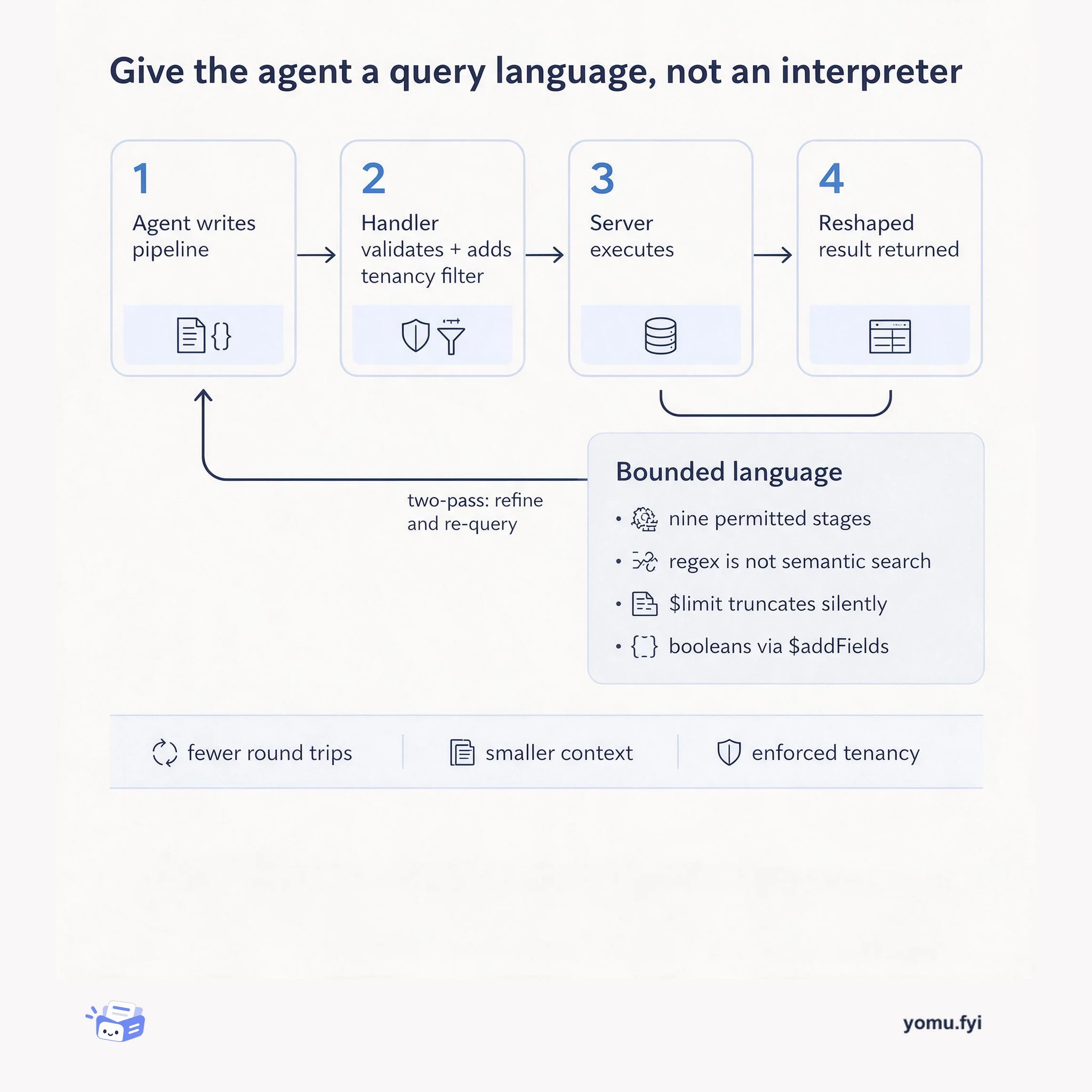
How to Give an Agent a Query Language Instead of a Code Interpreter
A four-step pattern for letting a document agent write validated aggregation pipelines instead of arbitrary code, so results come back shaped and tenancy stays enforced.
Loading…
Topic
542 posts about AI Agents. Every summary links to the original.
See the idea
A four-step pattern for letting a document agent write validated aggregation pipelines instead of arbitrary code, so results come back shaped and tenancy stays enforced.
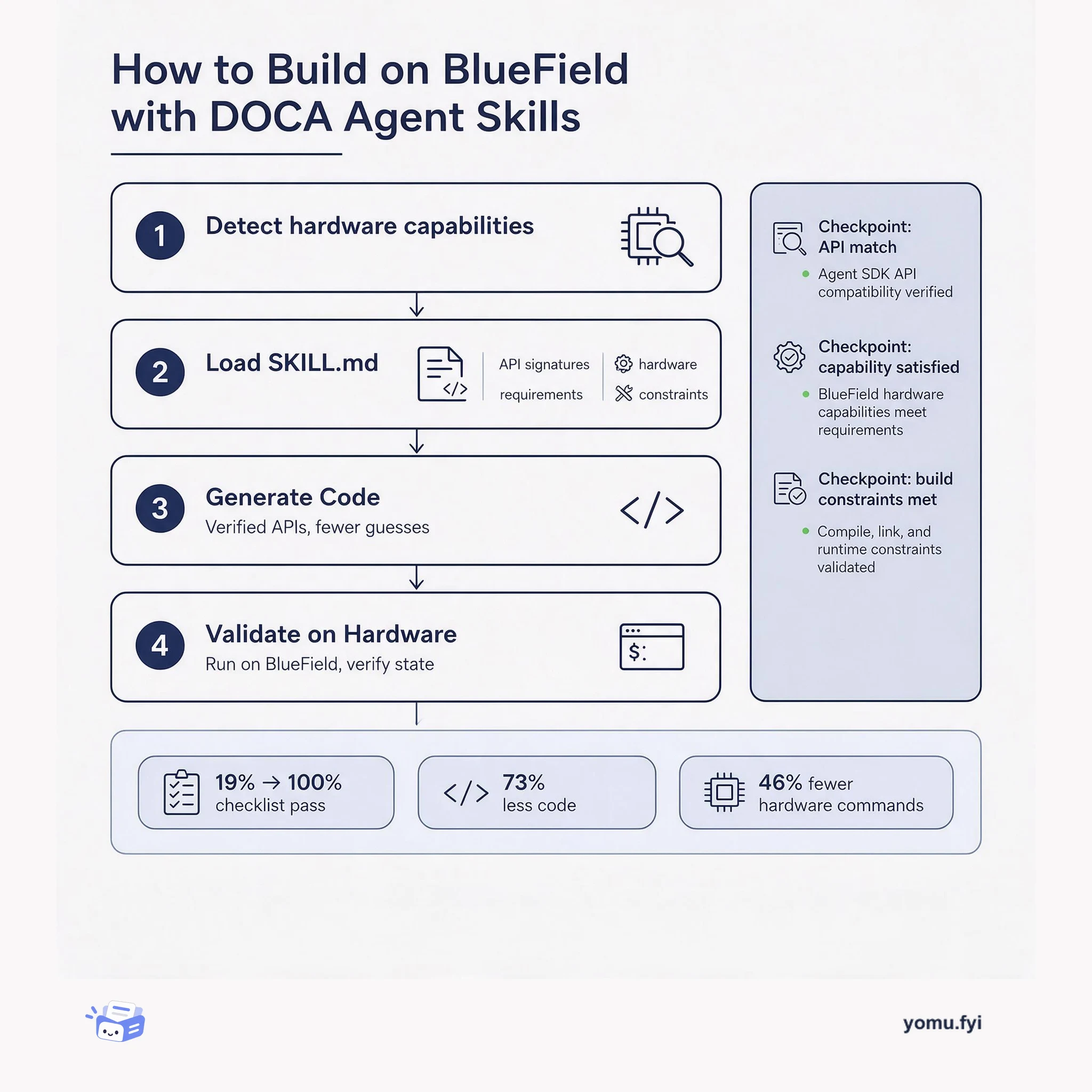
A practical how-to for using NVIDIA DOCA Agent Skills to generate BlueField code with verified APIs and hardware checks, reducing correction cycles and failed builds.
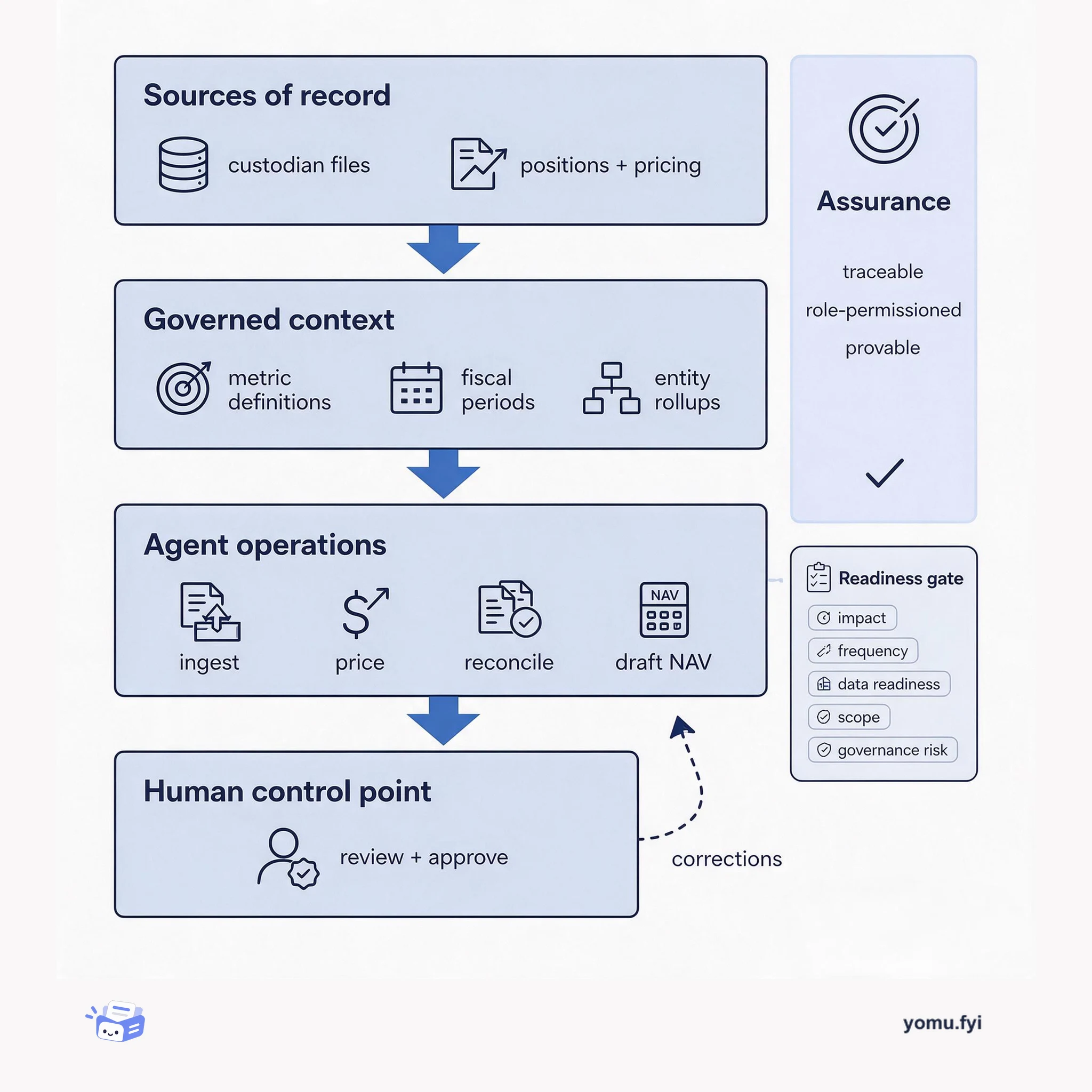
Asset management runs as a layered control plane: custodian and pricing data feed a governed context layer, agents run the overnight fund work, and a human signs off before anything is published.
The Good Stuff
Paid picks we use ourselves. Links carry a referral code — a subscription through one earns us a commission at no extra cost to you.
Newest first
Databricks announces a major evolution of Lakeflow, its unified platform for data engineering across ingestion, transformation, and orchestration, with capabilities centrally governed by Unity Catalog. Genie Code and generally available Lakeflow Designer support agentic and no-code pipeline development, while Genie ZeroOps monitors production assets, analyzes failures, proposes fixes, and validates them in a governed sandbox before human approval. Lakeflow Connect expands to more than 100 managed connectors, and Zerobus Ingest adds Kafka-compatible, gRPC, REST, SDK, and OpenTelemetry interfaces for high-volume event ingestion. Real-Time Mode for Spark Declarative Pipelines reaches Public Preview with end-to-end latency as low as 5 milliseconds, alongside declarative APIs and expanded Lakeflow Jobs integrations. The release also adds data-readiness triggers and external orchestration for systems including Snowflake, REST APIs, Slack, and PagerDuty.
Genie ZeroOps is an autonomous background agent for monitoring and operating data and AI assets, including jobs, pipelines, tables, and ML models. It continuously detects visible and silent failures, uses Unity Catalog lineage and platform observability to assess root causes, generates remediation through development workflows, and verifies fixes in isolated sandboxes. These environments use shallow, zero-copy table clones, scoped permissions, and network isolation, so proposed changes run against real data without touching production or applying anything before approval. For ML workloads, the agent can diagnose degraded predictions, train a candidate on corrected features, evaluate it against the production model’s existing eval suite and criteria, and support live-traffic ramping when it is measurably better. Genie ZeroOps is entering private preview in the coming weeks, initially supporting jobs, pipelines, tables, and ML workloads; Apps and Lakebase databases are on the roadmap.
Lakebase Search is a beta offering on AWS and Azure that adds hybrid vector and full-text retrieval to Lakebase Postgres. It uses the lakebase_vector and lakebase_text extensions to keep retrieval, memory, operational data, and hybrid search in one backend. lakebase_vector retains pgvector types and operators, applies RaBitQ clustering and compression for 32x smaller indexes, and targets more than 1B vectors, while lakebase_text replaces GIN with object-storage-optimized BM25 ranking. A tiered cache keeps hot data on NVMe and places colder data in object storage; the source reports lower memory needs, faster index builds, and cold-cache startup than standard pgvector HNSW in its LAION-100M benchmark. The extensions also combine vector similarity and keyword relevance with reciprocal rank fusion in a single SQL query, enabling joins and tenant filtering alongside transactional workflows.
Databricks announces Genie One, Genie Agents, and Genie Ontology to help enterprises answer business questions and act on data whose context is scattered across dashboards, queries, documents, tickets, and chats. Genie One connects data and business tools through Lakehouse federation, Lakeflow Connect, native integrations, Slack, Teams, mobile apps, schedules, alerts, document creation, custom skills, and MCP support. Genie Agents evolve Genie Spaces into domain-specific agents that can reason over structured and unstructured data, execute multi-step workflows, and be created from a prompt. Genie Ontology builds a permission-aware living graph from enterprise assets, weighting sources by authority, usage, certification, and freshness. In an internal 28-question benchmark, Genie answered 84.5% correctly on the first attempt and delivered twice the speed of the strongest coding agent.
Databricks announces CustomerLake, an Agentic Customer Data Platform embedded natively in its lakehouse, bringing Customer 360, identity resolution, audience building, campaign automation, activation, and personalization alongside governed data and AI models. The announcement addresses fragmented identities, stale audiences, manual campaign workflows, and the duplication and governance burden created by separate martech systems. CustomerLake uses Unity Catalog and Lakehouse Federation to access customer data across Databricks, Snowflake, Google BigQuery, cloud object storage, operational databases, and other enterprise systems, while Profile Agents create business-ready profiles and Campaign Agents build audiences, recommend actions, activate channels, and optimize engagement. Its operating model is described as embedded, democratized, and autonomous, with Agentic Identity Resolution combining deterministic, probabilistic, and agentic workflows. CustomerLake is now available in Private Preview and launches with an open partner ecosystem.
Omnigent is an open-source meta-harness designed to combine, control, and share agents across different harnesses, models, and interfaces. Databricks says users currently juggle multiple agents and copy context between them, while builders struggle to combine or replace harnesses with incompatible interfaces. Its runner wraps terminal-based agents and SDKs in sandboxed sessions with a uniform API for messages, files, streamed text, and tool calls; a server adds policies, sharing, and access through terminal, web, mobile, native Mac OS, and APIs. Features include live collaboration, hosted sandbox execution, contextual security and cost policies, OS isolation, and multi-harness authoring. Released in alpha under Apache 2.0, Omnigent is intended to provide a durable layer above changing agents and harnesses.
The post concludes a series on how copy-on-write database branching in Databricks Lakebase changes team-scale evolutionary database development without changing its underlying methodology. For a team of fifty developers, long-running tier branches and ephemeral feature branches form a parent-linked promotion hierarchy, replacing separately provisioned environment instances and enabling promotion by merge, rollback by repoint, and computable schema divergence. Governance is declared once and inherited per branch, with policies intended to prevent transitions that contradict the parent chain; Unity Catalog captures metadata for attribution and audit. The DBA's role becomes platform engineering, while agents operate inside an executable SCM state machine with documented inputs, outputs, schema validation, and enforced gates. An optional TDD layer adds dedicated roles, acceptance-criterion scenarios, RED-GREEN-REFACTOR cycles, and artifact contracts, and the conclusion presents the resulting workflow as operational for human and agent practitioners.
Mercedes-Benz Korea piloted a “Talk to Data” architecture that extends its Databricks analytics foundation with a governed semantic layer for enterprise AI, rather than treating the effort as a chatbot project. The design moves Power BI DAX KPI logic into Unity Catalog Business Semantics and Metric Views, keeping sources, joins, measures, dimensions, comments, and synonyms alongside governed Lakehouse data. Genie spaces use curated metric views for domain questions, while Agent Bricks composes persona-based agents, with Unity Catalog enforcing row- and column-level access. An automated DAX-to-Metric-View transpiler parses semantic models, maps tables, generates draft definitions, flags non-automatable measures, and reports conversion gaps. The documented playbook combines gold-layer curation, KPI validation, regression testing, Genie optimization, persona agents, and Databricks Apps; the pilot reports AI answers aligned with established KPI definitions and BI reporting logic.
Databricks announces ready-to-use Model Context Protocol (MCP) servers for healthcare and life sciences through Databricks Marketplace, addressing the need to combine curated biomedical knowledge, timely data, specialized tools, and private records. Listings include services for drug and target intelligence, literature, clinical trials, FDA information, Medicare coverage, ontologies, real-world evidence, clinical semantics, and interoperability, while Climb connects live public sources with private Gold-layer data under Unity Catalog governance. Marketplace and custom MCP servers are centralized in the MCP Catalog and governed by Unity AI Gateway, with Genie Spaces, AI Search, Unity Catalog functions, and SQL Warehouses available as managed MCP servers. Users can assemble agents in AI Playground, Agent Bricks, or notebooks, then deploy endpoints or apps with MLflow tracing, evaluation, human feedback, and AI guardrails; examples span molecular-property lookup, clinical questions, and drug research.
AI Agents can answer support questions without backend access, but they cannot complete changes such as payment-plan updates, claims, or account edits. Connecting an Agent to CRM, billing, order-management, or other systems moves support from explanation to end-to-end resolution, and the source frames that shift as the basis for an engineering request. Data from a 2026 Customer Service Transformation Report shows improved metrics among 87% of teams with mature AI deployment, versus 62% overall, while only 10% report reaching that stage; an internal comparison found Procedures with system access produced the largest gains in workflows requiring judgment, branching, live data, or handoffs. The recommended case starts with one high-volume, repeatable workflow, maps its data and actions, and defines a narrow pilot. Teams can then progress from no integration to read-only access and finally write actions, using measured results to justify further work.
Auto-review governs local agent autonomy as a continuum, allowing routine work to proceed while reviewing actions whose consequences depend on context, user intent, and security stakes. A small classifier agent runs before tool calls in the same RPC stream as the parent agent, and can inspect workspace contents with ReadFile, Grep, Glob, and ListDir when a command alone is insufficient. Its blocks return explanations rather than automatically prompting users, enabling the parent agent to narrow or replace a risky action. Evaluation used 6,122 deduplicated labeled rows from internal developer sessions plus synthetic high-consequence cases, and tested tool use, overrides, parse failures, and behavioral flapping. Early results show the classifier blocks around 4% of reviewed actions, while about 7% of Auto-review chats experience at least one interruption.
Howden’s rapid acquisition pace exposed limits in an enterprise data model built around one product per use case, downstream quality checks, and dashboard-driven consumption. Group Chief Data Officer Barry Panayi describes shifting to open, governed data services, moving mastering and quality checks closer to ingestion, and codifying reconciliation in the Accord data model. On Databricks, the company consolidated more than 100 sources of record, standardized pipelines and shared code, and built reusable assets for cross-domain analytics, while continuing to productionize models as consistent services. The account argues that AI agents require a composable services layer, and that insight lag—the time between data existing and being usable—matters more than freshness; conversational analytics through Genie also reduced dashboard-building work.
AWS and Databricks describe their expanded collaboration at Data + AI Summit 2026, where AWS returns as a Legend Sponsor with sessions, demos, customer stories, and industry forums. The partnership centers on generative AI adoption, unified governance, and open data architectures, including an agentic stack that combines Amazon Bedrock, Bedrock AgentCore, Kiro, and the Databricks Data + AI Platform. A featured integration uses a governed MCP connection through Databricks Apps so AgentCore can query Unity Catalog-governed data, ask AI/BI Genie questions, and read low-latency state from Lakebase while honoring existing permissions. AWS will demonstrate these workflows at Booth #100 and present a session on federating Unity Catalog to AWS Glue, alongside customer examples including Mastercard, Talkdesk, nCino, Addepar, and Workday. Attendees can also join technical conversations, receptions, and a 14-day Databricks on AWS Marketplace trial with $400 in usage credits.
AML operations are strained by fragmented systems, high false-positive volumes, manual case documentation, and opaque vendor scoring, leaving analysts focused on backlog rather than financial-crime intelligence. The proposed Databricks Data + AI Platform unifies transaction monitoring, KYC, sanctions, case history, and policy data under Unity Catalog, using Lakeflow Connect and a Bronze–Silver–Gold Delta architecture with masking, row-level security, and lineage. MLflow, Model Serving, Lakehouse Monitoring, and inference tables support institution-specific detection models, while Agent Bricks coordinates agents for evidence gathering, recommendations, and SAR drafting with analysts retaining final decisions. The architecture also uses Lakebase for governed operational state and Databricks Apps for analyst and executive experiences. Reported outcomes include a 75% reduction in false positives reaching the analyst queue and compressing three-to-six-hour investigations to minutes.
Claude Fable 5 is now generally available on Databricks, with rollout across AWS, Azure, and Google Cloud through Unity AI Gateway. The Mythos-class model targets long-running, complex, and ambiguous work, including autonomous enterprise workflows, document question answering, code investigation, and multimodal tasks. In Databricks' OfficeQA Pro benchmark, Fable 5 achieved 57.9% correctness, setting a state of the art; compared with Claude Opus 4.8, it was 20% more accurate and used 12% fewer tool calls, but ran approximately 30% slower and generated 2.5x more output tokens. Unity AI Gateway provides unified API access, fine-grained permissions, Unity Catalog logging, request and tool-call guardrails, and spend controls. Agent Bricks supports domain-specific agents, while Anthropic's policy includes 30-day retention for trust and safety purposes only.
Fin is being made available as a Service Agent on top of HubSpot and Freshworks, allowing HubSpot and Freshdesk customers to deploy it without migrating from their helpdesk. The announcement says customers can get it integrated and live in less than an hour across voice, email, chat, social, and other channels, with a stated 76% average resolution rate. Fin is described as handling complex queries that require reading and writing to third-party systems, while remaining configurable to each business’s policies; its openness includes APIs, MCPs, a CLI, access to the Apex trained model, and public product, help-center, and developer documentation. The broader argument is that open Agent platforms let customers experiment, replace components, and avoid vendor lock-in, with competition determined by product quality.
Okta Developer Connect San Francisco brought more than 100 developers, architects, founders, platform engineers, and security leaders to Okta HQ for technical sessions, hands-on labs, and community conversations about securing identity in the age of AI. The keynote announced general availability of Okta for AI Agents, which provides discovery, shadow AI detection, short-lived credentials, scoped tokens, vaulted secrets, MCP server controls, lifecycle governance, SIEM audit logs, and a kill switch. Sessions examined Cross App Access, using identity assertion and token exchange across a requesting app, identity provider, and resource app, plus Auth0-based patterns including Token Vault, asynchronous authorization, and fine-grained access control. Discussions described agents outpacing governance, static credentials creating risk, and RAG pipelines requiring data-layer permissions that match user access. The event concluded that builders should treat agents as identities with ownership, scope, review, consent, and revocation designed before integrations go live.
Plenitude and Databricks built an agent-based system that turns solar and wind plant maintenance PDFs into structured data for cross-plant analysis. Event-driven ingestion uses Databricks Jobs and the ai_parse_document AI Function to extract text, tables, figures, and metadata, then stores page- and object-level JSON records in Delta Lake with coordinates, version history, and links to source reports. A Genie space uses Unity Catalog metadata, knowledge-store instructions, and SQL generation to answer natural-language questions, produce visualizations, and export results, while Agent Bricks can orchestrate multi-step workflows and downstream actions. The design also applies automatic liquid clustering to dynamic queries and row-level security to restrict results by country. The resulting data layer supports historical trends, plant comparisons, recurring-fault analysis, and a foundation for predictive maintenance, although the source frames predictive use as a future improvement.
Human-in-the-loop (HITL) is an AI and machine learning approach that places people in training, supervision, or decision-making to improve accuracy, safety, and ethical alignment. Its feedback loop can include data labeling, output review, escalation, approval, override, and continuous feedback, with confidence thresholds and risk scoring routing only selected decisions to people. The explainer distinguishes HITL, where review occurs before flagged actions, from human-on-the-loop monitoring and human-over-the-loop governance, and separates HITL from RLHF, a training-specific technique. It describes uses in medical imaging, moderation, autonomous vehicles, financial services, and AI agents handling consequential actions. Databricks Agent Bricks is presented as supporting governed traces and Agent Learning from Human Feedback, including a case where 32 feedback items improved instruction-following from roughly 12% to 80%.
Data + AI Summit 2026 features a dedicated financial services program for leaders evaluating AI transformation across banking, payments, insurance, and professional services. It lists sessions on proprietary data for underwriting, responsible AI in banking and payments, and AI delivery in professional services featuring First American, American Modern Insurance Group, Vantage Bank Texas, Santander, FIS, Acxiom, EXL, Bain, and EY. The Financial Services Forum includes executive firesides with leaders from Morgan Stanley, JPMorganChase, Mastercard, and RBC Capital Markets. A financial services lounge at the Moscone Expo offers demos, Databricks experts, and Agentic Banker and Virtual CFO use cases. Training courses on AI Agents, Lakebase, and apps plus hands-on labs and certification sessions are presented as a route from strategy to execution with executives and technical teams splitting focus.
The best engineering reads, once a week.