How to Give an Agent a Query Language Instead of a Code Interpreter
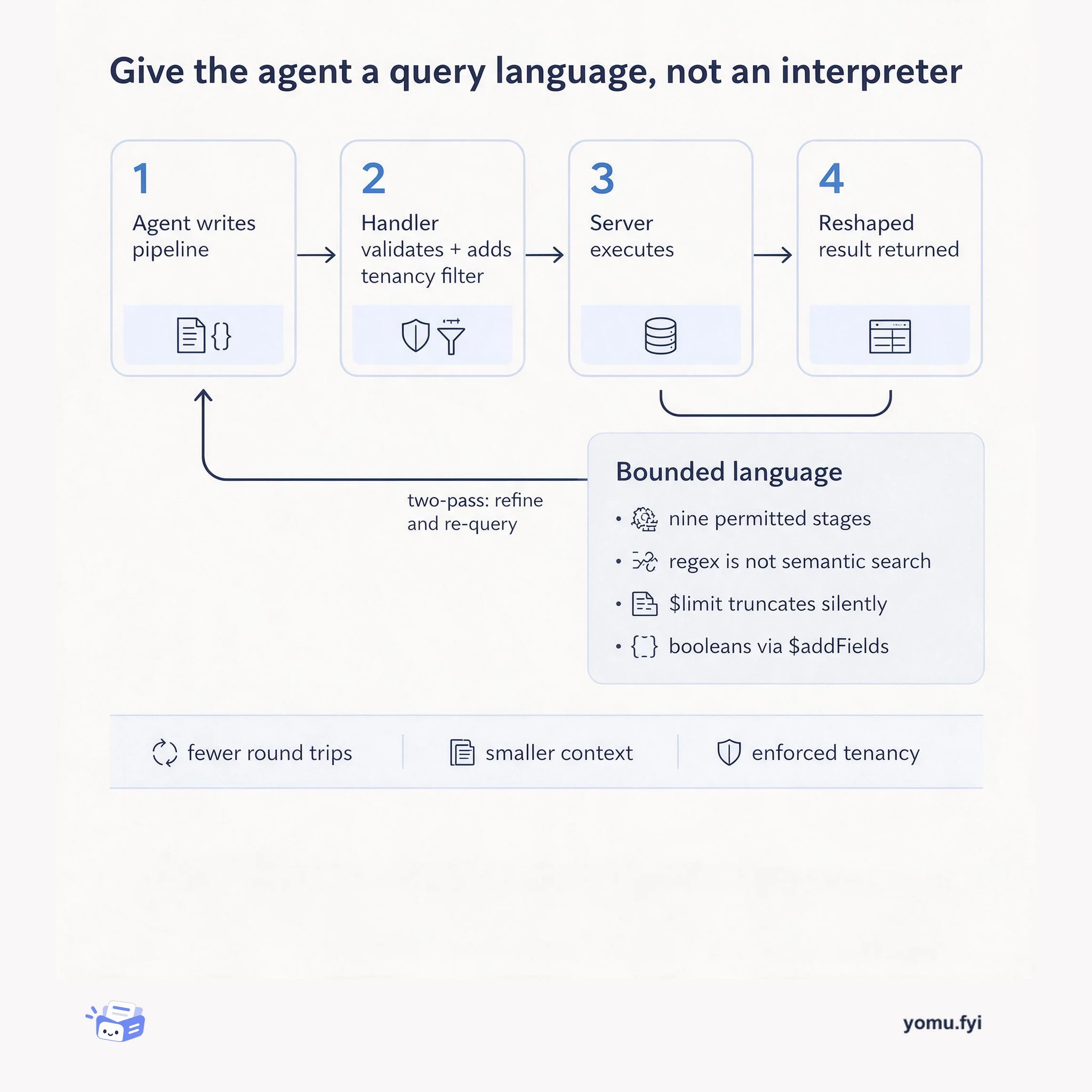
A four-step pattern for letting a document agent write validated aggregation pipelines instead of arbitrary code, so results come back shaped and tenancy stays enforced.
Loading…
Topic
542 posts about AI Agents. Every summary links to the original.
See the idea
A four-step pattern for letting a document agent write validated aggregation pipelines instead of arbitrary code, so results come back shaped and tenancy stays enforced.
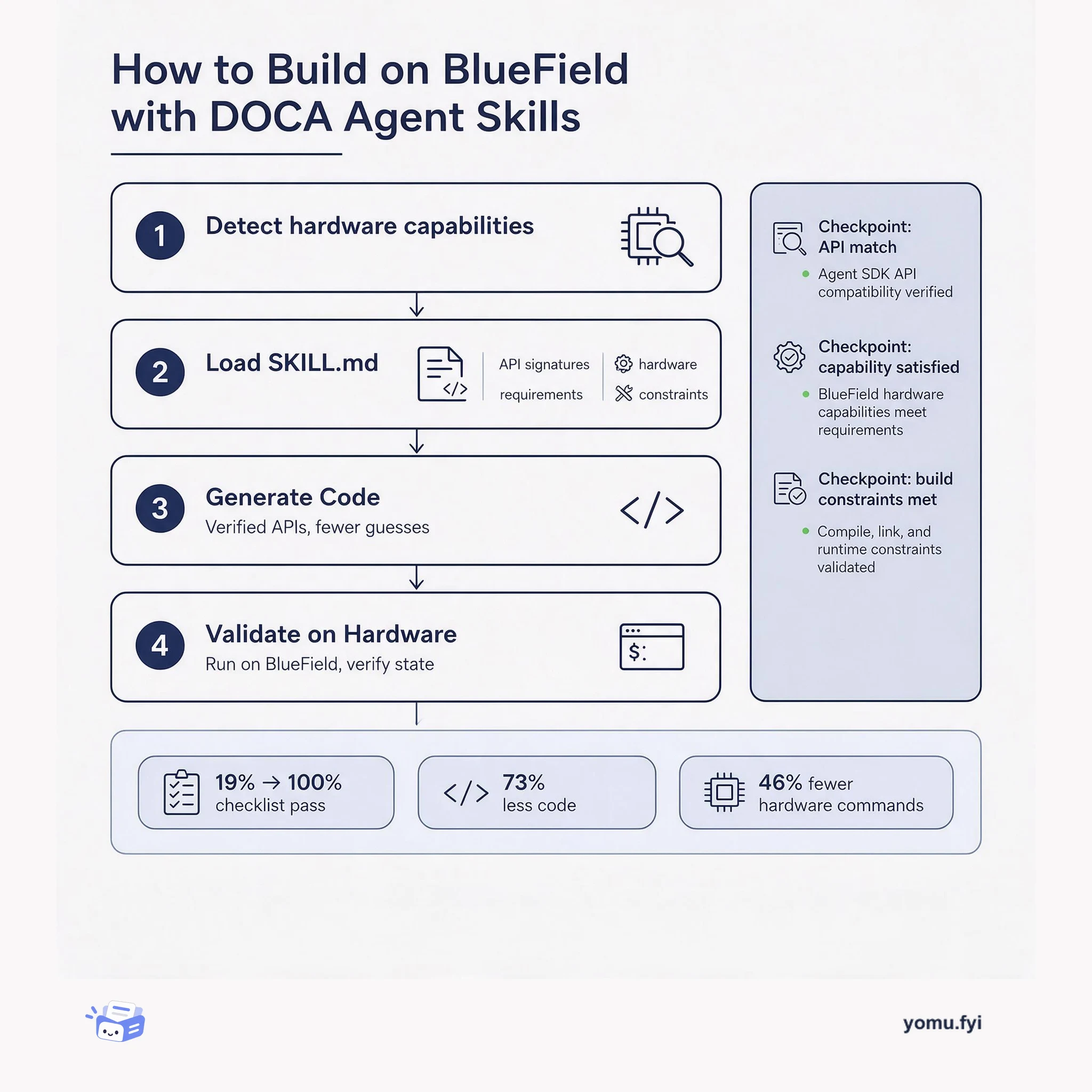
A practical how-to for using NVIDIA DOCA Agent Skills to generate BlueField code with verified APIs and hardware checks, reducing correction cycles and failed builds.
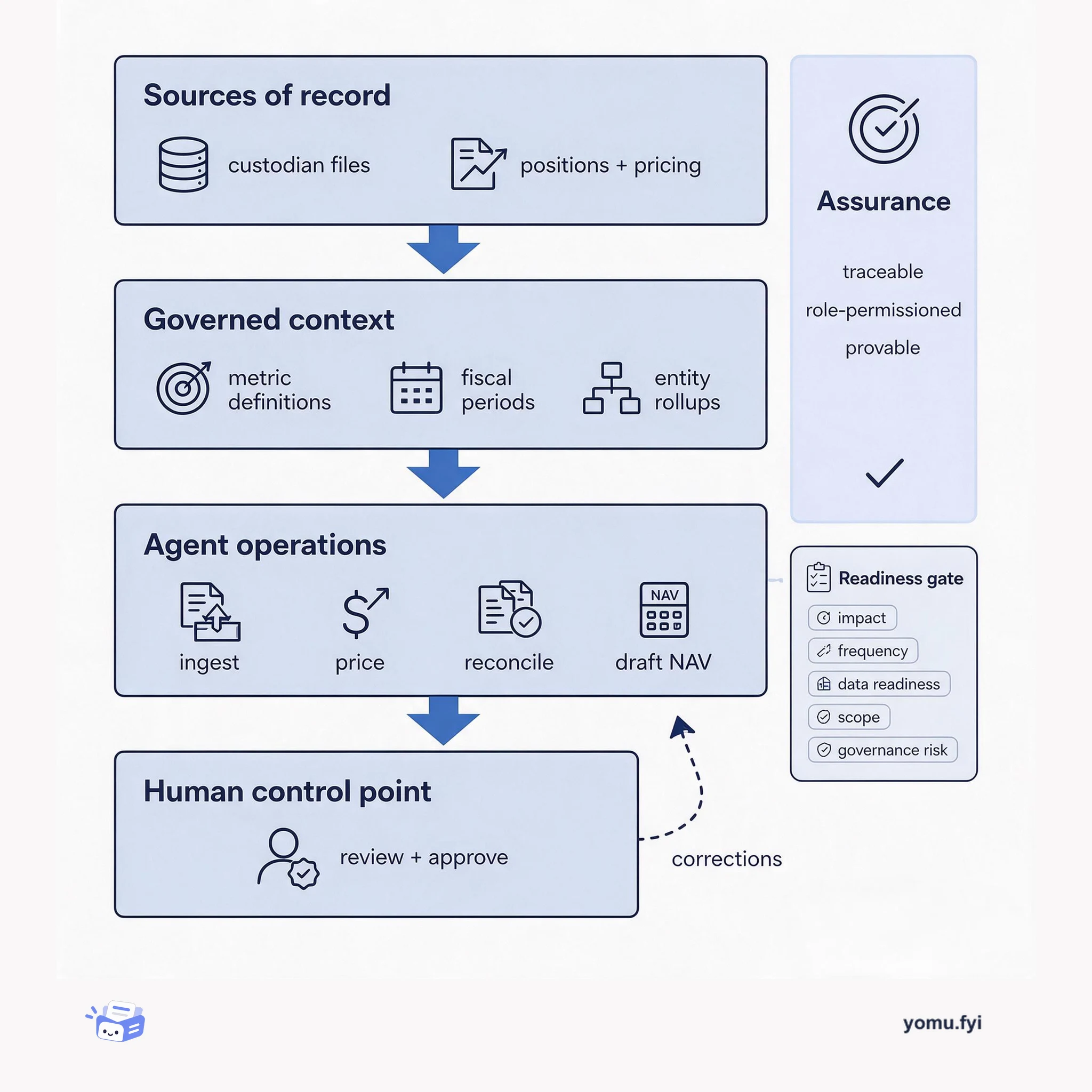
Asset management runs as a layered control plane: custodian and pricing data feed a governed context layer, agents run the overnight fund work, and a human signs off before anything is published.
The Good Stuff
Paid picks we use ourselves. Links carry a referral code — a subscription through one earns us a commission at no extra cost to you.
Newest first
Google announces the Google Colab Command-Line Interface (CLI), a tool that connects a local terminal with remote Colab runtimes for developers and AI agents. It can provision GPUs or TPUs with commands such as colab --gpu A100, execute local Python scripts and ML pipelines remotely with colab exec, recover artifacts and replayable .ipynb logs, and provide interactive access through colab repl or colab console. The source demonstrates an agent-driven QLoRA fine-tuning workflow for google/gemma-3-1b-it on a Text-to-SQL dataset: an Antigravity agent provisions a T4, installs transformers, datasets, peft, trl, bitsandbytes, and accelerate, runs finetune_run.py, saves a notebook log, downloads model artifacts, and stops the runtime. The resulting safetensors adapter and configuration files can be loaded locally, while the CLI is presented as programmable and usable by terminal-based agents.
Design Mode updates Cursor’s browser-based agent workflow for spatial UI work, letting users edit a product in context rather than relying on chat descriptions alone. Users can select one or more elements, draw on a frozen viewport frame, or narrate instructions by voice; references can express relationships such as matching components or changing a group together. Element selection supplies identity signals including XPath, component, attributes, computed styles, and fiber-tree props, alongside a screenshot capturing layout and page state. Users can queue edits while earlier ones run, manage multiple subagents, and see results through hot reloads, with Composer 2.5 described as suited to fast, targeted interface changes. The update is presented as a way to tighten the noticing-to-editing loop while preserving control and precision during UI iteration.
Data + AI Summit 2026 presents a Telecommunications Industry Experience for operators responding to surging network traffic, regulatory pressure, cybersecurity threats, competition, and customer churn. The event, scheduled for June 15–18 in San Francisco, positions unified data and AI, governed workflows, and production use cases as the basis for operationalized, AI-native telecom models. Its June 17 Telecommunications Industry Forum features keynotes, presentations, and executive panels on customer experience, autonomous network operations, fraud prevention, secure agent deployment, and the return from modernizing legacy data warehouses. Breakout sessions cover automated metadata generation for Genie, conversational AI/BI, Lakeflow pipelines with Agent Bricks, and data exfiltration protection with egress monitoring. The industry lounge will demonstrate Model as a Service and agentic real-time decisioning, while the agenda emphasizes peer examples and architectural blueprints for scaling AI under telecom governance and compliance.
Fin Voice 2 is presented as a customer-service voice agent designed to address the latency, complexity, and reliability demands of phone support. Built on Apex Flash, described as a model trained on millions of customer experience interactions and tuned for low-latency channels, it separates real-time speech processing from the answer-generation layer rather than routing speech through a general text workflow. The product is claimed to deliver faster, more natural conversations, higher resolution rates, and higher customer satisfaction, though the post does not provide measurements. It can reportedly handle identity verification, refunds, appointments, emotional-state changes, confirmations, external-system actions, proactive follow-up calls, and contextual handoffs to human agents. Fin Voice 2 also adds configuration and management features, including call-quality and behavior insights, topic analysis, one-click recommendations, and self-service controls.
The Cursor SDK’s TypeScript and Python releases add custom tools, auto-review, and nested subagents. Custom tools let developers pass function definitions through local.customTools, exposed via a built-in MCP server, making them available to all subagents. Auto-review routes local agent tool calls through a classifier; instructions in permissions.json control which calls run automatically and which are held for review. The SDK now supports a JSONL store for agent metadata as an alternative to SQLite, and developers can implement the LocalAgentStore interface for custom backends. Subagents can spawn their own subagents without additional configuration, and the release includes reliability and platform fixes.
Cursor’s canvas release adds Design Mode, enabling users to select and annotate UI elements directly while guiding edits. The update also turns agent context usage into an interactive canvas report, breaking token consumption across the system prompt, tool definitions, rules, skills, and more. Because the report is interactive, users can ask follow-up questions, customize its answers, or use an embedded Debug with Agent button to seek opportunities to reduce context usage in a new conversation. Other changes include full-screen browser access for shared canvases, prompt-triggering buttons, improved handling of canvas type errors, better component styling, and more chart customization options.
Anthropic announces the Services Track and Claude Partner Hub to make its partner ecosystem easier for enterprise customers to evaluate firms that can put Claude into production. The Services Track has Select, Preferred, and Global Premier tiers, measured by certified practitioners, production deployments, public customer stories, and for Global Premier, a joint business plan with named executive sponsors. Requirements include at least 10, 100, or 1,000 active certified individuals, alongside tier-specific deployment and endorsement thresholds, with a single bar for firms of all sizes. The Hub provides daily refreshed standing dashboards, a public directory showing each firm's tier and evidence, and an MCP connector that lets partners query partnership information through Claude. Promotions occur twice yearly, with an additional 2026 review, while downgrades are limited to the annual review after notice and an opportunity to close gaps.
Ramp’s Stack is an AI-native accounting suite designed to automate repetitive book-closing work, including reconciliations, variance analysis, data entry, and schedules and accruals. To avoid overfitting to individual design partners, Ramp built a benchmark of synthetic business worlds, realistic accounting tasks, and accountant-written grading criteria, including standard and roll-forward worlds for testing memory transfer. The benchmark contains 237 tasks and 3,469 grading criteria in the analyzed slice, and supports repeated runs to compare models, prompts, tools, skills, harness changes, and memory behavior. Optimization included ablating skills, shrinking a spreadsheet skill from 14,000 to 5,000 characters, and tuning the system against end-to-end task performance rather than narrow evaluations. The resulting Stack system achieved the highest agent performance, with 4% higher accuracy and 3% better Pass@1, while remaining on the latency frontier with GPT 5.4; schedules and accruals were harder for raw models than variance analysis.
Databricks Genie is presented as a cross-industry technology layer for enterprise challenges including financial planning, legal compliance, and IT operations. As a “Research Agent,” it can generate multi-step research plans to explain business anomalies and support answers with verifiable proof from the lakehouse. The post showcases partner solutions across technology, sales, marketing, HR, finance and procurement, supply chain, customer service, and IT operations, with examples spanning governed analytics, multi-agent orchestration, data observability, causal analysis, and incident management. These implementations aim to replace fragmented or static workflows with real-time, contextualized intelligence and production-grade agentic workflows, supporting anomaly investigation, root-cause analysis, ticket classification, and conversational troubleshooting. The stated goal is faster, more confident decision making across departments through governed self-service access to insights.
Resend reports reaching 3,000,000 users six months after reaching 1 million, while its team grew from 25 to 43 members and weekly npm downloads increased from 1.4M to 6.8M. The company says it has been profitable since last year without reducing cloud or Datadog spending or slowing hiring, treating profitability as flexibility for product decisions rather than the goal. Its support model gives AI agents the product’s tools for routine questions while keeping engineer support available when answers are not found. For developers and agents, Resend has made every page render as Markdown, expanded MCP coverage from about 8% to about 90%, shipped a 53-command CLI, and planned remote MCP and OAuth, while positioning Automations alongside sending, receiving, and broadcasting in one email platform.
Agentic BI uses autonomous AI agents to automate work between raw business data and actionable insight, including data preparation, query execution, chart and narrative generation, and report distribution. Traditional BI depends on analysts to gather data, write queries, maintain dashboards, and assemble reports, while agentic systems let business users ask natural-language questions and receive governed answers. The guide identifies a governed semantic layer as foundational, because shared metric definitions and deterministic execution help keep outputs consistent, auditable, and trustworthy, with human approval checkpoints for higher-risk handoffs. It recommends inventorying data structure, schema drift risk, and integration costs, then piloting a narrowly defined workflow and measuring time to insight, analyst hours reclaimed, satisfaction, and accuracy before expansion.
Genie Code adds personalization through persistent instructions, task-specific Agent Skills, shared repository conventions, and MCP servers. Instructions apply across every agent-mode session, while AGENTS.md and CLAUDE.md files can be discovered automatically for team conventions. Skills are markdown-based packages with names, descriptions, guidance, reusable code, or scripts, scoped to workflows and available personally or through Workspace/.assistant/skills/. MCP servers expose external tools, data, and workflows from managed services, Unity Catalog-connected servers, or Databricks Apps, with workspace admin controls and permission-based user selection. Managed OAuth flows for Google Drive, SharePoint, and GitHub are currently in beta, while the MCP marketplace and Genie Code settings support server discovery and setup.
Teams plan changes increase included usage, add a Premium seat for heavy agent users, and give administrators more visibility and control over spending. Standard seats now separate included usage into a First-party models pool for Auto and Composer 2.5 and a Third-Party API pool, with no cost change: $32 per seat monthly on annual plans or $40 on monthly plans. Premium seats provide five times Standard usage at three times the price—$96 annually or $120 monthly—and can be mixed with Standard seats; the post says the first-party pool should cover a full month of heavy agent usage for 99% of users. The dashboard reports usage by pool and can recommend seat types, while rebuilt alerts support dollar thresholds delivered through Slack or email. Changes apply immediately to new customers and to renewing customers whose billing cycles start July 1, 2026.
Executives from Danone, Capital One, Warner Bros. Discovery, Ford Credit, Gilead Sciences, and Databricks discuss scaling AI agents for measurable business value while maintaining governance, trust, and cost control. They describe deployment as only the first step, followed by monitoring, observability, performance assessment, and continuous learning, with risk reviews and ongoing evaluation integrated into the agent lifecycle. Organizations are shifting from single-task automation toward specialized multi-agent orchestration for complex workflows, while shadow capabilities and controlled sandboxes test accuracy without exposing live operations. Leaders recommend building momentum through low-risk wins such as Capital One’s Chat Concierge, training employees to prompt, and providing natural-language interfaces, certified data, consistent guardrails, and a secure architecture for deployment and monitoring.
AI-driven customer service depends on knowledge management because a Service Agent needs accurate product, feature, policy, and troubleshooting information to resolve queries end to end. The guide divides the work into two phases: building a knowledge base, and maintaining, optimizing, and scaling existing content. It recommends using support conversations and tools such as Fin Recommendations to identify gaps, prioritize FAQs, onboarding guides, troubleshooting material, and other resources, then centralize content and control what the Agent can use. Ongoing practices include scheduled reviews, a request log, launch-planning updates, consistent terminology, audience targeting, and contact details for escalation. The stated conclusion is that knowledge management should be a continuous core service function, with improvements producing more resolutions, better data, and further opportunities to refine support.
Modal announced Role-Based Access Control for Team and Enterprise users, enabling teams to grant agents and humans precise workspace access within Environments. Environments are workspace subdivisions with dedicated storage, apps, and limits, commonly set as dev-staging-production or per-developer. These now act as enforceable security boundaries through Restricted Environments, where workspace members are read-only by default and only explicitly assigned users or service users can deploy or manage resources. The RBAC system distinguishes human developers, AI agents, CI deployers, and external callers with recommended identities and environment access patterns, such as service users for agents and proxy auth tokens for external callers. Built on a new permissions architecture running for months, RBAC ties into Audit Logs and is the first of planned tools; future additions include spending limits and programmatic permissions.
Faire reports doubling weekly PR throughput after adopting Cursor Cloud Agents, replacing its in-house Samurai background-agent system and putting an 18-month MobX-to-native-React-state migration under one engineer’s coordination. Cloud agents run in isolated development environments with the dependencies, internal services, credentials, and tooling needed to write, test, verify, and ship changes; Faire configures these through agent-led repository onboarding or Dockerfiles. The team also uses more than 25 Cursor Automations for over 2,000 autonomous weekly runs, including Slack bug triage, CI-failure fixes, and PR routing. For the migration, Faire’s Swarm scraper records MobX usages in S3 and dispatches tasks sequentially to isolated virtual machines, while another cloud-agent effort created five stacked preview-build PRs in under a day. Faire says engineering output is approaching two to three times its previous level and is now examining bottlenecks elsewhere in product development.
The post argues that “speed-to-lead” is no longer the central sales constraint because AI Agents can start conversations with website prospects immediately, at any hour and in any language. It describes how shift scheduling, routing delays, CRM batch processing, and unavailable SDRs created response gaps, with Fin’s former SLA targets set at one hour for best-fit leads and forty-eight hours for others. An Agent can combine immediate engagement with qualification, discovery, and an initial demo moment in one continuous conversation, filtering low-fit leads and handing teams richer context. This shifts SDR work toward phone-based selling, relationship building, complex deal navigation, and multi-threaded stakeholder engagement. The post says teams should measure completion, qualification, contact capture, meetings, pipeline, and conversation satisfaction; Fin reports S2 pipeline volume up 77% year-on-year since enabling Fin for Sales in July.
Anthropic describes how it contains Claude across claude.ai, Claude Code, and Claude Cowork as model capabilities and access expand the potential blast radius of autonomous agents. It distinguishes user misuse, model misbehavior, and external attackers, then assigns defenses across the agent’s environment, the model, and external content such as MCP servers, plugins, and web results. The main containment patterns include ephemeral gVisor containers for claude.ai, while Claude Code’s sandboxing and Cowork’s virtual-machine design tailor isolation to different users and capabilities. Reported measurements show Claude Opus 4.7 at roughly 0.1% attack success on single prompt-injection attempts and Claude Code auto mode catching roughly 83% of overeager behaviors, but neither replaces hard environmental boundaries. The conclusion favors mature isolation primitives, least-necessary access, and defense in depth because probabilistic safeguards can miss failures and permitted egress can still expose data.
Evaluating an AI Agent for customer service requires more than measuring accuracy, resolution rates, containment, or benchmark performance on curated datasets. A credible proof of concept should reproduce real support conditions, including multi-turn, vague, sensitive, multilingual, rephrased, and multi-source queries, while testing recovery, task tracking, and human handoffs. It should also assess the customer experience: natural, on-brand tone, trust, graceful uncertainty, and seamless transitions can differ even when quantitative scores match. Finally, teams should examine whether conversations can be reviewed for gaps, how quickly knowledge and behavior can be updated, and how the vendor supports ongoing improvement. The resulting POC demonstrates not only that the Agent works now, but that it can support long-term operational success after launch.
The best engineering reads, once a week.