How to Build an ASL Gloss Workflow That Keeps Context
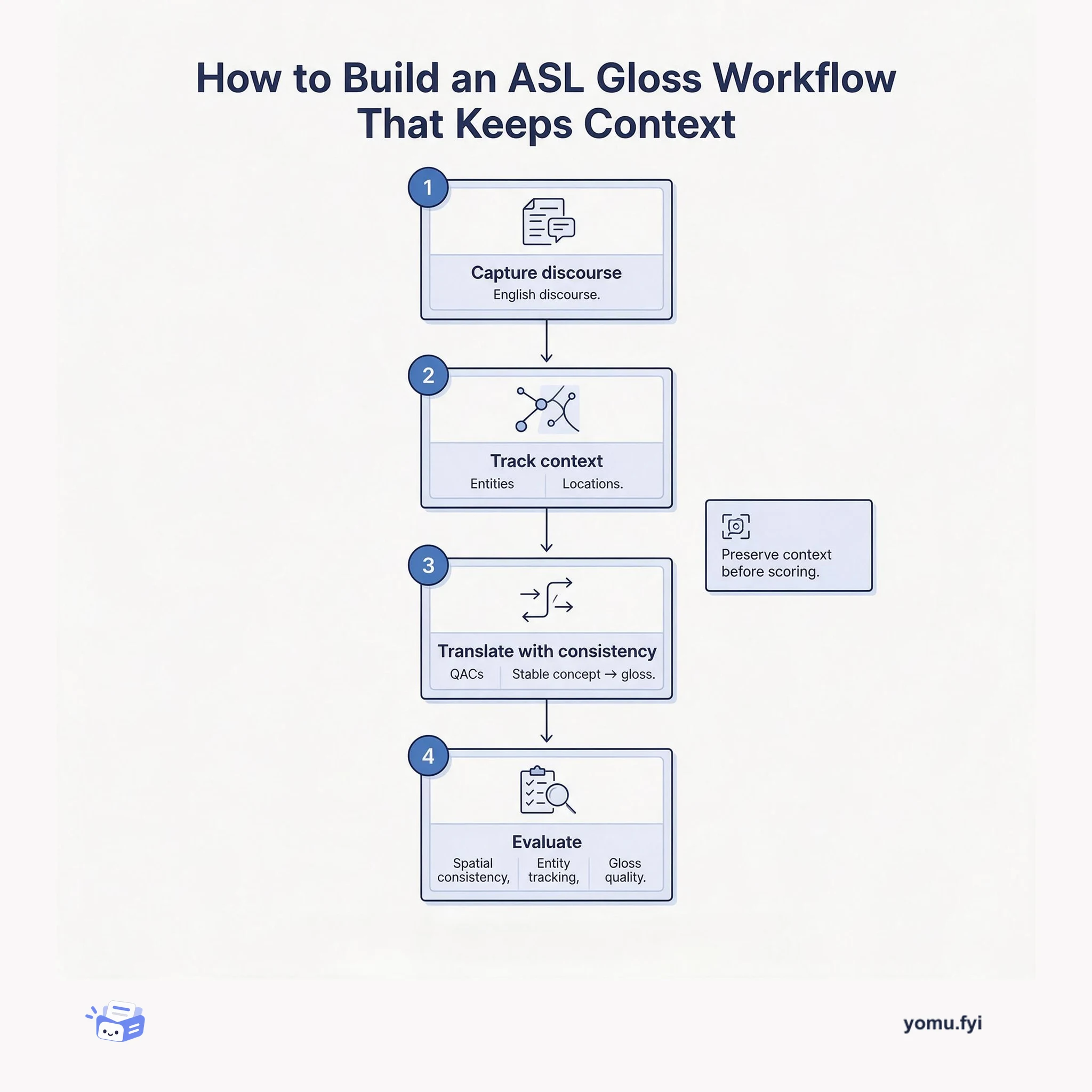
Learn a practical workflow for translating English discourse into ASL gloss while preserving spatial references, question-answer structure, and consistent concept-to-gloss mappings.
Loading…
Topic
458 posts about AI. Every summary links to the original.
See the idea
Learn a practical workflow for translating English discourse into ASL gloss while preserving spatial references, question-answer structure, and consistent concept-to-gloss mappings.
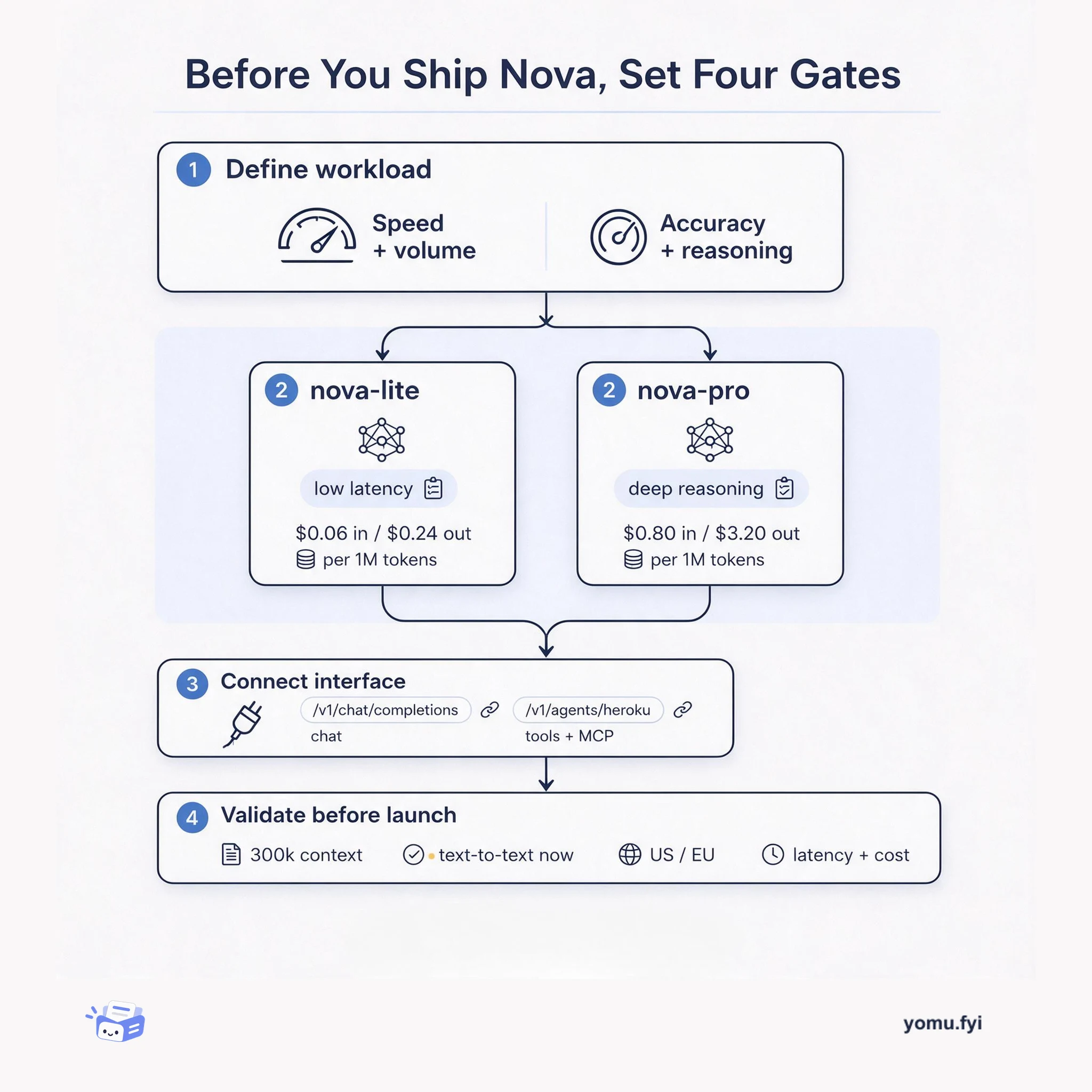
A practical checklist for putting Amazon Nova into an application: choose nova-lite or nova-pro by workload, expose tools, and verify context, modality, region, and cost constraints.
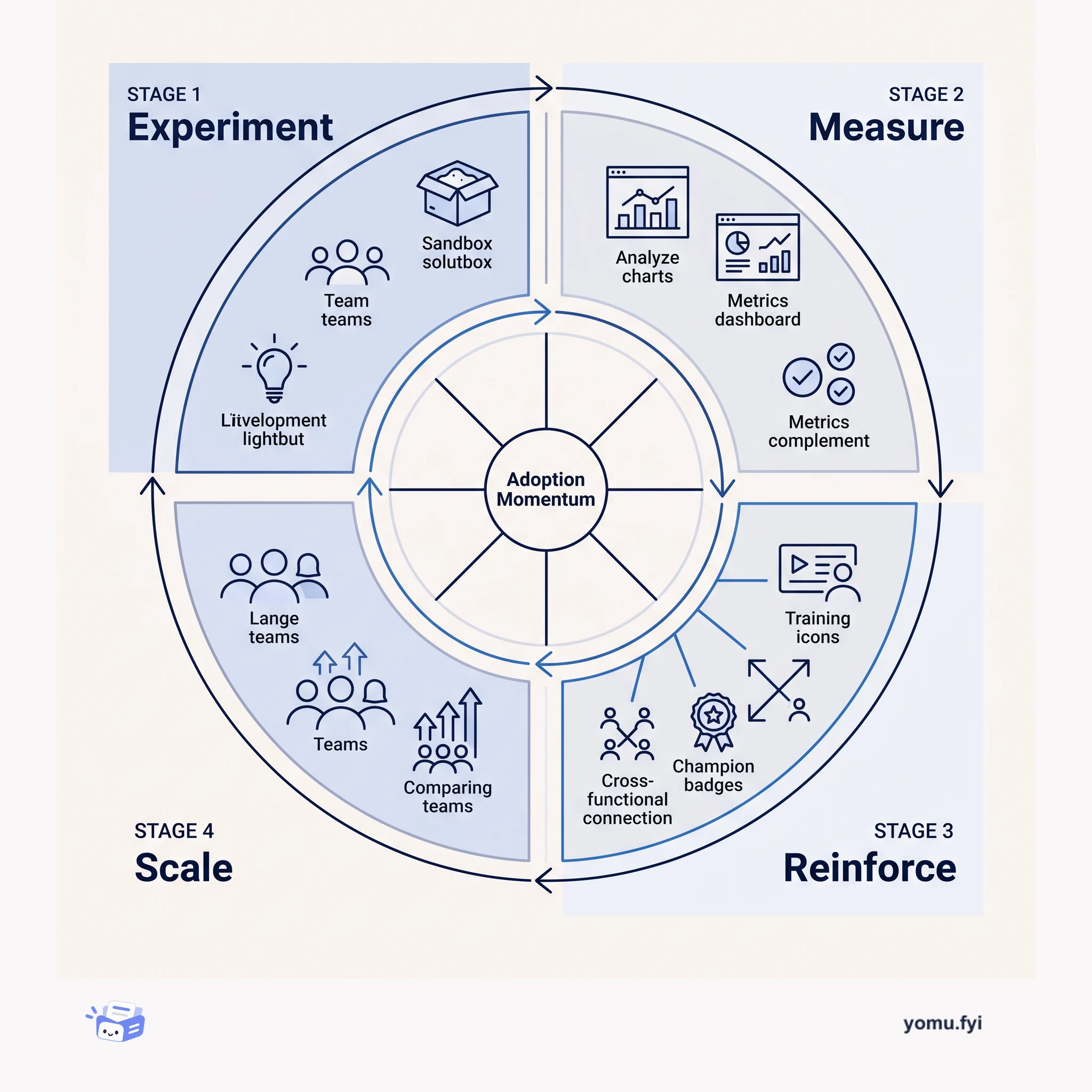
Adoption moves through experimentation, measurement, and reinforcement loops. Learn how leading companies build momentum from pilot programs into enterprise-wide habits and measurable business impact.
The Good Stuff
Paid picks we use ourselves. Links carry a referral code — a subscription through one earns us a commission at no extra cost to you.
Newest first
Michael Truell, co-founder and CEO of Cursor, recounts the company’s path from an initial mechanical-engineering AI project to an AI code editor and developer tool. He describes the pivot, the decision to fork VS Code, and the challenge of building AI-native coding tools while balancing speed with control. Cursor initially prioritized product quality over networking, speaking events, and hiring, then added roughly one person every two to three months while scrutinizing its first hires for belief in the vision and dissatisfaction with the current state. Truell argues that founders should question startup orthodoxy rather than follow universal rules, citing Cursor’s solution-first origin, four-person founding team, and deliberately slow hiring before its reported rapid growth.
A TDWI survey conducted with MongoDB and Capgemini found that only 11% of companies have AI applications in production, despite widespread recognition of AI’s value. The report identifies data readiness challenges including managing diverse data types, ensuring accessibility, and providing sufficient compute power, with less than half of companies managing newer data formats and only 41% feeling they have enough compute. The post argues that AI applications are dynamic, continuously adapting and learning from user behavior, requiring a flexible data foundation unlike traditional static software. MongoDB positions its modern database solutions as essential, citing examples like Lombard Odier’s modernization with generative AI tooling and Victoria’s Secret’s AI-powered visual search using MongoDB Atlas Vector Search. The post concludes that organizations must modernize their tech stacks and execution to keep pace with AI-driven change, or risk being left behind.
In March 2023, an effort to reduce repetitive questions overwhelming Grab’s ML Platform support channels began as a chatbot for platform documentation and became GrabGPT, an internal ChatGPT-like tool. The initial chatbot used chatbot-ui and more than 20,000 words of Q&A documentation, but GPT-3.5-turbo’s 8,000-token limit forced summaries below 800 words; embedding search also performed poorly, so the approach was abandoned. The pivot extended existing frameworks, added Google login, and deployed a tool through Grab’s catwalk model-serving platform, later named GrabGPT. It reached 300 registered users on day one, more than 3,000 users and 600 daily active users by month three, and nearly all Grabbers according to the post, with private routing, global accessibility, multi-provider model support, and auditable interactions cited as reasons for adoption.
Notion introduces Notion AI for Work, an all-in-one set of AI capabilities built into its workspace to address time spent searching for answers, writing updates, and following up after meetings. The release adds AI Meeting Notes, Enterprise Search across connected tools, Research Mode for drafting documents from workspace sources and the web, access to top AI models, and bundled pricing. AI Meeting Notes transcribes conversations, summarizes them, surfaces action items, and stores meetings in Notion so they can be searched and connected to projects; connectors support Slack, Microsoft, Jira, Google Workspace, and GitHub, with more planned. Research Mode can produce project updates, research reports, and internal best-practice documents from a single prompt, while the offering starts at $20 per user per month versus the stated $150–300-plus range for separate tools. Research Mode and AI Meeting Notes are available, while Enterprise Search and connectors are rolling out.
The post examines why organizations struggle to make AI useful in daily work despite strong demand. Tool fragmentation forces teams to search across disconnected systems, manually prepare data, and switch context, while resource limits and concerns about hallucinations complicate adoption. A survey of 1,000 productivity-software decision-makers found that integrating AI into existing systems was the leading challenge, while productivity motivated 57% and AI specifically motivated 44% of platform evaluations. The post presents embedded AI and connected workflows as the response, citing Notion AI’s AI Meeting Notes and Enterprise Search as examples. It reports that 86% of users would be disappointed without it, over 70% report improved work quality and faster information processing, and 50% save more than an hour weekly.
Notion Mail’s founders argue that email remains universal but has become an overwhelming work hub, forcing messages ranging from spam to critical information into an equal inbox structure. They describe rebuilding it around a familiar inbox with Notion’s more opinionated conventions, including labels instead of folders, no nested labels, and a modern editor with shortcuts, slash commands, and mentions. The team says earlier AI plans focused on advanced drafting and auto-response, but research suggested most users need organization more than composition; on a given day, 80–90 percent may only want to read email. Its resulting Auto Labeling feature learns from a few confirmed examples and applies personalized labels, such as doctors’ appointments or customer support requests, to future messages. The founders position this as a shift from speeding up manual triage toward helping people take action and gather information, while leaving future direction to user feedback.
eBay announces a new AI shopping agent designed to provide personalized product recommendations and guidance throughout the marketplace and buying journey. It uses shopping preferences, user requests, and predictive inline messaging to support activities such as finding gifts or assembling a Spring Break wardrobe. The agent extends eBay’s shift from simple chatbots toward conversational and interactive systems intended to understand, interact with, and anticipate customer needs, combining agentic AI with eBay’s infrastructure, customer insights, and product knowledge. eBay says its Responsible AI team collaborates on AI-powered features to align them with safety, fairness, transparency, and accountability, while the new experience starts with a small percentage of U.S. customers and will expand on a rolling basis.
Cursor introduces a representative sample of the people on its team and collaborators, spanning infrastructure, distributed systems, AI research, design, performance, and product development. The profiles include Aman Karmani, Jeremy Stribling, Jacob Jackson, Ian Huang, Sasha Rush, Alex Haugland, Ryo Lu, Lukas Möller, Jack Gallagher, and Michael Feldstein, with prior work at GitHub, Keybase, OpenAI, Cornell, Google, Notion, DeepJudge, Midjourney, Figma, and Meta. Their cited work includes KBFS, speculative decoding, a browser-based multiplayer Minecraft engine, language-model efficiency and long-context research, Cursor’s in-house inference engine, and Midjourney pretraining and reinforcement learning. The post invites people interested in transformational AI products, frontier RL, AI infrastructure, or distributed systems to contact [email protected].
eBay has introduced a simplified, mobile-friendly listing flow that integrates its “magical listing” AI technology to reduce the effort required to create high-quality listings. Sellers start with photos and a title, while AI uses image matching and inference to suggest item specifics and categories through guided pages where sellers can review and approve the content. Early testing in the U.K. found a 50% reduction in total listing steps and faster listing times, while eBay says item-specific accuracy will continue improving through updates made during the year. The tool is available in the eBay mobile app for private sellers across all categories in the U.S., U.K., and Germany, and eBay plans to expand it to sellers using business tools.
Fly.io reports that users driving the platform’s most recent growth are robots rather than people, prompting a reconsideration of developer experience (DX) as the primary product lens. The post describes how vibe-coding workflows use Fly Machines—Docker containers running as hardware-isolated virtual machines—to create, modify, stop, and rapidly restart environments without paying during stopped periods. These workflows favor incremental filesystem state, object storage, and controllable routing for MCP connections, including potentially long-lived SSE connections that should reach the same stateful instance. Fly.io also proposes exposing its API through MCP and using sealed, tokenized secrets so isolated machines can substitute real OAuth credentials only when needed. It concludes that a useful robot experience (RX) will require more than an MCP interface, while managed Postgres remains the company’s most important engineering priority and the platform is still primarily designed for humans.
Notion announces Lena Waters as its new Chief Marketing Officer while the company prepares to ship Notion Mail and enters a new phase of growth. Waters says she was attracted by Notion’s technical vision, user enthusiasm, mission, and volume of product releases, and brings experience from Grammarly and Docusign across consumer and B2B marketing, AI, IPO, acquisition integration, and multi-product expansion. She describes her operating theme as building scalable systems without sacrificing creativity, authenticity, or user connection. Her view of marketing’s AI role includes articulating a clear vision and roadmap, educating users, and collecting feedback as Notion AI changes how people work, think, and create. Her immediate priorities are listening, learning, meeting users, and understanding individual and enterprise customers.
Social listening queries filter relevant brand, product, industry, or consumer mentions from large volumes of online conversation, beginning with the research questions the analysis should answer. The guide explains Boolean operators including quotation marks for exact phrases, OR for alternatives, AND for context, NEAR/x for proximity, NOT for exclusions, wildcards for variations, and brackets for grouping. It recommends adding misspellings, hashtags, account handles, websites, and exclusions, then testing and adjusting the query while keeping its structure simple where possible. Brandwatch Consumer Research offers Boolean, non-Boolean, and blank query options, with editor validation and Iris AI suggestions for entities, keywords, hashtags, subreddits, and multilingual terms.
eBay has introduced UX enhancements that make local listings, fast-shipping items, delivery estimates, and retail standards easier to find on Search item cards. Because its inventory comes from thousands of sellers in a global, decentralized network, eBay uses artificial intelligence that considers customer proximity, chosen shipping service, seller shipping history, and real-time data synchronization to improve estimate accuracy and coverage. Item cards now show delivery ranges for all fast-shipping items, whether delivery is paid or free, while the “Shipping and pickup” filter supports fast shipping, Free shipping, Local pickup, and Click & Collect options. For local pickup, cards display the exact distance between the buyer and item location. In Germany, the eBay Top-Service badge identifies items meeting standards including fast and free shipping, easy returns, and trusted sellers, simplifying overlapping retail signals.
Fly.io’s GPU bet was intended to give internet-facing apps fast AI/ML inference through Fly GPU Machines, which pair a hardware-mapped Nvidia GPU with a Fly Machine. Building them required dedicated GPU servers, Intel Cloud Hypervisor with PCI passthrough, driver work, orchestrator changes, security assessments, and handling large model-weight files. The product has not found product-market fit because most software developers want LLM APIs and services such as OpenAI, Anthropic, Claude, GPT, Replicate, or RunPod rather than raw GPUs, while serious GPU users seek much larger clusters and lightweight users may be too uncertain a market. L40S demand exists, but those GPUs are not driving the core business. Fly.io will keep existing GPU Machines but does not plan a near-term v2, concluding that the bet was worth making without compromising its isolation or developer experience.
The article examines how companies on the Forbes AI 50 list are adopting AI for knowledge work, noting that research with Harvard Business Review found only three percent of organizations use AI for knowledge management. Examples from Synthesia and Wiremind favor small, practical wins, including onboarding videos, data visualizations, staging-versus-production comparisons, and complex dataset validation. Adoption is supported through experimentation, departmental AI champions, sandbox hours, documented guidelines, colleague-led training, and feedback systems rather than forced rollout. To measure impact, the companies track usage, new use cases, employee satisfaction, time savings, and output quality; Pinecone reports an 8× increase in sales activity after implementing AI tools. The article concludes that AI may initially expand team capability instead of immediately reducing costs, while repeated experiments can build lasting work habits and support innovation.
eBay announces a collaboration with OpenAI as part of its strategy to shape agentic ecommerce and redefine online discovery and shopping for enthusiasts. The company is among the first to collaborate on the research preview of Operator, an AI agent that acts as a virtual assistant and autonomously performs tasks across the internet, including online shopping. Operator directs users to eBay for unique inventory finds, a model eBay anticipates will expand sellers’ reach by giving more buyers exposure to that inventory. The announcement also places the work within eBay’s broader effort to evolve internal AI agent capabilities and deepen strategic partnerships while learning how these technologies can empower buyers and help sellers grow their businesses.
Grab developed LLM-Kit, a comprehensive framework for setting up production-ready Generative AI applications while addressing security, scalability, integration, monitoring, and standardisation concerns. Its pre-configured structure includes an API server, configuration management, a sample LLM Agent, tests, and an integrated stack spanning Poetry, Gunicorn, FastAPI, LangChain, LangSmith, HashiCorp Vault, Amazon EKS, and GitLab CI. Engineers submit application details through a form, which triggers GitLab project and code-scaffold generation, CI/CD setup, Terraform-based staging and production infrastructure provisioning, and secure GPT-token storage in Vault. The scaffold also includes authentication, API documentation, observability, Redis and vector-database integrations, deployment pipelines, and a cookbook with organisational examples; the post reports that it has onboarded hundreds of GenAI applications and saves an estimated 1.5 weeks before teams begin their first feature.
Cursor announces that Supermaven, a fast, context-aware coding copilot, is joining the company, bringing creator Jacob Jackson and the Supermaven team into the effort. The post says the combination is intended to accelerate development of a more useful product built around purpose-built models, a tailored editing experience, and other product ideas. It anticipates product improvements, including a future version of the Tab model designed to be fast, context-aware, and highly intelligent during sequences of long changes. The Supermaven plugin will remain maintained, although Cursor will be the team’s core focus. The shift follows Supermaven’s earlier move toward an editor because extension APIs were blocking further capabilities the team wanted to build.
Anthropic outlines its preparations for the 2024 U.S. election cycle, the first in which generative AI tools are widely available. Since July 2023, it has updated its Usage Policy, strengthened misuse detection, and redirected users toward authoritative voting information. The policy prohibits campaigning, lobbying, election misinformation, targeting voting machines, and interference with vote counting or certification, while Claude's text-only output prevents it from generating image, audio, or video deepfakes. Controls include prompt modifications, API audits, possible account suspensions, cloud-provider coordination, red-teaming, Policy Vulnerability Testing, and automated evaluations of political parity, harmful-query refusals, misinformation prevention, and voter-profiling risks; a TurboVote pop-up handles voting-information requests because models lack real-time election data, while the system prompt states Claude's knowledge cutoff.
Vector databases store and manage high-dimensional vector representations of data, grouping them by similarity rather than traditional row-and-column organization. They support semantic and similarity-based retrieval by converting text, images, audio, or video into embeddings, indexing them with methods such as product quantization and HNSW, and comparing query vectors with indexed vectors. These capabilities underpin use cases including RAG, hybrid search, recommendations, NLP, image and video recognition, and anomaly detection, while sharding, partitioning, caching, and replication support scale. The article distinguishes a vector database from a standalone index because it also provides storage, CRUD, metadata filtering, horizontal scaling, and data management functions, and describes Databricks AI Search as an integrated implementation with automatic scaling, optimization, security, and governance.
The best engineering reads, once a week.