How to Build an ASL Gloss Workflow That Keeps Context
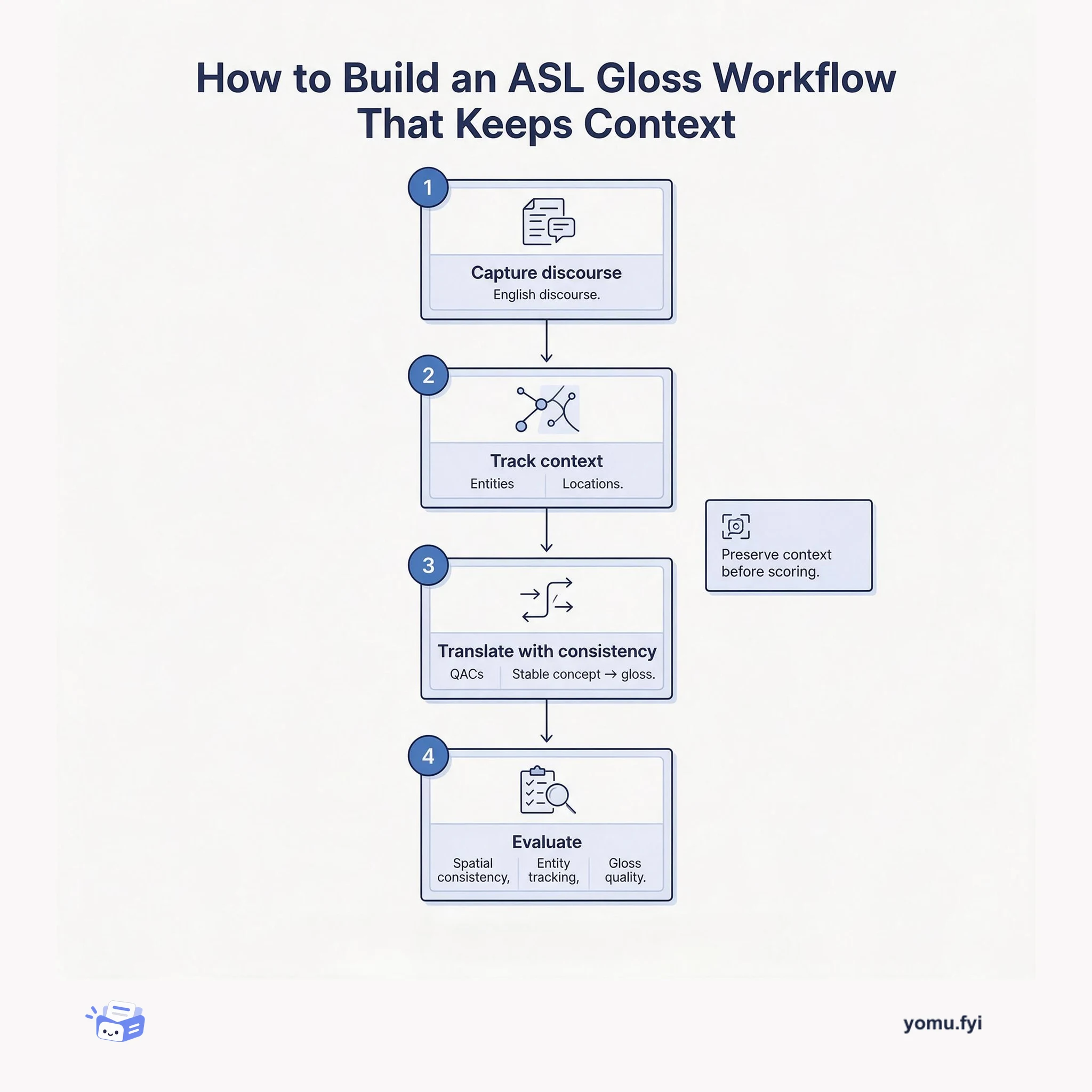
Learn a practical workflow for translating English discourse into ASL gloss while preserving spatial references, question-answer structure, and consistent concept-to-gloss mappings.
Loading…
Topic
486 posts about AI. Every summary links to the original.
See the idea
Learn a practical workflow for translating English discourse into ASL gloss while preserving spatial references, question-answer structure, and consistent concept-to-gloss mappings.
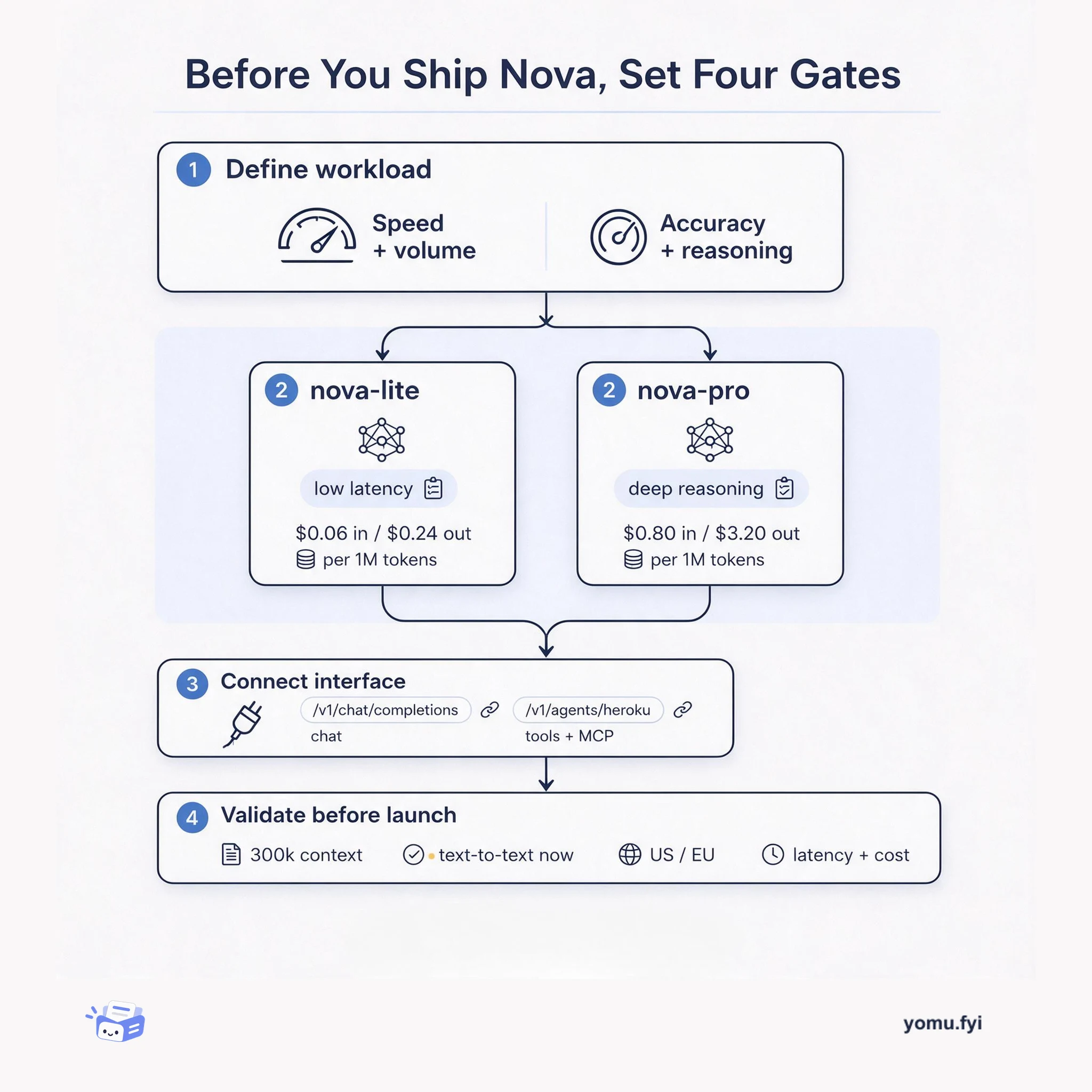
A practical checklist for putting Amazon Nova into an application: choose nova-lite or nova-pro by workload, expose tools, and verify context, modality, region, and cost constraints.
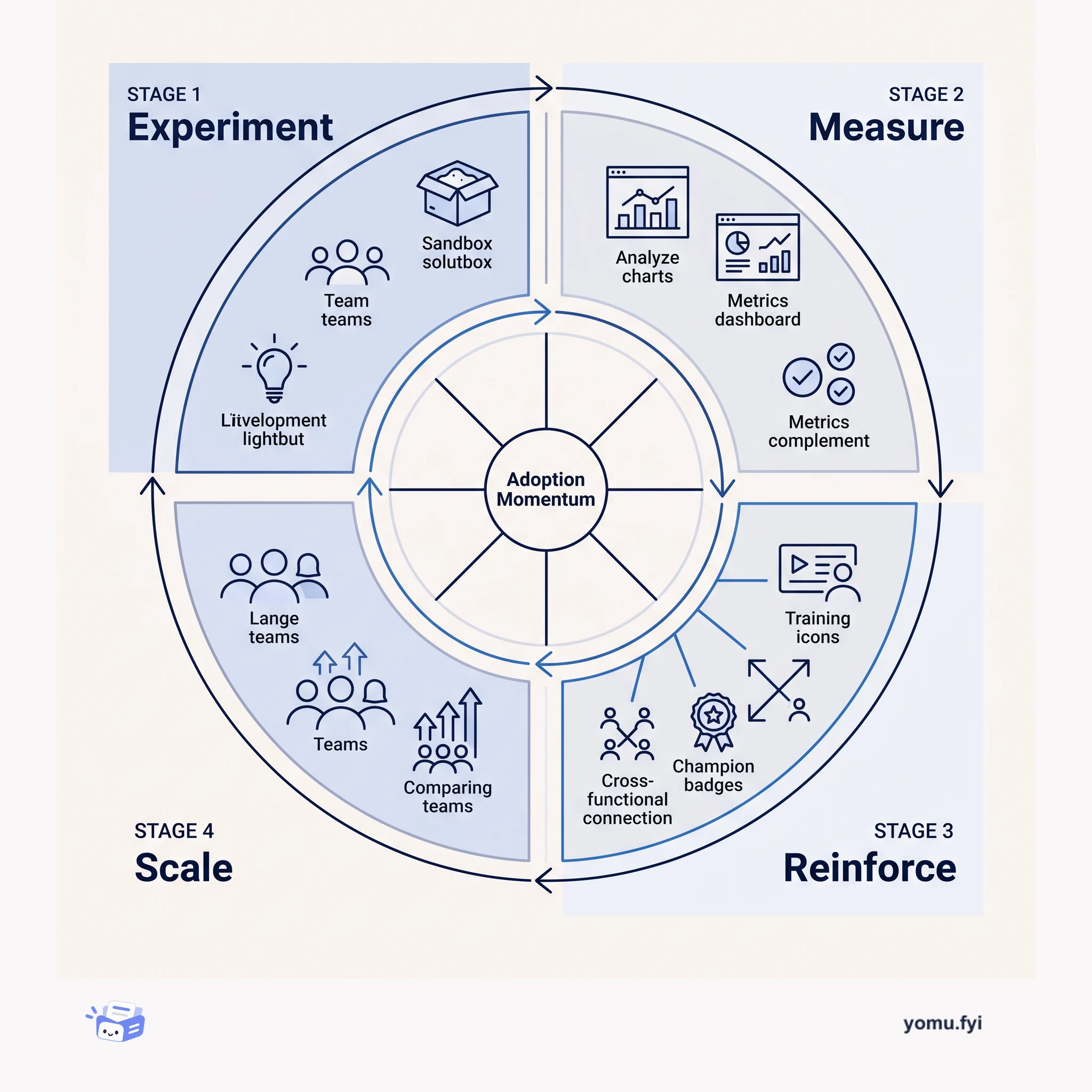
Adoption moves through experimentation, measurement, and reinforcement loops. Learn how leading companies build momentum from pilot programs into enterprise-wide habits and measurable business impact.
The Good Stuff
Paid picks we use ourselves. Links carry a referral code — a subscription through one earns us a commission at no extra cost to you.
Newest first
AI is changing customer service operations by shifting human agents away from queue-level work such as triage and FAQs toward training systems, complex escalations, and strategic improvement. In research from The 2026 Customer Service Transformation Report, 45% of teams updated job descriptions with AI-related responsibilities, 40% said agents focus more on training AI systems, and 27% primarily handle complex escalations and edge cases. Interviews with 166 customers found nearly 95% reporting meaningful workflow changes, while 83% saw roles become more strategic and supervisory; mature teams also reported less time handling support volume. New positions including AI knowledge managers and conversation designers are emerging, while existing staff can move into AI-focused work such as optimizing knowledge, monitoring outputs, and improving customer journeys. The source recommends transparent communication, agent participation, dedicated time outside inbox, and metrics such as resolution rate as teams build operating models with AI at their core.
Dario Amodei says Anthropic considers AI deployment for US and allied democratic defense existentially important and has deployed Claude across the Department of War and other national security agencies, including classified networks and National Laboratories. The company says it supports intelligence analysis, modeling and simulation, operational planning, and cyber operations, while restricting Claude’s use by firms linked to the Chinese Communist Party and advocating chip export controls. Anthropic maintains two safeguards: mass domestic surveillance is incompatible with democratic values, and current frontier systems are not reliable enough for fully autonomous weapons without proper oversight. The Department has stated it demands “any lawful use” and threatens offboarding, a “supply chain risk” designation, and Defense Production Act action; Anthropic says it will not remove the safeguards, while offering continued service or transition support.
The episode presents Harvey’s founding and growth through Gabe Pereyra’s account of building an AI platform for large law firms and their clients. Two roommates—Winston, a securities litigator, and Gabe, an AI researcher—identified an opportunity in legal. Harvey chose a general-purpose platform over a narrow workflow such as NDA review, aiming for a comprehensive AI associate capable of handling varied work. The discussion also covers enterprise accuracy, infrastructure over models, and the difficulty of turning early seven-figure deals into a repeatable sales machine, with investors helping on that learning curve. Harvey’s trajectory includes a seed check from OpenAI and a valuation reported at $8 billion, while the episode frames domain expertise and scalable go-to-market execution as central founder lessons.
Stripe rolled out Cursor to more than 3,000 engineers while preserving its standards for developer experience and API uptime. The company preloaded Cursor on every machine, taught it in onboarding labs alongside VS Code and IntelliJ, and used Cursor Rules to supply codebase and coding-standard context, with teams able to add local rules. Adoption was reinforced by power users, while code review evolved to use LLMs to flag complex methods and risky files so reviewers could focus attention without sacrificing quality. An internal survey found developer sentiment at a five-year high, and MacVicar observed the largest productivity gains among longest-tenured engineers rather than junior developers. That finding has prompted exploration of letting new hires learn the codebase before receiving Cursor access, reinforcing MacVicar’s advice to start before every AI-workflow question is settled.
Anthropic has officially opened a Bengaluru office, marking its second in Asia after Tokyo, and announced partnerships spanning enterprise, education, agriculture, and public services in India. India is Claude.ai's second-largest market, with nearly half of usage involving computer and mathematical tasks; Anthropic says its run-rate revenue there has doubled since its October 2025 expansion. The company is improving support for Indic languages through training data in ten languages and is working with Karya and the Collective Intelligence Project on evaluations for locally relevant tasks in agriculture and law. Other initiatives include Claude-powered education pilots, public-sector projects such as an Adalat AI WhatsApp helpline, and adoption of the open-source Model Context Protocol, while the office will hire local talent and provide applied AI expertise to customers.
Survey data from more than 3,000 global knowledge workers and 85-plus interviews examines why strong demand for workplace AI has not translated into broad adoption. Although 93 percent call AI essential to modern productivity software and 80 percent are likely to switch to a platform offering it, only 20 percent say AI is deeply integrated into their company’s tools. Respondents prioritize recurring workflows such as automated project updates, continuously current knowledge hubs, and goal-based templates, while decision-makers identify integration as the leading implementation challenge alongside security and data quality, unclear strategy, resource constraints, and compatibility. The proposed pattern is to place AI inside existing work, illustrated by Faire’s reported results with Notion AI: smoother meetings for 81 percent of surveyed staff and workflows running 30 percent faster.
CX Score was built to give support leaders a defensible view of customer experience across conversations, addressing whether an automated metric can be trusted. The team grounded its criteria in how experienced support professionals assess strong, mixed, and poor interactions, then created a dataset of thousands of conversations reviewed by experts, with two reviewers where possible and disagreement resolution. It operates as a production system using specialized prompt engineering, support-focused model configuration, neutral defaults for ambiguous evidence, and multi-stage evaluation across LLM models. Precision, recall, F1, regression, and bias checks set a required F1 above 0.8, while field testing with real customers examined varied tickets, languages, agent types, and conversation lengths. The stated conclusion is that CX Score is designed to be inspected, explained, and defended rather than treated as a black-box output.
European organisations face a knowledge paradox: 97% of surveyed business leaders say knowledge management is critical, but only 28% report having a coherent strategy, with poor practices costing up to €16,000 per employee annually. Interviews with leaders in France, Germany and the UK connect scattered information across people and tools to slower progress, weaker decision confidence, repetitive work and lost institutional knowledge. The post argues that centralised knowledge is a prerequisite for effective AI, noting that 56% of organisations already use AI for knowledge management and 29% are piloting it, while incomplete documentation can undermine deployments. Recommended practices include explaining the personal benefit of documentation, designing systems that pull participation rather than enforce compliance, and treating knowledge as a shared organisational asset. Examples include Nelly, Above, UnternehmerTUM and EGYM using simpler documentation workflows and shared spaces to reduce silos and keep information current.
NVIDIA has deployed Cursor across its software development lifecycle, with more than 30,000 developers using it daily and committing over three times as much code as before. NVIDIA’s long-lived, interdependent codebases and varied technology stacks made it difficult to understand downstream effects and keep pace with rapid change. Cursor maps and semantically reasons over large codebases, retrieving relevant context, while custom rules and MCP servers extend it from code generation into reviews, testing, debugging, issue-driven fixes, CI troubleshooting, and git-flow automation. The company also uses it to help new hires learn unfamiliar systems and experienced engineers work across programming languages and stack areas. NVIDIA reports that bug rates have remained flat despite higher coding velocity, while code-style consistency has improved.
Grab introduced Cursor in late 2024 as one of several AI coding assistants and reports rapid adoption across engineering and non-technical teams. Monthly active usage reached 98% of Tech Grabbers, weekly usage about 75%, and Cursor suggestions were accepted around 50% of the time, compared with a cited industry average of 30%. About half of users engage on at least 10 consecutive days monthly, while more than a third of merge requests incorporate Cursor; common uses include test generation, refactoring, code navigation, bug fixing, and routine automation. Grab built monorepo indexing and distributed preconfigured rules for environment-specific suggestions, while a fixed-effects regression effort is examining productivity; early findings report a statistically robust dose-response relationship, with gains increasing alongside usage intensity.
The 2026 Customer Service Transformation Report examines how organizations are adopting AI in customer service, based on a survey of over 2,400 global customer service professionals. It identifies a widening difference between narrow deployments that handle simple questions or workflow steps and mature deployments that integrate AI into critical operations, assign it more responsibility, and improve it continuously. Although 62% of respondents report improved customer-service metrics after implementing AI, mature teams report this at 87%, while only 10% say deployment is mature. The report also finds mature deployment associated with higher quality and consistency, clearer ROI measurement, and less time spent handling support volume; 43% report higher quality and consistency. With customer experience becoming the top priority for 58% in 2026, support is positioned as a proving ground for expanding AI into customer success, marketing, and sales, with 52% planning that scale.
Notion held a private tender offer in which GIC, Sequoia Capital, and Index Ventures purchased about $270 million of shares directly from current and former employees at an $11 billion valuation. GIC is a new investor, while Sequoia and Index are returning investors; Notion says GIC’s long-term outlook and experience supporting growth in APAC and globally aligned with its future plans, including its Singapore office and regional presence in Tokyo, Seoul, and Sydney. The company says its growth accelerated in 2025 alongside AI adoption: more than 50% of ARR came from AI-enabled customers at the end of last year, and that percentage more than doubled over the last year. To broaden participation, Notion removed the one-year vesting cliff on options for current employees, providing financial liquidity to more Notinos and their families.
Dropbox adopted Cursor to increase software-development velocity across a demanding environment: its own data centers handle more than 300,000 requests per second, while thousands of engineers maintain a monorepo exceeding 550,000 files. Engineers first experimented organically in 2024, then AI champions, easier sign-up, and a company-wide hackathon helped broaden adoption; CTO Ali Dasdan’s two-hour “smart finder” experience reinforced executive support. Cursor indexed the monorepo by scanning non-ignored files, splitting code into structured chunks, and generating embeddings for a semantic index that supports code generation and editing. More than 90 percent of engineers now use AI tools weekly, with Cursor appearing across coding, review, testing, documentation, and migrations. Dropbox reports that PR throughput and cycle time have moved into the upper tier of industry benchmarks, while describing an ongoing redesign of its software-development lifecycle.
Salesforce has made Cursor available to thousands of engineers working across a codebase built over more than 25 years, and reports more than 30% higher velocity alongside gains in code quality. Junior engineers used it to understand existing code and contribute more effectively, while senior engineers began with tedious tasks before expanding to higher-value work as trust grew. Adoption spread from small groups that demonstrated impact, and AI eventually reached every part of the software development lifecycle rather than code writing alone. Salesforce tracks cycle time, quality measured by bug count, and throughput; it reports double-digit improvements across all three, an 85% reduction in one team’s legacy code coverage time, and far more unit tests generated with Cursor.
Claude’s constitution describes how explicit principles can guide a language model’s behavior instead of relying on values implicitly determined through large-scale human feedback. The approach uses AI feedback in two training phases: the model first critiques and revises responses using the principles, then reinforcement learning selects the more harmless output using AI-generated evaluations. The post says Constitutional AI produced a Pareto improvement in tests, with the model responding more appropriately to adversarial inputs while remaining helpful and not evasive; harmlessness results came without human harmlessness data. The constitution draws on the UN Declaration of Human Rights, safety practices, other AI-lab principles, global platform guidelines, and attempts to include non-Western perspectives, while remaining an iterative, adjustable document.
eBay’s leaders identify five AI-related trends they expect to shape commerce and engineering in 2026, building on the company’s 2025 work in search, recommendations, seller tools, and eBay Live. They predict AI will absorb complexity across translation, compliance, payments, logistics, and risk while enabling continuous verification and agentic commerce that can negotiate, verify provenance, and execute cross-border transactions. Other forecasts include using AI to surface pre-loved goods, identify recyclable materials, deliver company-specific context to models for developer productivity, and make shopping more emotionally engaging. The final theme is uncertainty: because generative models introduce unpredictable behavior, product teams will need guardrails and faster learning from observable failures rather than relying on fully predictable flows.
BriX addresses “deployment slop,” the gap between quickly built AI prototypes and enterprise production, where inconsistent versions, reliability failures, and security risks can block adoption. The platform centralizes production infrastructure so semi-technical domain experts can configure deployments rather than become DevOps specialists, covering scaling, monitoring, audit trails, access controls, data connections, and consistent behavior. BriX supports switching among models such as Claude, GPT, and Gemini; its Model Context Protocols (MCPs) provide standardized, pre-built connectors to approved enterprise data sources with built-in access controls and query logging. Centralized system prompts and context files enforce shared guardrails, while custom frontends and persistent, shareable reports extend use beyond chat interfaces. The stated result is a platform intended to turn deployment into a configuration task, helping teams move from prototypes to enterprise-grade tools in days rather than months.
Notion welcomes the Sequin team—Eric Goldman, Anthony Accomazzo, and Carter Pedersen—following discussions about the companies’ shared view of fragmented knowledge work. Sequin built a data-syncing product that brought information from systems including Salesforce, ServiceNow, and Stripe into Postgres, giving developers flexible building blocks instead of requiring them to recreate integrations. The founders say they were drawn to Notion’s enterprise search, work on AI and agents, ambitious direction, and strong user community, while Notion describes Sequin’s experience as aligned with its plans. The announcement frames the broader problem as information scattered across documents, conversations, and tools, and points to AI and agents as a way to help teams find information, automate repetitive work, and prepare for AI-native work.
Lean teams competing with larger companies cannot match their rivals’ hiring capacity or budgets, prompting a reassessment of success based on individual impact rather than headcount. Adding tools, integrations, and AI can create a “multi-tool trap,” scattering information and accelerating mistakes when infrastructure and direction are weak. The recommended response is to consolidate work and knowledge into connected systems, invest in documentation such as roadmaps, specifications, requirements, and strategic memos, and choose infrastructure improvements over reflexive hiring. These foundations give AI usable context, preserve decisions through organizational change, and help individuals operate as effective generalists; the conclusion is that scalable infrastructure can let one person do work that once required three, while making each future hire more impactful.
Merge found that company knowledge was scattered across Slack, Google Docs, Salesforce, and other tools, causing repeated questions, slow onboarding, and time lost searching for context. It used Notion AI as a shared knowledge layer, connected Salesforce and Slack, and gave teams guidance on what content to add, including detailed project documents, meeting transcripts, and structured databases. Teams populated the workspace with content calendars, sales enablement materials, hiring plans, roadmaps, and an AI Prompt Library, while all-hands and team meetings demonstrated practical workflows. Merge reports that employees now ask Notion AI first, saving each team member several hours per week, helping teams make decisions with less manual searching, and making faster information retrieval one of the most-cited contributors to improved satisfaction in its latest company-wide survey.
The best engineering reads, once a week.