Activation Steering: One Dial, Two Costs
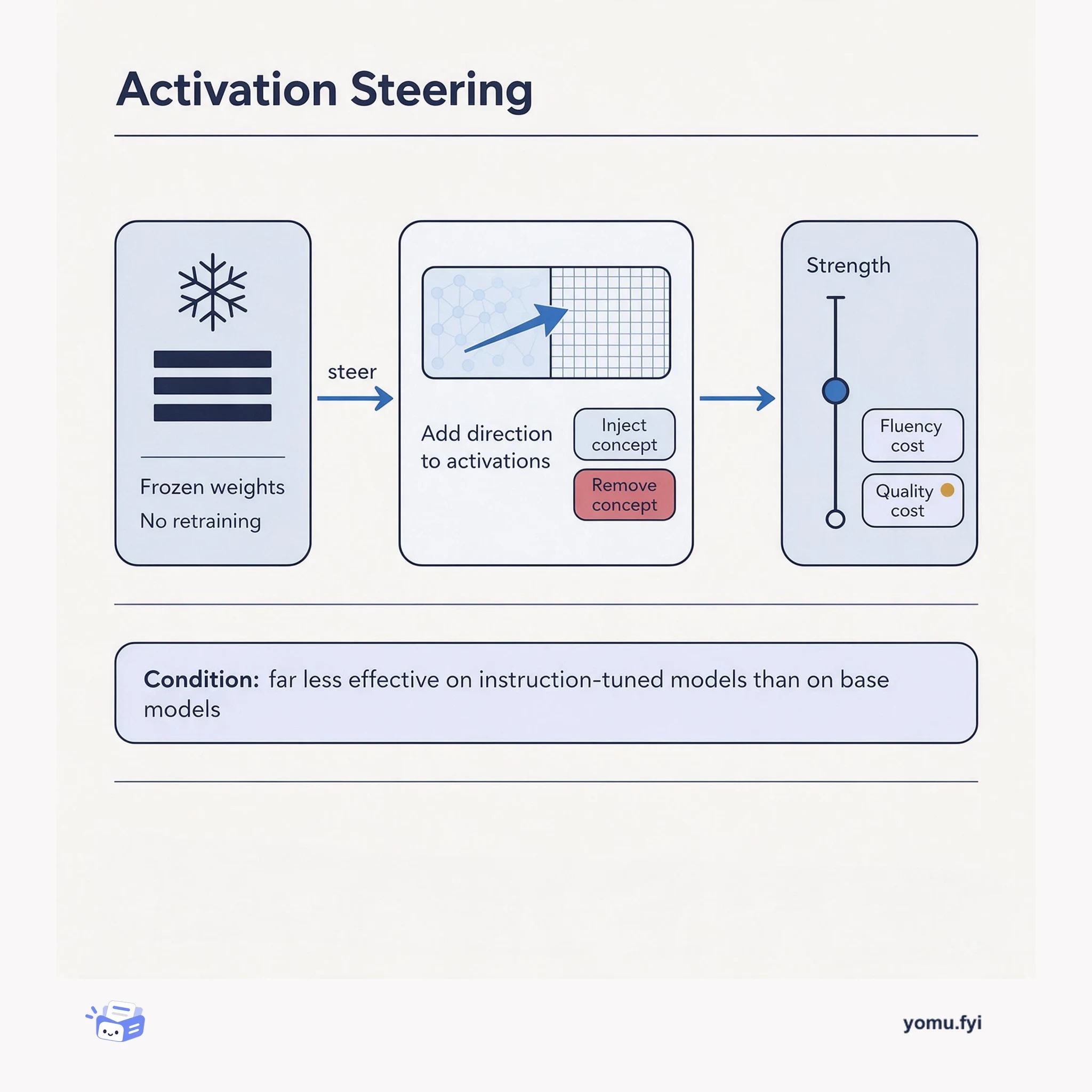
Activation steering edits a model's internal activations to add or remove a concept at inference time. This explainer maps its one control knob, its two costs, and when it beats prompting.
Loading…
Topic
670 posts about LLMs. Every summary links to the original.
See the idea
Activation steering edits a model's internal activations to add or remove a concept at inference time. This explainer maps its one control knob, its two costs, and when it beats prompting.
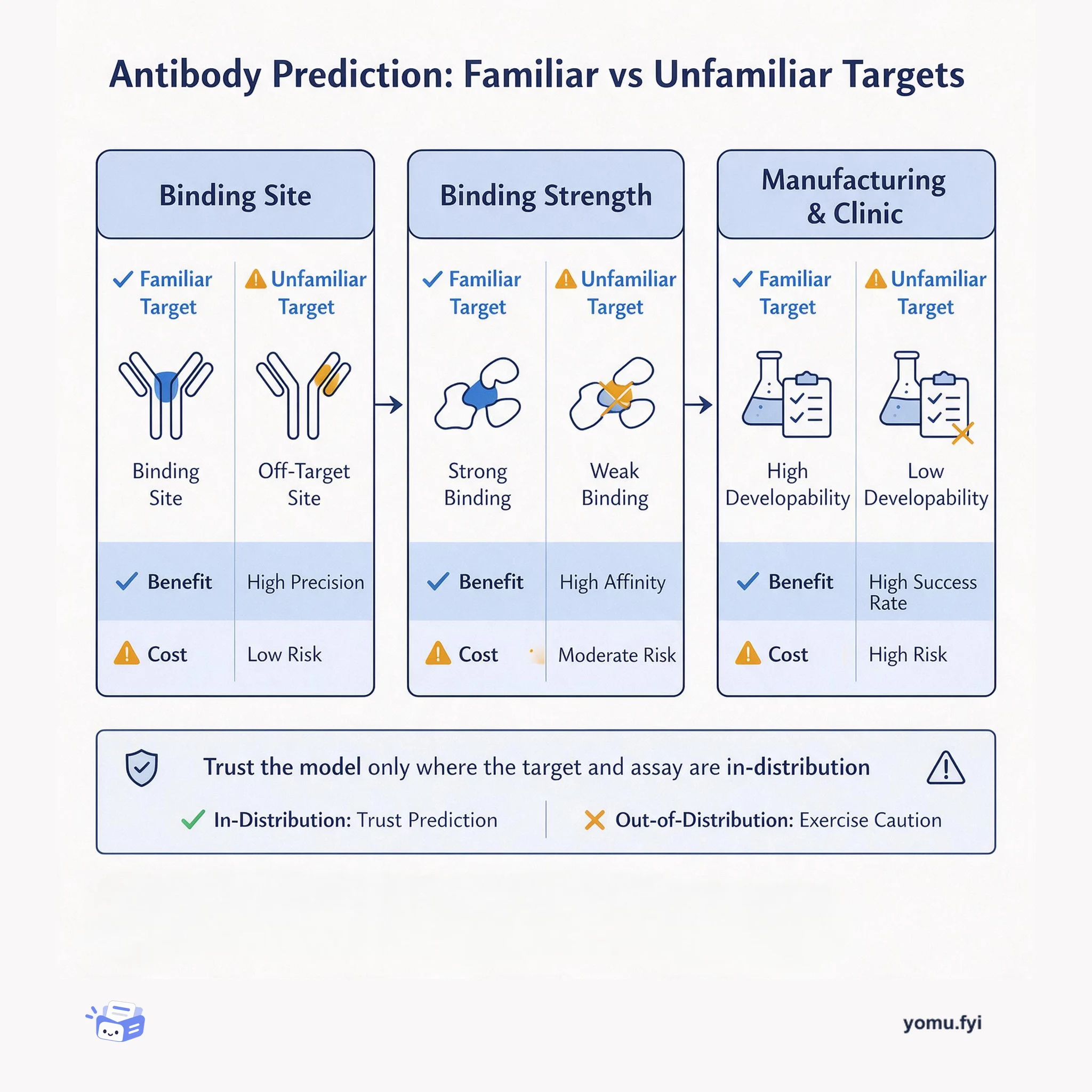
Antibody discovery is a three-stage prediction pipeline, and AI models that excel on familiar targets degrade sharply on unfamiliar ones. This explainer maps where that gap appears and what it costs.
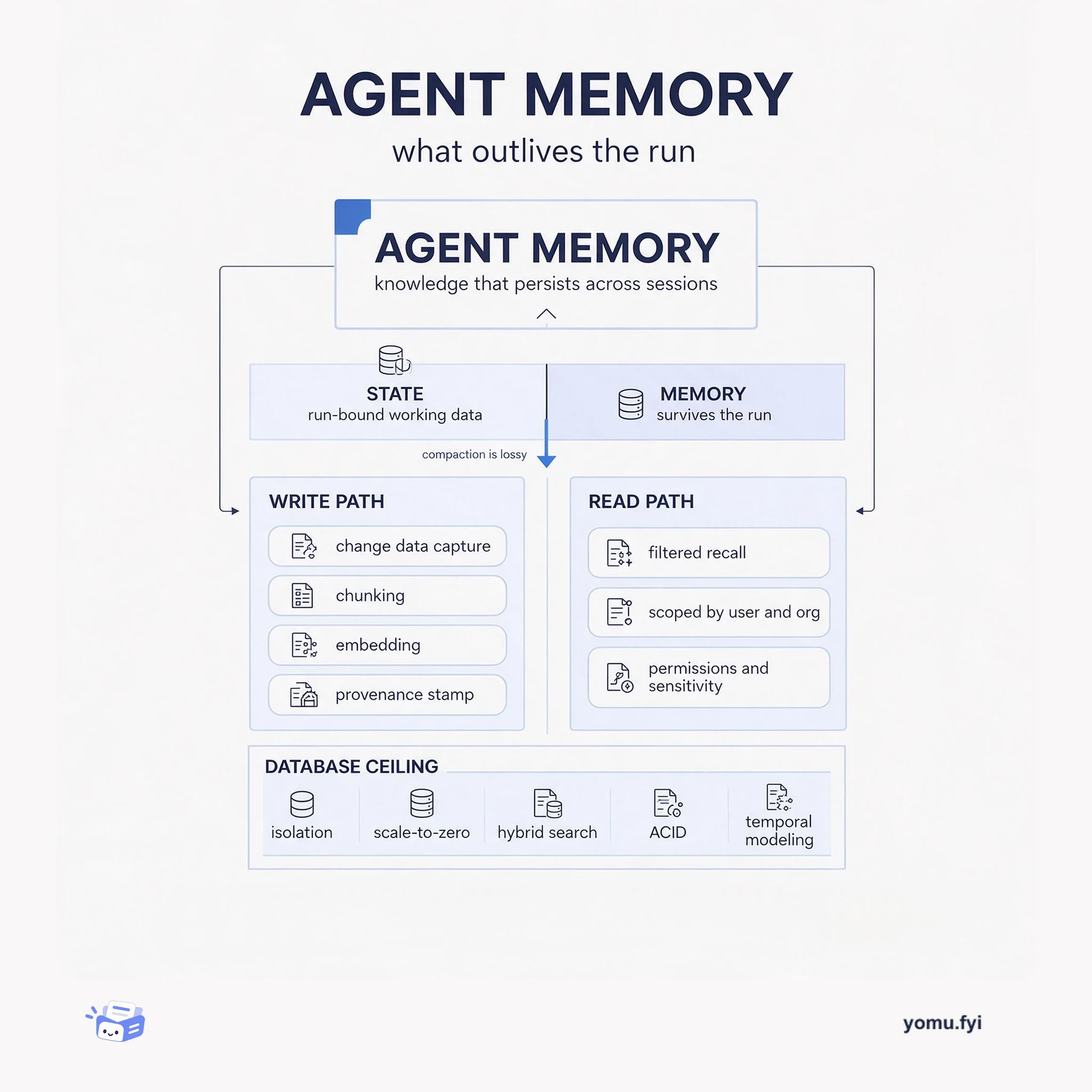
Agent memory is the knowledge that survives a run, not the working state inside one. This explainer separates the two, then maps the write path, the read path, and the database limits that cap recall.
The Good Stuff
Paid picks we use ourselves. Links carry a referral code — a subscription through one earns us a commission at no extra cost to you.
Newest first
Stripe makes thousands of near real-time risk decisions every second, balancing fraud detection against false positives that disrupt legitimate businesses. Zero-shot prompting achieved 0.487 precision, domain-guided prompting 0.706, and human reviewers 0.790 at the same recall. The team applied supervised fine-tuning (SFT) to an open-weight 4B-parameter LLM, serializing features like card payments and account activity into text records, training it on labels, and deriving a continuous fraud score from the next-token probabilities normalized over two label tokens. SFT increased average precision by approximately 24% over domain-guided prompting and 70% over zero-shot prompting, and consistently outperformed XGBoost across multiple risk tasks. Linear probing of hidden states showed that SFT made benign signals more linearly decodable, with ROC-AUC improving from 0.583 to 0.642, indicating the model better recognizes legitimate business activity and reduces false positives.
Production-grade LLM agents require deterministic machinery around the probabilistic model, not a larger model. A maturity model defines six levels: determinism, evaluation, confidence, safety and governance, operability, and production-grade build, each assuming the one below. Teams should fix their weakest level in order, starting with determinism before evals, and contain the model to a single node in a fixed graph where it proposes actions a separate component applies after approval. A self-assessment checklist with items like evals as a CI gate and layered guardrails helps teams identify their current level, with fewer than half ticked indicating they are earlier than the demo suggests. The post links to a series of 25 deep-dive articles covering each rung of the maturity model.
Level 5 covers operability for LLM systems: daily running, cost control, provider outage survival, and fast shutdown on misbehavior. A single gateway funnels all model traffic, measuring cost, routing requests, enabling failover, and hosting an instantaneous kill switch; a shared decision_id threads metrics, logs, traces, and the audit ledger. Observability supplements RED metrics with a decision layer capturing auto vs. human splits, guardrail blocks, judge disagreements, token spend per tenant and capability, and shadow-eval pass ratios via tiered structured logs. Cost controls attribute spending at the gateway per tenant and capability, with hard budget ceilings; optimization follows order: skip model, batch, cache, right-size, trim—each step profiled against quality. The platform spine includes stateless agent services, the gateway, an audit datastore, cache, secrets store, and object storage—scoped with least-privilege IAM and encryption, avoiding queues or vector stores until warranted.
The NVIDIA KGMON team placed second in the KDD Cup 2026 Data Agents competition by building a reliable agent system around a small, fixed LLM. The system constrained the agent’s action space through a harness that normalized data access by converting CSV and JSON files into SQLite tables, exposed a limited set of custom functions for schema inspection, SQL queries, and answer writing, and seeded the agent with schema context before analysis. Documents and videos were handled through targeted tools like prose_helper for extracting rules from documents and keyframe extraction with aligned transcripts for video evidence, keeping the main LLM context focused. The team emphasized inspectability by recording execution traces and running repeated attempts, using evaluation and trajectory review to identify failures and refine the harness. The key lesson is that reliability for data analytics agents often comes from the harness design, not the model’s capabilities.
Fintech companies handling savings, credit, and investments require customer service that builds trust and meets strict regulatory requirements. Intercom’s Fin AI agent, powered by large language models, uses existing knowledge content to automatically resolve over half of customer queries on average. Fundrise reported Fin handled over 50% of support cases within three months, while Sharesies achieved an almost 70% resolution rate over email in 12 weeks. Fin delivers real-time personalization by pulling live transaction data from external systems, supports over 45 languages with real-time translation, and scales during peak periods like tax season. It includes compliance safeguards such as automatic escalation of regulated activities to licensed agents and integration with KYC and AML processes.
JetBrains open-sourced Mellum2.1, a compact 12B mixture-of-experts model with only 2.5B active parameters, released under the Apache 2.0 license. The architecture is unchanged from Mellum2, so all improvements come from post-training through reinforcement learning now the main training phase. The model trained on millions of sandboxed runs across thousands of real environments to develop agentic coding skills like exploring codebases, editing files, and checking its own changes. Performance evaluations show substantial gains in agentic coding, general coding, competitive programming, math, tool calling, and general knowledge compared to Mellum2 and similar open models like Qwen3.5-9B and Gemma 4 E4B. Mellum2.1 matches Mellum2’s speed and with multi-token prediction serves almost twice as many tokens as Qwen3.5-9B under heavy load.
The author wanted a small version of the prompt rewriter that ships with Qwen-Image 2.1, but the official 9B model requires about 20 GB of memory. Using ML Intern in HuggingChat, they created a 0.8B version that runs on a CPU, returns valid output 99.7% of the time, and uses about a quarter of the teacher’s tokens. The compute for the entire project, including having the 9B model label 8,797 example requests, came to USD 16. Over a few days, the author made five more models using the same approach, each starting as a message in HuggingChat with ML Intern switched on. The author’s prompts include verified facts, a baseline request, a smoke test, and a spending cap. The six models built include a citrus disease vision model, a Huggy character LoRA, a camera-angle LoRA, a doodle-in LoRA, a pocket rewriter, and a distilled text-to-image model.
When an LLM system makes decisions that matter, Level 4 safety and governance requires four disciplines: layered guardrails, PII handled at boundaries, an immutable audit trail, and scoped memory. Guardrails are independent layers arranged in a pipeline—input, grounding, output scrub, verification, judge, and confidence routing—each with a simple contract, and they fail closed so an error blocks the request. PII is handled at every boundary by classifying fields—unknown defaults to PII, secret never persisted—and redacting or hashing before crossing, storing only an HMAC hash in the audit ledger. The audit ledger is append-only, tamper-evident, and written as the final step of each decision, making past decisions traceable with a one-row query. Memory is split into seed (shipped config) and runtime (earned state); clear_state purges only runtime, returning behavior to baseline, and learning flows through a reviewed merge into seed.
A production LLM system must know when it is uncertain, not just produce answers. The confidence layer composes a score from four independent signals — model self-score, deterministic verification, judge agreement, and historical accuracy — with the model’s own claim deliberately weighted lowest. That raw score is calibrated via isotonic regression against empirical accuracy so that a score of 0.9 means right roughly 90% of the time. A per-slice threshold decides automation versus human review, and an abstain floor escalates inputs too uncertain to even draft. An independent judge evaluates high-stakes decisions, feeding its agreement into the confidence score and flagging disagreements. Human handoffs show the draft, reasoning, evidence, and why it was routed, and every human action is captured as signal to tune thresholds and improve the agent.
The post argues that evaluation for LLM systems must function as a deployment gate in CI, not as an ad-hoc notebook exercise, to catch regressions before they ship. It describes a structured golden set of test cases with explicit scoring, versioned alongside code, and auto-routed to slices based on request attributes, with per-slice pass-rate gates to prevent a 99% overall from hiding a 70% slice. The gate catches sharp quality drops (cliffs) but misses gradual degradation (slow leaks) across releases, which requires separate drift detection. Drift detection compares each run against a known-good baseline using a two-proportion z-test or difference-of-means test, flagging meaningful regressions even when the pass rate remains above the floor. Shadow evals sample a percentage of live decisions, score them out-of-band, and feed failures back into the golden set, while trend signals like human override rate and confidence shifts indicate emerging drift.
The post introduces Level 1 of a six-level maturity model for production LLM systems, the determinism layer, which contains the model to a single node so the surrounding system is ordinary, testable code. The core design move is making the agent a pure function that proposes decisions without side effects, with a separate substrate that applies proposals only after approval. The system uses a fixed graph of nodes where the LLM is used only in one node for judgment, and all other nodes are deterministic, testable code. Structured output is enforced via schema constraints and validation, and confidence is composed from independent signals rather than taken from the model. For capabilities requiring autonomy, a bounded loop with a step cap and tool allow-list is used, but the default is the fixed graph to maintain predictability and auditability.
Red Hat’s emerging technologies team built IdeaBot, an AI-enabled SaaS platform on OpenShift that automates innovation workflows from initial concept to a standardized idea report. The platform guides users through four stages—discovery, research, refinement, and synthesis—using conversational interviews, automated research across internal and external sources, a curation board with confidence scoring, and a synthesis view that compiles deliverables like executive summaries and market analysis. Security enforces session isolation in dedicated pods, credential isolation through an auth proxy and token service that injects short-lived tokens, and stateless compute with PostgreSQL persistence and a warm pod pool to reduce cold starts. Development uses EARS syntax and Gherkin feature files to drive behavior-driven development, enabling automated test generation and reproducible builds. Red Hat plans to extend IdeaBot toward fully autonomous, reproducible agentic SDLC pipelines using factory patterns.
LLM-native IDEs (LIDEs) that allow AI agents to read repositories, execute commands, and modify code introduce significant security and privacy risks, as developers report incidents like leaked API secrets and file deletions. The authors analyzed 15.4 million Reddit posts from 46 subreddits using a three-stage pipeline, manually verifying 446 relevant posts and 6,280 comments for qualitative coding. They developed a taxonomy of 32 issues across 10 categories, with unauthorized file operations being the most frequent security problem (43.1%) and lack of transparency the top privacy concern (45.9%). Seven of the ten issue categories stem from system-level design choices rather than the underlying LLM’s reasoning. Developers commonly use self-devised workarounds such as configuration management (33%) and code governance (31%), indicating a trust gap between expectations and actual LIDE guarantees.
Bitwise determinism ensures independent and checkpoint-resumed training runs follow the same numerical trajectory, providing four key benefits: replaying failures, preserving checkpoint continuity, detecting unexpected differences, and comparing changes without run-to-run variation. At trillion-parameter scale across thousands of GPUs, nondeterminism complicates failure reproduction and fix validation. NVIDIA Megatron Core targets two guarantees: independent reproducibility and bitwise checkpoint resume. The post describes a validation procedure using full-precision metrics and a progressive tracing workflow that uses torch.hash_tensor for GPU-resident fingerprints to narrow divergence from end-to-end metrics to the responsible kernel. A Nemotron case study demonstrates that kernel optimizations, such as separating grouped-GEMM writers and applying a fixed reduction order, can reduce the determinism performance overhead to approximately 2% steady-state determinism tax at scale.
Anthropic is expanding its Cyber Verification Program (CVP) to make advanced AI models with reduced safeguards available to qualifying security professionals. The program now offers three access tiers—Defense Access, Red Team Access, and Specialized Access—each with different verification requirements and security controls. Defense Access allows defensive work like incident response and vulnerability analysis, while Red Team Access adds authorized penetration testing. Specialized Access, with the fewest cyber blocks, is reserved for organizations testing high-risk safety systems and is reviewed in collaboration with the US government. Evaluations on CyScenarioBench showed that the Red Team Access tier did not block any tasks and achieved a 68% success rate, equivalent to no safeguards, while the Defense Access tier blocked 46 of 50 tasks.
Falcon-Emirati-7B is a dialect-specialized language model built on Falcon-H1-Arabic to understand and generate Emirati Arabic, a Gulf dialect with distinct vocabulary and cultural context that Modern Standard Arabic models miss. The model uses a hybrid architecture combining Mamba state-space models and Transformer attention running in parallel inside every block, with fused outputs for efficient long-context processing. Training required a dedicated data pipeline of authentic Emirati web content, MSA material about Emirati culture, and synthetic data guided by strict glossaries and style rules to cover gaps in available dialectal text. On the Alyah benchmark, Falcon-Emirati-7B scored 84.83%, outperforming larger multilingual models, and achieved 85.57% on the UAE cultural understanding task in ArabCulture-Dialogue. The 7B parameter size was chosen as the best balance of quality against training and inference cost for dialect adaptation.
Existing systems estimate user price sensitivity from spending behavior or demographic proxies, missing residential property values and creating one-dimensional profiles. This invention proposes a four-step method that combines public property data with LLM-assisted data structuring, building-level price estimation, hierarchical clustering, and user mapping. The method collects public property records, uses LLMs to standardize attributes such as postcode, transaction price, and property size, then aggregates transactions within buildings to calculate weighted average sale prices. A hierarchical clustering model groups buildings into affluence tiers based on estimated resale values, accounting for regional market differences, and users are mapped to these tiers via aggregated geographic signals. The approach remains unimplemented and untested in live markets, with potential applications in personalization, advertising, and operational planning subject to future technical validation and privacy approvals.
Training a single LLM agent jointly across diverse interactive environments is challenged by scalar rewards that provide limited information about cross-environment relationships and no within-group reward contrast when rewards are identical. RISED addresses this by using rubrics—textual descriptions of rollout behaviors—to guide both online data selection and policy supervision. An LLM judge tags each rollout with a predefined rubric vocabulary shared across environments, and these profiles select data aligned with the batch’s behavioral composition while limiting overlap with already-selected data. Positive rubrics supply token-level supervision via an on-policy self-distillation teacher, while negative rubrics steer subsequent rollouts away from recurring failure modes. Across model backbones, RISED achieves the highest mean pass rate across environments and ranks first or second in every individual environment.
The talk traces the tech industry’s journey from the late stages of SaaS in 2019, through pandemic virtual offices and NFTs, to the 2022 downturn and ChatGPT’s launch in November 2022. 2023 was a year of prototypes and ‘thin wrappers’ on ChatGPT, but also real learning about building with LLMs, including non-deterministic approaches. The author argues the AI transformation is now real, moving beyond superficial features to fundamentally rethinking products, exemplified by the shift from ‘Software as a Service’ to ‘Service as Software.’ The future of customer service includes proactive, personalized bots, video and voice bots, and the ability to analyze all conversations to deeply understand customers. The author cites Bloom’s 2 sigma effect as an example of AI’s potential in education and urges optimism, noting that learners will inherit the earth.
Elizabeth McGuane, UX Director at Shopify, argues that the design process should begin with words—defining concepts and building shared language—before any visual work. She draws on 15 years of experience in web and product design to explain that misalignment often stems from teams arguing over names because they haven’t agreed on what something actually is. Her book ‘Design by Definition’ provides methods to use linguistic elements like metaphor and narrative to frame design problems clearly and improve collaboration across disciplines. McGuane emphasizes treating text as a spatial design element, prioritizing simplification and consistency over literary flourish. The interview also covers how evolving technologies like LLMs challenge traditional interface conventions, requiring designers to rethink their approach.
The best engineering reads, once a week.