APAC Is Not One Region: The Regionalize vs. Standardize Tradeoff
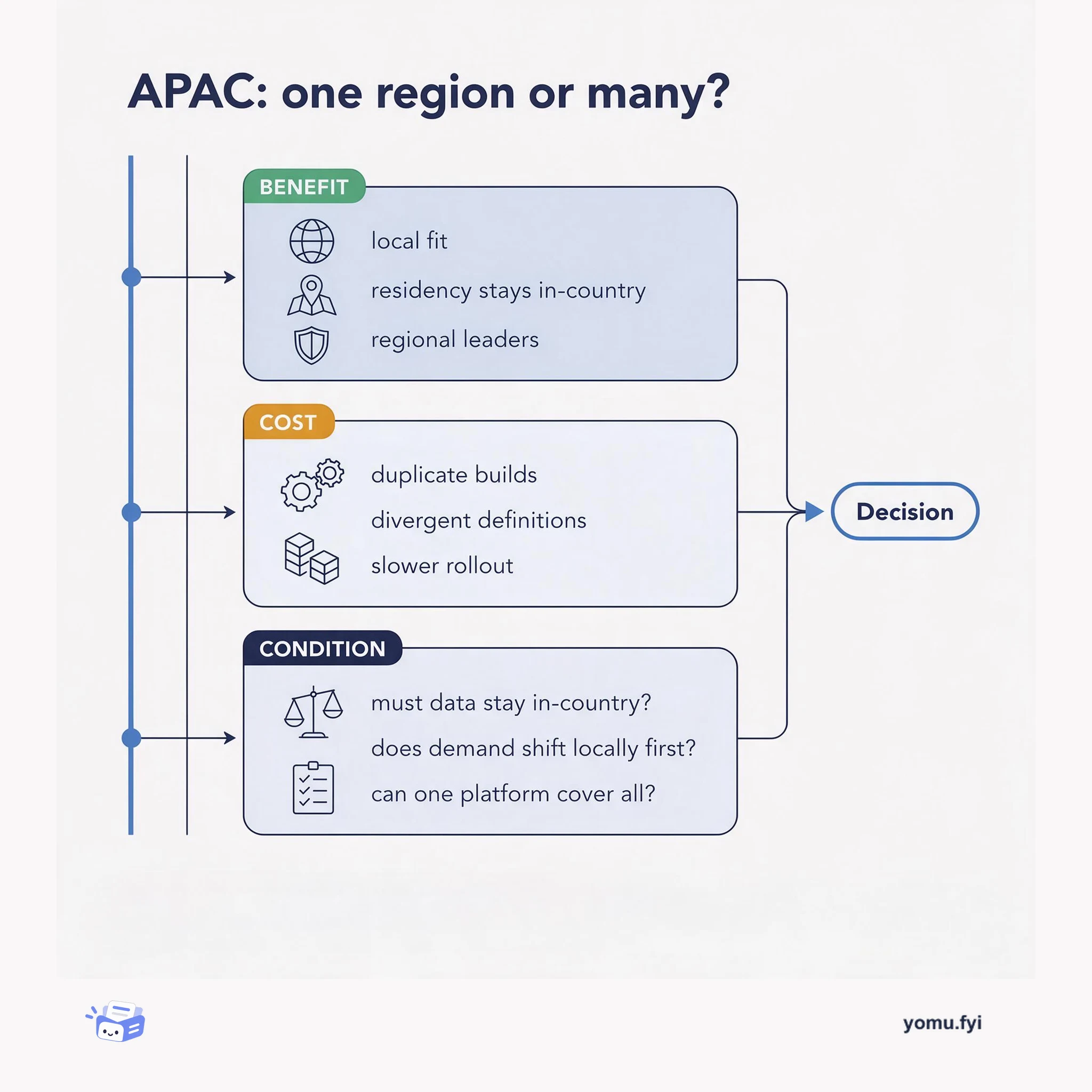
APAC is a federation of markets, not a single deployment region. This diagram maps the tradeoff between local autonomy and one shared platform, and the conditions that decide it.
Loading…
Topic
5 posts about Localization. Every summary links to the original.
See the idea
APAC is a federation of markets, not a single deployment region. This diagram maps the tradeoff between local autonomy and one shared platform, and the conditions that decide it.
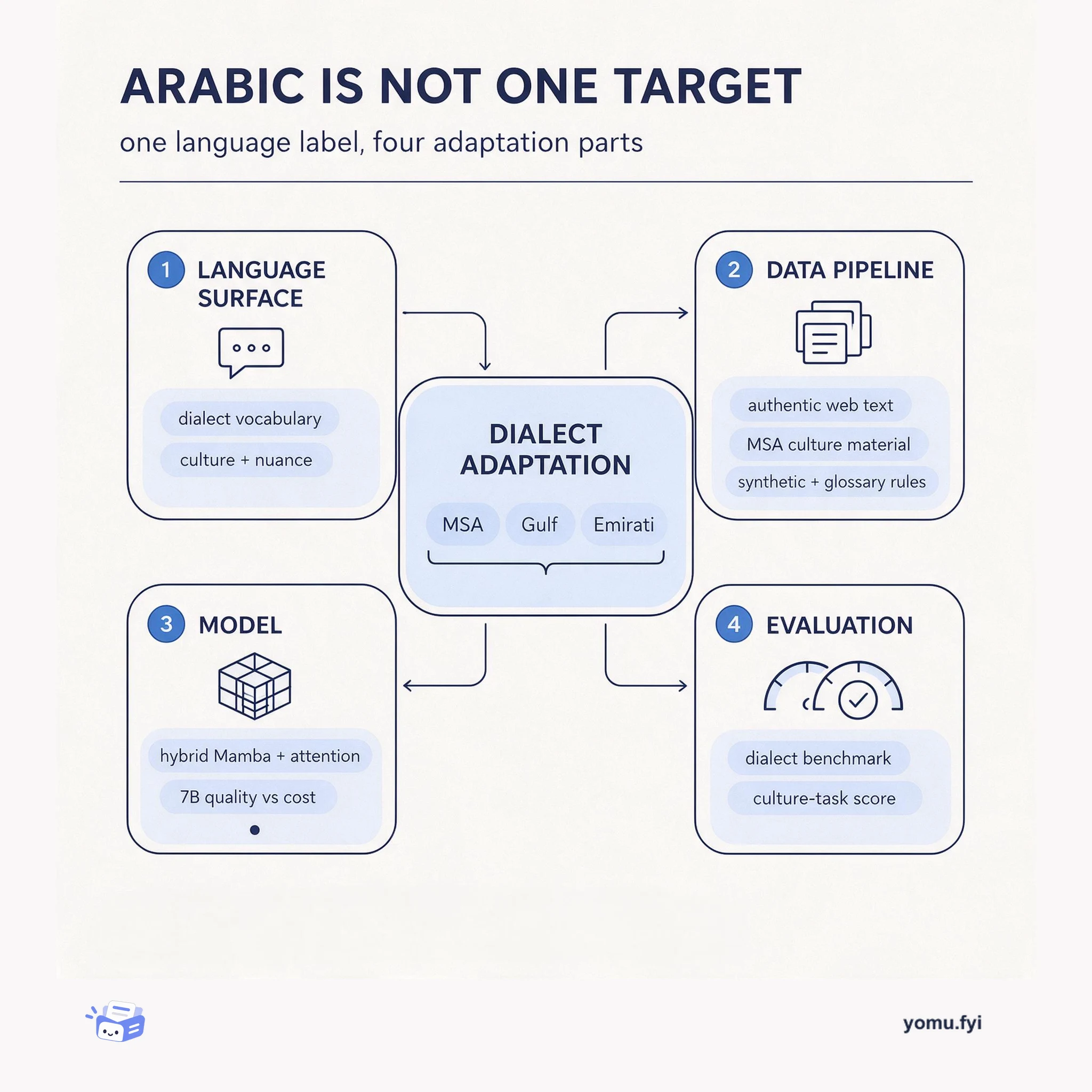
Arabic is not a single target for a language model. This explainer maps its four parts — dialect surface, data pipeline, model, and evaluation — so you can tell where an Arabic feature really succeeds or fails.
The Good Stuff
Paid picks we use ourselves. Links carry a referral code — a subscription through one earns us a commission at no extra cost to you.
Newest first
Building enterprise-grade AI voice agents in production demands managing real-time latency, telecommunication networks, regional accents, compliance frameworks, and unpredictable customer behaviour—issues that standard text-based LLM benchmarks do not capture. The recommended approach combines Microsoft Azure for hyperscale infrastructure, Twilio for global communications, and WIZ.AI for localisation, so engineering teams avoid building low-level infrastructure and focus on unique business value. Field data from WIZ.AI across Asia reveals an ideal conversational response window of 500–800 ms, with a P90 latency under 2.0 s currently acceptable, and real-time code-switching support for languages like Singlish and Hinglish. Success metrics shift from pilot capability to commercial production benchmarks such as connection rate, recognition and tagging accuracy, and measurable business outcomes like Promise-to-Pay conversion. Engineering practices to maintain code quality include cross-model code reviews and strict pull-request line-count guardrails enforced by pre-commit hooks.
Intercom introduces Resolution Bot, a machine-learning support chatbot designed to resolve customer issues rather than merely direct people to help-center articles. In the Intercom Messenger, it provides tailored resolutions, can use integrations such as Shopify to surface order status, and proactively suggests answers while customers type. The update adds six languages—Spanish, French, Italian, Brazilian Portuguese, Russian, and German—along with demographic targeting based on factors such as spend, business type, and location. New reporting shows answer-level sends and resolution rates, identifies underperforming answers, and lets teams filter conversation metrics for bot interactions. Intercom reports that the bot automatically resolves 33% of common support questions and saved businesses an average of 109 hours of customers’ time over the last year, positioning the release as a way to provide faster, more consistent support at global scale.
International address handling is difficult because countries and locales differ in field order, required fields, terminology, translations, and display conventions. Shopify models each address with fields such as names, address lines, zones, postal code, city, country code, and phone, then stores country-specific metadata in YAML-backed country data. A reusable format describes form and display order, allowing clients to reorder fields, prepopulate country and zone values, and add locale-specific characters such as Japan’s 〒 and 様. Label keys and translations handle terms such as province, prefecture, postcode, and pincode, while an API endpoint keeps applications synchronized and accepts locale information. The team also provides @shopify/address and higher-level components, while identifying caching as a remaining issue to reduce repeated network calls.
Shopify’s move to support six additional languages exposed a challenge in its admin graphs: condensing numbers without distorting locale-specific conventions. The team needed locale-aware abbreviations for sales, visits, and customer data, because unshortened values could consume axis space. Existing JavaScript libraries either exceeded the requirement or conflicted with Shopify’s stack, while the Intl API lacked implemented number-condensing support. During Hack Days, the developers used abbreviation data from Unicode’s Common Locale Data Repository (CLDR) and currency information from Intl.js to build functions for locale-specific numbers and currencies. Their package handles examples such as Portuguese “3 mil” and non-Western systems including India’s lakhs and crores, and was released as condense-number on npm in July 2018.
Shopify describes the engineering challenge of internationalizing a platform whose twelve years of development left thousands of hardcoded English strings across millions of lines of code. The team first used cops, linters, and tests to stop new violations, then automated extraction of existing content into module-specific dictionaries using keys derived from file paths and strings. A Rails I18n-based pseudolocalization backend replaced characters and doubled vowels, making untranslated content visible while exposing UI problems caused by longer words; UTF-8 migrations and application fixes addressed character-set and internationalization bugs. Finally, an internal Translation Platform connected GitHub webhooks and a translation management system, automatically submitting changed language files and returning approved translations as commits or pull requests. After six months, Shopify was available in a variety of languages, while the team continued addressing localization issues involving formatting, geography, payments, shipping, iconography, and regional requirements.
The best engineering reads, once a week.